Veronese
The Enchanting Fresco Painter
First created 20 Aug 2021. Version 1.0 - 28 Sep 2021. Daperro. London.
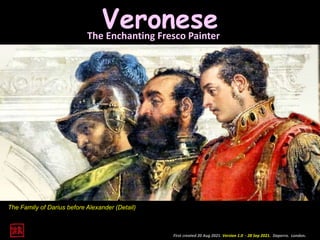
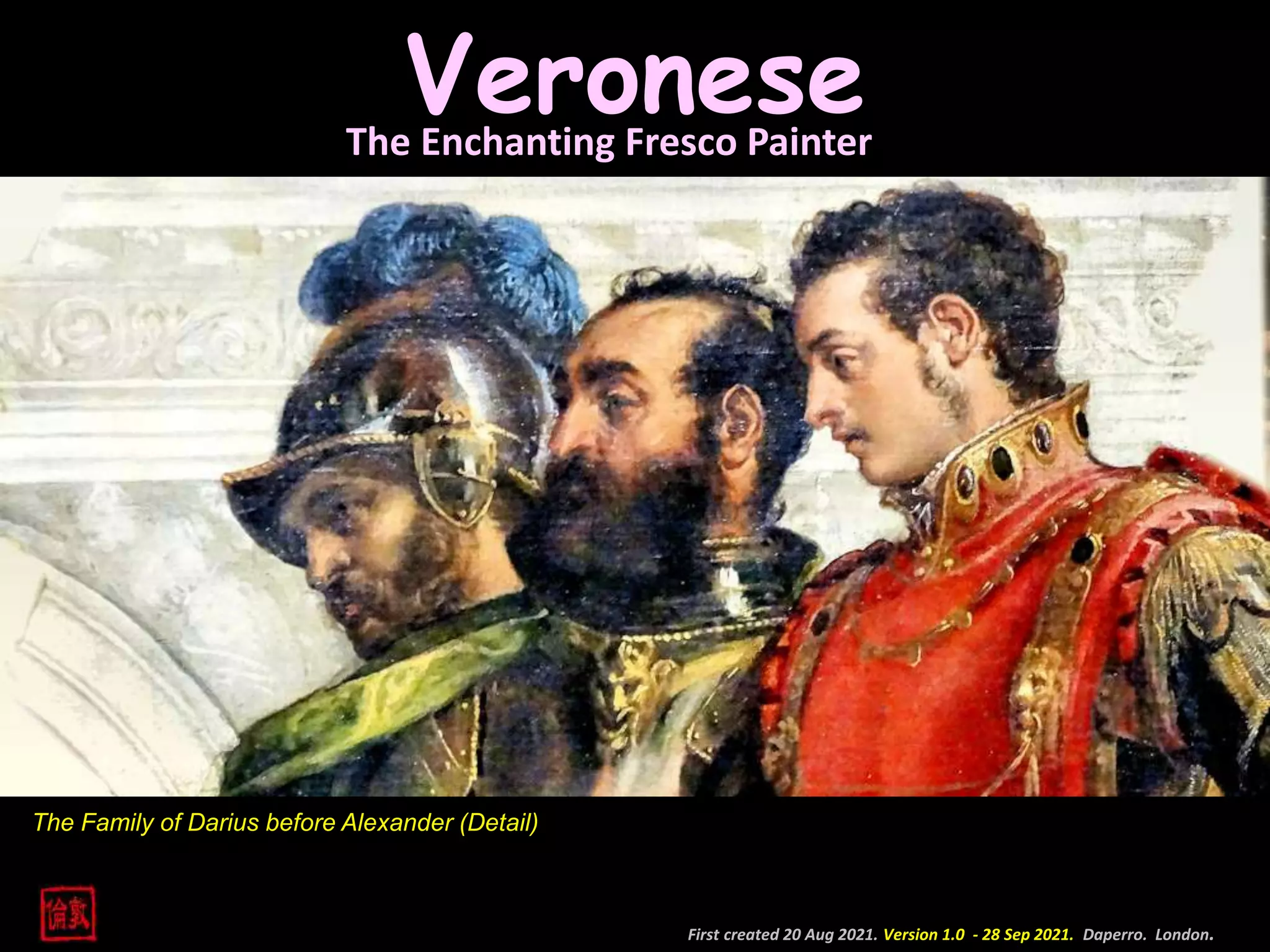
The Family of Darius before Alexander (Detail)
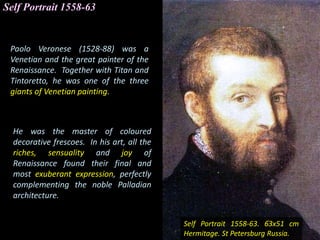
Paolo Veronese (1528-88) was a
Venetian and the great painter of the
Renaissance. Together with Titan and
Tintoretto, he was one of the three
giants of Venetian painting.
Self Portrait 1558-63
Self Portrait 1558-63. 63x51 cm
Hermitage. St Petersburg Russia.
He was the master of coloured
decorative frescoes. In his art, all the
riches, sensuality and joy of
Renaissance found their final and
most exuberant expression, perfectly
complementing the noble Palladian
architecture.
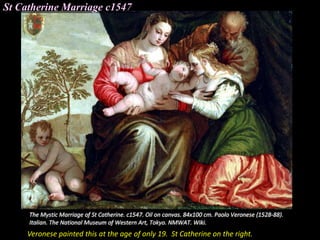
St Catherine Marriage c1547
Veronese painted this at the age of only 19. St Catherine on the right.
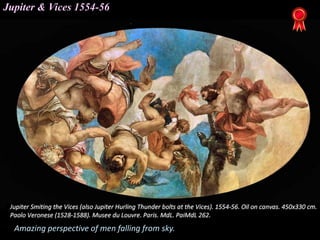
Jupiter & Vices 1554-56
Amazing perspective of men falling from sky.
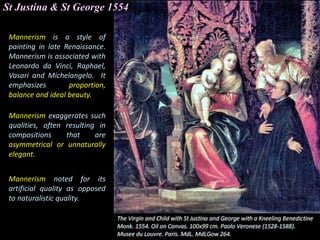
St Justina & St George 1554
Mannerism is a style of
painting in late Renaissance.
Mannerism is associated with
Leonardo da Vinci, Raphael,
Vasari and Michelangelo. It
emphasizes proportion,
balance and ideal beauty.
Mannerism exaggerates such
qualities, often resulting in
compositions that are
asymmetrical or unnaturally
elegant.
Mannerism noted for its
artificial quality as opposed
to naturalistic quality.
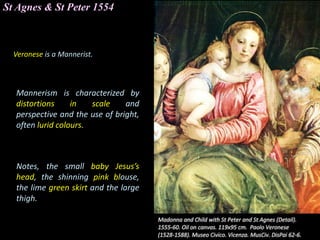
St Agnes & St Peter 1554
Mannerism is characterized by
distortions in scale and
perspective and the use of bright,
often lurid colours.
Notes, the small baby Jesus’s
head, the shinning pink blouse,
the lime green skirt and the large
thigh.
Veronese is a Mannerist.
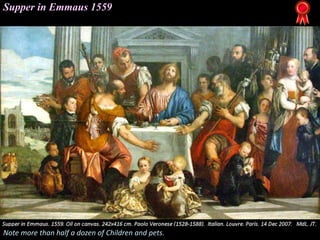
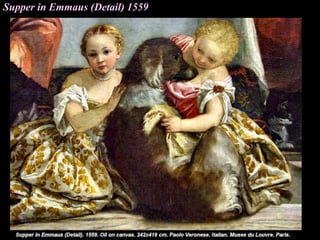
Supper in Emmaus 1559
Note more than half a dozen of Children and pets.
Supper in Emmaus (Detail) 1559
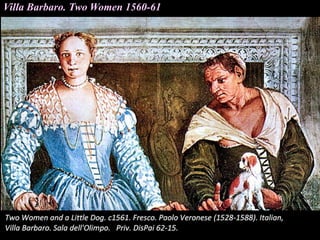
Villa Barbaro. Two Women 1560-61
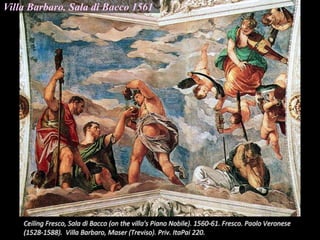
Villa Barbaro. Sala di Bacco 1561
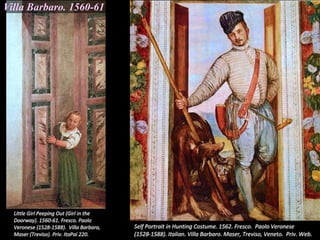
Villa Barbaro. 1560-61
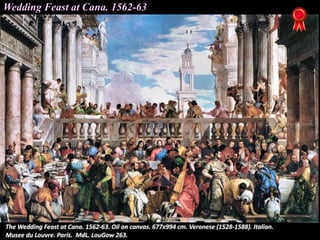
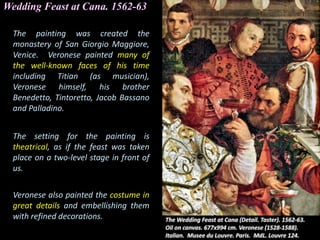
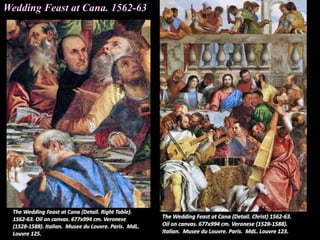
Wedding Feast at Cana. 1562-63
The painting was created the
monastery of San Giorgio Maggiore,
Venice. Veronese painted many of
the well-known faces of his time
including Titian (as musician),
Veronese himself, his brother
Benedetto, Tintoretto, Jacob Bassano
and Palladino.
The setting for the painting is
theatrical, as if the feast was taken
place on a two-level stage in front of
us.
Veronese also painted the costume in
great details and embellishing them
with refined decorations.
Wedding Feast at Cana. 1562-63
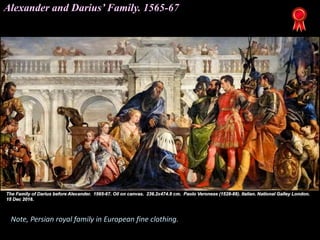
Alexander and Darius’ Family. 1565-67
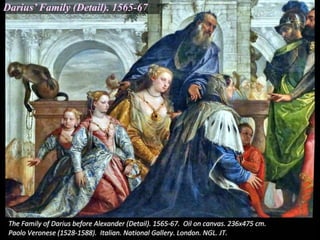
Note, Persian royal family in European fine clothing.
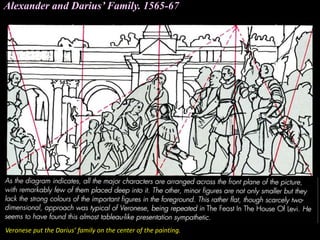
Veronese put the Darius’ family on the center of the painting.
Alexander and Darius’ Family. 1565-67
Darius’ Family (Detail). 1565-67
Alexander 1565-67
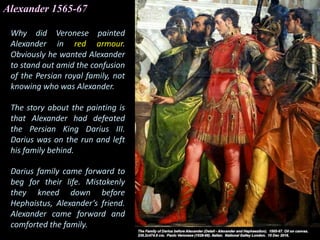
Why did Veronese painted
Alexander in red armour.
Obviously he wanted Alexander
to stand out amid the confusion
of the Persian royal family, not
knowing who was Alexander.
The story about the painting is
that Alexander had defeated
the Persian King Darius III.
Darius was on the run and left
his family behind.
Darius family came forward to
beg for their life. Mistakenly
they kneed down before
Hephaistus, Alexander’s friend.
Alexander came forward and
comforted the family.
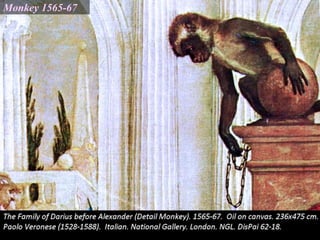
Monkey 1565-67
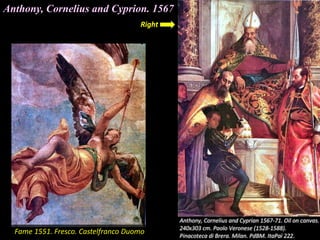
Anthony, Cornelius and Cyprion. 1567
Fame 1551. Fresco. Castelfranco Duomo
Right
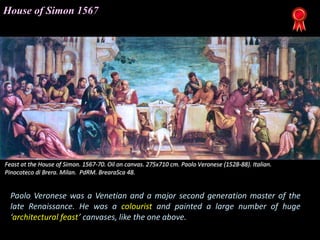
Paolo Veronese was a Venetian and a major second generation master of the
late Renaissance. He was a colourist and painted a large number of huge
‘architectural feast’ canvases, like the one above.
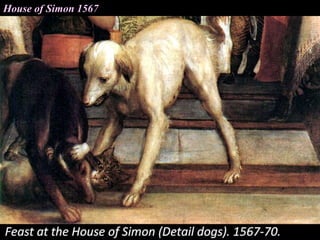
House of Simon 1567
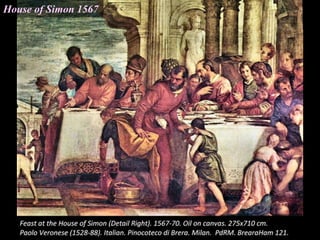
House of Simon 1567
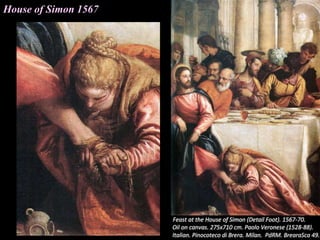
House of Simon 1567
House of Simon 1567
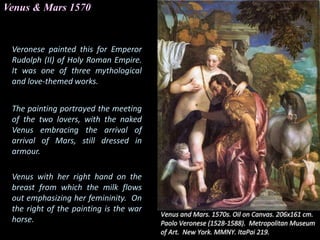
Venus & Mars 1570
Veronese painted this for Emperor
Rudolph (II) of Holy Roman Empire.
It was one of three mythological
and love-themed works.
The painting portrayed the meeting
of the two lovers, with the naked
Venus embracing the arrival of
arrival of Mars, still dressed in
armour.
Venus with her right hand on the
breast from which the milk flows
out emphasizing her femininity. On
the right of the painting is the war
horse.
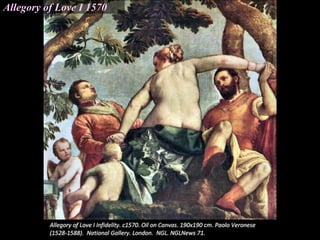
Allegory of Love I 1570
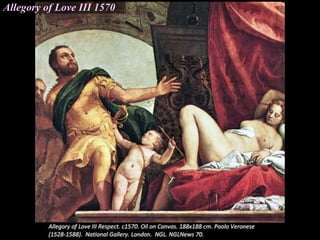
Allegory of Love III 1570
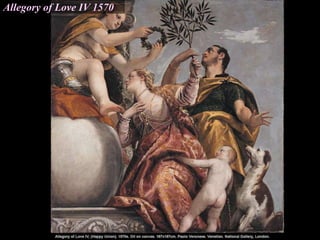
Allegory of Love IV 1570
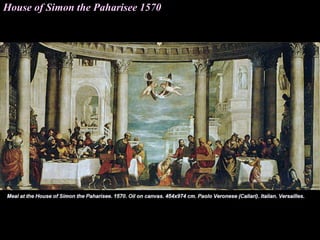
House of Simon the Paharisee 1570
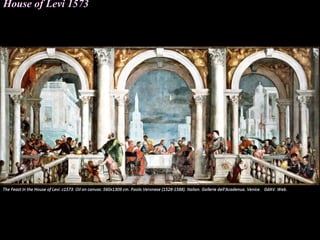
House of Levi 1573
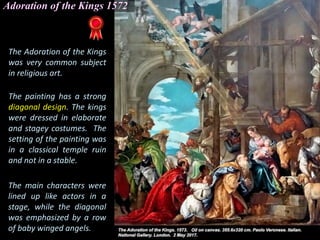
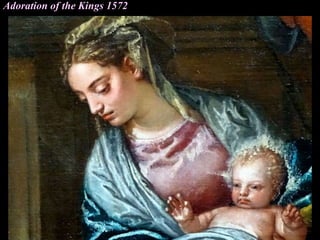
Adoration of the Kings 1572
The Adoration of the Kings
was very common subject
in religious art.
The painting has a strong
diagonal design. The kings
were dressed in elaborate
and stagey costumes. The
setting of the painting was
in a classical temple ruin
and not in a stable.
The main characters were
lined up like actors in a
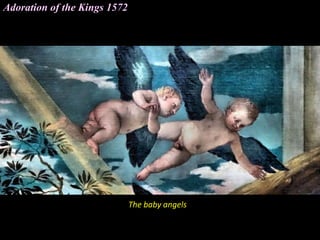
stage, while the diagonal
was emphasized by a row
of baby winged angels.
Adoration of the Kings 1572
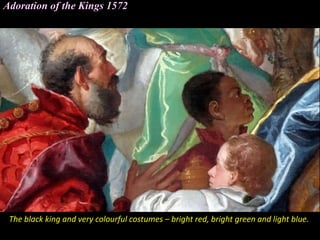
The black king and very colourful costumes – bright red, bright green and light blue.
Adoration of the Kings 1572
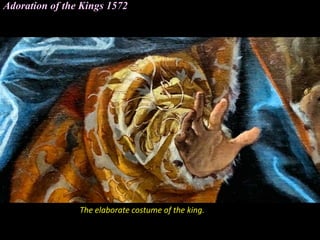
The elaborate costume of the king.
Adoration of the Kings 1572
The baby angels
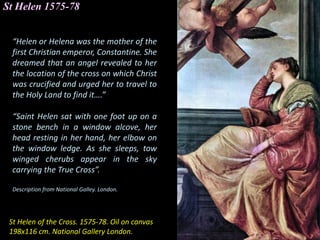
St Helen 1575-78
St Helen of the Cross. 1575-78. Oil on canvas
198x116 cm. National Gallery London.
“Helen or Helena was the mother of the
first Christian emperor, Constantine. She
dreamed that an angel revealed to her
the location of the cross on which Christ
was crucified and urged her to travel to
the Holy Land to find it….”
“Saint Helen sat with one foot up on a
stone bench in a window alcove, her
head resting in her hand, her elbow on
the window ledge. As she sleeps, tow
winged cherubs appear in the sky
carrying the True Cross”.
Description from National Galley. London.
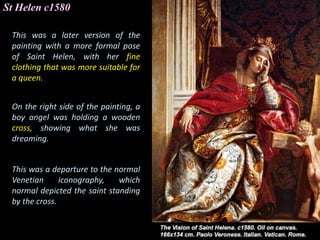
St Helen c1580
This was a later version of the
painting with a more formal pose
of Saint Helen, with her fine
clothing that was more suitable for
a queen.
On the right side of the painting, a
boy angel was holding a wooden
cross, showing what she was
dreaming.
This was a departure to the normal
Venetian iconography, which
normal depicted the saint standing
by the cross.
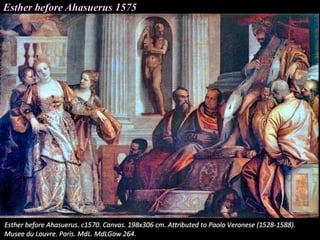
Esther before Ahasuerus 1575
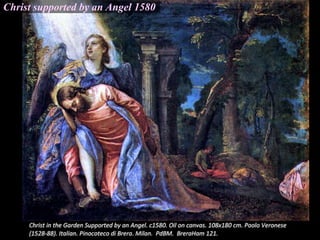
Christ supported by an Angel 1580
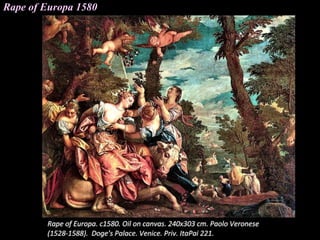
Rape of Europa 1580
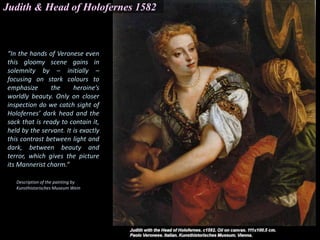
Judith & Head of Holofernes 1582
“In the hands of Veronese even
this gloomy scene gains in
solemnity by – initially –
focusing on stark colours to
emphasize the heroine’s
worldly beauty. Only on closer
inspection do we catch sight of
Holofernes’ dark head and the
sack that is ready to contain it,
held by the servant. It is exactly
this contrast between light and
dark, between beauty and
terror, which gives the picture
its Mannerist charm.”
Description of the painting by
Kunsthistorisches Museum Wein
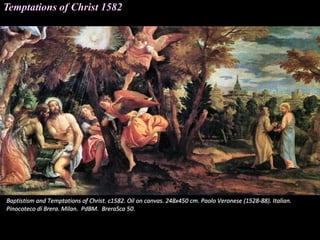
Temptations of Christ 1582
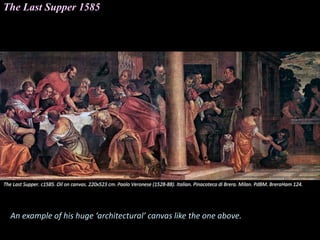
The Last Supper 1585
An example of his huge ‘architectural’ canvas like the one above.
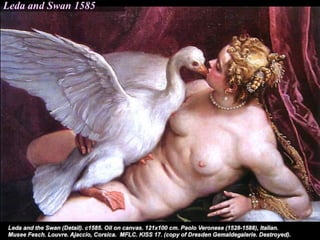
Leda and Swan 1585
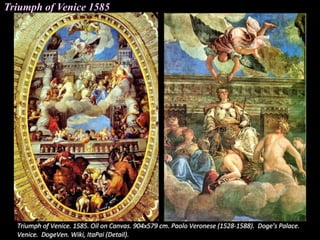
Triumph of Venice 1585
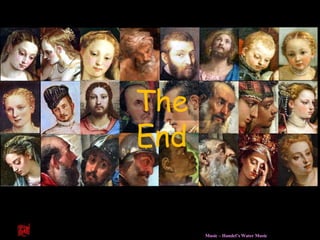
The
End
Music – Handel’s Water Music
Baroque Painters
April 2019
End

Veronese 1.0

  • 1.
    Veronese The Enchanting FrescoPainter First created 20 Aug 2021. Version 1.0 - 28 Sep 2021. Daperro. London. The Family of Darius before Alexander (Detail)
  • 2.
    Paolo Veronese (1528-88)was a Venetian and the great painter of the Renaissance. Together with Titan and Tintoretto, he was one of the three giants of Venetian painting. Self Portrait 1558-63 Self Portrait 1558-63. 63x51 cm Hermitage. St Petersburg Russia. He was the master of coloured decorative frescoes. In his art, all the riches, sensuality and joy of Renaissance found their final and most exuberant expression, perfectly complementing the noble Palladian architecture.
  • 3.
    St Catherine Marriagec1547 Veronese painted this at the age of only 19. St Catherine on the right.
  • 4.
    Jupiter & Vices1554-56 Amazing perspective of men falling from sky.
  • 5.
    St Justina &St George 1554 Mannerism is a style of painting in late Renaissance. Mannerism is associated with Leonardo da Vinci, Raphael, Vasari and Michelangelo. It emphasizes proportion, balance and ideal beauty. Mannerism exaggerates such qualities, often resulting in compositions that are asymmetrical or unnaturally elegant. Mannerism noted for its artificial quality as opposed to naturalistic quality.
  • 6.
    St Agnes &St Peter 1554 Mannerism is characterized by distortions in scale and perspective and the use of bright, often lurid colours. Notes, the small baby Jesus’s head, the shinning pink blouse, the lime green skirt and the large thigh. Veronese is a Mannerist.
  • 7.
    Supper in Emmaus1559 Note more than half a dozen of Children and pets.
  • 8.
    Supper in Emmaus(Detail) 1559
  • 9.
    Villa Barbaro. TwoWomen 1560-61
  • 10.
    Villa Barbaro. Saladi Bacco 1561
  • 11.
  • 12.
    Wedding Feast atCana. 1562-63
  • 13.
    Wedding Feast atCana. 1562-63 The painting was created the monastery of San Giorgio Maggiore, Venice. Veronese painted many of the well-known faces of his time including Titian (as musician), Veronese himself, his brother Benedetto, Tintoretto, Jacob Bassano and Palladino. The setting for the painting is theatrical, as if the feast was taken place on a two-level stage in front of us. Veronese also painted the costume in great details and embellishing them with refined decorations.
  • 14.
    Wedding Feast atCana. 1562-63
  • 15.
    Alexander and Darius’Family. 1565-67 Note, Persian royal family in European fine clothing.
  • 16.
    Veronese put theDarius’ family on the center of the painting. Alexander and Darius’ Family. 1565-67
  • 17.
  • 18.
    Alexander 1565-67 Why didVeronese painted Alexander in red armour. Obviously he wanted Alexander to stand out amid the confusion of the Persian royal family, not knowing who was Alexander. The story about the painting is that Alexander had defeated the Persian King Darius III. Darius was on the run and left his family behind. Darius family came forward to beg for their life. Mistakenly they kneed down before Hephaistus, Alexander’s friend. Alexander came forward and comforted the family.
  • 19.
  • 20.
    Anthony, Cornelius andCyprion. 1567 Fame 1551. Fresco. Castelfranco Duomo Right
  • 21.
    Paolo Veronese wasa Venetian and a major second generation master of the late Renaissance. He was a colourist and painted a large number of huge ‘architectural feast’ canvases, like the one above. House of Simon 1567
  • 22.
  • 23.
  • 24.
  • 25.
    Venus & Mars1570 Veronese painted this for Emperor Rudolph (II) of Holy Roman Empire. It was one of three mythological and love-themed works. The painting portrayed the meeting of the two lovers, with the naked Venus embracing the arrival of arrival of Mars, still dressed in armour. Venus with her right hand on the breast from which the milk flows out emphasizing her femininity. On the right of the painting is the war horse.
  • 26.
  • 27.
  • 28.
  • 29.
    House of Simonthe Paharisee 1570
  • 30.
  • 31.
    Adoration of theKings 1572 The Adoration of the Kings was very common subject in religious art. The painting has a strong diagonal design. The kings were dressed in elaborate and stagey costumes. The setting of the painting was in a classical temple ruin and not in a stable. The main characters were lined up like actors in a stage, while the diagonal was emphasized by a row of baby winged angels.
  • 32.
    Adoration of theKings 1572
  • 33.
    Adoration of theKings 1572 The black king and very colourful costumes – bright red, bright green and light blue.
  • 34.
    Adoration of theKings 1572 The elaborate costume of the king.
  • 35.
    Adoration of theKings 1572 The baby angels
  • 36.
    St Helen 1575-78 StHelen of the Cross. 1575-78. Oil on canvas 198x116 cm. National Gallery London. “Helen or Helena was the mother of the first Christian emperor, Constantine. She dreamed that an angel revealed to her the location of the cross on which Christ was crucified and urged her to travel to the Holy Land to find it….” “Saint Helen sat with one foot up on a stone bench in a window alcove, her head resting in her hand, her elbow on the window ledge. As she sleeps, tow winged cherubs appear in the sky carrying the True Cross”. Description from National Galley. London.
  • 37.
    St Helen c1580 Thiswas a later version of the painting with a more formal pose of Saint Helen, with her fine clothing that was more suitable for a queen. On the right side of the painting, a boy angel was holding a wooden cross, showing what she was dreaming. This was a departure to the normal Venetian iconography, which normal depicted the saint standing by the cross.
  • 38.
  • 39.
    Christ supported byan Angel 1580
  • 40.
  • 41.
    Judith & Headof Holofernes 1582 “In the hands of Veronese even this gloomy scene gains in solemnity by – initially – focusing on stark colours to emphasize the heroine’s worldly beauty. Only on closer inspection do we catch sight of Holofernes’ dark head and the sack that is ready to contain it, held by the servant. It is exactly this contrast between light and dark, between beauty and terror, which gives the picture its Mannerist charm.” Description of the painting by Kunsthistorisches Museum Wein
  • 42.
  • 43.
    The Last Supper1585 An example of his huge ‘architectural’ canvas like the one above.
  • 44.
  • 45.
  • 46.
  • 47.
  • 48.
  • 49.

Editor's Notes

  • #2 Paolo Veronese (c1528-88) was born in Verona and trained under several minor artists. The Chief influence on him was Titian. He worked in Venice probably from 1553, when he began his ceiling for the Doge’s Palace, with daring Sotto in Su (from below to above) perspective and Mannerist nudes in complicated poses filling up the picture space. He went to Rome for the first time in 1560, probably after he painted the frescoes in Villa Maser. He specialised mainly in huge pictures of Biblical, allegorical or historical subjects. With vast crowd and of accessory figures. Golden hair women, children, horses, dogs, apes, courtiers, musicians and soldier in armours.
  • #47 History of Major Releases Version 2.4 included three PwrPoint slides on Travel, Building & Gallery