Gothic Architecture
Gothic
 Gothic mainly refers to the barbarians.
 In Italy, Goths are the destroyer of the
old Roman civilization.
 It is a term given by the men of
Renaissance, who wanted to express
their contempt for everything.
 Their style was very sophisticated.
Gothic Architecture
 Gothic is the final phase of the medieval
architecture.
 It originated in France.
 Until the beginning of 13th
century, French
influence was paramount.
 It prevailed in northern Europe for nearly 300
years.
Gothic period can be divided into
three phases:
 Early Gothic
 High Gothic
 Late Gothic
Main features of Gothic
Architecture
The most obvious definition involves key
elements involved in the Gothic buildings.
 Pointed arch
 Ribbed vaults
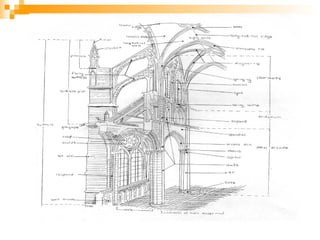
 Flying buttresses
 Widows with tracery
 Rose windows
 Piers composed of colonnades.
 Shafts bundled around a core
 Spires
 Tracery
 Wood carving
 Moldings
 Verticality
 Stained glass
Influences
1. Geographical:
By the end of 12th
century, the Latin
races of France, Italy and Spain
developed into independent states or
kingdoms.
 Germany became the centre of Holy
Roman Empire.
 England came under the Norman kings.
2.Geological:
 There were different styles of architecture
according to different countries.
3.Climatic :
 Climatic influences vary from north to
south and from east to west.
 Climate has effected the rise of arcades and
the size of door and window openings.
 Heavy snowfalls necessitated steep gothic
roofs in the north.
4.Religious:
 The immense power of popes in the thirteenth
century can be judged from the way they made and
unmade the emperors and kings and disposed off their
dominions.
 There were periodical pilgrimages to the shrines
between 1170 to 1270.
 About 80 cathedrals and 500 great churches were
built in France.
 Areas around France and the land along the River
Loire was under the strict hold of king. So, lot of
experimentations in construction were made.
 This great wave of construction of churches lasted for
three long centuries in Europe.
Historical:
FRANCE
 In France, the English lost their positions and the
disintegration of Germany into a number of
independence states and the contests between
Muslim Moor and Christians in Spain, transferred
the commerce of the east to the cities of Italy.
 In France there is an area known as Normandy and
St. Etienne is cathedral which expresses a high
gothic architecture in its buildings. It is such a
beautiful and perfect building that it serves as a
prototype for Gothic architecture in France.
ENGLAND
 A group of people which are Vikings and called
themselves as Normans took the architecture form Italy
and France to England and applied it there. This laid the
foundation for the English Gothic architecture in England.
 In the 11th to 13th century Christianity had spread
throughout Europe. There were three major factors
which lead towards the religious activities.
 Churches
 Guilds (associations)
 City States
 In the same time the Europeans started
crusades (religious wars) in Palestine, so
Christianity was at its peak.
 In these crusades, Europeans got in contact
with Muslims in the east and they got
inspirations and learnt a lot about pointed
arches.
 Since they were advancing, defeating and
learning new things from other civilizations, so
that was the period of flourishment in Europe.
 Social:
The rapid growth of towns and the development of
commercial activity, with the consequent increase of
wealth, inspired a rivalry between neighboring cities which
was expressed in the creation of magnificent buildings.
 They had a lot of wealth, laborers (skilled), and
associations. So all these factors lead in building castles,
churches, hospitals, city halls and guild halls.
 Out of all these, churches were reflection of superb,
marvelous architecture.
 In this race, they also did some experimentations in
construction techniques and it also polished up the Gothic
architecture
 All these factors contributed to enormous constructions
Philosophy
 The new style was not the development of
Roman forms, structure and technology.
 But the driving force was new conception of
relationships between material and spiritual
things.
 The forces of nature can be seen now as the
workings of God.
 The structures were elongated as they were
going towards heaven.
Building Examples
Early Gothic (1150-1250)
 Notre dame at Laon
 Notre dame Paris
High Gothic (1250-1350)
 Cathedral of Notre Dame at Chartres
 Notre Dame at Bourges
 S. Maria Novella Florence (1278-1350)
Late Gothic (1350-1520)
 Cologne Cathedral
 Milan Cathedral
 Granada Cathedral
 Barcelona Cathedral
In addition to these, there was secular architecture which
consisted of:
 Houses
 Castles (Doge’s Palace in Venice)
 Cities
Early Gothic
 Gothic was a result of technical
development in vaulting.
 In about 1100, builders of Durham
Cathedral invented a new method.
 Then, originated the gothic style, from
northern France.
ST. Denis
near Paris
Abbey Church of St. Denis(1140-
1144)
 It is a royal mausoleum near Paris.
 It was the first grand model.
 It was formerly a basilica.
 St. Denis building was a French Royal
Monastery located 6 miles north of Paris.
 Saint Denis was martyred by the Romans in the
3rd
century and later designated as the patron
(favourite) Saint of France.
History Of Suger:
 Abbot Suger was one of the most energetic
patron of art.
 His parents had donated him to the Abbey of St.
Denis when he was 3 years old.
 King Louis VII of France was among his school
companions.
 Because of administrative and diplomatic skills,
he was elected as Abbot of St. Denis in 1122 at
the age of 36.
HISTORY OF CHURCH
 The existing building had been dedicated
for religious purpose in 775 AD.
 Eastern Chapel was enlarged in 832 AD.
 Sugar wanted to rebuild the church into a
glorious building.
 By 1137 AD the church was enlarged.
 New West front and the Narthex were
constructed.
 After 3 years twin towers and sculpture portals
were added.
 The three doorways had carved tympana and
jamb statues.
 Tympana: The space enclosed between the
lintel and the arch of medieval doorway.
 Jamb: Sides of doors and windows
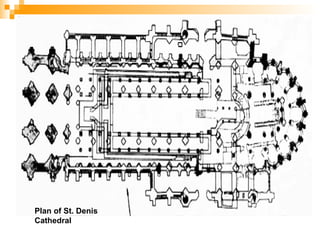
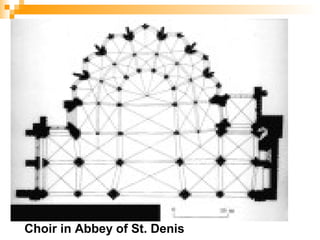
Plan of St. Denis
Cathedral
Choir in Abbey of St. Denis
 The windows were articulated., and had rose
windows.
 The Suger studied the temple of Solomon (a
design specified by God and thought over
mystical and metaphysical property spiritual
images).
 He wanted to exceed (leave behind) the most
splendid church building in history.
Interior
 Rib vaults from the narthex sprang from
grouped piers.
 The east end was enlarged.
 In 1144 a new choir was formed of
distinguished churchmen and royalty.
 The main elevation and the upper parts of the
choir were rebuilt in 13th century.
 There was colored light in the seven shallow
radiating chapels of the choir, each with two
large glass stained windows.
 The irregular bays of this complex were
covered by rib vaults rising to a uniform
crown height.
 It all creates an airy, luminous and rich
interior that glowed like jewels.
Choir and upper part of Nave
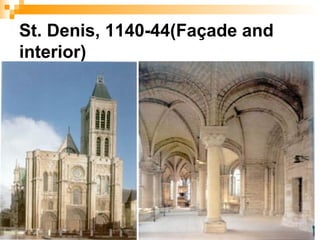
St. Denis, 1140-44(Façade and
interior)
 The nave was reconstructed in 1231-
1281.
 The nave is three-story elevation of the
arcade, triforium and clerestory.
 Saint-Denis Cathedral was the earliest
appearance of light triforium by which the
vertical continuity was achieved.
St. Denis Rose window
Choir at St, Denis Stained glass window
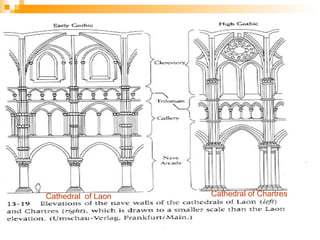
Cathedral of Laon Cathedral of Chartres
Notre Dame
 Many of the great cathedrals were
dedicated to Virgin Mary (as a mother who
had suffered great sorrow).
 She is Notre Dame in French language.
 Our lady in English.
 She was often shown in sculptures and
featured in stained glass.
 Two early cathedrals in northern France
were
 Notre Dame at Laon
 Notre Dame at Paris
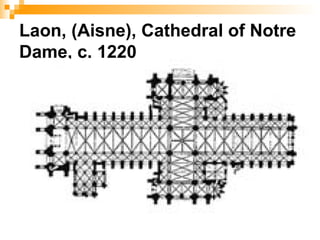
Laon, (Aisne), Cathedral of Notre
Dame, c. 1220
Cathedral of Notre Dame at Laon
 The Cathedral of Notre Dame at Laon, was begun in
1155 to replace the older structure, that had become too
small to meet the needs of the growing cathedral.
 The choir and transept were finished in 20 years.
 The nave, the west front and crossing were completed
by about 1205.
 The flying buttresses may not be original to the church. It
had elements from the Romanesque works.
 Long nave
 Sexpartite ribbed vaults
 Lantern crossing tower
 Galleries
 Semi-circular apse
 Western towers (found in Norman
churches
Interior
 Pointed arch is incorporated into the profile of the
sexpartite rib vaults.
 Molding around the clerestory windows.
 Cylindrical piers in the nave arcade.
 Verticality
 Three dimensional sculptured quality of the west front,
built in 1190- 1205.
 Protective porch hoods over the three portals projects
from the plane of the facade creating a sense of depth.
 Depth is repeated in the arched windows.
Cathedral of Notre Dame, at Laon
Interior
 Pointed arch is incorporated into the profile of the
sexpartite rib vaults.
 Molding around the clerestory windows.
 Cylindrical piers in the nave arcade.
 Verticality
 Three dimensional sculptured quality of the west front,
built in 1190- 1205.
 Protective porch hoods over the three portals projects
from the plane of the facade creating a sense of depth.
 Depth is repeated in the arched windows.
Chartres (Eure et Loir), Cathedral
of Notre Dame, ca. 1200
West work Stained glass windows
Nave, choir and rib vaults
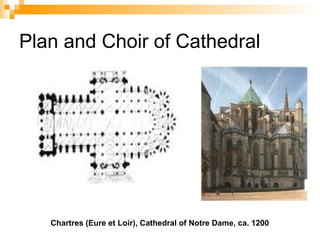
Plan and Choir of Cathedral
Chartres (Eure et Loir), Cathedral of Notre Dame, ca. 1200
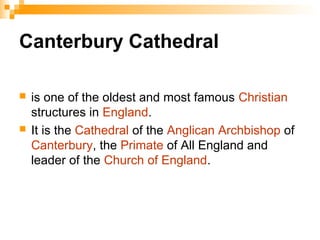
Canterbury Cathedral
 is one of the oldest and most famous Christian
structures in England.
 It is the Cathedral of the Anglican Archbishop of
Canterbury, the Primate of All England and
leader of the Church of England.
Canterbury Cathedral
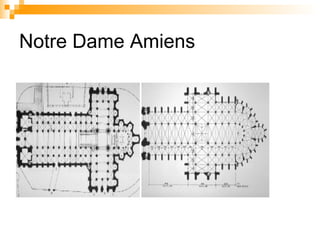
Notre Dame Amiens
 The
Charters
Cathedral
Architectural character
1. The three essential elements of Gothic Architecture are:
Ribbed vault, the flying buttress and the pointed arch.
Surprisingly, they all had appeared in the Romanesque
Architecture.
The aesthetic possibilities of these elements had not
been discovered yet. But the Gothic architects wanted to
design, taller, slender and lighter buildings. (developing
unchecked in heaven ward direction)
2, Prime significance was given to the interior space.
Spiritual Impact
 These buildings depict the yearning for
union with God.
 The sky pointing forms direct man’s
thought towards god and a view of a
different world.
 Figures were standing in tiny niches under
exquisite canopies and band of cluster of
grape vines, leaves, flowers and animals.
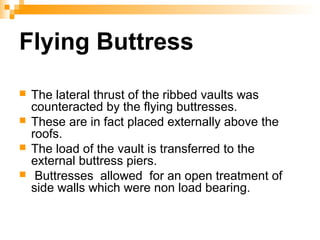
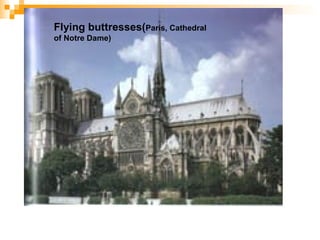
Flying Buttress
 The lateral thrust of the ribbed vaults was
counteracted by the flying buttresses.
 These are in fact placed externally above the
roofs.
 The load of the vault is transferred to the
external buttress piers.
 Buttresses allowed for an open treatment of
side walls which were non load bearing.
Flying buttresses(Paris, Cathedral
of Notre Dame)
Windows
 Windows became larger and larger.
 They were filled with screens of glass.
 Usually a single figure stood against a
plain background surrounded by a border.
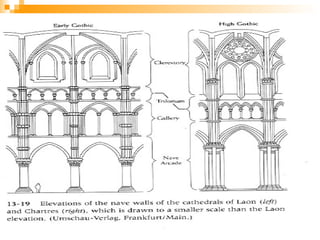
Choir and upper part of Nave
The nave wall
The nave wall is divided into four horizontal
zones.
 Arcade
 Triforium
 Gallery
 Clerestory
The nave
wall
Pointed arches
 were helpful in the handling of the weight.
 It could be raised to any desired height- over
spans of varying width without the stilting.
 The use of pointed arch allowed the architects to
erect a vault over a rectangular space of any
required dimensions.
 Thus they were helpful in giving the expression
of verticality.
Laon, Cathedral of Notre DameParis, Cathedral of Notre Dame
The Choir Arrangement
 To meet the needs, the choir was
extended well beyond the crossing and
were spacious enough to accommodate
large number of clergy.
 The choir arrangement appeared for the
first time in true Gothic construction.
The Choir of Charters Cathedral
The principle of unity
 The late Gothic ailed hall expressed the principle of
unity of space and structure
 The crossing and the vaults had the same roof height as
the surrounding compartments.
 The transepts of most Gothic churches had greater
projections.
 Sexpartite system was replaced by quadripartite arches.
 Every bay was covered by intersecting rib vault.
 The compartments were linked together by transverse
ribs.
 Usually at the corner of each vaulting bay, there is a
cluster of five shafts.
Unity in Nave and Choir
by rib vaults
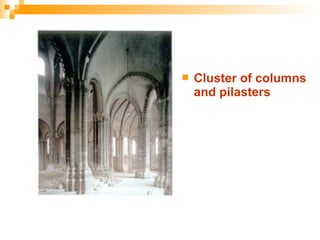
 Cluster of columns
and pilasters
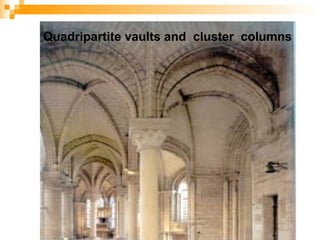
Quadripartite vaults and cluster columns

Gothic architecture

  • 1.
  • 2.
    Gothic  Gothic mainlyrefers to the barbarians.  In Italy, Goths are the destroyer of the old Roman civilization.  It is a term given by the men of Renaissance, who wanted to express their contempt for everything.  Their style was very sophisticated.
  • 3.
    Gothic Architecture  Gothicis the final phase of the medieval architecture.  It originated in France.  Until the beginning of 13th century, French influence was paramount.  It prevailed in northern Europe for nearly 300 years.
  • 4.
    Gothic period canbe divided into three phases:  Early Gothic  High Gothic  Late Gothic
  • 5.
    Main features ofGothic Architecture The most obvious definition involves key elements involved in the Gothic buildings.  Pointed arch  Ribbed vaults  Flying buttresses  Widows with tracery  Rose windows  Piers composed of colonnades.
  • 6.
     Shafts bundledaround a core  Spires  Tracery  Wood carving  Moldings  Verticality  Stained glass
  • 8.
    Influences 1. Geographical: By theend of 12th century, the Latin races of France, Italy and Spain developed into independent states or kingdoms.  Germany became the centre of Holy Roman Empire.  England came under the Norman kings.
  • 9.
    2.Geological:  There weredifferent styles of architecture according to different countries. 3.Climatic :  Climatic influences vary from north to south and from east to west.  Climate has effected the rise of arcades and the size of door and window openings.  Heavy snowfalls necessitated steep gothic roofs in the north.
  • 10.
    4.Religious:  The immensepower of popes in the thirteenth century can be judged from the way they made and unmade the emperors and kings and disposed off their dominions.  There were periodical pilgrimages to the shrines between 1170 to 1270.  About 80 cathedrals and 500 great churches were built in France.  Areas around France and the land along the River Loire was under the strict hold of king. So, lot of experimentations in construction were made.  This great wave of construction of churches lasted for three long centuries in Europe.
  • 11.
    Historical: FRANCE  In France,the English lost their positions and the disintegration of Germany into a number of independence states and the contests between Muslim Moor and Christians in Spain, transferred the commerce of the east to the cities of Italy.  In France there is an area known as Normandy and St. Etienne is cathedral which expresses a high gothic architecture in its buildings. It is such a beautiful and perfect building that it serves as a prototype for Gothic architecture in France.
  • 12.
    ENGLAND  A groupof people which are Vikings and called themselves as Normans took the architecture form Italy and France to England and applied it there. This laid the foundation for the English Gothic architecture in England.  In the 11th to 13th century Christianity had spread throughout Europe. There were three major factors which lead towards the religious activities.  Churches  Guilds (associations)  City States
  • 13.
     In thesame time the Europeans started crusades (religious wars) in Palestine, so Christianity was at its peak.  In these crusades, Europeans got in contact with Muslims in the east and they got inspirations and learnt a lot about pointed arches.  Since they were advancing, defeating and learning new things from other civilizations, so that was the period of flourishment in Europe.
  • 14.
     Social: The rapidgrowth of towns and the development of commercial activity, with the consequent increase of wealth, inspired a rivalry between neighboring cities which was expressed in the creation of magnificent buildings.  They had a lot of wealth, laborers (skilled), and associations. So all these factors lead in building castles, churches, hospitals, city halls and guild halls.  Out of all these, churches were reflection of superb, marvelous architecture.  In this race, they also did some experimentations in construction techniques and it also polished up the Gothic architecture  All these factors contributed to enormous constructions
  • 15.
    Philosophy  The newstyle was not the development of Roman forms, structure and technology.  But the driving force was new conception of relationships between material and spiritual things.  The forces of nature can be seen now as the workings of God.  The structures were elongated as they were going towards heaven.
  • 16.
    Building Examples Early Gothic(1150-1250)  Notre dame at Laon  Notre dame Paris High Gothic (1250-1350)  Cathedral of Notre Dame at Chartres  Notre Dame at Bourges  S. Maria Novella Florence (1278-1350)
  • 17.
    Late Gothic (1350-1520) Cologne Cathedral  Milan Cathedral  Granada Cathedral  Barcelona Cathedral In addition to these, there was secular architecture which consisted of:  Houses  Castles (Doge’s Palace in Venice)  Cities
  • 19.
    Early Gothic  Gothicwas a result of technical development in vaulting.  In about 1100, builders of Durham Cathedral invented a new method.  Then, originated the gothic style, from northern France.
  • 20.
  • 21.
    Abbey Church ofSt. Denis(1140- 1144)  It is a royal mausoleum near Paris.  It was the first grand model.  It was formerly a basilica.  St. Denis building was a French Royal Monastery located 6 miles north of Paris.  Saint Denis was martyred by the Romans in the 3rd century and later designated as the patron (favourite) Saint of France.
  • 22.
    History Of Suger: Abbot Suger was one of the most energetic patron of art.  His parents had donated him to the Abbey of St. Denis when he was 3 years old.  King Louis VII of France was among his school companions.  Because of administrative and diplomatic skills, he was elected as Abbot of St. Denis in 1122 at the age of 36.
  • 23.
    HISTORY OF CHURCH The existing building had been dedicated for religious purpose in 775 AD.  Eastern Chapel was enlarged in 832 AD.  Sugar wanted to rebuild the church into a glorious building.  By 1137 AD the church was enlarged.
  • 24.
     New Westfront and the Narthex were constructed.  After 3 years twin towers and sculpture portals were added.  The three doorways had carved tympana and jamb statues.  Tympana: The space enclosed between the lintel and the arch of medieval doorway.  Jamb: Sides of doors and windows
  • 25.
    Plan of St.Denis Cathedral
  • 26.
    Choir in Abbeyof St. Denis
  • 27.
     The windowswere articulated., and had rose windows.  The Suger studied the temple of Solomon (a design specified by God and thought over mystical and metaphysical property spiritual images).  He wanted to exceed (leave behind) the most splendid church building in history.
  • 28.
    Interior  Rib vaultsfrom the narthex sprang from grouped piers.  The east end was enlarged.  In 1144 a new choir was formed of distinguished churchmen and royalty.  The main elevation and the upper parts of the choir were rebuilt in 13th century.  There was colored light in the seven shallow radiating chapels of the choir, each with two large glass stained windows.
  • 29.
     The irregularbays of this complex were covered by rib vaults rising to a uniform crown height.  It all creates an airy, luminous and rich interior that glowed like jewels.
  • 30.
    Choir and upperpart of Nave
  • 31.
  • 32.
     The navewas reconstructed in 1231- 1281.  The nave is three-story elevation of the arcade, triforium and clerestory.  Saint-Denis Cathedral was the earliest appearance of light triforium by which the vertical continuity was achieved.
  • 33.
  • 34.
    Choir at St,Denis Stained glass window
  • 35.
    Cathedral of LaonCathedral of Chartres
  • 36.
    Notre Dame  Manyof the great cathedrals were dedicated to Virgin Mary (as a mother who had suffered great sorrow).  She is Notre Dame in French language.  Our lady in English.  She was often shown in sculptures and featured in stained glass.
  • 37.
     Two earlycathedrals in northern France were  Notre Dame at Laon  Notre Dame at Paris
  • 38.
    Laon, (Aisne), Cathedralof Notre Dame, c. 1220
  • 39.
    Cathedral of NotreDame at Laon  The Cathedral of Notre Dame at Laon, was begun in 1155 to replace the older structure, that had become too small to meet the needs of the growing cathedral.  The choir and transept were finished in 20 years.  The nave, the west front and crossing were completed by about 1205.  The flying buttresses may not be original to the church. It had elements from the Romanesque works.
  • 40.
     Long nave Sexpartite ribbed vaults  Lantern crossing tower  Galleries  Semi-circular apse  Western towers (found in Norman churches
  • 41.
    Interior  Pointed archis incorporated into the profile of the sexpartite rib vaults.  Molding around the clerestory windows.  Cylindrical piers in the nave arcade.  Verticality  Three dimensional sculptured quality of the west front, built in 1190- 1205.  Protective porch hoods over the three portals projects from the plane of the facade creating a sense of depth.  Depth is repeated in the arched windows.
  • 42.
    Cathedral of NotreDame, at Laon
  • 44.
    Interior  Pointed archis incorporated into the profile of the sexpartite rib vaults.  Molding around the clerestory windows.  Cylindrical piers in the nave arcade.  Verticality  Three dimensional sculptured quality of the west front, built in 1190- 1205.  Protective porch hoods over the three portals projects from the plane of the facade creating a sense of depth.  Depth is repeated in the arched windows.
  • 45.
    Chartres (Eure etLoir), Cathedral of Notre Dame, ca. 1200 West work Stained glass windows
  • 46.
    Nave, choir andrib vaults
  • 47.
    Plan and Choirof Cathedral Chartres (Eure et Loir), Cathedral of Notre Dame, ca. 1200
  • 48.
    Canterbury Cathedral  isone of the oldest and most famous Christian structures in England.  It is the Cathedral of the Anglican Archbishop of Canterbury, the Primate of All England and leader of the Church of England.
  • 49.
  • 50.
  • 51.
  • 52.
  • 53.
    Architectural character 1. Thethree essential elements of Gothic Architecture are: Ribbed vault, the flying buttress and the pointed arch. Surprisingly, they all had appeared in the Romanesque Architecture. The aesthetic possibilities of these elements had not been discovered yet. But the Gothic architects wanted to design, taller, slender and lighter buildings. (developing unchecked in heaven ward direction) 2, Prime significance was given to the interior space.
  • 54.
    Spiritual Impact  Thesebuildings depict the yearning for union with God.  The sky pointing forms direct man’s thought towards god and a view of a different world.  Figures were standing in tiny niches under exquisite canopies and band of cluster of grape vines, leaves, flowers and animals.
  • 57.
    Flying Buttress  Thelateral thrust of the ribbed vaults was counteracted by the flying buttresses.  These are in fact placed externally above the roofs.  The load of the vault is transferred to the external buttress piers.  Buttresses allowed for an open treatment of side walls which were non load bearing.
  • 58.
  • 59.
    Windows  Windows becamelarger and larger.  They were filled with screens of glass.  Usually a single figure stood against a plain background surrounded by a border.
  • 60.
    Choir and upperpart of Nave
  • 61.
    The nave wall Thenave wall is divided into four horizontal zones.  Arcade  Triforium  Gallery  Clerestory
  • 63.
  • 64.
    Pointed arches  werehelpful in the handling of the weight.  It could be raised to any desired height- over spans of varying width without the stilting.  The use of pointed arch allowed the architects to erect a vault over a rectangular space of any required dimensions.  Thus they were helpful in giving the expression of verticality.
  • 65.
    Laon, Cathedral ofNotre DameParis, Cathedral of Notre Dame
  • 66.
    The Choir Arrangement To meet the needs, the choir was extended well beyond the crossing and were spacious enough to accommodate large number of clergy.  The choir arrangement appeared for the first time in true Gothic construction.
  • 67.
    The Choir ofCharters Cathedral
  • 68.
    The principle ofunity  The late Gothic ailed hall expressed the principle of unity of space and structure  The crossing and the vaults had the same roof height as the surrounding compartments.  The transepts of most Gothic churches had greater projections.  Sexpartite system was replaced by quadripartite arches.  Every bay was covered by intersecting rib vault.  The compartments were linked together by transverse ribs.  Usually at the corner of each vaulting bay, there is a cluster of five shafts.
  • 69.
    Unity in Naveand Choir by rib vaults
  • 70.
     Cluster ofcolumns and pilasters
  • 71.
    Quadripartite vaults andcluster columns