western NAME : NOOR HALISAH NASARUDDIN    (870106-49-5400) : MOHD HAZLAN BIN HARMAN SHAH    (890522-59-5288)   : HAIRUL HAFIZI BIN MASKOR   (860909-23-6737) SEMESTER : YEAR 2 SEM 1 COURSE: BACELOR OF ARCHITECTURE STUDIES LECTURE NAME : PN.SHARIFAH HASMIMAH
The Ancient history of architecture can be divided into three main era: Ancient Egypt Ancient Rome Ancient Greek The topic that I Have Chosen is Ancient Rome An Pantheon in Rome, Italy
PANTHEON An image of Pantheon in Rome, Italy Pantheon, outside
Introduction  Ancient Rome Building – “ The Pantheon” The text of the original inscription (" M·AGRIPPA·L·F·COS·TERTIVM·FECIT ", standing for Latin:  Marcus Agrippa, Lucii filius, consul tertium fecit  translated to "' Marcus Agrippa, son of Lucius, Consul for the third time, built this ") The Pantheon was once known as the “ Temple to all the Gods” . Commissioned by Marcus Agrappa as a Temple, rebuilt by Emperor Hadrian in about 126 AD. The name “pantheon” comes either from the statues of so many gods or from the resemblance of the dome to the heavens. During construction, the area of the pantheon was on the outskirts of Rome. Under the  Roman Republic  the  Campus Martius  had served as gathering place for elections and the army.
Con’t However, under Augustus and the new Principate both were deemed to be unnecessary.  The construction of the Pantheon was part of a program of construction that was undertaken by Augustus Caesar and his supporters. They built more than twenty structures on the Campus Martius, including the Baths of Agrippa and the Saepta Julia. It had long been thought that current building was built by Agrippa, with later alterations undertaken, and this was in part due to the inscription on the front of the temple. However, archaeological excavations have shown that the Pantheon of Agrippa had been completely destroyed, and Emperor Hadrian was probably responsible for rebuilding the Pantheon on the site of Agrippa's original temple.
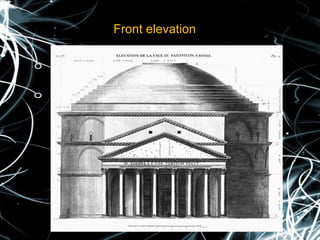
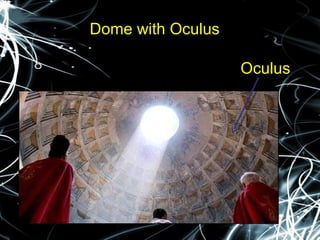
Characteristics of “The Pantheon” The building is circular with a  portico  of three ranks of huge granite Corinthian columns (eight in the first rank and two groups of four behind) under a pediment opening into the  rotunda , under a coffered,  concrete dome , with a central opening ( oculus ) to the sky. Almost two thousand years after it was built, the Pantheon's dome is still the world's largest unreinforced concrete dome.  The height to the  oculus  and the diameter of the interior circle are the same, 43.3 metres (142 ft).  A rectangular structure links the portico with the rotunda. It is one of the best preserved of all Roman buildings.  It has been in continuous use throughout its history, and since the 7th century, the Pantheon has been used as a  Roman   Catholic   church  dedicated to "St. Mary and the Martyrs" but informally known as "Santa Maria Rotonda."
Pantheon Rome Model
INSIDE VIEW
Plan of the building with characteristics
Front elevation
Back side
CROSS- SECTION OF THE PANTHEON
2D structure drawing FRONT ELEVATION LEFT ELEVATION SECTION PLAN
THE  PANTHEON ,  ROME ,  ITALY  GOOGLE EARTH 3D BUILDINGS
Left elevation Internal overview
Dome with Oculus Oculus
Top view Dome
Pantheon obelisk in the front of Pantheon Drum arch, Parthenon Columns DOME DOOR Entryway carving detail, porch side Panorama inside Entryway arch Pantheon's pillars
References http://en.wikipedia.org/wiki/Architecture_of_ancient_Greece http://www.google.com.my/imglanding?q=pantheon&imgurl=http://vclass.mgt.psu.ac.th/~parinya/MM/artlessons/pantheon.jpg&imgrefurl=http://vclass.mgt.psu.ac.th/~parinya/MM/artlessons/timeline.html&usg=__z6bMAflngNC5cnPYkvaVFbllRVM=&h=340&w=600&sz=33&hl=en&um=1&itbs=1&tbnid=kVM4yXOhATraAM:&tbnh=77&tbnw=135&prev=/images%3Fq%3Dpantheon%26um%3D1%26hl%3Den%26sa%3DX%26tbs%3Disch:1&um=1&sa=X&tbs=isch:1&start=2#tbnid=etwKRgzSf8gCgM&start=24 http://en.wikipedia.org/wiki/Architecture_of_ancient_Rome http://en.wikipedia.org/wiki/Ancient_Rome http://www.google.com.my/imglanding?q=pantheon&imgurl=http://vclass.mgt.psu.ac.th/~parinya/MM/artlessons/pantheon.jpg&imgrefurl=http://vclass.mgt.psu.ac.th/~parinya/MM/artlessons/timeline.html&usg=__z6bMAflngNC5cnPYkvaVFbllRVM=&h=340&w=600&sz=33&hl=en&um=1&itbs=1&tbnid=kVM4yXOhATraAM:&tbnh=77&tbnw=135&prev=/images%3Fq%3Dpantheon%26um%3D1%26hl%3Den%26sa%3DX%26tbs%3Disch:1&um=1&sa=X&tbs=isch:1&start=2#tbnid=hO7nEBNpXVYswM&start=22
References http://en.wikipedia.org/wiki/File:Pantheon_rome_2005may.jpg http://en.wikipedia.org/wiki/History_of_architecture http://en.wikipedia.org/wiki/Campus_Martius http://en.wikipedia.org/wiki/Principate
CONCLUSION

The Pantheon