Van Dyck
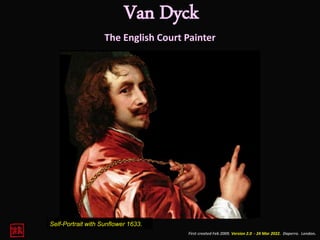
The English Court Painter
First created Feb 2009. Version 2.0 - 24 Mar 2022. Daperro. London.
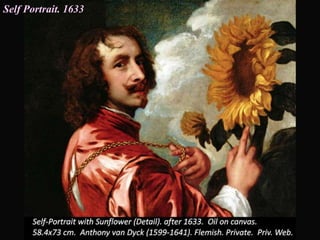
Self-Portrait with Sunflower 1633.
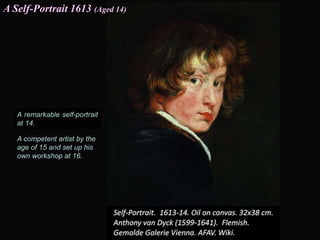
A Self-Portrait 1613 (Aged 14)
A remarkable self-portrait
at 14.
A competent artist by the
age of 15 and set up his
own workshop at 16.
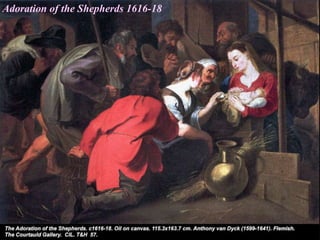
Adoration of the Shepherds 1616-18
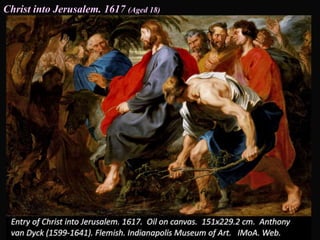
Christ into Jerusalem. 1617 (Aged 18)
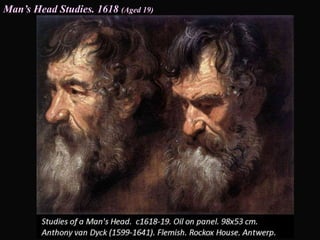
Man’s Head Studies. 1618 (Aged 19)
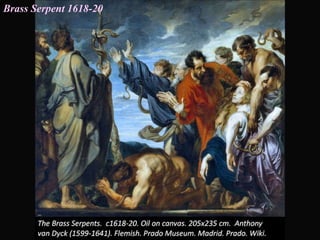
Brass Serpent 1618-20
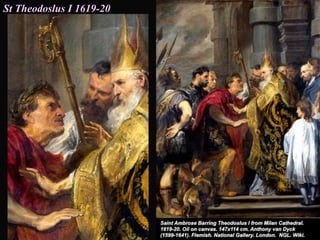
St Theodoslus I 1619-20
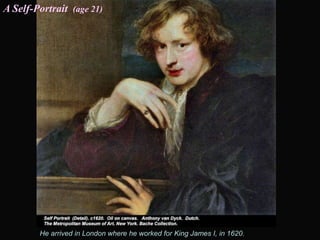
He arrived in London where he worked for King James I, in 1620.
A Self-Portrait (age 21)
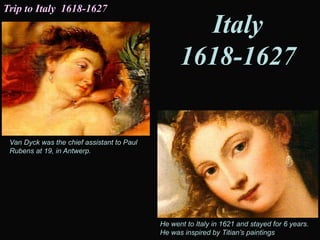
Van Dyck was the chief assistant to Paul
Rubens at 19, in Antwerp.
He went to Italy in 1621 and stayed for 6 years.
He was inspired by Titian’s paintings
Trip to Italy 1618-1627
Italy
1618-1627
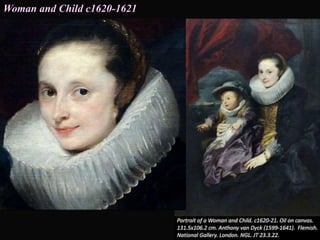
Woman and Child c1620-1621
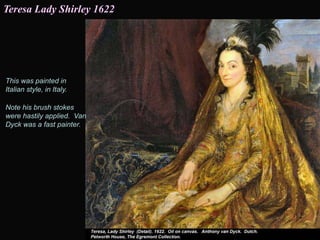
This was painted in
Italian style, in Italy.
Teresa Lady Shirley 1622
Note his brush stokes
were hastily applied. Van
Dyck was a fast painter.
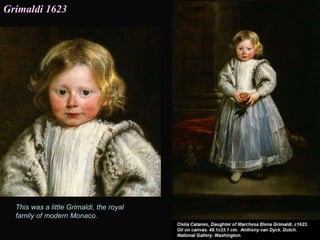
This was a little Grimaldi, the royal
family of modern Monaco.
Grimaldi 1623
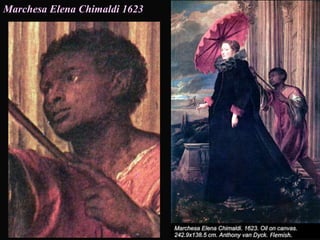
Marchesa Elena Chimaldi 1623
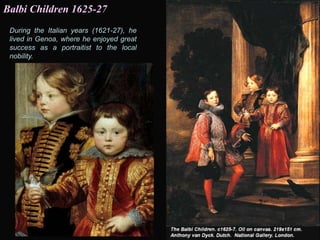
During the Italian years (1621-27), he
lived in Genoa, where he enjoyed great
success as a portraitist to the local
nobility.
Balbi Children 1625-27
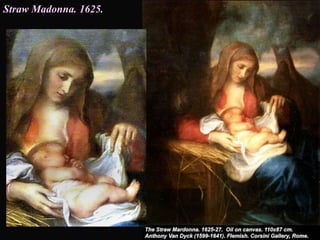
Straw Madonna. 1625.
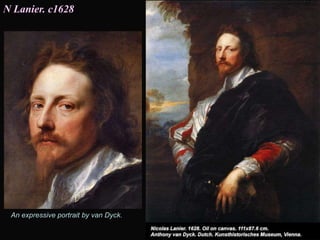
N Lanier. c1628
An expressive portrait by van Dyck.
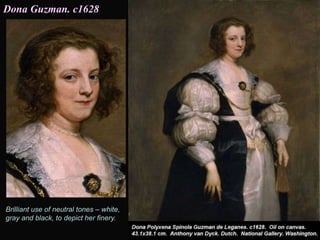
Brilliant use of neutral tones – white,
gray and black, to depict her finery.
Dona Guzman. c1628
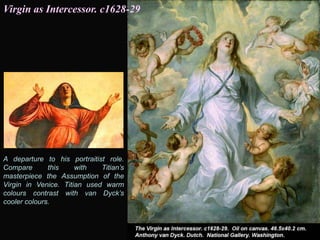
A departure to his portraitist role.
Compare this with Titian’s
masterpiece the Assumption of the
Virgin in Venice. Titian used warm
colours contrast with van Dyck’s
cooler colours.
Virgin as Intercessor. c1628-29
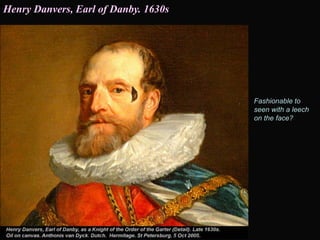
Fashionable to
seen with a leech
on the face?
Henry Danvers, Earl of Danby. 1630s
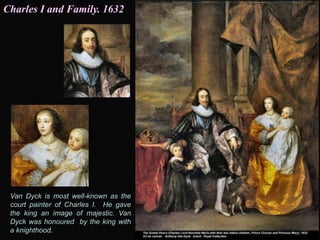
Van Dyck is most well-known as the
court painter of Charles I. He gave
the king an image of majestic. Van
Dyck was honoured by the king with
a knighthood.
Charles I and Family. 1632
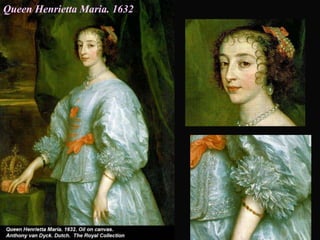
Queen Henrietta Maria. 1632
Self Portrait. 1633
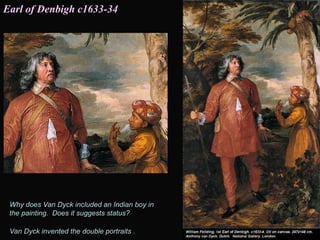
Why does Van Dyck included an Indian boy in
the painting. Does it suggests status?
Van Dyck invented the double portraits .
Earl of Denbigh c1633-34
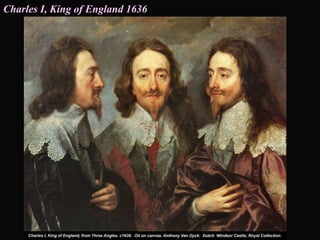
Charles I, King of England 1636
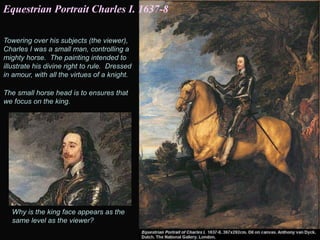
Towering over his subjects (the viewer),
Charles I was a small man, controlling a
mighty horse. The painting intended to
illustrate his divine right to rule. Dressed
in amour, with all the virtues of a knight.
The small horse head is to ensures that
we focus on the king.
Why is the king face appears as the
same level as the viewer?
Equestrian Portrait Charles I. 1637-8
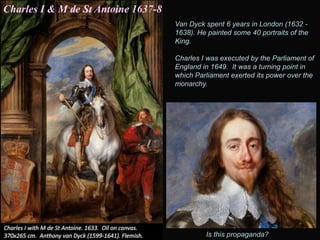
Van Dyck spent 6 years in London (1632 -
1638). He painted some 40 portraits of the
King.
Charles I was executed by the Parliament of
England in 1649. It was a turning point in
which Parliament exerted its power over the
monarchy.
Is this propaganda?
Charles I & M de St Antoine 1637-8
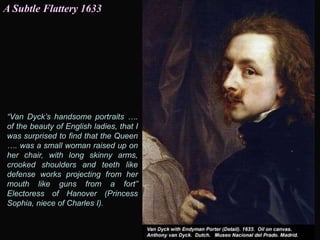
“Van Dyck’s handsome portraits ….
of the beauty of English ladies, that I
was surprised to find that the Queen
…. was a small woman raised up on
her chair, with long skinny arms,
crooked shoulders and teeth like
defense works projecting from her
mouth like guns from a fort”
Electoress of Hanover (Princess
Sophia, niece of Charles I).
A Subtle Flattery 1633
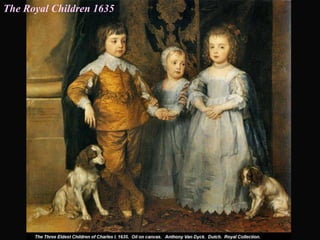
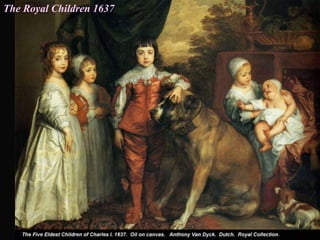
The Royal Children 1635
The Royal Children 1637
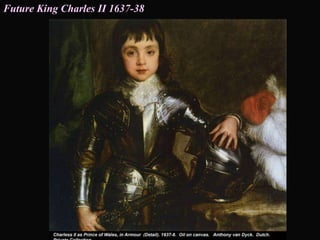
Future King Charles II 1637-38
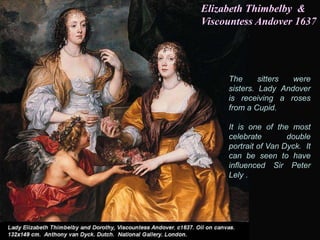
The sitters were
sisters. Lady Andover
is receiving a roses
from a Cupid.
It is one of the most
celebrate double
portrait of Van Dyck. It
can be seen to have
influenced Sir Peter
Lely .
Elizabeth Thimbelby &
Viscountess Andover 1637
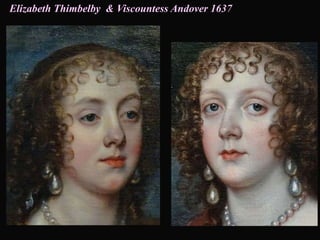
Elizabeth Thimbelby & Viscountess Andover 1637
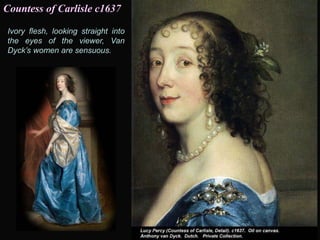
Ivory flesh, looking straight into
the eyes of the viewer, Van
Dyck’s women are sensuous.
Countess of Carlisle c1637
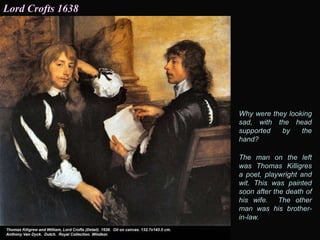
Why were they looking
sad, with the head
supported by the
hand?
The man on the left
was Thomas Killigres
a poet, playwright and
wit. This was painted
soon after the death of
his wife. The other
man was his brother-
in-law.
Lord Crofts 1638
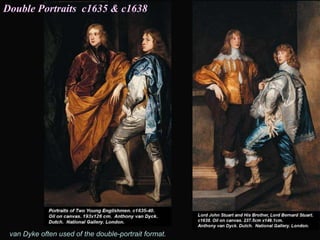
Double Portraits c1635 & c1638
van Dyke often used of the double-portrait format.
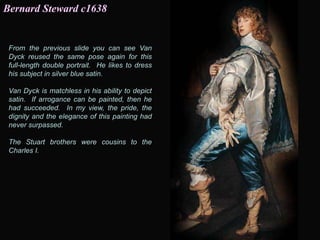
From the previous slide you can see Van
Dyck reused the same pose again for this
full-length double portrait. He likes to dress
his subject in silver blue satin.
Van Dyck is matchless in his ability to depict
satin. If arrogance can be painted, then he
had succeeded. In my view, the pride, the
dignity and the elegance of this painting had
never surpassed.
The Stuart brothers were cousins to the
Charles I.
Bernard Steward c1638
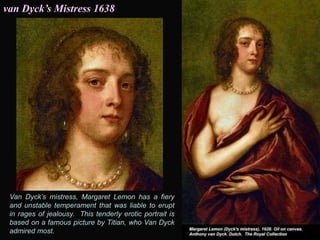
Van Dyck’s mistress, Margaret Lemon has a fiery
and unstable temperament that was liable to erupt
in rages of jealousy. This tenderly erotic portrait is
based on a famous picture by Titian, who Van Dyck
admired most.
van Dyck’s Mistress 1638
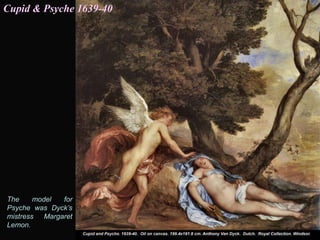
The model for
Psyche was Dyck’s
mistress Margaret
Lemon.
Cupid & Psyche 1639-40
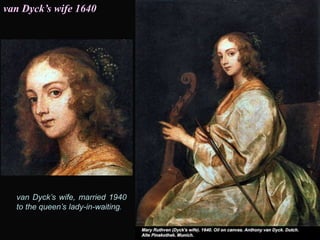
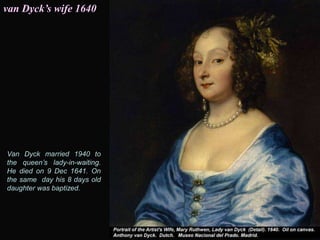
Van Dyck married 1940 to
the queen’s lady-in-waiting.
He died on 9 Dec 1641. On
the same day his 8 days old
daughter was baptized.
van Dyck’s wife 1640
van Dyck’s wife, married 1940
to the queen’s lady-in-waiting.
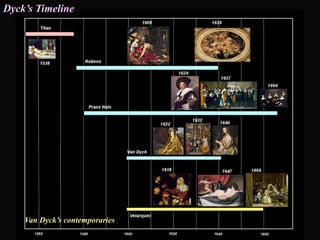
Van Dyck’s contemporaries
Dyck’s Timeline
Music – Handel-Alla Hornpipe, The Water Music.
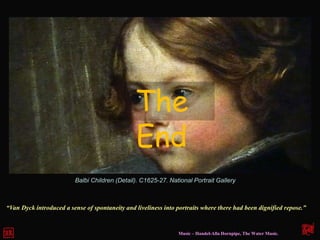
“Van Dyck introduced a sense of spontaneity and liveliness into portraits where there had been dignified repose.”
Balbi Children (Detail). C1625-27. National Portrait Gallery
The
End
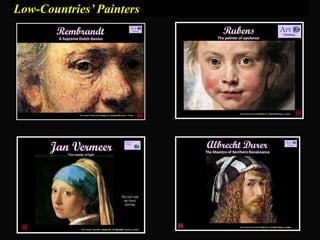
Low-Countries’ Painters
April 2019
Anthony van Dyck 2.0

Anthony van Dyck 2.0

  • 1.
    Van Dyck The EnglishCourt Painter First created Feb 2009. Version 2.0 - 24 Mar 2022. Daperro. London. Self-Portrait with Sunflower 1633.
  • 2.
    A Self-Portrait 1613(Aged 14) A remarkable self-portrait at 14. A competent artist by the age of 15 and set up his own workshop at 16.
  • 3.
    Adoration of theShepherds 1616-18
  • 4.
    Christ into Jerusalem.1617 (Aged 18)
  • 5.
    Man’s Head Studies.1618 (Aged 19)
  • 6.
  • 7.
  • 8.
    He arrived inLondon where he worked for King James I, in 1620. A Self-Portrait (age 21)
  • 9.
    Van Dyck wasthe chief assistant to Paul Rubens at 19, in Antwerp. He went to Italy in 1621 and stayed for 6 years. He was inspired by Titian’s paintings Trip to Italy 1618-1627 Italy 1618-1627
  • 10.
    Woman and Childc1620-1621
  • 11.
    This was paintedin Italian style, in Italy. Teresa Lady Shirley 1622 Note his brush stokes were hastily applied. Van Dyck was a fast painter.
  • 12.
    This was alittle Grimaldi, the royal family of modern Monaco. Grimaldi 1623
  • 13.
  • 14.
    During the Italianyears (1621-27), he lived in Genoa, where he enjoyed great success as a portraitist to the local nobility. Balbi Children 1625-27
  • 15.
  • 16.
    N Lanier. c1628 Anexpressive portrait by van Dyck.
  • 17.
    Brilliant use ofneutral tones – white, gray and black, to depict her finery. Dona Guzman. c1628
  • 18.
    A departure tohis portraitist role. Compare this with Titian’s masterpiece the Assumption of the Virgin in Venice. Titian used warm colours contrast with van Dyck’s cooler colours. Virgin as Intercessor. c1628-29
  • 19.
    Fashionable to seen witha leech on the face? Henry Danvers, Earl of Danby. 1630s
  • 20.
    Van Dyck ismost well-known as the court painter of Charles I. He gave the king an image of majestic. Van Dyck was honoured by the king with a knighthood. Charles I and Family. 1632
  • 21.
  • 22.
  • 23.
    Why does VanDyck included an Indian boy in the painting. Does it suggests status? Van Dyck invented the double portraits . Earl of Denbigh c1633-34
  • 24.
    Charles I, Kingof England 1636
  • 25.
    Towering over hissubjects (the viewer), Charles I was a small man, controlling a mighty horse. The painting intended to illustrate his divine right to rule. Dressed in amour, with all the virtues of a knight. The small horse head is to ensures that we focus on the king. Why is the king face appears as the same level as the viewer? Equestrian Portrait Charles I. 1637-8
  • 26.
    Van Dyck spent6 years in London (1632 - 1638). He painted some 40 portraits of the King. Charles I was executed by the Parliament of England in 1649. It was a turning point in which Parliament exerted its power over the monarchy. Is this propaganda? Charles I & M de St Antoine 1637-8
  • 27.
    “Van Dyck’s handsomeportraits …. of the beauty of English ladies, that I was surprised to find that the Queen …. was a small woman raised up on her chair, with long skinny arms, crooked shoulders and teeth like defense works projecting from her mouth like guns from a fort” Electoress of Hanover (Princess Sophia, niece of Charles I). A Subtle Flattery 1633
  • 28.
  • 29.
  • 30.
  • 31.
    The sitters were sisters.Lady Andover is receiving a roses from a Cupid. It is one of the most celebrate double portrait of Van Dyck. It can be seen to have influenced Sir Peter Lely . Elizabeth Thimbelby & Viscountess Andover 1637
  • 32.
    Elizabeth Thimbelby &Viscountess Andover 1637
  • 33.
    Ivory flesh, lookingstraight into the eyes of the viewer, Van Dyck’s women are sensuous. Countess of Carlisle c1637
  • 34.
    Why were theylooking sad, with the head supported by the hand? The man on the left was Thomas Killigres a poet, playwright and wit. This was painted soon after the death of his wife. The other man was his brother- in-law. Lord Crofts 1638
  • 35.
    Double Portraits c1635& c1638 van Dyke often used of the double-portrait format.
  • 36.
    From the previousslide you can see Van Dyck reused the same pose again for this full-length double portrait. He likes to dress his subject in silver blue satin. Van Dyck is matchless in his ability to depict satin. If arrogance can be painted, then he had succeeded. In my view, the pride, the dignity and the elegance of this painting had never surpassed. The Stuart brothers were cousins to the Charles I. Bernard Steward c1638
  • 37.
    Van Dyck’s mistress,Margaret Lemon has a fiery and unstable temperament that was liable to erupt in rages of jealousy. This tenderly erotic portrait is based on a famous picture by Titian, who Van Dyck admired most. van Dyck’s Mistress 1638
  • 38.
    The model for Psychewas Dyck’s mistress Margaret Lemon. Cupid & Psyche 1639-40
  • 39.
    Van Dyck married1940 to the queen’s lady-in-waiting. He died on 9 Dec 1641. On the same day his 8 days old daughter was baptized. van Dyck’s wife 1640
  • 40.
    van Dyck’s wife1640 van Dyck’s wife, married 1940 to the queen’s lady-in-waiting.
  • 41.
  • 42.
    Music – Handel-AllaHornpipe, The Water Music. “Van Dyck introduced a sense of spontaneity and liveliness into portraits where there had been dignified repose.” Balbi Children (Detail). C1625-27. National Portrait Gallery The End
  • 43.
  • 44.

Editor's Notes

  • #2 Van Dyck was among the greatest and the most successful portraitists who has ever lived. He dazzlied 17C contemporaries not only in his native Netherlands but also in Italy and above all in England. His influence on subsequent portrait painting in Britain proved so great that it lasted to the beginning of 20C.
  • #43 V2.0 Greatly expanded to over 40 slides. Format to latest standard. V1.0 First published in Feb 2009.