WHAT DO WE MEAN BY
OUTCOMES?
Outcomes are clear learning
results that learners have to
demonstrate at the end of
significant learning
experiences
Outcomes based education (OBE)
is a process that involves the
restructuring of curriculum,
assessment and reporting practices
in education to reflect the
achievement of high order learning
and mastery rather than the
accumulation of course credits”
(Tucker, 2004).
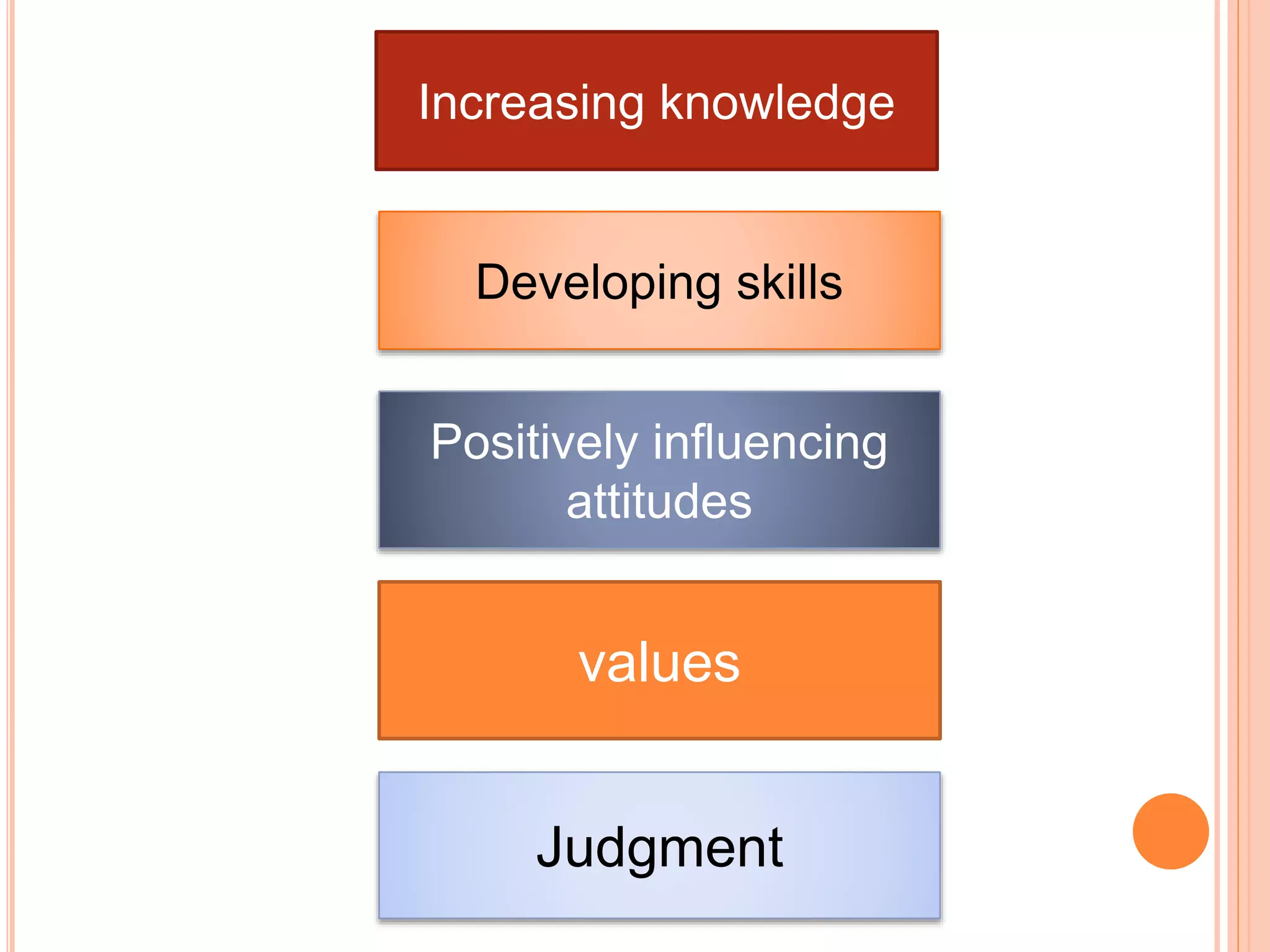
Increasing knowledge
Developing skills
values
Positively influencing
attitudes
Judgment
OBE
It is a student-centered approach
to education that focuses on the intended
learning outcomes resulting from
instruction (Nicholson, 2011).
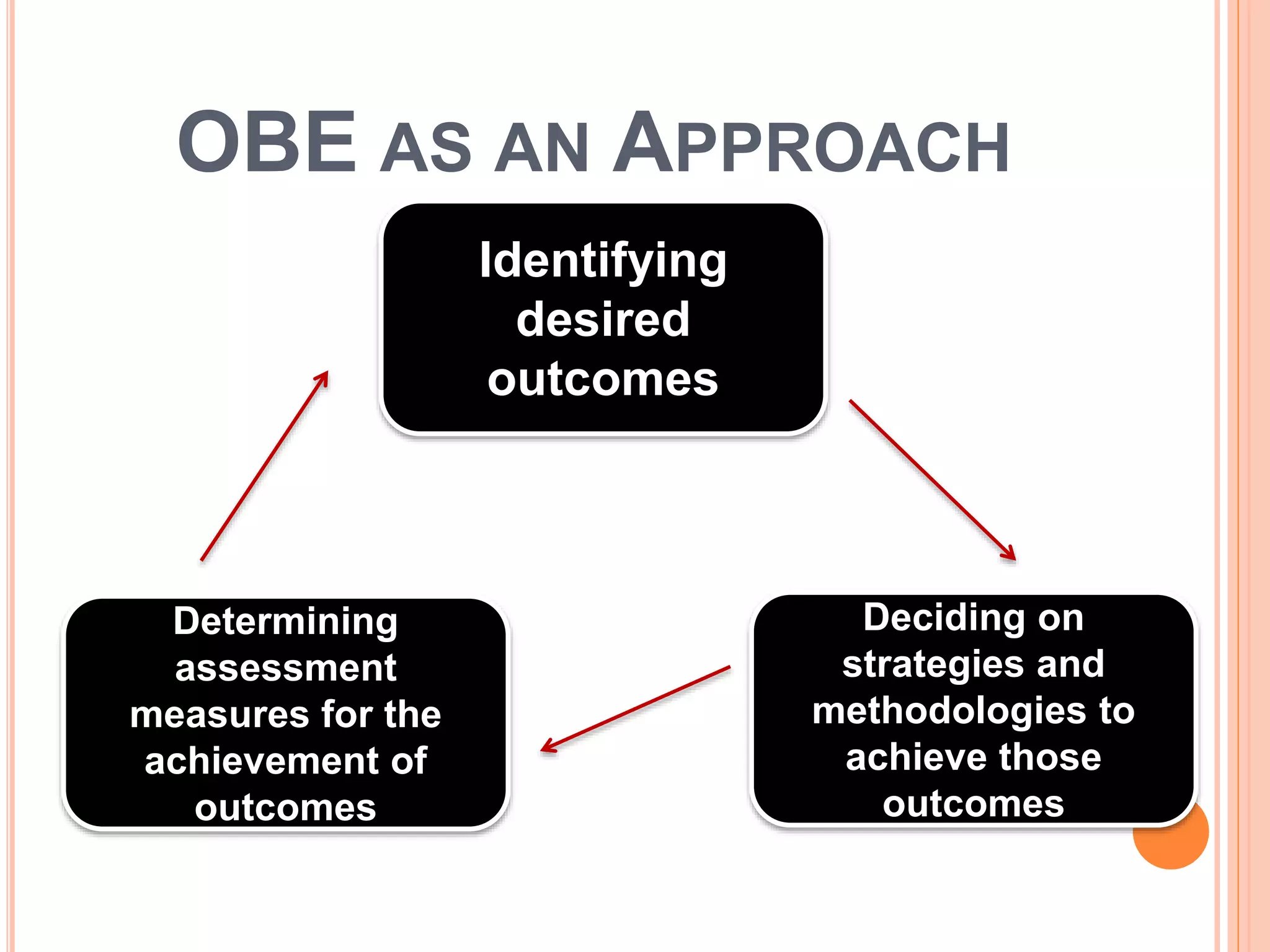
OBE AS AN APPROACH
Identifying
desired
outcomes
Deciding on
strategies and
methodologies to
achieve those
outcomes
Determining
assessment
measures for the
achievement of
outcomes
CHED MEMO 46. S. 2012 mandates
outcomes-based education (OBE)
standards for higher education
institutions.
The Enhanced Basic Education
Curriculum of the Department of
Education, introduced content
standards, performance standards and
competencies in the K to 12 Curriculum
Guide.
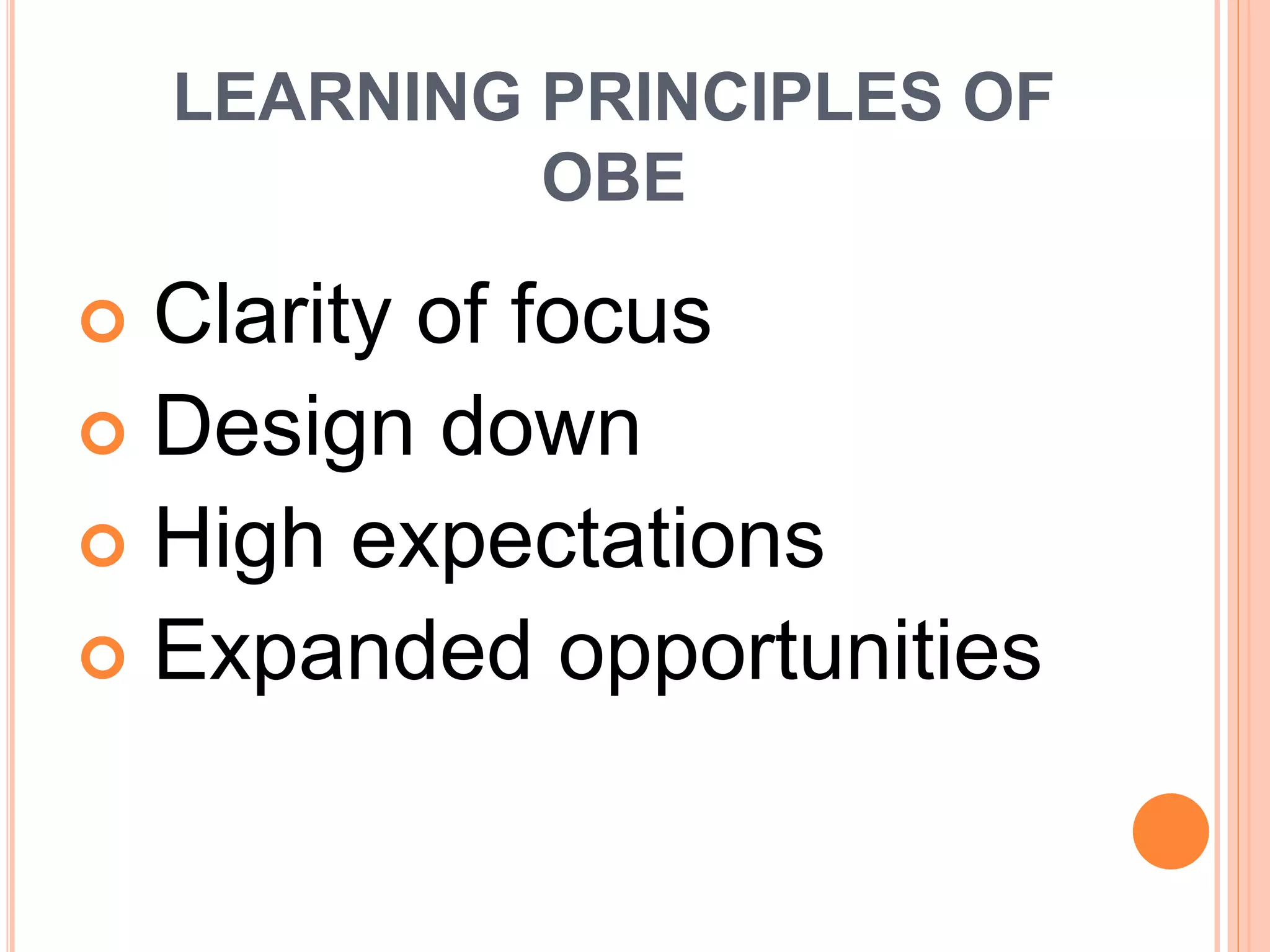
LEARNING PRINCIPLES OF
OBE
 Clarity of focus
 Design down
 High expectations
 Expanded opportunities
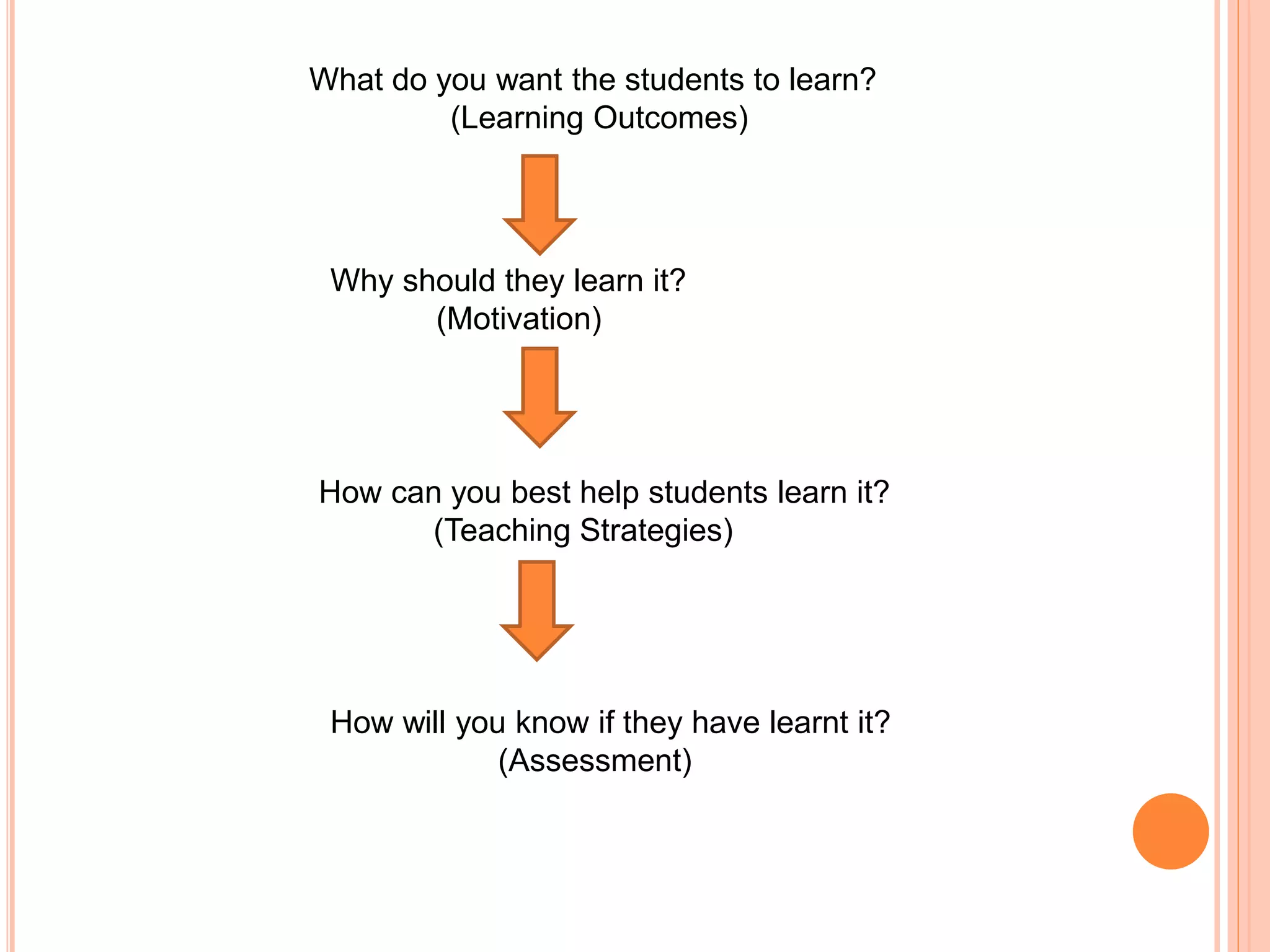
WHY IS IT IMPORTANT TO
KNOW THE OUTCOMES PRIOR
TO PLANNING AND TEACHING?
What do you want the students to learn?
(Learning Outcomes)
Why should they learn it?
(Motivation)
How can you best help students learn it?
(Teaching Strategies)
How will you know if they have learnt it?
(Assessment)
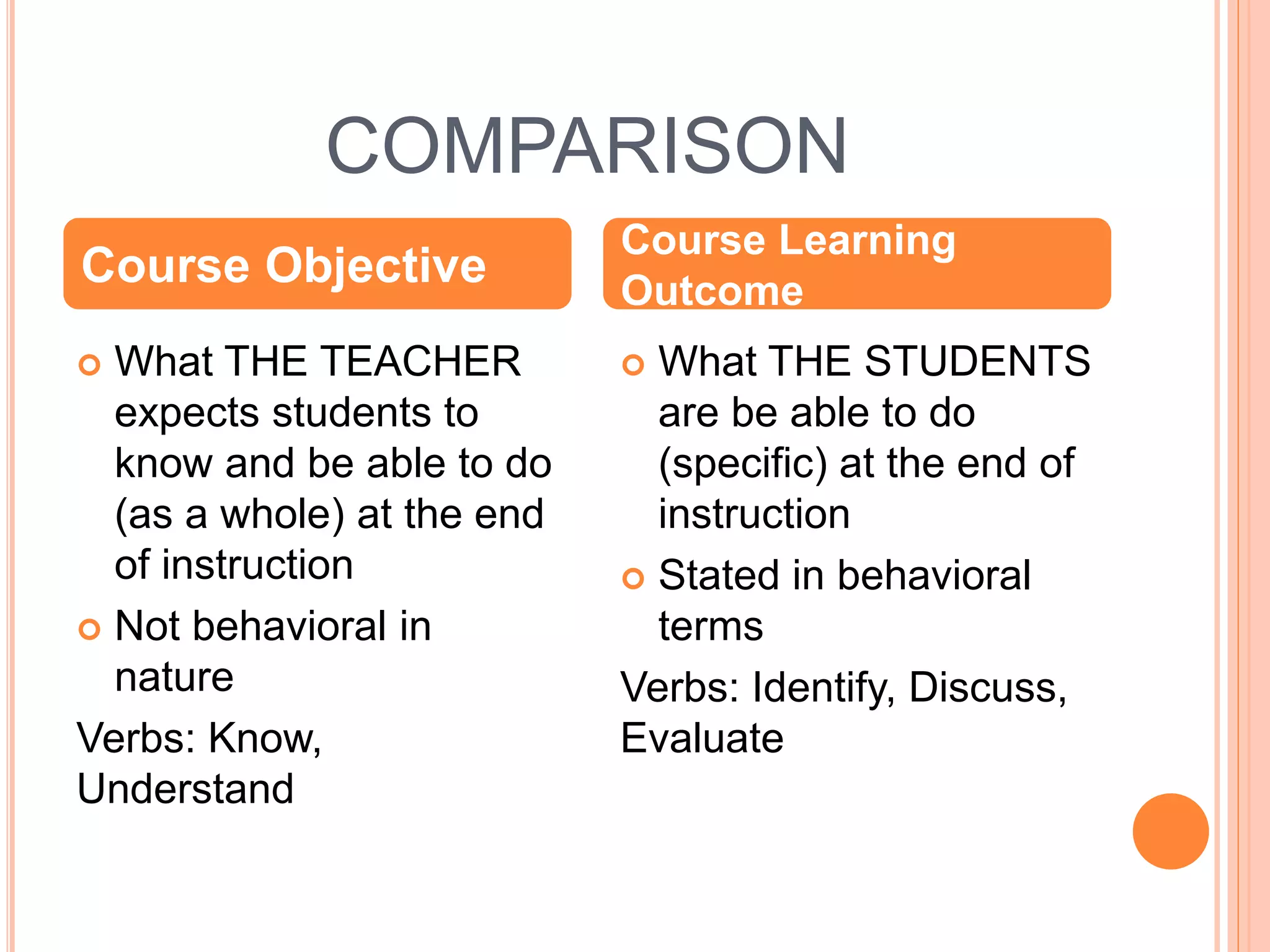
COMPARISON
 What THE TEACHER
expects students to
know and be able to do
(as a whole) at the end
of instruction
 Not behavioral in
nature
Verbs: Know,
Understand
 What THE STUDENTS
are be able to do
(specific) at the end of
instruction
 Stated in behavioral
terms
Verbs: Identify, Discuss,
Evaluate
Course Objective
Course Learning
Outcome
COMPARISON
 One course objective
may generate several
learning outcomes
 Objectives are
intended results or
consequences of
instruction, curricula,
programmes, or
activities.
 Several learning
outcomes are derived
from one course
objective
 Outcomes are
achieved results or
consequences of what
was learned –
evidence that some
learning took place.
Course Objective
Course Learning
Outcome
WHY OBE?
 Provide direction in the planning of a
learning activity
 Focus learner’s behavior on that is to be
changed
 Serve as guidelines for content, instruction
and evaluation
 Identify specifically what should be learned
 Convey to learners exactly what is to be
accomplished
EXAMPLE
Objective: To provide participants with a
good understanding of outcome-based
education
Outcome: Participants must be able to
demonstrate their grasp of OBE by, e.g.
writing learning outcomes for the
courses they teach
2 APPROACHES OF OBE:
1. TRADITIONAL/TRANSITIONAL
- emphasizes student mastery of
traditional subject-related academic
outcomes
2. TRANSFORMATIONAL
- emphasizes long term, cross-
curricular outcomes that are related
directly to students’ future life roles.
This means that OBE moves from
subject-specific outcomes and
cross-discipline outcomes to long-
term, cross-curricular outcomes
that are directly related to students
future life roles……
Outcomes-Based Education

Outcomes-Based Education

  • 2.
    WHAT DO WEMEAN BY OUTCOMES? Outcomes are clear learning results that learners have to demonstrate at the end of significant learning experiences
  • 4.
    Outcomes based education(OBE) is a process that involves the restructuring of curriculum, assessment and reporting practices in education to reflect the achievement of high order learning and mastery rather than the accumulation of course credits” (Tucker, 2004).
  • 5.
  • 7.
    OBE It is astudent-centered approach to education that focuses on the intended learning outcomes resulting from instruction (Nicholson, 2011).
  • 8.
    OBE AS ANAPPROACH Identifying desired outcomes Deciding on strategies and methodologies to achieve those outcomes Determining assessment measures for the achievement of outcomes
  • 9.
    CHED MEMO 46.S. 2012 mandates outcomes-based education (OBE) standards for higher education institutions. The Enhanced Basic Education Curriculum of the Department of Education, introduced content standards, performance standards and competencies in the K to 12 Curriculum Guide.
  • 10.
    LEARNING PRINCIPLES OF OBE Clarity of focus  Design down  High expectations  Expanded opportunities
  • 11.
    WHY IS ITIMPORTANT TO KNOW THE OUTCOMES PRIOR TO PLANNING AND TEACHING?
  • 12.
    What do youwant the students to learn? (Learning Outcomes) Why should they learn it? (Motivation) How can you best help students learn it? (Teaching Strategies) How will you know if they have learnt it? (Assessment)
  • 13.
    COMPARISON  What THETEACHER expects students to know and be able to do (as a whole) at the end of instruction  Not behavioral in nature Verbs: Know, Understand  What THE STUDENTS are be able to do (specific) at the end of instruction  Stated in behavioral terms Verbs: Identify, Discuss, Evaluate Course Objective Course Learning Outcome
  • 14.
    COMPARISON  One courseobjective may generate several learning outcomes  Objectives are intended results or consequences of instruction, curricula, programmes, or activities.  Several learning outcomes are derived from one course objective  Outcomes are achieved results or consequences of what was learned – evidence that some learning took place. Course Objective Course Learning Outcome
  • 15.
    WHY OBE?  Providedirection in the planning of a learning activity  Focus learner’s behavior on that is to be changed  Serve as guidelines for content, instruction and evaluation  Identify specifically what should be learned  Convey to learners exactly what is to be accomplished
  • 16.
    EXAMPLE Objective: To provideparticipants with a good understanding of outcome-based education Outcome: Participants must be able to demonstrate their grasp of OBE by, e.g. writing learning outcomes for the courses they teach
  • 17.
    2 APPROACHES OFOBE: 1. TRADITIONAL/TRANSITIONAL - emphasizes student mastery of traditional subject-related academic outcomes 2. TRANSFORMATIONAL - emphasizes long term, cross- curricular outcomes that are related directly to students’ future life roles.
  • 18.
    This means thatOBE moves from subject-specific outcomes and cross-discipline outcomes to long- term, cross-curricular outcomes that are directly related to students future life roles……