Group 1
Soc. Sci. 13 (Rizal’s Life and Works)
TF (6:00-7:30PM)
Group Members:
Abalde, Carl Joseph
Baranda, Christopher Ryan
Belisario, Arlene Grace
Bengil, Dympna Karyn
Duyogan, Denice Shairah
Edrozo, Jennefer
Ginisiran, Janica
Hermo, Hannah Juneizza
Nablo, Cherry
Orlanes, Ellaine Jane
Paigalan, Rose
Pamaong, Jean
Tinsay, Jimmy Jr.
The
Novel
…
The book narrates the
return of the protagonist of
Noli Me Tangere,
Crisostomo Ibarra, under
the disguise of a wealthy
jeweler named Simoun.
Disillusioned by the abuses
of the Spanish, Ibarra
abandons his pacifist
beliefs in order to return to
the Philippines and start a
violent revolution.
The second novel written by Jose
Rizal
The sequel to Noli Me Tangere
Consists of 38 chapters
Written in Spanish
The Reign of Greed
Rizal dedicated El
Filibusterismo to the
three martyred priests of
Cavite mutiny. The
execution of the three
priests was significant to
the title of the novel.
Characters of Noli
Me Tangere and El
Filibusterismo
Crisostomo Ibarra
 Spanish Mestizo
 Young man who
studied in Europe for
seven years
 Fiance of Maria Clara
 Believed in the
importance of
education to the
youth
 Has liberal mind and
outspoken
 Ibarra as Rizal’s
reflection of himself
Simoun
 A disguised Crisostomo
Ibarra
 infamous wealthy jeweler
 Referred to as the Brown
Cardinal A tall, dark man
with white hair and a thin
black beard
 Wears European clothing
 Speaks a strange mix of
English and South
American accents
 Poses himself as a
supporter of Spanish
government when in fact,
he is against them
 Wanted to get revenge from
the injustice he received
from the Spanish
government through
instigating revolution
KAPITAN TIAGO
• Don Santiago de
los Santos, known
by his
nickname Tiago
• Has apolitical
title CapitánTiago
is a Filipino
businessman and
the cabeza de
barangay (barangay
head) of the town of
San Diego
• also known as the
father of Maria Clara.
KAPITAN TIAGO
• he adopted Basilio
and let him finish
college
• Forced Basilio to
take medicine and
someday help him
in his Cock Fights
• he died in the
later part of the
novel because of
an addiction
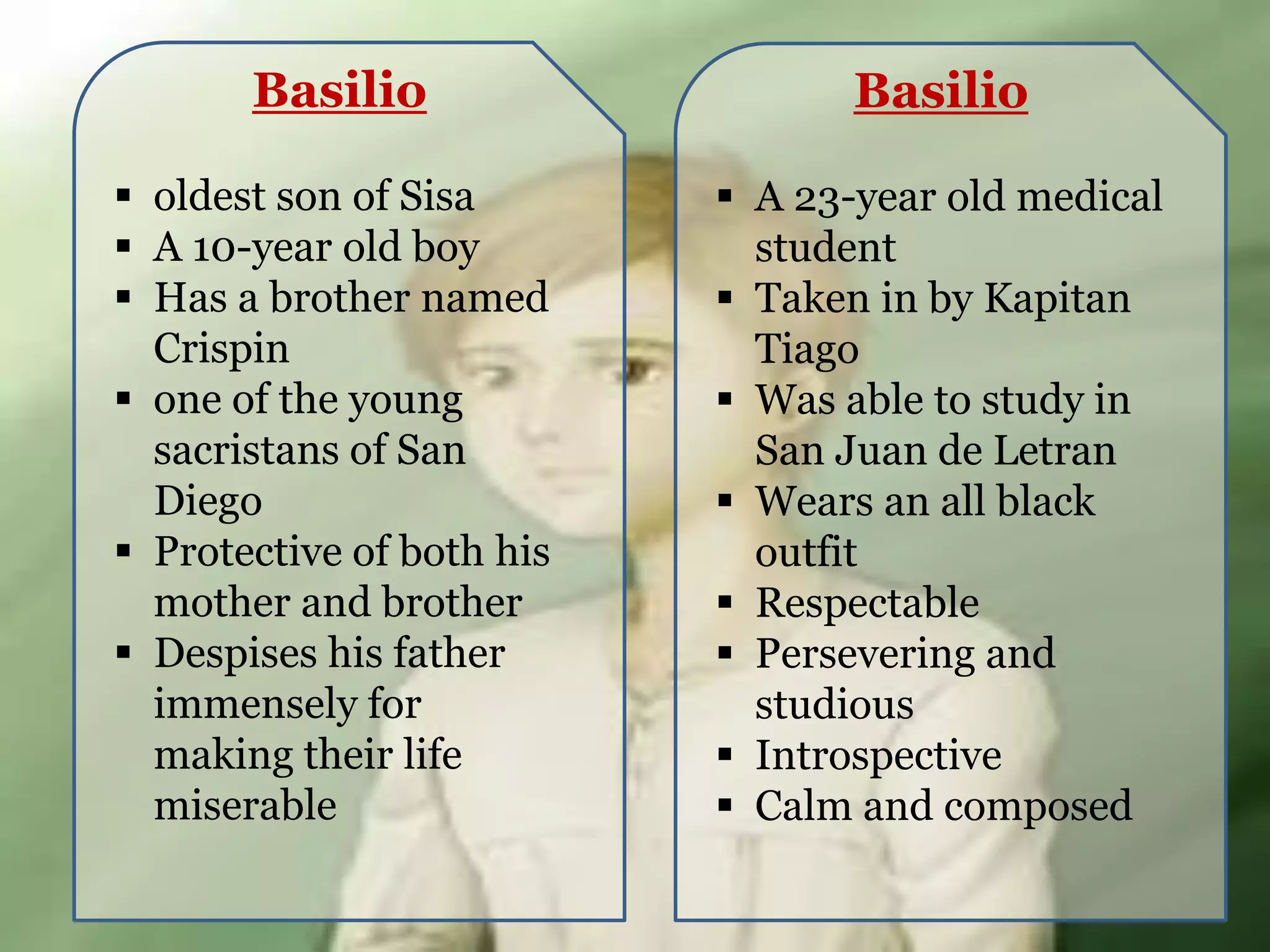
Basilio
 oldest son of Sisa
 A 10-year old boy
 Has a brother named
Crispin
 one of the young
sacristans of San
Diego
 Protective of both his
mother and brother
 Despises his father
immensely for
making their life
miserable
Basilio
 A 23-year old medical
student
 Taken in by Kapitan
Tiago
 Was able to study in
San Juan de Letran
 Wears an all black
outfit
 Respectable
 Persevering and
studious
 Introspective
 Calm and composed
PADRE SALVI
• Padre Damaso 's
successor as pastor
in the town of San
Diego
• described as sickly
and always seemed
to have something in
mind
• He has a secret
passion for Maria
Clara , the girlfriend
of the protagonist
Crisostomo Ibarra
PADRE SALVI
• The description of
Padre Salvi in this
novel did not change
• He was still slender
and an unhappy friar
and manages the
convent of Sta. Clara
• He was still slender
and an unhappy friar
and manages the
convent of Sta. Clara
• He also sent a letter
containing the story
of the death of Maria
Clara
PADRE SIBAYLA
 a young, good looking
Dominican priest with
an air of
maturity;curate
of Binondo
 A former professor
at Colegio de San Juan
de Letran who is cool
and intelligent
 has thin, refined lips
that would plainly show
disdain when needed
 weighs his words and
speaks little
 good in resolving
different views
PADRE SIBAYLA
• Has almost the
same personality
in the novel
The reason why
Crisostomo Ibarra
came back to
SanDiego and
changed his name
• Juan Crisostomo Ibarra came back to San diego
for one main reason which is to visit his father's
grave. It was stated in the book that: "Ibarra,
goes to his hometown, San Diego, where María
Clara's family also has a house. He goes to see
his father's grave at the Catholic cemetery and
finds it has been disturbed".
• The reason why Crisostomo Ibarra change his
name is because he wants to seek revenge
against the Spanish.
CENTRAL THEME:
ideal means of achieving social reform
Reasons of changing the
plot and theme:
• El Filibusterismo shares the theme “ Violence
is not the answer” when Simoun’s grand plan
thwarted.
• When he asked Father Florentino about the
failure of his plan, the friar answered with
“Perhaps He (God) saw there was not justice
in the way you wanted it done.”
• The way Simoun “wanted it done” was by
blowing up the house of Kapitan Tiyago
which had many Spaniards with important
positions.
• El Filibusterismo is far more dark and brutal
thant of Noli Me Tangere.
• It had many events of murder, sexual abuse
and suicide.
• El filibusterismo is a massive turning point
from Ibarra being idealistic and open man t
Simoun who became vengeful, angry, and
somewhat cunning.
Source: www.slideshare.net
The theme and plot of El Filibusterismo was
changed to convey the message that the
present system of government in the
Philippines through corrupt officials, dominated by
the friars can lead to the downfall of Spain. This point
was stressed by Simoun in the novel, when he said, “
what is a man to do when he is denied justice ? Take
the law into his own hands or wait for Spanish to give
him rights...” From the foregoing, Rizal was very
certain that because of the nature and operation of the
government, those who are intelligent, generous, hard-
working, courageous, and loyal citizens were driven
into opposition, crime and subversion.
Relevance to the Issues
in the Philippine Society
El Filibusterismo is not a mere inspiration to us
Filipinos but also a reflection which taught us lessons of
yesterday which still live today. Few of the main purposes
of this novel are: to defend Filipino people from foreign
accusations of foolishness and lack of knowledge, to show
how the Filipino people live during Spanish colonial
period and the cries and woes of his countrymen against
abusive officials. This novels along with Rizal's
involvement in organizations that aim to address and
reform the Spanish system and its issues led to Rizal's
exile to Dapitan and eventual execution.
Moreover, this had a profound effect on
Philippine society in terms of views about national
identity, the Catholic faith and its influence on Filipino's
choice, and the government's issues of corruption, abuse,
and discrimination, and on a larger scale, the issues
related to the effect of colonization on people's lives and
the cause for independence. Rizal already did his part, it’s
now our time to put into actions the words and wisdom
that Rizal left. We must not let these words just remain
words!
f i n
By: Jennefer L. Edrozo

El Filibusterismo

  • 1.
    Group 1 Soc. Sci.13 (Rizal’s Life and Works) TF (6:00-7:30PM)
  • 2.
    Group Members: Abalde, CarlJoseph Baranda, Christopher Ryan Belisario, Arlene Grace Bengil, Dympna Karyn Duyogan, Denice Shairah Edrozo, Jennefer Ginisiran, Janica Hermo, Hannah Juneizza Nablo, Cherry Orlanes, Ellaine Jane Paigalan, Rose Pamaong, Jean Tinsay, Jimmy Jr.
  • 3.
  • 4.
    The book narratesthe return of the protagonist of Noli Me Tangere, Crisostomo Ibarra, under the disguise of a wealthy jeweler named Simoun. Disillusioned by the abuses of the Spanish, Ibarra abandons his pacifist beliefs in order to return to the Philippines and start a violent revolution.
  • 5.
    The second novelwritten by Jose Rizal The sequel to Noli Me Tangere Consists of 38 chapters Written in Spanish
  • 6.
  • 7.
    Rizal dedicated El Filibusterismoto the three martyred priests of Cavite mutiny. The execution of the three priests was significant to the title of the novel.
  • 8.
    Characters of Noli MeTangere and El Filibusterismo
  • 9.
    Crisostomo Ibarra  SpanishMestizo  Young man who studied in Europe for seven years  Fiance of Maria Clara  Believed in the importance of education to the youth  Has liberal mind and outspoken  Ibarra as Rizal’s reflection of himself Simoun  A disguised Crisostomo Ibarra  infamous wealthy jeweler  Referred to as the Brown Cardinal A tall, dark man with white hair and a thin black beard  Wears European clothing  Speaks a strange mix of English and South American accents  Poses himself as a supporter of Spanish government when in fact, he is against them  Wanted to get revenge from the injustice he received from the Spanish government through instigating revolution
  • 10.
    KAPITAN TIAGO • DonSantiago de los Santos, known by his nickname Tiago • Has apolitical title CapitánTiago is a Filipino businessman and the cabeza de barangay (barangay head) of the town of San Diego • also known as the father of Maria Clara. KAPITAN TIAGO • he adopted Basilio and let him finish college • Forced Basilio to take medicine and someday help him in his Cock Fights • he died in the later part of the novel because of an addiction
  • 11.
    Basilio  oldest sonof Sisa  A 10-year old boy  Has a brother named Crispin  one of the young sacristans of San Diego  Protective of both his mother and brother  Despises his father immensely for making their life miserable Basilio  A 23-year old medical student  Taken in by Kapitan Tiago  Was able to study in San Juan de Letran  Wears an all black outfit  Respectable  Persevering and studious  Introspective  Calm and composed
  • 12.
    PADRE SALVI • PadreDamaso 's successor as pastor in the town of San Diego • described as sickly and always seemed to have something in mind • He has a secret passion for Maria Clara , the girlfriend of the protagonist Crisostomo Ibarra PADRE SALVI • The description of Padre Salvi in this novel did not change • He was still slender and an unhappy friar and manages the convent of Sta. Clara • He was still slender and an unhappy friar and manages the convent of Sta. Clara • He also sent a letter containing the story of the death of Maria Clara
  • 13.
    PADRE SIBAYLA  ayoung, good looking Dominican priest with an air of maturity;curate of Binondo  A former professor at Colegio de San Juan de Letran who is cool and intelligent  has thin, refined lips that would plainly show disdain when needed  weighs his words and speaks little  good in resolving different views PADRE SIBAYLA • Has almost the same personality in the novel
  • 14.
    The reason why CrisostomoIbarra came back to SanDiego and changed his name
  • 15.
    • Juan CrisostomoIbarra came back to San diego for one main reason which is to visit his father's grave. It was stated in the book that: "Ibarra, goes to his hometown, San Diego, where María Clara's family also has a house. He goes to see his father's grave at the Catholic cemetery and finds it has been disturbed". • The reason why Crisostomo Ibarra change his name is because he wants to seek revenge against the Spanish.
  • 16.
    CENTRAL THEME: ideal meansof achieving social reform
  • 17.
    Reasons of changingthe plot and theme:
  • 18.
    • El Filibusterismoshares the theme “ Violence is not the answer” when Simoun’s grand plan thwarted. • When he asked Father Florentino about the failure of his plan, the friar answered with “Perhaps He (God) saw there was not justice in the way you wanted it done.” • The way Simoun “wanted it done” was by blowing up the house of Kapitan Tiyago which had many Spaniards with important positions.
  • 19.
    • El Filibusterismois far more dark and brutal thant of Noli Me Tangere. • It had many events of murder, sexual abuse and suicide. • El filibusterismo is a massive turning point from Ibarra being idealistic and open man t Simoun who became vengeful, angry, and somewhat cunning. Source: www.slideshare.net
  • 20.
    The theme andplot of El Filibusterismo was changed to convey the message that the present system of government in the Philippines through corrupt officials, dominated by the friars can lead to the downfall of Spain. This point was stressed by Simoun in the novel, when he said, “ what is a man to do when he is denied justice ? Take the law into his own hands or wait for Spanish to give him rights...” From the foregoing, Rizal was very certain that because of the nature and operation of the government, those who are intelligent, generous, hard- working, courageous, and loyal citizens were driven into opposition, crime and subversion.
  • 21.
    Relevance to theIssues in the Philippine Society
  • 22.
    El Filibusterismo isnot a mere inspiration to us Filipinos but also a reflection which taught us lessons of yesterday which still live today. Few of the main purposes of this novel are: to defend Filipino people from foreign accusations of foolishness and lack of knowledge, to show how the Filipino people live during Spanish colonial period and the cries and woes of his countrymen against abusive officials. This novels along with Rizal's involvement in organizations that aim to address and reform the Spanish system and its issues led to Rizal's exile to Dapitan and eventual execution. Moreover, this had a profound effect on Philippine society in terms of views about national identity, the Catholic faith and its influence on Filipino's choice, and the government's issues of corruption, abuse, and discrimination, and on a larger scale, the issues related to the effect of colonization on people's lives and the cause for independence. Rizal already did his part, it’s now our time to put into actions the words and wisdom that Rizal left. We must not let these words just remain words!
  • 24.
    f i n By:Jennefer L. Edrozo