Performance-Based
Assessment
Melody Grace M. Lizano
What is
Performance-Based
Assessment?
Performance-based
assessment measures
students' ability to apply
the skills and knowledge
learned from a unit or
units of study.
The Office of Technology
Assessment of the U.S. Congress
described performance
assessment as testing that requires
a student to create an answer or a
product that demonstrates his or
her knowledge or skills.
Group projects enabling a
number of students to work
together on a complex
problem that requires
planning, research, internal
discussion, and group
presentation.
Essays
Essays assessing students'
understanding of a subject
through a written
description, analysis,
explanation, or summary.
Experiments
Experiments testing
how well students
understand scientific
concepts and can
carry out scientific
processes.
Demonstrations
Demonstrations
giving students
opportunities to
show their mastery
of subject-area
content and
procedures.
Portfolios
Portfolios allowing
students to provide a
broad portrait of their
performance through
files that contain
collections of students'
work, assembled over
time.
What are
the essential
characteristics of a
performance
-based
assessment?
• Complex
• Authentic
• Process/
product-oriented
• Open-ended
• Time-bound
What are
the purposes
of a
performanc
e-based
assessment
• track learners’ work on a task
• show them the value of their
work processes
• help them self-monitor so
that they can use tools such as
periodic reflections, working
files and learning logs more
effectively
 Definition Of Performance Task
 Benefits/Drawbacks
 Characteristics
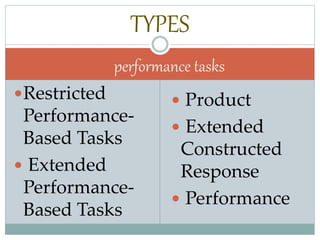
 TYPES
 Product
 Extended Constructed Response
 Performance
TYPES OF PERFORMANCE- BASED TASK
are tasks that ask students to
create products or perform
tasks to show their mastery of
particular skills.
Performance tasks
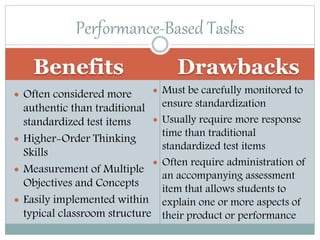
Performance-Based Tasks
Benefits
 Often considered more
authentic than traditional
standardized test items
 Higher-Order Thinking
Skills
 Measurement of Multiple
Objectives and Concepts
 Easily implemented within
typical classroom structure
Drawbacks
 Must be carefully monitored to
ensure standardization
 Usually require more response
time than traditional
standardized test items
 Often require administration of
an accompanying assessment
item that allows students to
explain one or more aspects of
their product or performance
Characteristics of Performance-Based Tasks
 call for the application of
knowledge and skills, not just
recall or recognition
are open-ended and typically
do not yield a single, correct
answer.
 establish novel and authentic
provide evidence of
understanding via transfer.
 are multi-faceted.
 can integrate two or more
subjects as well as 21st century
skills
 open-ended tasks are
Characteristics of Performance-Based Tasks
Types of performance
tasks
Restricted
Performance-
Based Tasks
 Extended
Performance-
Based Tasks
 Product
 Extended
Constructed
Response
 Performance
TYPES
performance tasks
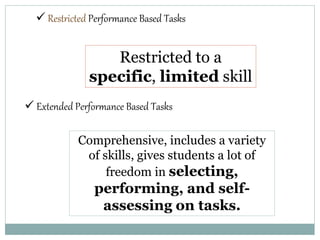
 Restricted Performance Based Tasks
Restricted to a
specific, limited skill
 Extended Performance Based Tasks
Comprehensive, includes a variety
of skills, gives students a lot of
freedom in selecting,
performing, and self-
assessing on tasks.
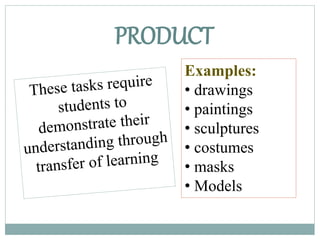
PRODUCT
Examples:
• drawings
• paintings
• sculptures
• costumes
• masks
• Models
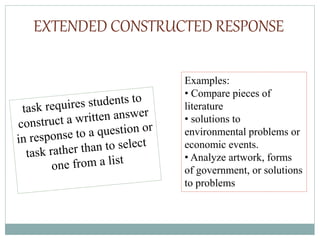
EXTENDED CONSTRUCTED RESPONSE
Examples:
• Compare pieces of
literature
• solutions to

environmental problems or
economic events.
• Analyze artwork, forms
of government, or solutions
to problems
PERFORMANCE
Examples:
• playing a musical
instrument
• carrying out the steps in a
scientific experiment
• speaking a foreign
language
• reading aloud with
fluency repairing an engine
• working productively in a
group.
Process in
Conducting
Performance
Based
Assessment
Brualdi, Amy (1998)
STEP 1:
Defining the
Purpose
A What concept, skill, or knowledge am I trying
got assess?
What should my students know?
At what level should mu students be
performing?
What type of knowledge is being assessed:
reasoning, memory or process?
Stiggins, 1994
STEP 2:
Choosing
the activity
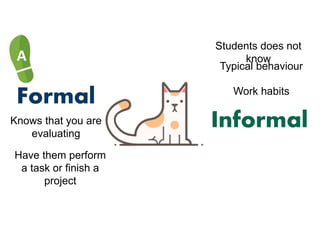
Formal
Informal
Students does not
know
Typical behaviour
A
Work habits
Knows that you are
evaluating
Have them perform
a task or finish a
project
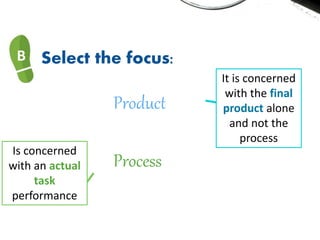
B Select the focus:
Process
Product
Is concerned
with an actual
task
performance
It is concerned
with the final
product alone
and not the
process
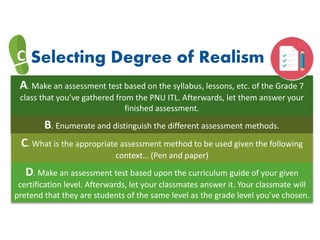
A. Make an assessment test based on the syllabus, lessons, etc. of the Grade 7
class that you’ve gathered from the PNU ITL. Afterwards, let them answer your
finished assessment.
C Selecting Degree of Realism
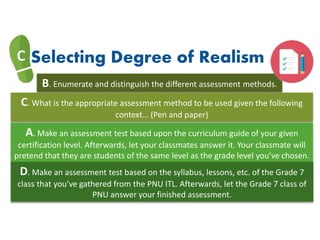
B. Enumerate and distinguish the different assessment methods.
C. What is the appropriate assessment method to be used given the following
context… (Pen and paper)
D. Make an assessment test based upon the curriculum guide of your given
certification level. Afterwards, let your classmates answer it. Your classmate will
pretend that they are students of the same level as the grade level you’ve chosen.
C Selecting Degree of Realism
B. Enumerate and distinguish the different assessment methods.
C. What is the appropriate assessment method to be used given the following
context… (Pen and paper)
A. Make an assessment test based upon the curriculum guide of your given
certification level. Afterwards, let your classmates answer it. Your classmate will
pretend that they are students of the same level as the grade level you’ve chosen.
D. Make an assessment test based on the syllabus, lessons, etc. of the Grade 7
class that you’ve gathered from the PNU ITL. Afterwards, let the Grade 7 class of
PNU answer your finished assessment.
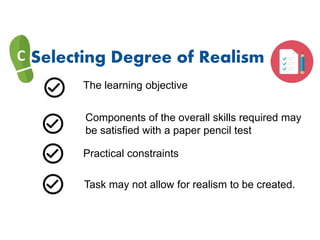
C Selecting Degree of Realism
The learning objective
Components of the overall skills required may
be satisfied with a paper pencil test
Practical constraints
Task may not allow for realism to be created.
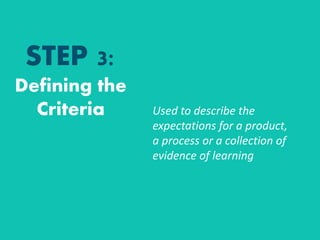
STEP 3:
Defining the
Criteria
STEP 3:
Defining the
Criteria Used to describe the
expectations for a product,
a process or a collection of
evidence of learning
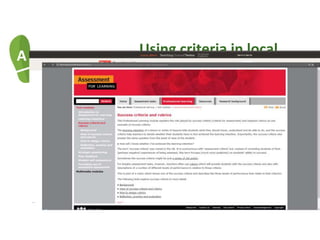
Using criteria in local
and state curriculums
A
B Develop own set of criteria
• Identify the overall performance or task to be
assessed and perform it yourself or imagine
yourself performing it.
• List the importance aspects of the performance or
product.
• Try to limit the number of performance criteria, so
they can all be observed during a pupil’s
performance.
• Express the performance criteria in terms of observable pupil behaviors or
product characteristics.
• Don’t us ambiguous words that cloud the meaning of the performance criteria.
• Arrange the performance criteria in the order in which they are likely to be
observed.
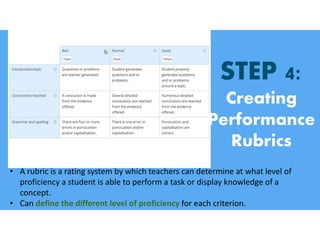
STEP 4:
Creating
Performance
Rubrics
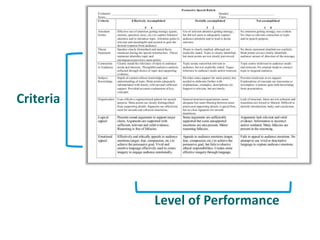
• A rubric is a rating system by which teachers can determine at what level of
proficiency a student is able to perform a task or display knowledge of a
concept.
• Can define the different level of proficiency for each criterion.
Criteria
Level of Performance
STEP 5:
Assessing the
Performance
• Checklist Approach
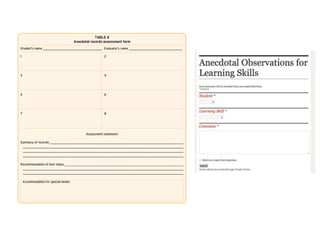
• Narrative/
Anecdotal Approach
• Rating Scale
Approach
• Memory Approach
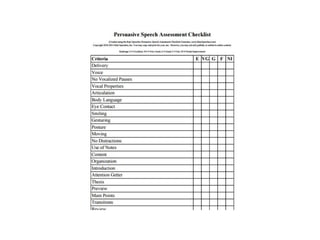
A Checklist Approach
When you use this, you only
have to indicate whether or
not certain elements are
present in the performances
B Narrative/ Anecdotal Record
When teachers use this, they will
write narrative reports of what was
done during each of the
performances. From these reports,
teachers can determine how well
their students met their standards
C Rating Scale Approach
When teachers use this, they indicate to what
degree the standards were met. Usually, teachers
will use a numerical scale. For instance, one teacher
may rate each criterion on a scale of one to five with
one meaning "skill barely present" and five meaning
"skill extremely well executed."
D Memory Approach
When teachers use this, they observe the students
performing the tasks without taking any notes. They
use the information from their memory to
determine whether or not the students were
successful.
GUIDELINES IN DEVELOPING
PERFORMANCE ASSESSMENT
1. What are the performance outcomes being
assessed?
2. What standards are aligned with these
performance outcomes?
3. How will you set the
context for the task and
engage students in
authentic and relevant
ways?
4. What materials/resources will
students encounter and use in this
performance assessment?
5. What specific question(s) and
directions will be in your prompt?
(What will your prompt say?)
6. What will students produce that will
give you evidence of their
performance?
7. What is your scoring system?
8. What scaffolding strategies or mini-
tasks will help students access and
complete the performance assessment?
9. How will you meet the needs of your
diverse students?
PROCEDURES IN
DEVELOPING
PERFORMANCE
ASSESSMENT
STEP 1. List the skills and
knowledge you wish to have
students learn as a result of
completing a task.
QUESTIONS TO CONSIDER
• What important cognitive skills or attributes do I want my
students to develop?
• What social and affective skills or attributes do I want my
students to develop?
• What metacognitive skills do I want my students to develop
• What types of problems do I want them to be able to solve?
• What concepts and principles do I want my students to be able
to apply?
• ]
STEP 2. Design a performance
task which requires the
students to demonstrate these
skills and knowledge.
QUESTIONS TO CONSIDER
• How much time will it take students to develop or acquire the skill or
accomplishment?
• How does the desired skill or accomplishment relate to other complex
cognitive, social, and affective skills?
• How does the desired skill or accomplishment relate to long-term school
and curricular goals?
• How does the desired skill relate to the school improvement plan?
• What is the intrinsic importance of the desired skills or accomplishment?
• Are the desired skills and accomplishments teachable and attainable for
your students?
STEP 3. Develop explicit
performance criteria which
measure the extent to which
students have mastered the
skills and knowledge.
EVERYTHING RUBRICS
Rainer John T. Rovillos-Escaño III-3 BEE SHS
JUDGE
RULES
DECISION
PERFORMANCE
DIDYOU KNOW?
The word rubric comes from
the Latin word for red.
진짜야?
DIDYOU KNOW?
The word rubric comes from
the Latin word for red.
멋지다!
WHAT IS RUBRIC?
A rubric is a coherent set of criteria
for students' work that includes
descriptions of levels of performance
quality on the criteria. (Brookhart, 2013)
WHAT IS ITS PURPOSE?
The main purpose of rubrics is to assess
performances. For some performances,
we observe the student in the process of
improving his language skills, like delivering a
persuasive speech or critiquing the latest
movie.
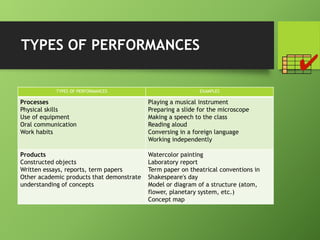
TYPES OF PERFORMANCES
TYPES OF PERFORMANCES EXAMPLES
Processes
Physical skills
Use of equipment
Oral communication
Work habits
Playing a musical instrument
Preparing a slide for the microscope
Making a speech to the class
Reading aloud
Conversing in a foreign language
Working independently
Products
Constructed objects
Written essays, reports, term papers
Other academic products that demonstrate
understanding of concepts
Watercolor painting
Laboratory report
Term paper on theatrical conventions in
Shakespeare's day
Model or diagram of a structure (atom,
flower, planetary system, etc.)
Concept map
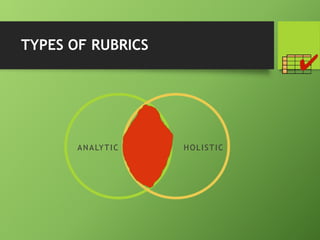
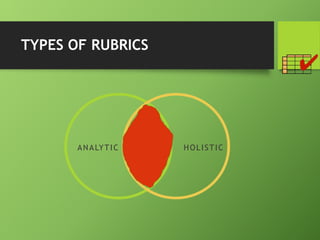
TYPES OF RUBRICS
ANALYTIC HOLISTIC
ANALYTIC RUBRIC
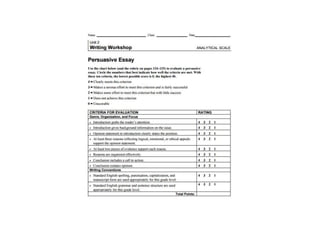
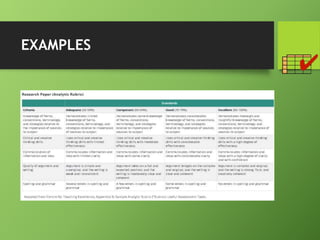
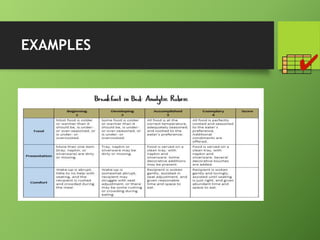
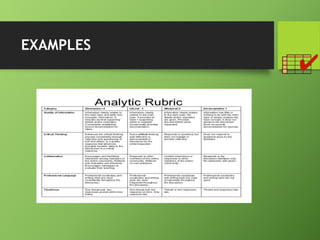
An analytic rubric resembles a grid with the criteria
for a student product listed in the leftmost column and
with levels of performance listed across the top
row often using numbers and/or descriptive tags. The
cells within the center of the rubric may be left blank or
may contain descriptions (called descriptors) of what the
specified criteria look like for each level of performance.
When scoring with an analytic rubric each of the criteria
is scored individually.(DePaul University, 2017)
EXAMPLES
EXAMPLES
EXAMPLES
ADVANTAGES & DISADVANTAGES
ADVANTAGES DISADVANTAGES
 Gives diagnostic information to
teacher.
 Gives formative feedback to
students.
 Easier to link to instruction than
holistic rubrics.
 Preferable for formative
assessment; adaptable for
summative assessment; if you need
an overall score for grading, you
can combine the scores.
 Provide useful feedback on areas of
strength and weakness.
 Criterion can be weighted to
reflect the relative importance of
each dimension.
 Takes more time to score than
holistic rubrics.
 Takes more time to achieve inter-
rater reliability than with holistic
rubrics.
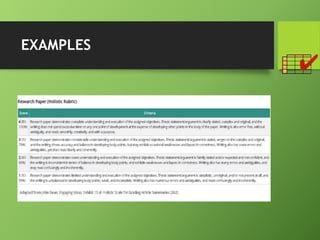
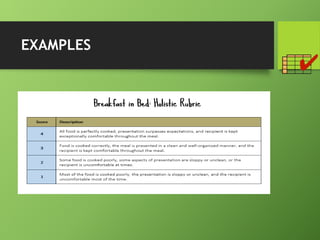
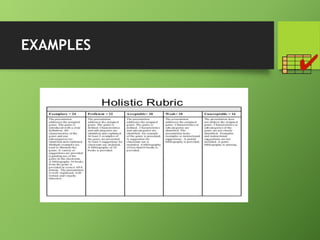
HOLISTIC RUBRIC
A holistic rubric consists of a single scale with all
criteria to be included in the evaluation being
considered together (e.g., clarity, organization, and
mechanics). With a holistic rubric the rater assigns a
single score (usually on a 1 to 4 or 1 to 6 point scale)
based on an overall judgment of the student work. The
rater matches an entire piece of student work to a single
description on the scale.
(DePaul University, 2017)
EXAMPLES
EXAMPLES
EXAMPLES
ADVANTAGES & DISADVANTAGES
ADVANTAGES DISADVANTAGES
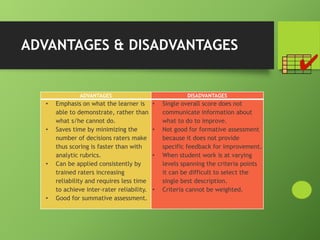
• Emphasis on what the learner is
able to demonstrate, rather than
what s/he cannot do.
• Saves time by minimizing the
number of decisions raters make
thus scoring is faster than with
analytic rubrics.
• Can be applied consistently by
trained raters increasing
reliability and requires less time
to achieve inter-rater reliability.
• Good for summative assessment.
• Single overall score does not
communicate information about
what to do to improve.
• Not good for formative assessment
because it does not provide
specific feedback for improvement.
• When student work is at varying
levels spanning the criteria points
it can be difficult to select the
single best description.
• Criteria cannot be weighted.
TYPES OF RUBRICS
ANALYTIC HOLISTIC
ANAHOLISTIC RUBRIC
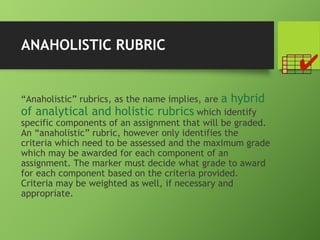
“Anaholistic” rubrics, as the name implies, are a hybrid
of analytical and holistic rubrics which identify
specific components of an assignment that will be graded.
An “anaholistic” rubric, however only identifies the
criteria which need to be assessed and the maximum grade
which may be awarded for each component of an
assignment. The marker must decide what grade to award
for each component based on the criteria provided.
Criteria may be weighted as well, if necessary and
appropriate.
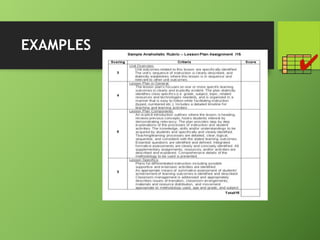
EXAMPLES
WHY IS IT IMPORTANT?
Rubrics are important because they clarify for
students the qualities their work should
have. This point is often expressed in terms of
students understanding the learning target and
criteria for success. For this reason, rubrics help
teachers teach, they help coordinate instruction
and assessment, and they help students learn.
REFERENCES
• Brookhart, S.M. (2013). How to Create and Use Rubrics for
Formative Assessment and Grading. Accessed March 2, 2017 at
http://www.ascd.org/publications/books/112001/chapters/What-
Are-Rubrics-and-Why-Are-They-Important%C2%A2.aspx
• DePaul University. (2001-2017). Types of Rubrics. Accessed March
2, 2017 at http://resources.depaul.edu/teaching-
commons/teaching-guides/feedback-grading/rubrics/Pages/types-
of-rubrics.aspx
• Queens University. (2017). Examples of Innovative Assessments.
Accessed March 2, 2017 at
http://www.queensu.ca/teachingandlearning/modules/assessmen
ts/35_s4_05_types_of_rubrics.html
• https://www.edutopia.org/blog/performance-based-assessment-
reviewing-basics-patricia-hilliard
• https://blog.performancetask.com/what-is-a-performance-task-
part-1-9fa0d99ead3b#.9nszx5f2r
• http://www.projectappleseed.org/assessment
• http://webcache.googleusercontent.com/search?q=cache:http://c
ms.education.gov.il/NR/rdonlyres/B8B6C46B-36AA-497A-
9FE7-4F34D8E7FE2A/30971/epages1227.doc

Performance-based Assessment

  • 1.
  • 2.
  • 3.
    Performance-based assessment measures students' abilityto apply the skills and knowledge learned from a unit or units of study.
  • 4.
    The Office ofTechnology Assessment of the U.S. Congress described performance assessment as testing that requires a student to create an answer or a product that demonstrates his or her knowledge or skills.
  • 5.
    Group projects enablinga number of students to work together on a complex problem that requires planning, research, internal discussion, and group presentation.
  • 6.
  • 7.
    Essays assessing students' understandingof a subject through a written description, analysis, explanation, or summary.
  • 8.
  • 9.
    Experiments testing how wellstudents understand scientific concepts and can carry out scientific processes.
  • 10.
  • 11.
    Demonstrations giving students opportunities to showtheir mastery of subject-area content and procedures.
  • 12.
  • 13.
    Portfolios allowing students toprovide a broad portrait of their performance through files that contain collections of students' work, assembled over time.
  • 14.
    What are the essential characteristicsof a performance -based assessment?
  • 15.
    • Complex • Authentic •Process/ product-oriented • Open-ended • Time-bound
  • 16.
    What are the purposes ofa performanc e-based assessment
  • 17.
    • track learners’work on a task • show them the value of their work processes • help them self-monitor so that they can use tools such as periodic reflections, working files and learning logs more effectively
  • 18.
     Definition OfPerformance Task  Benefits/Drawbacks  Characteristics  TYPES  Product  Extended Constructed Response  Performance TYPES OF PERFORMANCE- BASED TASK
  • 19.
    are tasks thatask students to create products or perform tasks to show their mastery of particular skills. Performance tasks
  • 20.
    Performance-Based Tasks Benefits  Oftenconsidered more authentic than traditional standardized test items  Higher-Order Thinking Skills  Measurement of Multiple Objectives and Concepts  Easily implemented within typical classroom structure Drawbacks  Must be carefully monitored to ensure standardization  Usually require more response time than traditional standardized test items  Often require administration of an accompanying assessment item that allows students to explain one or more aspects of their product or performance
  • 21.
    Characteristics of Performance-BasedTasks  call for the application of knowledge and skills, not just recall or recognition are open-ended and typically do not yield a single, correct answer.  establish novel and authentic
  • 22.
    provide evidence of understandingvia transfer.  are multi-faceted.  can integrate two or more subjects as well as 21st century skills  open-ended tasks are Characteristics of Performance-Based Tasks
  • 23.
  • 24.
    Restricted Performance- Based Tasks  Extended Performance- BasedTasks  Product  Extended Constructed Response  Performance TYPES performance tasks
  • 25.
     Restricted PerformanceBased Tasks Restricted to a specific, limited skill  Extended Performance Based Tasks Comprehensive, includes a variety of skills, gives students a lot of freedom in selecting, performing, and self- assessing on tasks.
  • 26.
    PRODUCT Examples: • drawings • paintings •sculptures • costumes • masks • Models
  • 27.
    EXTENDED CONSTRUCTED RESPONSE Examples: •Compare pieces of literature • solutions to environmental problems or economic events. • Analyze artwork, forms of government, or solutions to problems
  • 28.
    PERFORMANCE Examples: • playing amusical instrument • carrying out the steps in a scientific experiment • speaking a foreign language • reading aloud with fluency repairing an engine • working productively in a group.
  • 29.
  • 30.
  • 31.
    A What concept,skill, or knowledge am I trying got assess? What should my students know? At what level should mu students be performing? What type of knowledge is being assessed: reasoning, memory or process? Stiggins, 1994
  • 32.
  • 33.
    Formal Informal Students does not know Typicalbehaviour A Work habits Knows that you are evaluating Have them perform a task or finish a project
  • 34.
    B Select thefocus: Process Product Is concerned with an actual task performance It is concerned with the final product alone and not the process
  • 35.
    A. Make anassessment test based on the syllabus, lessons, etc. of the Grade 7 class that you’ve gathered from the PNU ITL. Afterwards, let them answer your finished assessment. C Selecting Degree of Realism B. Enumerate and distinguish the different assessment methods. C. What is the appropriate assessment method to be used given the following context… (Pen and paper) D. Make an assessment test based upon the curriculum guide of your given certification level. Afterwards, let your classmates answer it. Your classmate will pretend that they are students of the same level as the grade level you’ve chosen.
  • 36.
    C Selecting Degreeof Realism B. Enumerate and distinguish the different assessment methods. C. What is the appropriate assessment method to be used given the following context… (Pen and paper) A. Make an assessment test based upon the curriculum guide of your given certification level. Afterwards, let your classmates answer it. Your classmate will pretend that they are students of the same level as the grade level you’ve chosen. D. Make an assessment test based on the syllabus, lessons, etc. of the Grade 7 class that you’ve gathered from the PNU ITL. Afterwards, let the Grade 7 class of PNU answer your finished assessment.
  • 37.
    C Selecting Degreeof Realism The learning objective Components of the overall skills required may be satisfied with a paper pencil test Practical constraints Task may not allow for realism to be created.
  • 38.
  • 39.
    STEP 3: Defining the CriteriaUsed to describe the expectations for a product, a process or a collection of evidence of learning
  • 40.
    Using criteria inlocal and state curriculums A
  • 41.
    B Develop ownset of criteria • Identify the overall performance or task to be assessed and perform it yourself or imagine yourself performing it. • List the importance aspects of the performance or product. • Try to limit the number of performance criteria, so they can all be observed during a pupil’s performance. • Express the performance criteria in terms of observable pupil behaviors or product characteristics. • Don’t us ambiguous words that cloud the meaning of the performance criteria. • Arrange the performance criteria in the order in which they are likely to be observed.
  • 42.
    STEP 4: Creating Performance Rubrics • Arubric is a rating system by which teachers can determine at what level of proficiency a student is able to perform a task or display knowledge of a concept. • Can define the different level of proficiency for each criterion.
  • 43.
  • 44.
    STEP 5: Assessing the Performance •Checklist Approach • Narrative/ Anecdotal Approach • Rating Scale Approach • Memory Approach
  • 45.
    A Checklist Approach Whenyou use this, you only have to indicate whether or not certain elements are present in the performances
  • 47.
    B Narrative/ AnecdotalRecord When teachers use this, they will write narrative reports of what was done during each of the performances. From these reports, teachers can determine how well their students met their standards
  • 49.
    C Rating ScaleApproach When teachers use this, they indicate to what degree the standards were met. Usually, teachers will use a numerical scale. For instance, one teacher may rate each criterion on a scale of one to five with one meaning "skill barely present" and five meaning "skill extremely well executed."
  • 51.
    D Memory Approach Whenteachers use this, they observe the students performing the tasks without taking any notes. They use the information from their memory to determine whether or not the students were successful.
  • 54.
    GUIDELINES IN DEVELOPING PERFORMANCEASSESSMENT 1. What are the performance outcomes being assessed? 2. What standards are aligned with these performance outcomes?
  • 55.
    3. How willyou set the context for the task and engage students in authentic and relevant ways?
  • 56.
    4. What materials/resourceswill students encounter and use in this performance assessment? 5. What specific question(s) and directions will be in your prompt? (What will your prompt say?) 6. What will students produce that will give you evidence of their performance?
  • 57.
    7. What isyour scoring system? 8. What scaffolding strategies or mini- tasks will help students access and complete the performance assessment? 9. How will you meet the needs of your diverse students?
  • 58.
  • 59.
    STEP 1. Listthe skills and knowledge you wish to have students learn as a result of completing a task.
  • 60.
    QUESTIONS TO CONSIDER •What important cognitive skills or attributes do I want my students to develop? • What social and affective skills or attributes do I want my students to develop? • What metacognitive skills do I want my students to develop • What types of problems do I want them to be able to solve? • What concepts and principles do I want my students to be able to apply? • ]
  • 61.
    STEP 2. Designa performance task which requires the students to demonstrate these skills and knowledge.
  • 62.
    QUESTIONS TO CONSIDER •How much time will it take students to develop or acquire the skill or accomplishment? • How does the desired skill or accomplishment relate to other complex cognitive, social, and affective skills? • How does the desired skill or accomplishment relate to long-term school and curricular goals? • How does the desired skill relate to the school improvement plan? • What is the intrinsic importance of the desired skills or accomplishment? • Are the desired skills and accomplishments teachable and attainable for your students?
  • 63.
    STEP 3. Developexplicit performance criteria which measure the extent to which students have mastered the skills and knowledge.
  • 64.
    EVERYTHING RUBRICS Rainer JohnT. Rovillos-Escaño III-3 BEE SHS
  • 65.
  • 66.
  • 67.
  • 68.
  • 69.
    DIDYOU KNOW? The wordrubric comes from the Latin word for red. 진짜야?
  • 70.
    DIDYOU KNOW? The wordrubric comes from the Latin word for red. 멋지다!
  • 71.
    WHAT IS RUBRIC? Arubric is a coherent set of criteria for students' work that includes descriptions of levels of performance quality on the criteria. (Brookhart, 2013)
  • 72.
    WHAT IS ITSPURPOSE? The main purpose of rubrics is to assess performances. For some performances, we observe the student in the process of improving his language skills, like delivering a persuasive speech or critiquing the latest movie.
  • 73.
    TYPES OF PERFORMANCES TYPESOF PERFORMANCES EXAMPLES Processes Physical skills Use of equipment Oral communication Work habits Playing a musical instrument Preparing a slide for the microscope Making a speech to the class Reading aloud Conversing in a foreign language Working independently Products Constructed objects Written essays, reports, term papers Other academic products that demonstrate understanding of concepts Watercolor painting Laboratory report Term paper on theatrical conventions in Shakespeare's day Model or diagram of a structure (atom, flower, planetary system, etc.) Concept map
  • 74.
  • 75.
    ANALYTIC RUBRIC An analyticrubric resembles a grid with the criteria for a student product listed in the leftmost column and with levels of performance listed across the top row often using numbers and/or descriptive tags. The cells within the center of the rubric may be left blank or may contain descriptions (called descriptors) of what the specified criteria look like for each level of performance. When scoring with an analytic rubric each of the criteria is scored individually.(DePaul University, 2017)
  • 76.
  • 77.
  • 78.
  • 79.
    ADVANTAGES & DISADVANTAGES ADVANTAGESDISADVANTAGES  Gives diagnostic information to teacher.  Gives formative feedback to students.  Easier to link to instruction than holistic rubrics.  Preferable for formative assessment; adaptable for summative assessment; if you need an overall score for grading, you can combine the scores.  Provide useful feedback on areas of strength and weakness.  Criterion can be weighted to reflect the relative importance of each dimension.  Takes more time to score than holistic rubrics.  Takes more time to achieve inter- rater reliability than with holistic rubrics.
  • 80.
    HOLISTIC RUBRIC A holisticrubric consists of a single scale with all criteria to be included in the evaluation being considered together (e.g., clarity, organization, and mechanics). With a holistic rubric the rater assigns a single score (usually on a 1 to 4 or 1 to 6 point scale) based on an overall judgment of the student work. The rater matches an entire piece of student work to a single description on the scale. (DePaul University, 2017)
  • 81.
  • 82.
  • 83.
  • 84.
    ADVANTAGES & DISADVANTAGES ADVANTAGESDISADVANTAGES • Emphasis on what the learner is able to demonstrate, rather than what s/he cannot do. • Saves time by minimizing the number of decisions raters make thus scoring is faster than with analytic rubrics. • Can be applied consistently by trained raters increasing reliability and requires less time to achieve inter-rater reliability. • Good for summative assessment. • Single overall score does not communicate information about what to do to improve. • Not good for formative assessment because it does not provide specific feedback for improvement. • When student work is at varying levels spanning the criteria points it can be difficult to select the single best description. • Criteria cannot be weighted.
  • 85.
  • 86.
    ANAHOLISTIC RUBRIC “Anaholistic” rubrics,as the name implies, are a hybrid of analytical and holistic rubrics which identify specific components of an assignment that will be graded. An “anaholistic” rubric, however only identifies the criteria which need to be assessed and the maximum grade which may be awarded for each component of an assignment. The marker must decide what grade to award for each component based on the criteria provided. Criteria may be weighted as well, if necessary and appropriate.
  • 87.
  • 88.
    WHY IS ITIMPORTANT? Rubrics are important because they clarify for students the qualities their work should have. This point is often expressed in terms of students understanding the learning target and criteria for success. For this reason, rubrics help teachers teach, they help coordinate instruction and assessment, and they help students learn.
  • 89.
    REFERENCES • Brookhart, S.M.(2013). How to Create and Use Rubrics for Formative Assessment and Grading. Accessed March 2, 2017 at http://www.ascd.org/publications/books/112001/chapters/What- Are-Rubrics-and-Why-Are-They-Important%C2%A2.aspx • DePaul University. (2001-2017). Types of Rubrics. Accessed March 2, 2017 at http://resources.depaul.edu/teaching- commons/teaching-guides/feedback-grading/rubrics/Pages/types- of-rubrics.aspx • Queens University. (2017). Examples of Innovative Assessments. Accessed March 2, 2017 at http://www.queensu.ca/teachingandlearning/modules/assessmen ts/35_s4_05_types_of_rubrics.html
  • 90.
    • https://www.edutopia.org/blog/performance-based-assessment- reviewing-basics-patricia-hilliard • https://blog.performancetask.com/what-is-a-performance-task- part-1-9fa0d99ead3b#.9nszx5f2r •http://www.projectappleseed.org/assessment • http://webcache.googleusercontent.com/search?q=cache:http://c ms.education.gov.il/NR/rdonlyres/B8B6C46B-36AA-497A- 9FE7-4F34D8E7FE2A/30971/epages1227.doc

Editor's Notes

  • #70 The online Merriam-Webster dictionary lists the first meaning of rubric as "an authoritative rule" and the fourth meaning as "a guide listing specific criteria for grading or scoring academic papers, projects, or tests." How did the name for a color come to mean a rule or guide? At least as far back as the Middle Ages, the rules for the conduct of liturgical services—as opposed to the actual spoken words of the liturgy—were often printed in red, so the rules were "the red things" on the page.
  • #71 The online Merriam-Webster dictionary lists the first meaning of rubric as "an authoritative rule" and the fourth meaning as "a guide listing specific criteria for grading or scoring academic papers, projects, or tests." How did the name for a color come to mean a rule or guide? At least as far back as the Middle Ages, the rules for the conduct of liturgical services—as opposed to the actual spoken words of the liturgy—were often printed in red, so the rules were "the red things" on the page.
  • #72 The genius of rubrics is that they are descriptive and not evaluative. Of course, rubrics can be used to evaluate but the operating principle is we match the performance to the description rather than "judge" it. Thus rubrics are as good or bad as the criteria selected and the descriptions of the levels of performance under each. Effective rubrics have appropriate criteria and well-written descriptions of performance.