Assessment in an
Outcomes-based Education
Carlo Magno, PhD.
Correspondence: crlmgn@yahoo.com
Objectives
Construct a one session
plan showing outcomes
with appropriate
assessment and delivery
mode.
Case A
Cherry is a staff in Mall X. Her work is to get the
products in the stock room as requested by the sales
lady. Cherry has been working in Mall X for two
months right after her graduation. Cherry finished a
course in nursing and she is expected to assist
doctors and care for patients . One time the HR
called her and asked her to clean the wound of
another employee and put some bandage. She
asked for an alcohol and an automizer spray. She
placed the alcohol inside the automizer and started
spraying on the open wound. The employee started
to cry because the terrible pain. She shouted at the
patient “stop crying like a baby! This will hurt more if
you don’t stop!”
Case B
Cheryl conducted a graduate tracer study to
determine if the nursing program of the school is
adequate. She found in the survey that:
100% of the graduates were employed as nurses in
different sectors.
100% of the graduates were able to get a job in two
months.
100% of the graduates passed the licensure exam for
nursing.
60% of the faculty are receiving a salary of less than
Php15,000
80% of them working as a nurses were rated satisfactory
in their hospital performance by the hospital
administrators.
Outcomes-based Education
Clearly focusing and organizing everything in an
educational system around what is essential for all
students to be able to do successfully at the end of
their learning experiences.
This means starting with a clear picture of what is
important for students to be able to do, then
organizing the curriculum, instruction and
assessment to make sure this learning ultimately
happens (Spady, 1994).
Outcomes-based Education
In the process of designing program curriculum, the
outcomes of the learning is emphasized and pre-
determined
What is expected from the learning after the students
have graduated in order to equip them with the
necessary skills and capabilities before they enter the
work place
Then go backward with:
curriculum design
programme outcomes and course outcomes,
development of instructions
delivery modes
appropriate assessments methodologies
Outcomes-based Education
looking at the level at which the inputs, methods, and
execution produce the desired learning
competencies for the graduates of that program as
determined by the Technical Committees/Technical
Panels and as measured by appropriate
assessments.
It points to the way in which the level of attainment of
the outcomes can be progressively heightened.
Outcomes-based Education
Assessing student growth and competency in
relation to these outcomes
Detailing how outcomes based learning at a whole
program level functions within a complex university
context
What needs to be set?
Mission and Vision are translated into:
indicators (e.g., professional qualification or
employability)
metrics (e.g., percentage of passing in a licensure
exam or percentage of employment)
targets (e.g., 70% passing or 85% employed).
Outcomes-based Education
Outcomes – what learners are expected to know and be
able to do at the desired level of competence
Outcomes-based evaluation – clearly focusing and
organizing everything in an educational system around
what is essential for all students to be able to do
successfully at the end of the learning experiences.
Outcomes-based teaching and learning – constructive
alignment of intended, learning outcomes with
appropriate outcomes-based assessment methods and
teaching and learning activities. OBE applied in the
classroom level.
Performance criteria – specific, measureable
statements identifying the performance(s) required to
meet the outcome; conformed through evidence.
Outcomes-based Education
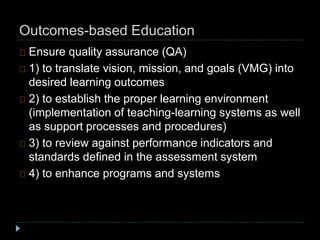
Ensure quality assurance (QA)
1) to translate vision, mission, and goals (VMG) into
desired learning outcomes
2) to establish the proper learning environment
(implementation of teaching-learning systems as well
as support processes and procedures)
3) to review against performance indicators and
standards defined in the assessment system
4) to enhance programs and systems
Approaches on OBE
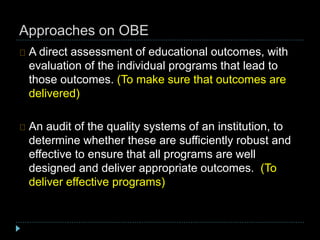
A direct assessment of educational outcomes, with
evaluation of the individual programs that lead to
those outcomes. (To make sure that outcomes are
delivered)
An audit of the quality systems of an institution, to
determine whether these are sufficiently robust and
effective to ensure that all programs are well
designed and deliver appropriate outcomes. (To
deliver effective programs)
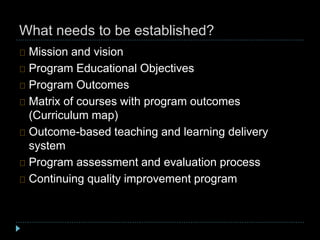
What needs to be established?
Mission and vision
Program Educational Objectives
Program Outcomes
Matrix of courses with program outcomes
(Curriculum map)
Outcome-based teaching and learning delivery
system
Program assessment and evaluation process
Continuing quality improvement program
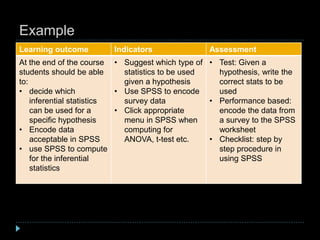
Example
Learning outcome Indicators Assessment
At the end of the course
students should be able
to:
• decide which
inferential statistics
can be used for a
specific hypothesis
• Encode data
acceptable in SPSS
• use SPSS to compute
for the inferential
statistics
• Suggest which type of
statistics to be used
given a hypothesis
• Use SPSS to encode
survey data
• Click appropriate
menu in SPSS when
computing for
ANOVA, t-test etc.
• Test: Given a
hypothesis, write the
correct stats to be
used
• Performance based:
encode the data from
a survey to the SPSS
worksheet
• Checklist: step by
step procedure in
using SPSS
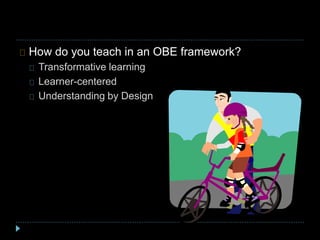
How do you teach in an OBE framework?
Transformative learning
Learner-centered
Understanding by Design
Case presentation
A group of nursing students at the start of the term thinks
that doing research is going to the library and compiling
information about a topic from different books. The
teacher knew about it by asking the students at the start
of the class what research is. The teacher started to
show examples of journal articles and how research is
conducted. The different methodologies and the use of
research was assigned. Then the students conducted
their own research using a nonexperimental design.
Towards the end of the term when the teacher asked
again what is research, students see it as a process of
arriving at new knowledge and supporting the ideas
through data (evidence).
Assessment
What is the function of assessment?
How do you help students learn better through
assessment?
Types of Assessment
Selected Response
Binary Choices
Multiple Choice
Matching Type
Constructed Response “Supply Test”
Short Form answers - identification
Completion – fill in the blanks, cloze test
Essay
Alternative Forms
Performance-based
Authentic-based
Portfolio Assessment
Features of performance assessment
Intended to assess what it is that students know and can
do with the emphasis on doing.
Have a high degree of realism about them (authentic).
Involve: (a) activities for which there is no single correct
answer, (b) assessing groups rather than individuals, (c)
testing that would continue over an extended period of
time, (d) self-evaluation of performances.
Likely use open-ended tasks aimed at assessing higher
level cognitive skills.
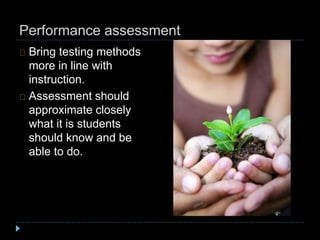
Performance assessment
Bring testing methods
more in line with
instruction.
Assessment should
approximate closely
what it is students
should know and be
able to do.
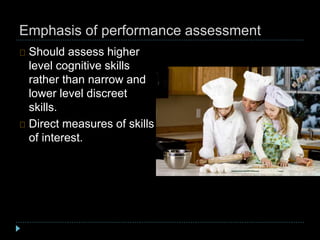
Emphasis of performance assessment
Should assess higher
level cognitive skills
rather than narrow and
lower level discreet
skills.
Direct measures of skills
of interest.
Characteristics of performance-based
assessment
Students perform, create, construct, produce, or do
something.
Deep understanding and/or reasoning skills are
needed and assessed.
Involves sustained work, [often days and weeks].
Calls on students to explain, justify, and defend.
Performance is directly observable.
Involves engaging in ideas of importance and
substance.
Relies on trained assessor’s judgments for scoring
Multiple criteria and standards are prespecified and
public
There is no single correct answer.
If authentic, the performance is grounded in real world
Learning Targets
Skills
Communication and presentation skills
Ex: Speaking
1. Speaking clearly, expressively, and audibly
a. Using voice expressively
b. Speaking articulately and pronouncing words correctly
c. Using appropriate vocal volume
2. Presenting ideas with appropriate introduction,
development, and conclusion
1. Presenting ideas in an effective order
2. Providing a clear focus on the central idea
3. Providing signal words, internal summaries, and transitions
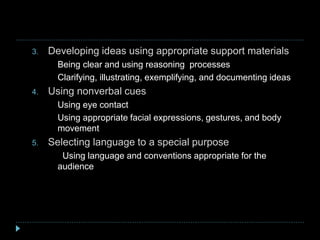
3. Developing ideas using appropriate support materials
a) Being clear and using reasoning processes
b) Clarifying, illustrating, exemplifying, and documenting ideas
4. Using nonverbal cues
a. Using eye contact
b. Using appropriate facial expressions, gestures, and body
movement
5. Selecting language to a special purpose
a. Using language and conventions appropriate for the
audience
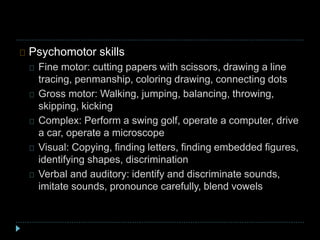
Psychomotor skills
Fine motor: cutting papers with scissors, drawing a line
tracing, penmanship, coloring drawing, connecting dots
Gross motor: Walking, jumping, balancing, throwing,
skipping, kicking
Complex: Perform a swing golf, operate a computer, drive
a car, operate a microscope
Visual: Copying, finding letters, finding embedded figures,
identifying shapes, discrimination
Verbal and auditory: identify and discriminate sounds,
imitate sounds, pronounce carefully, blend vowels
Products
Write promotional materials
Report on a foreign country
Playing a new song
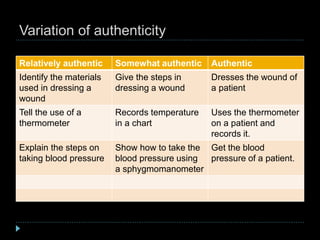
Variation of authenticity
Relatively authentic Somewhat authentic Authentic
Identify the materials
used in dressing a
wound
Give the steps in
dressing a wound
Dresses the wound of
a patient
Tell the use of a
thermometer
Records temperature
in a chart
Uses the thermometer
on a patient and
records it.
Explain the steps on
taking blood pressure
Show how to take the
blood pressure using
a sphygmomanometer
Get the blood
pressure of a patient.
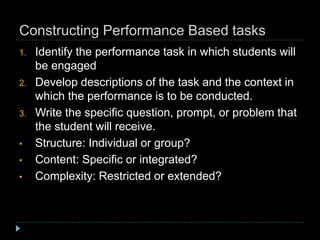
Constructing Performance Based tasks
1. Identify the performance task in which students will
be engaged
2. Develop descriptions of the task and the context in
which the performance is to be conducted.
3. Write the specific question, prompt, or problem that
the student will receive.
• Structure: Individual or group?
• Content: Specific or integrated?
• Complexity: Restricted or extended?
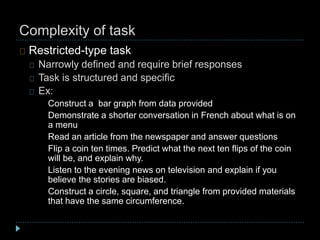
Complexity of task
Restricted-type task
Narrowly defined and require brief responses
Task is structured and specific
Ex:
Construct a bar graph from data provided
Demonstrate a shorter conversation in French about what is on
a menu
Read an article from the newspaper and answer questions
Flip a coin ten times. Predict what the next ten flips of the coin
will be, and explain why.
Listen to the evening news on television and explain if you
believe the stories are biased.
Construct a circle, square, and triangle from provided materials
that have the same circumference.
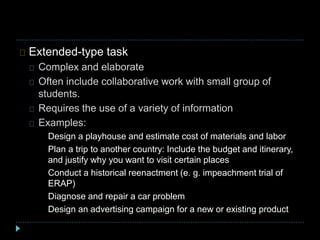
Extended-type task
Complex and elaborate
Often include collaborative work with small group of
students.
Requires the use of a variety of information
Examples:
Design a playhouse and estimate cost of materials and labor
Plan a trip to another country: Include the budget and itinerary,
and justify why you want to visit certain places
Conduct a historical reenactment (e. g. impeachment trial of
ERAP)
Diagnose and repair a car problem
Design an advertising campaign for a new or existing product
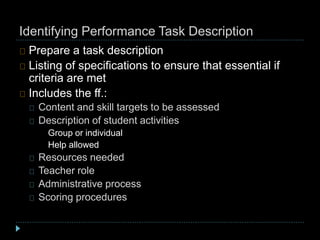
Identifying Performance Task Description
Prepare a task description
Listing of specifications to ensure that essential if
criteria are met
Includes the ff.:
Content and skill targets to be assessed
Description of student activities
Group or individual
Help allowed
Resources needed
Teacher role
Administrative process
Scoring procedures
Performance-based Task Question Prompt
Task prompts and questions will be based on the
task descriptions.
Clearly identifies the outcomes, outlines what the
students are encourage dot do, explains criteria for
judgment.
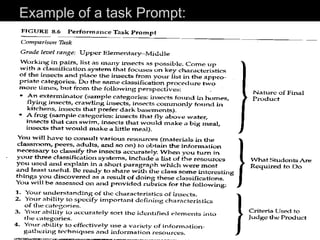
Example of a task Prompt:
Characteristics of Tasks
1. Should integrate the most essential aspects of the
content being assessed with the most essential
skills.
2. Should be authentic
Realistic
Require judgment and innovation
Ask the student to do the subject
Replicates or stimulates
Assess the students ability to efficiently and effectively
use a repertoire of knowledge and skill to negotiate a
complex task
Allows opportunities to rehearse, practice, consult
resources, and get feedback and refine performances
and products.
3. Structure the task to assess multiple learning
targets
4. Structure the task so that you can help students
succeed.
5. Think through what students will do to be sure that
the task is feasible
6. The task should allow for multiple solutions
7. The task should be clear
8. The task should be challenging and stimulating to
students
9. Include explicitly stated scoring criteria as part of
the task
10. Include constraints in completing the task
Performance Criteria
What you look for in student responses to evaluate
their progress toward meeting the learning target.
Dimensions of traits in performance that are used to
illustrate understanding, reasoning, and proficiency.
Start with identifying the most important dimensions
of the performance
What distinguishes an adequate to an inadequate
demonstration of the target?
Questions to ask:
What are the attributes of good writing, or good
scientific thinking, or good collaborative group
process, of effective oral presentation? More
generally, by what qualities or features will I know
whether students have produced an excellent
response to my assessment task?
What do I expect to see if this task is done
excellently, acceptably, or poorly?
Questions to ask:
Do I have samples or models of student work, from
my class or other sources, that exemplify some of
the criteria I might use in judging this task?
What criteria for this or similar task exist in my
national curriculum framework, my state assessment
program, my district curriculum guides, my school
assessment program?
What dimensions might I adapt from work done by
natural curriculum councils, by other teachers?
Example of Criteria
Learning target:
Students will be able to write a persuasive paper to
encourage the reader to accept a specific course of action
or point of view.
Criteria:
Appropriateness of language for the audience
Plausibility and relevance of supporting arguments.
Level of detail presented
Evidence of creative, innovative thinking
Clarity of expression
Organization of ideas
Rating Scales
Indicate the degree to which a particular dimension
is present.
Three kinds: Numerical, qualitative, combined
qualitative/quantitative
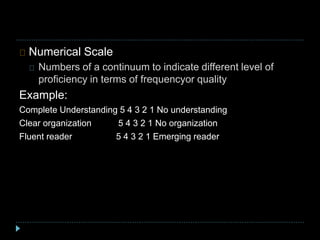
Numerical Scale
Numbers of a continuum to indicate different level of
proficiency in terms of frequencyor quality
Example:
Complete Understanding 5 4 3 2 1 No understanding
Clear organization 5 4 3 2 1 No organization
Fluent reader 5 4 3 2 1 Emerging reader
Qualitative scale
Uses verbal descriptions to indicate student performance.
Provides a way to check the whether each dimension was
evidenced.
Type A: Indicate different gradations of the dimension
Type B: Checklist
Example of Type A:
Minimal, partial, complete
Never, seldom, occasionally, frequently, always
Consistent, sporadically, rarely
None, some, complete
Novice, intermediate, advance, superior
Inadequate, needs improvement, good excellent
Excellent, proficient, needs improvement
Absent, developing, adequate, fully developed
Limited, partial, thorough
Emerging, developing, achieving
Not there yet, shows growth, proficient
Excellent, good, fair, poor
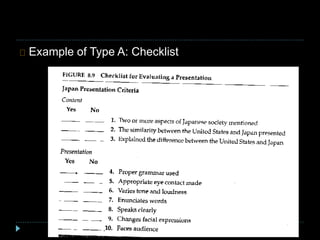
Example of Type A: Checklist
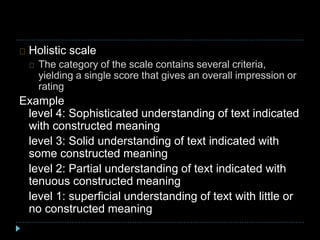
Holistic scale
The category of the scale contains several criteria,
yielding a single score that gives an overall impression or
rating
Example
level 4: Sophisticated understanding of text indicated
with constructed meaning
level 3: Solid understanding of text indicated with
some constructed meaning
level 2: Partial understanding of text indicated with
tenuous constructed meaning
level 1: superficial understanding of text with little or
no constructed meaning
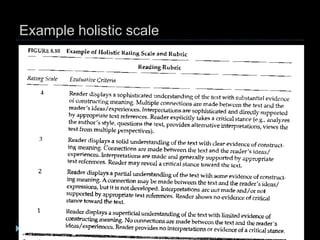
Example holistic scale
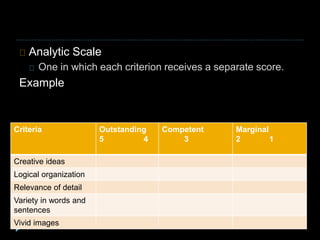
Analytic Scale
One in which each criterion receives a separate score.
Example
Criteria Outstanding
5 4
Competent
3
Marginal
2 1
Creative ideas
Logical organization
Relevance of detail
Variety in words and
sentences
Vivid images
Rubrics
When scoring criteria are combined with a rating
scale, a complete scoring guideline is produced or
rubric.
A scoring guide that uses criteria to differentiate
between levels of student proficiency.
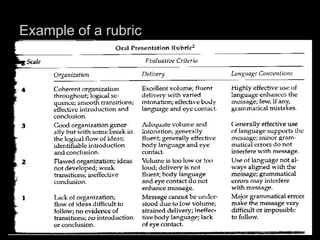
Example of a rubric
Rubrics should answer the following questions:
By what criteria should performance be judged?
Where should we look and what should we look for to
judge performance success?
What does the range in the performance quality look like?
How do we determine validity, reliability, and fairly what
scores should be given and what that score means?
How should the different levels of quality be described
and distinguished from one another?
Workshop
Create a one session plan that will run for one
session.
Indicate one learning outcomes (performance-
based)
Provide the indicators
How will you assess the outcomes?
Provide the following: Nature of the final
product, what students are required to do,
instrument (rubric/checklist)

Assessment in an Outcomes-Based Education

  • 1.
    Assessment in an Outcomes-basedEducation Carlo Magno, PhD. Correspondence: crlmgn@yahoo.com
  • 2.
    Objectives Construct a onesession plan showing outcomes with appropriate assessment and delivery mode.
  • 3.
    Case A Cherry isa staff in Mall X. Her work is to get the products in the stock room as requested by the sales lady. Cherry has been working in Mall X for two months right after her graduation. Cherry finished a course in nursing and she is expected to assist doctors and care for patients . One time the HR called her and asked her to clean the wound of another employee and put some bandage. She asked for an alcohol and an automizer spray. She placed the alcohol inside the automizer and started spraying on the open wound. The employee started to cry because the terrible pain. She shouted at the patient “stop crying like a baby! This will hurt more if you don’t stop!”
  • 4.
    Case B Cheryl conducteda graduate tracer study to determine if the nursing program of the school is adequate. She found in the survey that: 100% of the graduates were employed as nurses in different sectors. 100% of the graduates were able to get a job in two months. 100% of the graduates passed the licensure exam for nursing. 60% of the faculty are receiving a salary of less than Php15,000 80% of them working as a nurses were rated satisfactory in their hospital performance by the hospital administrators.
  • 5.
    Outcomes-based Education Clearly focusingand organizing everything in an educational system around what is essential for all students to be able to do successfully at the end of their learning experiences. This means starting with a clear picture of what is important for students to be able to do, then organizing the curriculum, instruction and assessment to make sure this learning ultimately happens (Spady, 1994).
  • 6.
    Outcomes-based Education In theprocess of designing program curriculum, the outcomes of the learning is emphasized and pre- determined What is expected from the learning after the students have graduated in order to equip them with the necessary skills and capabilities before they enter the work place Then go backward with: curriculum design programme outcomes and course outcomes, development of instructions delivery modes appropriate assessments methodologies
  • 7.
    Outcomes-based Education looking atthe level at which the inputs, methods, and execution produce the desired learning competencies for the graduates of that program as determined by the Technical Committees/Technical Panels and as measured by appropriate assessments. It points to the way in which the level of attainment of the outcomes can be progressively heightened.
  • 8.
    Outcomes-based Education Assessing studentgrowth and competency in relation to these outcomes Detailing how outcomes based learning at a whole program level functions within a complex university context
  • 9.
    What needs tobe set? Mission and Vision are translated into: indicators (e.g., professional qualification or employability) metrics (e.g., percentage of passing in a licensure exam or percentage of employment) targets (e.g., 70% passing or 85% employed).
  • 10.
    Outcomes-based Education Outcomes –what learners are expected to know and be able to do at the desired level of competence Outcomes-based evaluation – clearly focusing and organizing everything in an educational system around what is essential for all students to be able to do successfully at the end of the learning experiences. Outcomes-based teaching and learning – constructive alignment of intended, learning outcomes with appropriate outcomes-based assessment methods and teaching and learning activities. OBE applied in the classroom level. Performance criteria – specific, measureable statements identifying the performance(s) required to meet the outcome; conformed through evidence.
  • 11.
    Outcomes-based Education Ensure qualityassurance (QA) 1) to translate vision, mission, and goals (VMG) into desired learning outcomes 2) to establish the proper learning environment (implementation of teaching-learning systems as well as support processes and procedures) 3) to review against performance indicators and standards defined in the assessment system 4) to enhance programs and systems
  • 12.
    Approaches on OBE Adirect assessment of educational outcomes, with evaluation of the individual programs that lead to those outcomes. (To make sure that outcomes are delivered) An audit of the quality systems of an institution, to determine whether these are sufficiently robust and effective to ensure that all programs are well designed and deliver appropriate outcomes. (To deliver effective programs)
  • 13.
    What needs tobe established? Mission and vision Program Educational Objectives Program Outcomes Matrix of courses with program outcomes (Curriculum map) Outcome-based teaching and learning delivery system Program assessment and evaluation process Continuing quality improvement program
  • 14.
    Example Learning outcome IndicatorsAssessment At the end of the course students should be able to: • decide which inferential statistics can be used for a specific hypothesis • Encode data acceptable in SPSS • use SPSS to compute for the inferential statistics • Suggest which type of statistics to be used given a hypothesis • Use SPSS to encode survey data • Click appropriate menu in SPSS when computing for ANOVA, t-test etc. • Test: Given a hypothesis, write the correct stats to be used • Performance based: encode the data from a survey to the SPSS worksheet • Checklist: step by step procedure in using SPSS
  • 15.
    How do youteach in an OBE framework? Transformative learning Learner-centered Understanding by Design
  • 16.
    Case presentation A groupof nursing students at the start of the term thinks that doing research is going to the library and compiling information about a topic from different books. The teacher knew about it by asking the students at the start of the class what research is. The teacher started to show examples of journal articles and how research is conducted. The different methodologies and the use of research was assigned. Then the students conducted their own research using a nonexperimental design. Towards the end of the term when the teacher asked again what is research, students see it as a process of arriving at new knowledge and supporting the ideas through data (evidence).
  • 17.
    Assessment What is thefunction of assessment? How do you help students learn better through assessment?
  • 18.
    Types of Assessment SelectedResponse Binary Choices Multiple Choice Matching Type Constructed Response “Supply Test” Short Form answers - identification Completion – fill in the blanks, cloze test Essay Alternative Forms Performance-based Authentic-based Portfolio Assessment
  • 19.
    Features of performanceassessment Intended to assess what it is that students know and can do with the emphasis on doing. Have a high degree of realism about them (authentic). Involve: (a) activities for which there is no single correct answer, (b) assessing groups rather than individuals, (c) testing that would continue over an extended period of time, (d) self-evaluation of performances. Likely use open-ended tasks aimed at assessing higher level cognitive skills.
  • 20.
    Performance assessment Bring testingmethods more in line with instruction. Assessment should approximate closely what it is students should know and be able to do.
  • 21.
    Emphasis of performanceassessment Should assess higher level cognitive skills rather than narrow and lower level discreet skills. Direct measures of skills of interest.
  • 22.
    Characteristics of performance-based assessment Studentsperform, create, construct, produce, or do something. Deep understanding and/or reasoning skills are needed and assessed. Involves sustained work, [often days and weeks]. Calls on students to explain, justify, and defend. Performance is directly observable. Involves engaging in ideas of importance and substance. Relies on trained assessor’s judgments for scoring Multiple criteria and standards are prespecified and public There is no single correct answer. If authentic, the performance is grounded in real world
  • 23.
    Learning Targets Skills Communication andpresentation skills Ex: Speaking 1. Speaking clearly, expressively, and audibly a. Using voice expressively b. Speaking articulately and pronouncing words correctly c. Using appropriate vocal volume 2. Presenting ideas with appropriate introduction, development, and conclusion 1. Presenting ideas in an effective order 2. Providing a clear focus on the central idea 3. Providing signal words, internal summaries, and transitions
  • 24.
    3. Developing ideasusing appropriate support materials a) Being clear and using reasoning processes b) Clarifying, illustrating, exemplifying, and documenting ideas 4. Using nonverbal cues a. Using eye contact b. Using appropriate facial expressions, gestures, and body movement 5. Selecting language to a special purpose a. Using language and conventions appropriate for the audience
  • 25.
    Psychomotor skills Fine motor:cutting papers with scissors, drawing a line tracing, penmanship, coloring drawing, connecting dots Gross motor: Walking, jumping, balancing, throwing, skipping, kicking Complex: Perform a swing golf, operate a computer, drive a car, operate a microscope Visual: Copying, finding letters, finding embedded figures, identifying shapes, discrimination Verbal and auditory: identify and discriminate sounds, imitate sounds, pronounce carefully, blend vowels
  • 26.
    Products Write promotional materials Reporton a foreign country Playing a new song
  • 27.
    Variation of authenticity Relativelyauthentic Somewhat authentic Authentic Identify the materials used in dressing a wound Give the steps in dressing a wound Dresses the wound of a patient Tell the use of a thermometer Records temperature in a chart Uses the thermometer on a patient and records it. Explain the steps on taking blood pressure Show how to take the blood pressure using a sphygmomanometer Get the blood pressure of a patient.
  • 28.
    Constructing Performance Basedtasks 1. Identify the performance task in which students will be engaged 2. Develop descriptions of the task and the context in which the performance is to be conducted. 3. Write the specific question, prompt, or problem that the student will receive. • Structure: Individual or group? • Content: Specific or integrated? • Complexity: Restricted or extended?
  • 29.
    Complexity of task Restricted-typetask Narrowly defined and require brief responses Task is structured and specific Ex: Construct a bar graph from data provided Demonstrate a shorter conversation in French about what is on a menu Read an article from the newspaper and answer questions Flip a coin ten times. Predict what the next ten flips of the coin will be, and explain why. Listen to the evening news on television and explain if you believe the stories are biased. Construct a circle, square, and triangle from provided materials that have the same circumference.
  • 30.
    Extended-type task Complex andelaborate Often include collaborative work with small group of students. Requires the use of a variety of information Examples: Design a playhouse and estimate cost of materials and labor Plan a trip to another country: Include the budget and itinerary, and justify why you want to visit certain places Conduct a historical reenactment (e. g. impeachment trial of ERAP) Diagnose and repair a car problem Design an advertising campaign for a new or existing product
  • 31.
    Identifying Performance TaskDescription Prepare a task description Listing of specifications to ensure that essential if criteria are met Includes the ff.: Content and skill targets to be assessed Description of student activities Group or individual Help allowed Resources needed Teacher role Administrative process Scoring procedures
  • 32.
    Performance-based Task QuestionPrompt Task prompts and questions will be based on the task descriptions. Clearly identifies the outcomes, outlines what the students are encourage dot do, explains criteria for judgment.
  • 33.
    Example of atask Prompt:
  • 34.
    Characteristics of Tasks 1.Should integrate the most essential aspects of the content being assessed with the most essential skills. 2. Should be authentic Realistic Require judgment and innovation Ask the student to do the subject Replicates or stimulates Assess the students ability to efficiently and effectively use a repertoire of knowledge and skill to negotiate a complex task Allows opportunities to rehearse, practice, consult resources, and get feedback and refine performances and products.
  • 35.
    3. Structure thetask to assess multiple learning targets 4. Structure the task so that you can help students succeed. 5. Think through what students will do to be sure that the task is feasible 6. The task should allow for multiple solutions 7. The task should be clear 8. The task should be challenging and stimulating to students 9. Include explicitly stated scoring criteria as part of the task 10. Include constraints in completing the task
  • 36.
    Performance Criteria What youlook for in student responses to evaluate their progress toward meeting the learning target. Dimensions of traits in performance that are used to illustrate understanding, reasoning, and proficiency. Start with identifying the most important dimensions of the performance What distinguishes an adequate to an inadequate demonstration of the target?
  • 37.
    Questions to ask: Whatare the attributes of good writing, or good scientific thinking, or good collaborative group process, of effective oral presentation? More generally, by what qualities or features will I know whether students have produced an excellent response to my assessment task? What do I expect to see if this task is done excellently, acceptably, or poorly?
  • 38.
    Questions to ask: DoI have samples or models of student work, from my class or other sources, that exemplify some of the criteria I might use in judging this task? What criteria for this or similar task exist in my national curriculum framework, my state assessment program, my district curriculum guides, my school assessment program? What dimensions might I adapt from work done by natural curriculum councils, by other teachers?
  • 39.
    Example of Criteria Learningtarget: Students will be able to write a persuasive paper to encourage the reader to accept a specific course of action or point of view. Criteria: Appropriateness of language for the audience Plausibility and relevance of supporting arguments. Level of detail presented Evidence of creative, innovative thinking Clarity of expression Organization of ideas
  • 40.
    Rating Scales Indicate thedegree to which a particular dimension is present. Three kinds: Numerical, qualitative, combined qualitative/quantitative
  • 41.
    Numerical Scale Numbers ofa continuum to indicate different level of proficiency in terms of frequencyor quality Example: Complete Understanding 5 4 3 2 1 No understanding Clear organization 5 4 3 2 1 No organization Fluent reader 5 4 3 2 1 Emerging reader
  • 42.
    Qualitative scale Uses verbaldescriptions to indicate student performance. Provides a way to check the whether each dimension was evidenced. Type A: Indicate different gradations of the dimension Type B: Checklist
  • 43.
    Example of TypeA: Minimal, partial, complete Never, seldom, occasionally, frequently, always Consistent, sporadically, rarely None, some, complete Novice, intermediate, advance, superior Inadequate, needs improvement, good excellent Excellent, proficient, needs improvement Absent, developing, adequate, fully developed Limited, partial, thorough Emerging, developing, achieving Not there yet, shows growth, proficient Excellent, good, fair, poor
  • 44.
    Example of TypeA: Checklist
  • 45.
    Holistic scale The categoryof the scale contains several criteria, yielding a single score that gives an overall impression or rating Example level 4: Sophisticated understanding of text indicated with constructed meaning level 3: Solid understanding of text indicated with some constructed meaning level 2: Partial understanding of text indicated with tenuous constructed meaning level 1: superficial understanding of text with little or no constructed meaning
  • 46.
  • 47.
    Analytic Scale One inwhich each criterion receives a separate score. Example Criteria Outstanding 5 4 Competent 3 Marginal 2 1 Creative ideas Logical organization Relevance of detail Variety in words and sentences Vivid images
  • 48.
    Rubrics When scoring criteriaare combined with a rating scale, a complete scoring guideline is produced or rubric. A scoring guide that uses criteria to differentiate between levels of student proficiency.
  • 49.
  • 50.
    Rubrics should answerthe following questions: By what criteria should performance be judged? Where should we look and what should we look for to judge performance success? What does the range in the performance quality look like? How do we determine validity, reliability, and fairly what scores should be given and what that score means? How should the different levels of quality be described and distinguished from one another?
  • 51.
    Workshop Create a onesession plan that will run for one session. Indicate one learning outcomes (performance- based) Provide the indicators How will you assess the outcomes? Provide the following: Nature of the final product, what students are required to do, instrument (rubric/checklist)