OUTCOMES-BASED
EDUCATION (OBE):
Recent Development in Quality
Assurance
1. Shift of Instructional Focus
• Outcomes-Based Education (OBE)
 focuses classroom instruction
on the accomplishments (skills/competencies)
that students must demonstrate when they exit.
2. The Outcomes of Education:
Focus of Accreditation
• (a)Immediate Outcomes:
Competencies/skills acquired upon completion of
a subject, a grade/year level, a segment of the
program, or a program itself.
Examples of Immediate Outcomes
• Analytic ability
• Problem-solving skill
• Ability to communicate in writing, reading,
speaking and mathematically
• Skill in creative expression
Examples of Immediate Outcomes
• Skill in technology utilization
• Passing the licensure examination
• Initial job placement
• Admission in a graduate program
The Outcomes of Education:
Focus of Accreditation
• (b)Deferred Outcomes:
Ability to apply cognitive, psycho-motor and
affective skills/competencies in various aspects of
the professional and workplace practice.
Examples of
Deferred Outcomes
• Promotion in job position/rank as evidence of
work competence, skill and social relation.
• Success in professional practice or occupation as
evidence in skill in career planning, health and
service and continuing education.
Examples of
Deferred Outcomes
• Professional recognition, awards, distinction as
evidence of civic responsibility and participation in
environment conservation and other social
advocacies.
3. Program Objectives (P.O)
• broad goals that the program expects to achieve
• stated from the point of view of the faculty or of
the program itself such as “to develop/to provide/ to
motivate, etc.”
Program Objectives (P.O)
• Objectives are expressed as:
-cognitive, psychomotor and affective goals.
-focused on the well-rounded and profession-
specific development of the students.
• These are deferred outcomes of an educational program
which are observable and verifiable years after graduation.
4. Student Learning Outcomes
(S.L.O)
• are operational definitions of each of the program
objectives.
• stated as active transitive verbs such as “to
demonstrate/ to express/ to illustrate/ to apply”
• are immediate outcomes of education.
5. Sample Program Objectives (P.O.)
and
Student Learning Outcomes (S.L.O.)
Program :B.S. Ed./ B.E.Ed. Major in
Social Science
Course : Introduction to Sociology
Program Objectives Student Learning Outcomes
• 1. To provide instruction in
order to enable students to
understand the
interrelationships among
the social and cultural
bases of human behavior.
(Cognitive)
• 1.1. Student can describe critical
cross-cultural differences in
human behavior and explain
their interplay among society and
culture.
• 1.2. Students can describe critical
similarities in human behavior and
explain their interplay among
society and culture
Program Objectives Student Learning Outcomes
• 2. To equip students with
knowledge of research
methods appropriate to
investigations in socio-
cultural and
anthropological settings.
(Psychomotor)
• 2.1. Students can identify, define and give
examples of various methods in
ethnographic and anthropological
research.
• 2.2. Students can explain and interpret
research methodology in selected
ethnographic and anthropological
literature.
• 2.3 Students can submit a research
proposal on a selected ethnic group in the
community.
Program Objectives Student Learning Outcomes
• 3. To encourage in students
an appreciative
understanding of an
respect for cultural
differences.
(Affective)
• 3.1. Students can demonstrate
evidence of the unique social
organization characteristics of the
culture of selected ethnic groups in
the region.
• Students can submit creative
expressions, in visual arts or
literature, of the cross-cultural
differences of selected ethnic groups.
6. Curriculum
Mapping
Matching the Courses in the Curriculum
with the Desired Student Learning
Outcomes (SLO)
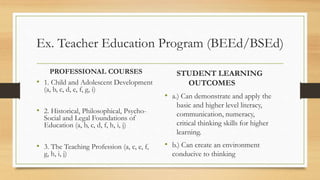
Ex. Teacher Education Program (BEEd/BSEd)
PROFESSIONAL COURSES
• 1. Child and Adolescent Development
(a, b, c, d, e, f, g, i)
• 2. Historical, Philosophical, Psycho-
Social and Legal Foundations of
Education (a, b, c, d, f, h, i, j)
• 3. The Teaching Profession (a, c, e, f,
g, h, i, j)
STUDENT LEARNING
OUTCOMES
• a.) Can demonstrate and apply the
basic and higher level literacy,
communication, numeracy,
critical thinking skills for higher
learning.
• b.) Can create an environment
conducive to thinking
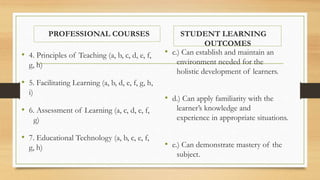
PROFESSIONAL COURSES STUDENT LEARNING
OUTCOMES
• 4. Principles of Teaching (a, b, c, d, e, f,
g, h)
• 5. Facilitating Learning (a, b, d, e, f, g, h,
i)
• 6. Assessment of Learning (a, c, d, e, f,
g)
• 7. Educational Technology (a, b, c, e, f,
g, h)
• c.) Can establish and maintain an
environment needed for the
holistic development of learners.
• d.) Can apply familiarity with the
learner’s knowledge and
experience in appropriate situations.
• e.) Can demonstrate mastery of the
subject.
PROFESSIONAL COURSES STUDENT LEARNING
OUTCOMES
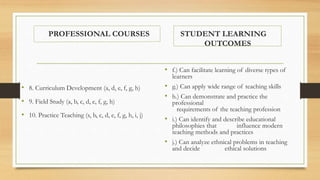
• 8. Curriculum Development (a, d, e, f, g, h)
• 9. Field Study (a, b, c, d, e, f, g, h)
• 10. Practice Teaching (s, b, c, d, e, f, g, h, i, j)
• f.) Can facilitate learning of diverse types of
learners
• g.) Can apply wide range of teaching skills
• h.) Can demonstrate and practice the
professional
requirements of the teaching profession
• i.) Can identify and describe educational
philosophies that influence modern
teaching methods and practices
• j.) Can analyze ethnical problems in teaching
and decide ethical solutions
7. Determining the Attainment of
Student Learning Outcomes (SLO)
through Outcomes-Based
Assessment (OBA)
7.1 Educational Assessment
• Is a comprehensive process of describing, judging
and communicating the quality of learning and
performances of students.
• Assessment in education is a comprehensive term
which includes measurement, evaluation and grading.
7.2 Outcomes-based Assessment
• Requires teachers to define clearly, in language
that their students can understand and apply,
the learning target, competencies or
performances expected of the students and
which the teachers should actualize.
Outcomes-Based Assessment
(OBA)
• is authentic assessment
• a form of assessment in which students perform
real-life tasks which are either replicas or simulations
of the kind of situations faced by adult citizens and
professionals.
(a) Teacher expectation in OBA
• Focusing on the key elements of the curriculum that will lead to the
desired outcomes.
• Ensuring that every activity, inside and outside the classroom, help
produce the desired results.
• Providing opportunities for students to demonstrate proficiency in
variety of modalities.
• Reviewing and revising learning targets as revealed by assessment of
results.
(b) Student Expectations in OBA
• Understanding clearly with competencies/skills
teachers expect to observe.
• Being ready to demonstrate what they know.
• Accepting responsibility for what they don’t know.
• Being prepared to continue achieving and reaching
high performance.
7.3 Recommended Outcomes-Based
Assessment Tools
• Anecdotal record
• Observation guide
• Interview guide
• Checklist
• End-of-chapter/unit/term test
• Journal (notebook of student)
• Literacy log book (new terms learned)
• Peer critique
• Performance or demonstration
• Portfolios
• Rubrics
• Written assignment
• Self-assessment
• Reflection essays
• Standardized tests
7.4 Characteristics of
OBA
Use of Measurable Assessment Tools
And
Key to Outcomes-Based Assessment
(a) Use of Measurable Assessment
Tools
• Outcomes-Based Assessment (OBA)
-focuses on student activities that will be relevant
after formal schooling concludes
-the approach is to design assessment tools that are
measurable and less abstract.
Example
• “Verbal Ability” is an abstract competency;
-on the other hand, a much easier competency to assess
is “to write coherent paragraph composed of
grammatically correct sentences.”
(b) Key to OBA
• The key to Outcomes-Based Assessment (OBA)
• is the teacher’s ability to provide a realistic simulation or
approximation of the setting
• in which the outcomes of learning will be required or
applied.
Examples:
• Role playing
• Gaming
• Demonstration
• Case Discussion
• Problem-Solving sessions, etc.
• In outcomes-based education,
practical applications of principles and theories are means
of verifying and measuring the extent of attainment
of the desired student learning outcomes.
• To ensure a meaningful and profitable experience,
in-campus facilities should be in place
where students can simulate the situations
they will encounter in the workplace.
• It is recommended that teacher educators conceptualize
- a laboratory with the appropriate equipment and
facilities
-to support the various simulation, role-play, student-
centered, problem- based and creative activities
-that will help prepare future teachers for the situations
they are likely to encounter.
This is the end-goal of outcome-based education.
Thank You!

Outcomes-Based Education (OBE)

  • 1.
  • 2.
    1. Shift ofInstructional Focus • Outcomes-Based Education (OBE)  focuses classroom instruction on the accomplishments (skills/competencies) that students must demonstrate when they exit.
  • 3.
    2. The Outcomesof Education: Focus of Accreditation • (a)Immediate Outcomes: Competencies/skills acquired upon completion of a subject, a grade/year level, a segment of the program, or a program itself.
  • 4.
    Examples of ImmediateOutcomes • Analytic ability • Problem-solving skill • Ability to communicate in writing, reading, speaking and mathematically • Skill in creative expression
  • 5.
    Examples of ImmediateOutcomes • Skill in technology utilization • Passing the licensure examination • Initial job placement • Admission in a graduate program
  • 6.
    The Outcomes ofEducation: Focus of Accreditation • (b)Deferred Outcomes: Ability to apply cognitive, psycho-motor and affective skills/competencies in various aspects of the professional and workplace practice.
  • 7.
    Examples of Deferred Outcomes •Promotion in job position/rank as evidence of work competence, skill and social relation. • Success in professional practice or occupation as evidence in skill in career planning, health and service and continuing education.
  • 8.
    Examples of Deferred Outcomes •Professional recognition, awards, distinction as evidence of civic responsibility and participation in environment conservation and other social advocacies.
  • 9.
    3. Program Objectives(P.O) • broad goals that the program expects to achieve • stated from the point of view of the faculty or of the program itself such as “to develop/to provide/ to motivate, etc.”
  • 10.
    Program Objectives (P.O) •Objectives are expressed as: -cognitive, psychomotor and affective goals. -focused on the well-rounded and profession- specific development of the students. • These are deferred outcomes of an educational program which are observable and verifiable years after graduation.
  • 11.
    4. Student LearningOutcomes (S.L.O) • are operational definitions of each of the program objectives. • stated as active transitive verbs such as “to demonstrate/ to express/ to illustrate/ to apply” • are immediate outcomes of education.
  • 12.
    5. Sample ProgramObjectives (P.O.) and Student Learning Outcomes (S.L.O.) Program :B.S. Ed./ B.E.Ed. Major in Social Science Course : Introduction to Sociology
  • 13.
    Program Objectives StudentLearning Outcomes • 1. To provide instruction in order to enable students to understand the interrelationships among the social and cultural bases of human behavior. (Cognitive) • 1.1. Student can describe critical cross-cultural differences in human behavior and explain their interplay among society and culture. • 1.2. Students can describe critical similarities in human behavior and explain their interplay among society and culture
  • 14.
    Program Objectives StudentLearning Outcomes • 2. To equip students with knowledge of research methods appropriate to investigations in socio- cultural and anthropological settings. (Psychomotor) • 2.1. Students can identify, define and give examples of various methods in ethnographic and anthropological research. • 2.2. Students can explain and interpret research methodology in selected ethnographic and anthropological literature. • 2.3 Students can submit a research proposal on a selected ethnic group in the community.
  • 15.
    Program Objectives StudentLearning Outcomes • 3. To encourage in students an appreciative understanding of an respect for cultural differences. (Affective) • 3.1. Students can demonstrate evidence of the unique social organization characteristics of the culture of selected ethnic groups in the region. • Students can submit creative expressions, in visual arts or literature, of the cross-cultural differences of selected ethnic groups.
  • 16.
    6. Curriculum Mapping Matching theCourses in the Curriculum with the Desired Student Learning Outcomes (SLO)
  • 17.
    Ex. Teacher EducationProgram (BEEd/BSEd) PROFESSIONAL COURSES • 1. Child and Adolescent Development (a, b, c, d, e, f, g, i) • 2. Historical, Philosophical, Psycho- Social and Legal Foundations of Education (a, b, c, d, f, h, i, j) • 3. The Teaching Profession (a, c, e, f, g, h, i, j) STUDENT LEARNING OUTCOMES • a.) Can demonstrate and apply the basic and higher level literacy, communication, numeracy, critical thinking skills for higher learning. • b.) Can create an environment conducive to thinking
  • 18.
    PROFESSIONAL COURSES STUDENTLEARNING OUTCOMES • 4. Principles of Teaching (a, b, c, d, e, f, g, h) • 5. Facilitating Learning (a, b, d, e, f, g, h, i) • 6. Assessment of Learning (a, c, d, e, f, g) • 7. Educational Technology (a, b, c, e, f, g, h) • c.) Can establish and maintain an environment needed for the holistic development of learners. • d.) Can apply familiarity with the learner’s knowledge and experience in appropriate situations. • e.) Can demonstrate mastery of the subject.
  • 19.
    PROFESSIONAL COURSES STUDENTLEARNING OUTCOMES • 8. Curriculum Development (a, d, e, f, g, h) • 9. Field Study (a, b, c, d, e, f, g, h) • 10. Practice Teaching (s, b, c, d, e, f, g, h, i, j) • f.) Can facilitate learning of diverse types of learners • g.) Can apply wide range of teaching skills • h.) Can demonstrate and practice the professional requirements of the teaching profession • i.) Can identify and describe educational philosophies that influence modern teaching methods and practices • j.) Can analyze ethnical problems in teaching and decide ethical solutions
  • 20.
    7. Determining theAttainment of Student Learning Outcomes (SLO) through Outcomes-Based Assessment (OBA)
  • 21.
    7.1 Educational Assessment •Is a comprehensive process of describing, judging and communicating the quality of learning and performances of students. • Assessment in education is a comprehensive term which includes measurement, evaluation and grading.
  • 22.
    7.2 Outcomes-based Assessment •Requires teachers to define clearly, in language that their students can understand and apply, the learning target, competencies or performances expected of the students and which the teachers should actualize.
  • 23.
    Outcomes-Based Assessment (OBA) • isauthentic assessment • a form of assessment in which students perform real-life tasks which are either replicas or simulations of the kind of situations faced by adult citizens and professionals.
  • 24.
    (a) Teacher expectationin OBA • Focusing on the key elements of the curriculum that will lead to the desired outcomes. • Ensuring that every activity, inside and outside the classroom, help produce the desired results. • Providing opportunities for students to demonstrate proficiency in variety of modalities. • Reviewing and revising learning targets as revealed by assessment of results.
  • 25.
    (b) Student Expectationsin OBA • Understanding clearly with competencies/skills teachers expect to observe. • Being ready to demonstrate what they know. • Accepting responsibility for what they don’t know. • Being prepared to continue achieving and reaching high performance.
  • 26.
    7.3 Recommended Outcomes-Based AssessmentTools • Anecdotal record • Observation guide • Interview guide • Checklist • End-of-chapter/unit/term test • Journal (notebook of student) • Literacy log book (new terms learned) • Peer critique • Performance or demonstration • Portfolios • Rubrics • Written assignment • Self-assessment • Reflection essays • Standardized tests
  • 27.
    7.4 Characteristics of OBA Useof Measurable Assessment Tools And Key to Outcomes-Based Assessment
  • 28.
    (a) Use ofMeasurable Assessment Tools • Outcomes-Based Assessment (OBA) -focuses on student activities that will be relevant after formal schooling concludes -the approach is to design assessment tools that are measurable and less abstract.
  • 29.
    Example • “Verbal Ability”is an abstract competency; -on the other hand, a much easier competency to assess is “to write coherent paragraph composed of grammatically correct sentences.”
  • 30.
    (b) Key toOBA • The key to Outcomes-Based Assessment (OBA) • is the teacher’s ability to provide a realistic simulation or approximation of the setting • in which the outcomes of learning will be required or applied.
  • 31.
    Examples: • Role playing •Gaming • Demonstration • Case Discussion • Problem-Solving sessions, etc.
  • 32.
    • In outcomes-basededucation, practical applications of principles and theories are means of verifying and measuring the extent of attainment of the desired student learning outcomes. • To ensure a meaningful and profitable experience, in-campus facilities should be in place where students can simulate the situations they will encounter in the workplace.
  • 33.
    • It isrecommended that teacher educators conceptualize - a laboratory with the appropriate equipment and facilities -to support the various simulation, role-play, student- centered, problem- based and creative activities -that will help prepare future teachers for the situations they are likely to encounter. This is the end-goal of outcome-based education.
  • 34.