Outcomes-Based Education:
Basis for Enhanced Teacher
Education Curriculum
MODULE 7
Lesson 1
Outcomes-Based
Education for
Teacher
Preparation
Curriculum
Why do we hear a lot of educators talking about
OBE?
What is Outcome-Based Education about?
Should curriculum for teacher preparation be
influenced by this? Why?
How will OBE address the 21st century teachers?
W. Spady (1994) – defined
OBE as clearly focusing, and organizing
everything in
educational system
around the essential for
all the students to do
successfully at the end of
their learning experiences.
1.What do we want these
students to learn?
2.Why do we want
students to learn these
things?
3.How can we best help
students to learn these
things?
4.How will you know
when the students have
learned?
All students can learn
and succeed, but not at
the same time or in the same
way.
Schools and teachers control the conditions that
will determine if the students are successful in
school learning.
Successful learning promotes
even more successful
learning.
Four
Essential
Principles
in OBE
Four Essential
Principles in OBE
Principle 1
Clarity of Focus
-a clear focus on what teachers
want students to learn is the
primary principle in OBE.
Teachers should bear in mind
that the outcome of teaching is
learning. Teachers and learners
should have a clear picture in
mind what knowledge, skills,
values must be achieved at the
end of the teaching-learning
process.
Four Essential
Principles in OBE
Principle 2
Designing Backwards
-at the beginning of curriculum
design, the learning outcome has
to be clearly defined. What to
achieve at the end of formal
schooling is determined at the
beginning. Decisions are always
traced back to desired results.
This means that planning,
implementing and assessing
should be connected to the
outcomes.
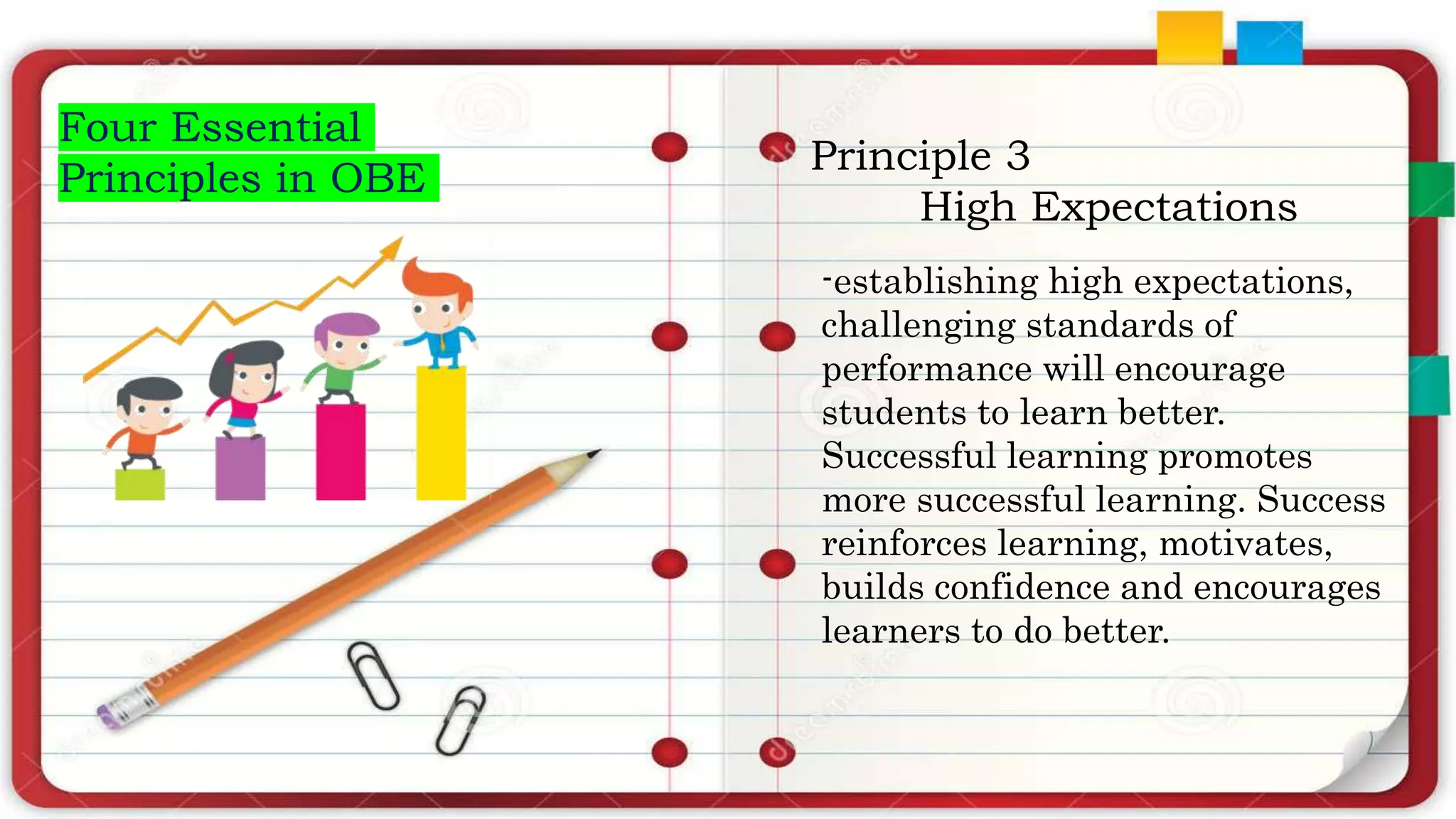
Four Essential
Principles in OBE
Principle 3
High Expectations
-establishing high expectations,
challenging standards of
performance will encourage
students to learn better.
Successful learning promotes
more successful learning. Success
reinforces learning, motivates,
builds confidence and encourages
learners to do better.
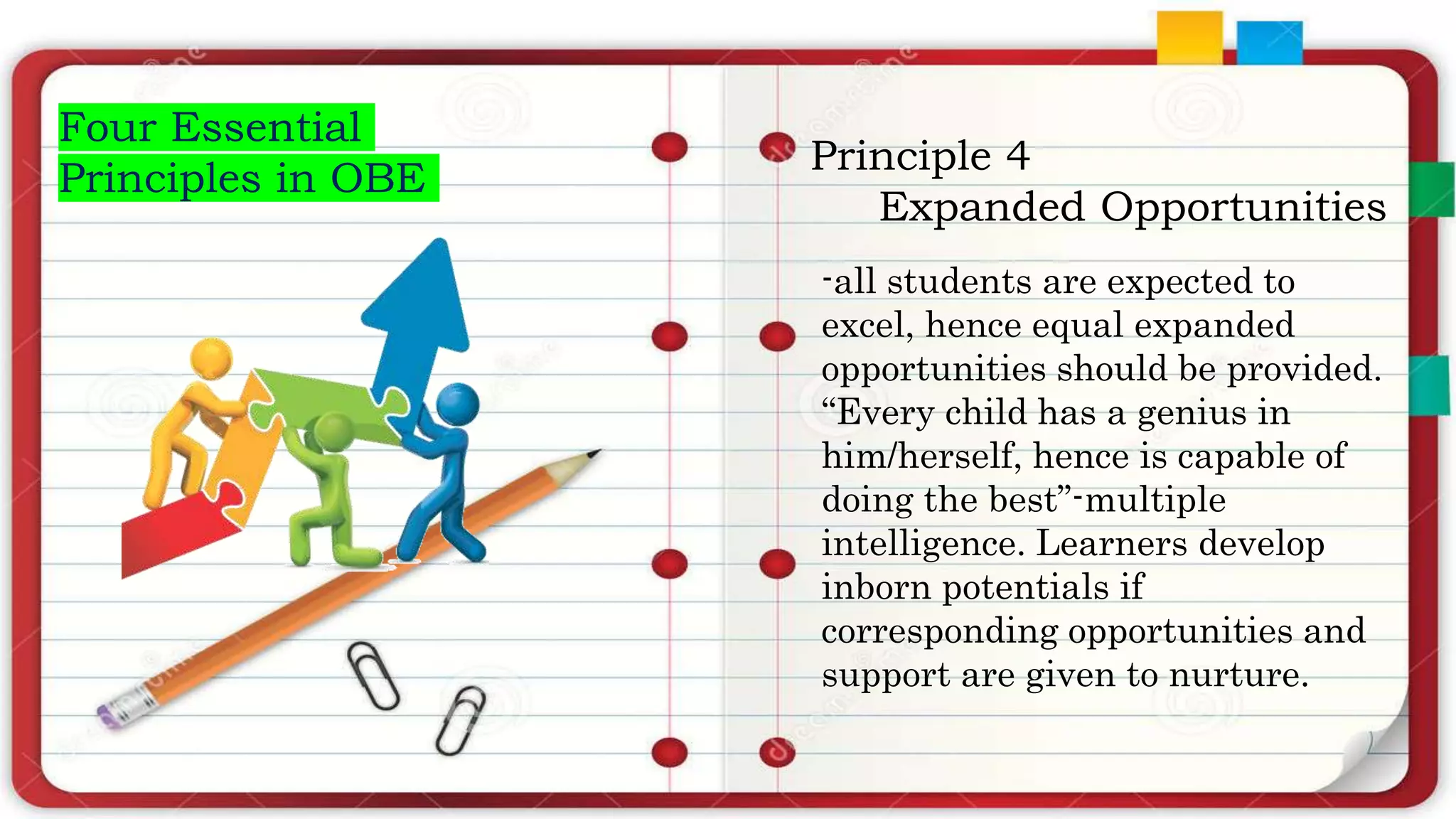
Four Essential
Principles in OBE
Principle 4
Expanded Opportunities
-all students are expected to
excel, hence equal expanded
opportunities should be provided.
“Every child has a genius in
him/herself, hence is capable of
doing the best”-multiple
intelligence. Learners develop
inborn potentials if
corresponding opportunities and
support are given to nurture.
Teaching-
Learning
in OBE
Teaching is teaching
if learners learn. Learning
is measured by its
outcome. Whatever
approach to teaching is
used, the intent should
focus on learning rather
than on teaching. It is
important that students
learn how to learn, hence a
teacher should be
innovative.
How then should teaching-learning be done in
OBE? Here are some tips:
1. Teachers must prepare students adequately. Teachers should know what
they want their students to learn and what learning outcomes to achieve.
Prior knowledge is important, thus review is necessary at the start of every
lesson.
2. Teachers must create a positive learning environment. The classroom
atmosphere should provide respect for diverse kind of learners. Students
should feel, regardless of individual uniqueness, the teacher is always there
to help.
4. Teachers must use a variety of teaching methods. T Taking into account
the learning outcome what the students want to achieve. Considering the
characteristics of the students, the resources available and the teaching skill
of the teacher.
5. Teachers must provide students with enough opportunities to use the
new knowledge and skills that they gain. Students need to explore with the
new learning, correct errors and adjust their thinking.
3. Teachers must help their students to understand. What they have to
learn, why they should learn it and how will they know that they have
learned.
6. Teacher must help students to bring each learning to a personal closure
that will make them aware of what they learned.
TRADITIONAL
AND OBE VIEW
IN THE
TEACHING-
LEARNING
PROCESS
Traditional View OBE View
Instruction Learning
Inputs and Resources Learning Resources
Knowledge is
transferred by the
teacher
Knowledge already
exists in the minds of
the learners
Teacher dispenses
knowledge
Teachers are
designers of methods
Teachers and
students are
independent and in
isolation
Teacher and students
work in teams
Assessment of Learning Outcomes in OBE
Assessment in OBE should also be
guided by the four principles of OBE
which are clarity of focus, designing
backwards, high expectations and
expanded opportunity. It should
contribute to the objectives of improving
students’ learning.
Guiding Principles in OBE Assessment
1. Assessment procedure should be valid. Procedure and tools
should actually assess what one intends to test.
2. Assessment procedure should be reliable. The
results should be consistent.
3. Assessment procedure should be fair.
Cultural background and other factors
should not influence assessment procedure.
4. Assessment should reflect the knowledge and skills that are
important to the students.
5. Assessment should tell both the teachers and students how students
are progressing.
6. Assessment should support every student’s opportunity to learn
things that are important.
7. Assessment should allow individuality or uniqueness to be
demonstrated.
8. Assessment should be comprehensive to cover a wide range of
learning outcomes.
Learner’s Responsibility for
Learning
In OBE, students are
responsible for their own
learning and progress.
Nobody can learn for the
learner. It is only the learner
himself/herself who can drive
himself/herself to learn, thus
learning is a personal matter.
Teachers can only facilitate
that learning, define the
learning outcomes to be
achieved and assist the
students to achieve those
outcomes.
One of the great
benefits of outcomes-
based education is that
it makes students aware of
what they should be
learning, why they are
learning it, why they are
actually learning, and
what they should do when
they are learning.
In OBE students should
reflect on themselves.
Here are some guide for
students;
1.What do I have to learn?
2.Why do I have to learn
it?
3.What will I be doing
while I am learning?
4.How will I know that I
am learning, what I
should be learning?
5.Will I have any say in
what I learn?
6.How will I be assessed?
Outcome Based Education

Outcome Based Education

  • 1.
    Outcomes-Based Education: Basis forEnhanced Teacher Education Curriculum MODULE 7
  • 2.
  • 3.
    Why do wehear a lot of educators talking about OBE? What is Outcome-Based Education about? Should curriculum for teacher preparation be influenced by this? Why? How will OBE address the 21st century teachers?
  • 4.
    W. Spady (1994)– defined OBE as clearly focusing, and organizing everything in educational system around the essential for all the students to do successfully at the end of their learning experiences.
  • 5.
    1.What do wewant these students to learn? 2.Why do we want students to learn these things? 3.How can we best help students to learn these things? 4.How will you know when the students have learned?
  • 6.
    All students canlearn and succeed, but not at the same time or in the same way. Schools and teachers control the conditions that will determine if the students are successful in school learning. Successful learning promotes even more successful learning.
  • 7.
  • 8.
    Four Essential Principles inOBE Principle 1 Clarity of Focus -a clear focus on what teachers want students to learn is the primary principle in OBE. Teachers should bear in mind that the outcome of teaching is learning. Teachers and learners should have a clear picture in mind what knowledge, skills, values must be achieved at the end of the teaching-learning process.
  • 9.
    Four Essential Principles inOBE Principle 2 Designing Backwards -at the beginning of curriculum design, the learning outcome has to be clearly defined. What to achieve at the end of formal schooling is determined at the beginning. Decisions are always traced back to desired results. This means that planning, implementing and assessing should be connected to the outcomes.
  • 10.
    Four Essential Principles inOBE Principle 3 High Expectations -establishing high expectations, challenging standards of performance will encourage students to learn better. Successful learning promotes more successful learning. Success reinforces learning, motivates, builds confidence and encourages learners to do better.
  • 11.
    Four Essential Principles inOBE Principle 4 Expanded Opportunities -all students are expected to excel, hence equal expanded opportunities should be provided. “Every child has a genius in him/herself, hence is capable of doing the best”-multiple intelligence. Learners develop inborn potentials if corresponding opportunities and support are given to nurture.
  • 12.
    Teaching- Learning in OBE Teaching isteaching if learners learn. Learning is measured by its outcome. Whatever approach to teaching is used, the intent should focus on learning rather than on teaching. It is important that students learn how to learn, hence a teacher should be innovative.
  • 13.
    How then shouldteaching-learning be done in OBE? Here are some tips: 1. Teachers must prepare students adequately. Teachers should know what they want their students to learn and what learning outcomes to achieve. Prior knowledge is important, thus review is necessary at the start of every lesson. 2. Teachers must create a positive learning environment. The classroom atmosphere should provide respect for diverse kind of learners. Students should feel, regardless of individual uniqueness, the teacher is always there to help.
  • 14.
    4. Teachers mustuse a variety of teaching methods. T Taking into account the learning outcome what the students want to achieve. Considering the characteristics of the students, the resources available and the teaching skill of the teacher. 5. Teachers must provide students with enough opportunities to use the new knowledge and skills that they gain. Students need to explore with the new learning, correct errors and adjust their thinking. 3. Teachers must help their students to understand. What they have to learn, why they should learn it and how will they know that they have learned.
  • 15.
    6. Teacher musthelp students to bring each learning to a personal closure that will make them aware of what they learned.
  • 16.
    TRADITIONAL AND OBE VIEW INTHE TEACHING- LEARNING PROCESS
  • 17.
    Traditional View OBEView Instruction Learning Inputs and Resources Learning Resources Knowledge is transferred by the teacher Knowledge already exists in the minds of the learners Teacher dispenses knowledge Teachers are designers of methods Teachers and students are independent and in isolation Teacher and students work in teams
  • 18.
    Assessment of LearningOutcomes in OBE Assessment in OBE should also be guided by the four principles of OBE which are clarity of focus, designing backwards, high expectations and expanded opportunity. It should contribute to the objectives of improving students’ learning.
  • 19.
    Guiding Principles inOBE Assessment 1. Assessment procedure should be valid. Procedure and tools should actually assess what one intends to test. 2. Assessment procedure should be reliable. The results should be consistent. 3. Assessment procedure should be fair. Cultural background and other factors should not influence assessment procedure. 4. Assessment should reflect the knowledge and skills that are important to the students. 5. Assessment should tell both the teachers and students how students are progressing. 6. Assessment should support every student’s opportunity to learn things that are important. 7. Assessment should allow individuality or uniqueness to be demonstrated. 8. Assessment should be comprehensive to cover a wide range of learning outcomes.
  • 20.
    Learner’s Responsibility for Learning InOBE, students are responsible for their own learning and progress. Nobody can learn for the learner. It is only the learner himself/herself who can drive himself/herself to learn, thus learning is a personal matter. Teachers can only facilitate that learning, define the learning outcomes to be achieved and assist the students to achieve those outcomes. One of the great benefits of outcomes- based education is that it makes students aware of what they should be learning, why they are learning it, why they are actually learning, and what they should do when they are learning.
  • 21.
    In OBE studentsshould reflect on themselves. Here are some guide for students; 1.What do I have to learn? 2.Why do I have to learn it? 3.What will I be doing while I am learning? 4.How will I know that I am learning, what I should be learning? 5.Will I have any say in what I learn? 6.How will I be assessed?