M.Ed. 2015-16
Curriculum Design & Development
Unit IV
Process of
Curriculum Development
M.Vijayalakshmi
Assistant Professor
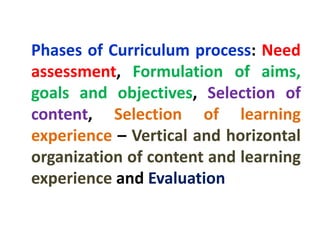
Phases of Curriculum process: Need
assessment, Formulation of aims,
goals and objectives, Selection of
content, Selection of learning
experience – Vertical and horizontal
organization of content and learning
experience and Evaluation
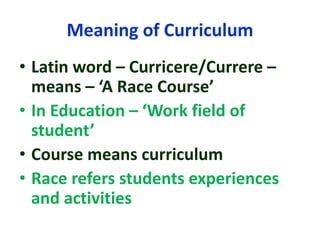
Meaning of Curriculum
• Latin word – Curricere/Currere –
means – ‘A Race Course’
• In Education – ‘Work field of
student’
• Course means curriculum
• Race refers students experiences
and activities
Concept of Curriculum
• Curriculum is a tool in the hands of
artist (teacher) to mould his
material (pupil) according to his
ideal (objectives) in this studio
(school)
- Cunningham
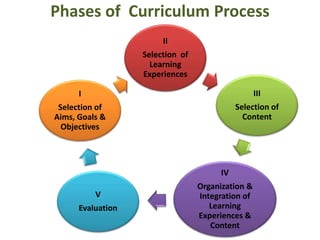
Phases of Curriculum Process
II
Selection of
Learning
Experiences
III
Selection of
Content
IV
Organization &
Integration of
Learning
Experiences &
Content
V
Evaluation
I
Selection of
Aims, Goals &
Objectives
SELECTION OF
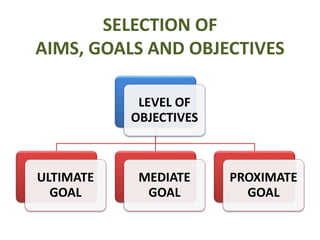
AIMS, GOALS AND OBJECTIVES
LEVEL OF
OBJECTIVES
ULTIMATE
GOAL
MEDIATE
GOAL
PROXIMATE
GOAL
SELECTION
OF
LEARNING EXPERIENCES
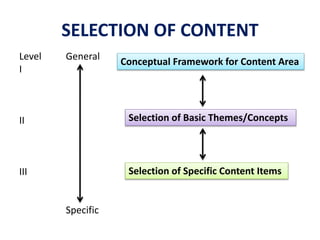
SELECTION OF CONTENT
Level
I
General
II
III
Specific
Selection of Specific Content Items
Selection of Basic Themes/Concepts
Conceptual Framework for Content Area
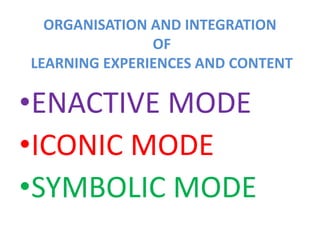
ORGANISATION AND INTEGRATION
OF
LEARNING EXPERIENCES AND CONTENT
•ENACTIVE MODE
•ICONIC MODE
•SYMBOLIC MODE
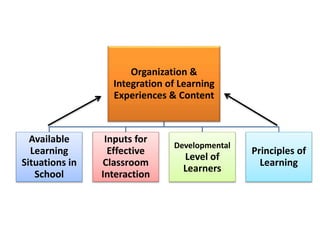
Organization &
Integration of Learning
Experiences & Content
Available
Learning
Situations in
School
Inputs for
Effective
Classroom
Interaction
Developmental
Level of
Learners
Principles of
Learning
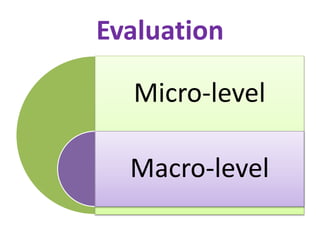
Evaluation
Micro-level
Macro-level
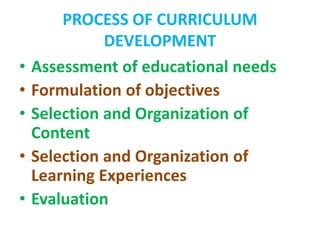
PROCESS OF CURRICULUM
DEVELOPMENT
• Assessment of educational needs
• Formulation of objectives
• Selection and Organization of
Content
• Selection and Organization of
Learning Experiences
• Evaluation
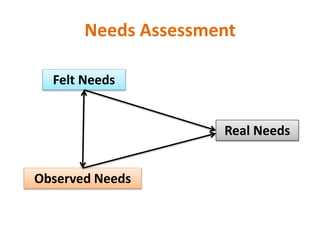
Needs Assessment
Felt Needs
Real Needs
Observed Needs
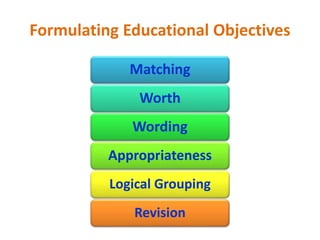
Formulating Educational Objectives
Matching
Worth
Wording
Appropriateness
Logical Grouping
Revision
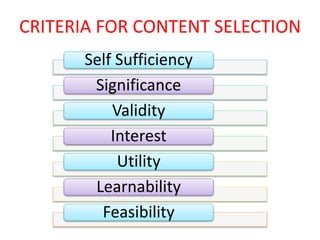
CRITERIA FOR CONTENT SELECTION
Self Sufficiency
Significance
Validity
Interest
Utility
Learnability
Feasibility
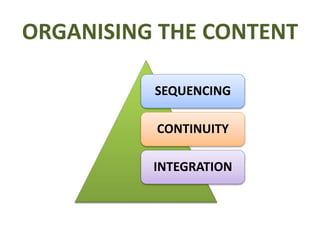
ORGANISING THE CONTENT
SEQUENCING
CONTINUITY
INTEGRATION
SELECTING LEARNING
EXPERIENCES
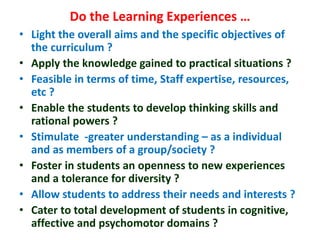
Do the Learning Experiences …
• Light the overall aims and the specific objectives of
the curriculum ?
• Apply the knowledge gained to practical situations ?
• Feasible in terms of time, Staff expertise, resources,
etc ?
• Enable the students to develop thinking skills and
rational powers ?
• Stimulate -greater understanding – as a individual
and as members of a group/society ?
• Foster in students an openness to new experiences
and a tolerance for diversity ?
• Allow students to address their needs and interests ?
• Cater to total development of students in cognitive,
affective and psychomotor domains ?
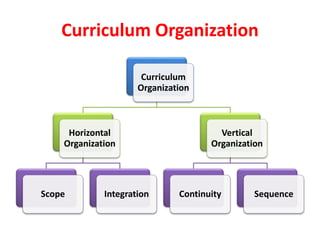
Curriculum Organization
Curriculum
Organization
Horizontal
Organization
Scope Integration
Vertical
Organization
Continuity Sequence
Prof. Abdelmoneim Ahmad Hassan 20
Curriculum Organization
• The aspect of curriculum organization that
describe the correlation or integration of
content taught concurrently is termed
horizontal organization. The aspect of
curriculum organization that describes the
sequencing of content is termed vertical
organization.
Prof. Abdelmoneim Ahmad Hassan 21
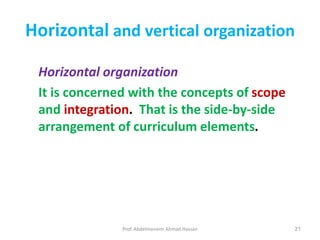
Horizontal and vertical organization
Horizontal organization
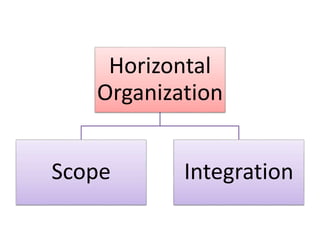
It is concerned with the concepts of scope
and integration. That is the side-by-side
arrangement of curriculum elements.
Horizontal
Organization
Scope Integration
Prof. Abdelmoneim Ahmad Hassan 23
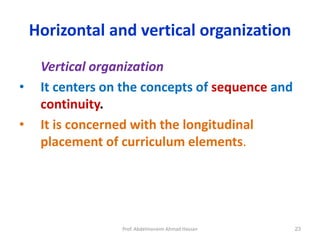
Horizontal and vertical organization
Vertical organization
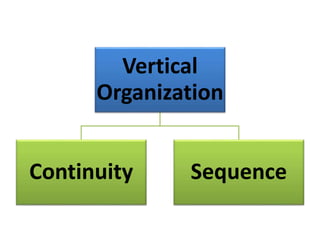
• It centers on the concepts of sequence and
continuity.
• It is concerned with the longitudinal
placement of curriculum elements.
Vertical
Organization
Continuity Sequence
Prof. Abdelmoneim Ahmad Hassan 25
Organization Dimension Considerations
• Scope deals with breadth and depth of the
curriculum content.
• Scope refers to all varieties and types of
educational experiences (cognitive, affective ,
psychomotor, and spiritual) that are to be
provided to the students through the school.
Sometimes the scope of the curriculum is
represented just simply as a listing of the key
topics and activities to be considered.
Prof. Abdelmoneim Ahmad Hassan 26
Organization Dimension Considerations
• Integration:
- It refers to the linking of all types of
knowledge and experiences contained
within the curriculum plan. It emphasizes
horizontal relations among various content
topics and themes involving all domains of
knowledge recognized.
Prof. Abdelmoneim Ahmad Hassan 27
Organization Dimension Considerations
• Some curriculum specialists say that
integration only occurs within the learner.
Other specialists say that the integration of
curriculum works to interrelate not only the
basic ideas within subjects, but to point to
the interrelationship with other subject
• Ex: Whole language learning in elementary school
• Students in secondary school combine science with
social study.
Prof. Abdelmoneim Ahmad Hassan 28
Organization Dimension Considerations
• Continuity:
It deals with the vertical manipulation or repetition
of curriculum components. Specialists indicated
that if, for example, reading skills is an important
objective, then “it is necessary to see that there is
returning and continuing opportunity for these
skills to be practiced and developed”. This means
that over time the same kind of skills will be
brought into continuing operation.
Prof. Abdelmoneim Ahmad Hassan 29
Organization Dimension Considerations
• Sequence is related to continuity but goes beyond
it. It is possible for a major curriculum element to
recur again and again but merely at the same level
so that there no progressive development of
understanding or skill or attitude or some other
factors. Sequence as criterion emphasizes the
importance of having each successive experience
builds upon the preceding one but to go more
broadly and deeply into the matter involved.
Prof. Abdelmoneim Ahmad Hassan 30
Organization Dimension Considerations
• Sequence is not just repetition of a skill or a
concept but deepening of it, so that each
successive encounter builds on the preceding
one.
Prof. Abdelmoneim Ahmad Hassan 36
Organization Dimension Considerations
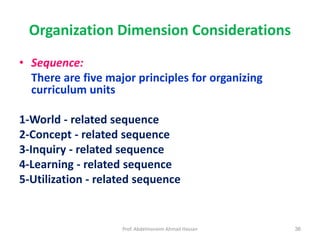
• Sequence:
There are five major principles for organizing
curriculum units
1-World - related sequence
2-Concept - related sequence
3-Inquiry - related sequence
4-Learning - related sequence
5-Utilization - related sequence
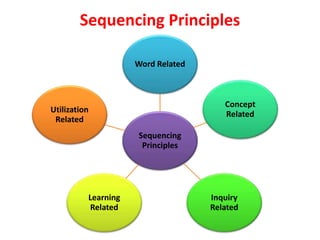
Sequencing Principles
Sequencing
Principles
Word Related
Concept
Related
Inquiry
Related
Learning
Related
Utilization
Related
Prof. Abdelmoneim Ahmad Hassan 38
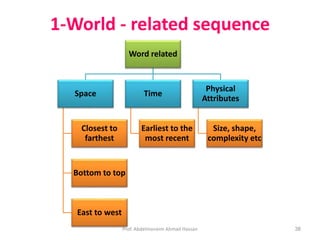
1-World - related sequence
Word related
Space
Closest to
farthest
Bottom to top
East to west
Time
Earliest to the
most recent
Physical
Attributes
Size, shape,
complexity etc
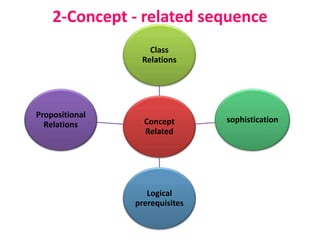
2-Concept - related sequence
Concept
Related
Class
Relations
sophistication
Logical
prerequisites
Propositional
Relations
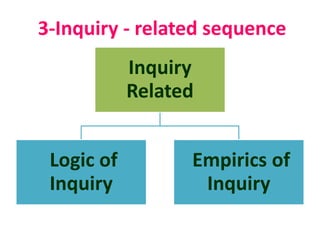
Inquiry
Related
Logic of
Inquiry
Empirics of
Inquiry
3-Inquiry - related sequence
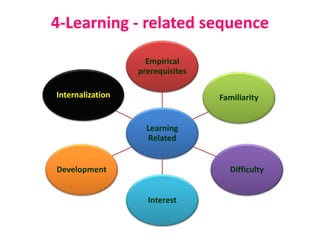
4-Learning - related sequence
Learning
Related
Empirical
prerequisites
Familiarity
Difficulty
Interest
Development
Internalization
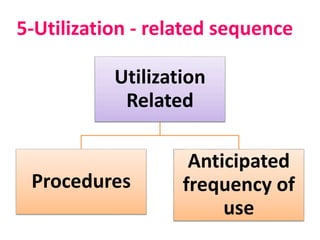
Utilization
Related
Procedures
Anticipated
frequency of
use
5-Utilization - related sequence
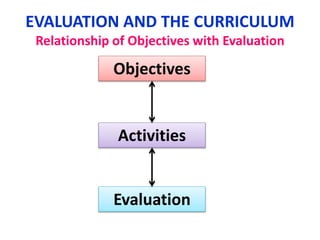
EVALUATION AND THE CURRICULUM
Relationship of Objectives with Evaluation
Objectives
Evaluation
Activities
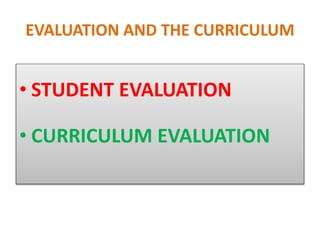
EVALUATION AND THE CURRICULUM
• STUDENT EVALUATION
• CURRICULUM EVALUATION
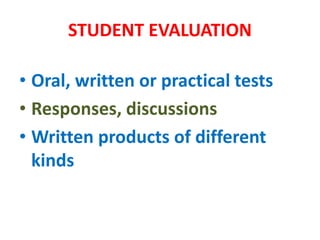
STUDENT EVALUATION
• Oral, written or practical tests
• Responses, discussions
• Written products of different
kinds
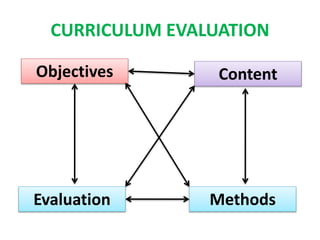
CURRICULUM EVALUATION
Objectives Content
Evaluation Methods
Process of Curriculum Development

Process of Curriculum Development

  • 1.
    M.Ed. 2015-16 Curriculum Design& Development Unit IV Process of Curriculum Development M.Vijayalakshmi Assistant Professor
  • 2.
    Phases of Curriculumprocess: Need assessment, Formulation of aims, goals and objectives, Selection of content, Selection of learning experience – Vertical and horizontal organization of content and learning experience and Evaluation
  • 3.
    Meaning of Curriculum •Latin word – Curricere/Currere – means – ‘A Race Course’ • In Education – ‘Work field of student’ • Course means curriculum • Race refers students experiences and activities
  • 4.
    Concept of Curriculum •Curriculum is a tool in the hands of artist (teacher) to mould his material (pupil) according to his ideal (objectives) in this studio (school) - Cunningham
  • 5.
    Phases of CurriculumProcess II Selection of Learning Experiences III Selection of Content IV Organization & Integration of Learning Experiences & Content V Evaluation I Selection of Aims, Goals & Objectives
  • 6.
    SELECTION OF AIMS, GOALSAND OBJECTIVES LEVEL OF OBJECTIVES ULTIMATE GOAL MEDIATE GOAL PROXIMATE GOAL
  • 7.
  • 8.
    SELECTION OF CONTENT Level I General II III Specific Selectionof Specific Content Items Selection of Basic Themes/Concepts Conceptual Framework for Content Area
  • 9.
    ORGANISATION AND INTEGRATION OF LEARNINGEXPERIENCES AND CONTENT •ENACTIVE MODE •ICONIC MODE •SYMBOLIC MODE
  • 10.
    Organization & Integration ofLearning Experiences & Content Available Learning Situations in School Inputs for Effective Classroom Interaction Developmental Level of Learners Principles of Learning
  • 11.
  • 12.
    PROCESS OF CURRICULUM DEVELOPMENT •Assessment of educational needs • Formulation of objectives • Selection and Organization of Content • Selection and Organization of Learning Experiences • Evaluation
  • 13.
  • 14.
  • 15.
    CRITERIA FOR CONTENTSELECTION Self Sufficiency Significance Validity Interest Utility Learnability Feasibility
  • 16.
  • 17.
  • 18.
    Do the LearningExperiences … • Light the overall aims and the specific objectives of the curriculum ? • Apply the knowledge gained to practical situations ? • Feasible in terms of time, Staff expertise, resources, etc ? • Enable the students to develop thinking skills and rational powers ? • Stimulate -greater understanding – as a individual and as members of a group/society ? • Foster in students an openness to new experiences and a tolerance for diversity ? • Allow students to address their needs and interests ? • Cater to total development of students in cognitive, affective and psychomotor domains ?
  • 19.
  • 20.
    Prof. Abdelmoneim AhmadHassan 20 Curriculum Organization • The aspect of curriculum organization that describe the correlation or integration of content taught concurrently is termed horizontal organization. The aspect of curriculum organization that describes the sequencing of content is termed vertical organization.
  • 21.
    Prof. Abdelmoneim AhmadHassan 21 Horizontal and vertical organization Horizontal organization It is concerned with the concepts of scope and integration. That is the side-by-side arrangement of curriculum elements.
  • 22.
  • 23.
    Prof. Abdelmoneim AhmadHassan 23 Horizontal and vertical organization Vertical organization • It centers on the concepts of sequence and continuity. • It is concerned with the longitudinal placement of curriculum elements.
  • 24.
  • 25.
    Prof. Abdelmoneim AhmadHassan 25 Organization Dimension Considerations • Scope deals with breadth and depth of the curriculum content. • Scope refers to all varieties and types of educational experiences (cognitive, affective , psychomotor, and spiritual) that are to be provided to the students through the school. Sometimes the scope of the curriculum is represented just simply as a listing of the key topics and activities to be considered.
  • 26.
    Prof. Abdelmoneim AhmadHassan 26 Organization Dimension Considerations • Integration: - It refers to the linking of all types of knowledge and experiences contained within the curriculum plan. It emphasizes horizontal relations among various content topics and themes involving all domains of knowledge recognized.
  • 27.
    Prof. Abdelmoneim AhmadHassan 27 Organization Dimension Considerations • Some curriculum specialists say that integration only occurs within the learner. Other specialists say that the integration of curriculum works to interrelate not only the basic ideas within subjects, but to point to the interrelationship with other subject • Ex: Whole language learning in elementary school • Students in secondary school combine science with social study.
  • 28.
    Prof. Abdelmoneim AhmadHassan 28 Organization Dimension Considerations • Continuity: It deals with the vertical manipulation or repetition of curriculum components. Specialists indicated that if, for example, reading skills is an important objective, then “it is necessary to see that there is returning and continuing opportunity for these skills to be practiced and developed”. This means that over time the same kind of skills will be brought into continuing operation.
  • 29.
    Prof. Abdelmoneim AhmadHassan 29 Organization Dimension Considerations • Sequence is related to continuity but goes beyond it. It is possible for a major curriculum element to recur again and again but merely at the same level so that there no progressive development of understanding or skill or attitude or some other factors. Sequence as criterion emphasizes the importance of having each successive experience builds upon the preceding one but to go more broadly and deeply into the matter involved.
  • 30.
    Prof. Abdelmoneim AhmadHassan 30 Organization Dimension Considerations • Sequence is not just repetition of a skill or a concept but deepening of it, so that each successive encounter builds on the preceding one.
  • 31.
    Prof. Abdelmoneim AhmadHassan 36 Organization Dimension Considerations • Sequence: There are five major principles for organizing curriculum units 1-World - related sequence 2-Concept - related sequence 3-Inquiry - related sequence 4-Learning - related sequence 5-Utilization - related sequence
  • 32.
  • 33.
    Prof. Abdelmoneim AhmadHassan 38 1-World - related sequence Word related Space Closest to farthest Bottom to top East to west Time Earliest to the most recent Physical Attributes Size, shape, complexity etc
  • 34.
    2-Concept - relatedsequence Concept Related Class Relations sophistication Logical prerequisites Propositional Relations
  • 35.
  • 36.
    4-Learning - relatedsequence Learning Related Empirical prerequisites Familiarity Difficulty Interest Development Internalization
  • 37.
  • 38.
    EVALUATION AND THECURRICULUM Relationship of Objectives with Evaluation Objectives Evaluation Activities
  • 39.
    EVALUATION AND THECURRICULUM • STUDENT EVALUATION • CURRICULUM EVALUATION
  • 40.
    STUDENT EVALUATION • Oral,written or practical tests • Responses, discussions • Written products of different kinds
  • 41.