Think ?????
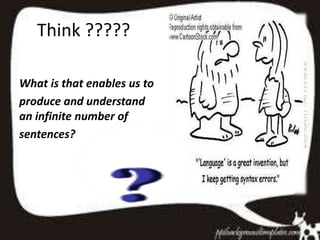
What is that enables us to
produce and understand
an infinite number of
sentences?
Unlike words, sentences are not finite in
number, and are not learned individually.
However, native speakers of a language
can use and understand sentences in their
language that they have not previously
encountered.
What is SYNTAX?
Knowing a language includes the ability to construct
phrases and sentences out of morphemes and words.
The part of grammar that represents a speaker’s
knowledge of these structures and their formation is
called SYNTAX.
In other words, SYNTAX is the study of sentence
patterns of language.
• The aim of this study is to show you what
syntactic structure is and what are the
rules that determine syntactic structure are
like.
• What is meant by “structure” here, is word
order. The meaning of a sentence
depends on the order in which words
occur in a sentence.
Compare the following sentences:
I sing because I am happy.
I am happy because I sing.
The two sentences above have the same
categories and number of words, but
different in structure (word order):thus, they
have different meanings.
SYNTACTIC CATEGORY
Syntactic Category is a set of words
and/or phrases in a language which share
a significant number of common
characteristics.
Syntactic categories commonly include:
1. Parts of Speech
(Determiner,Adjective,Noun,Pronoun,Prepos
ition,Adverb,Auxiliary,Verb),etc;
2. Phrase Structure Grammars:
(Noun, Phrase, Adjective Phrase, Verb
Phrase, Adverb Phrase, Preposition
Phrase);and
3. Sentence, as the core of the
structure.
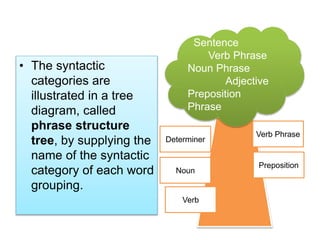
• The syntactic
categories are
illustrated in a tree
diagram, called
phrase structure
tree, by supplying the
name of the syntactic
category of each word
grouping.
Sentence
Verb Phrase
Noun Phrase
Adjective
Preposition
Phrase
Determiner
Noun
Verb
Verb Phrase
Preposition
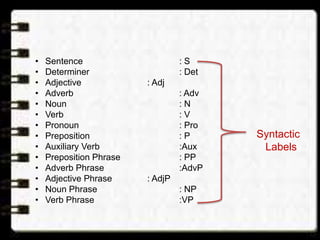
These names are often referred to as
syntactic labels(usually written by the
initials of the categories ), such as:
• Sentence : S
• Determiner : Det
• Adjective : Adj
• Adverb : Adv
• Noun : N
• Verb : V
• Pronoun : Pro
• Preposition : P
• Auxiliary Verb :Aux
• Preposition Phrase : PP
• Adverb Phrase :AdvP
• Adjective Phrase : AdjP
• Noun Phrase : NP
• Verb Phrase :VP
Syntactic
Labels
Dealing with the phrase
structure grammars as a part
of syntactic category, it is
important to comprehend the
concepts of:
Noun Phrase (NP)
Adjective Phrase (AdjP)
Verb Phrase (VP)
Adverb Phrase (AdvP), and
Preposition Phrase (PP).
But first of all, let us see
what the definition of
PHRASE is.
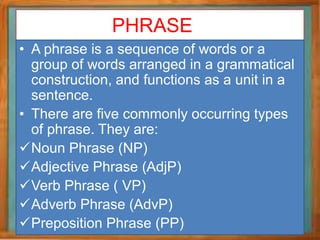
PHRASE
• A phrase is a sequence of words or a
group of words arranged in a grammatical
construction, and functions as a unit in a
sentence.
• There are five commonly occurring types
of phrase. They are:
Noun Phrase (NP)
Adjective Phrase (AdjP)
Verb Phrase ( VP)
Adverb Phrase (AdvP)
Preposition Phrase (PP)
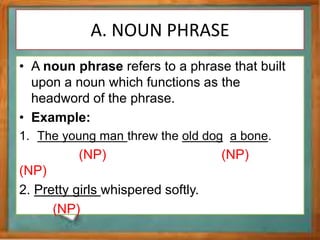
A. NOUN PHRASE
• A noun phrase refers to a phrase that built
upon a noun which functions as the
headword of the phrase.
• Example:
1. The young man threw the old dog a bone.
(NP) (NP)
(NP)
2. Pretty girls whispered softly.
(NP)
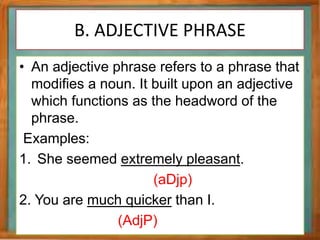
B. ADJECTIVE PHRASE
• An adjective phrase refers to a phrase that
modifies a noun. It built upon an adjective
which functions as the headword of the
phrase.
Examples:
1. She seemed extremely pleasant.
(aDjp)
2. You are much quicker than I.
(AdjP)
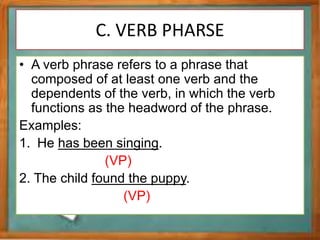
C. VERB PHARSE
• A verb phrase refers to a phrase that
composed of at least one verb and the
dependents of the verb, in which the verb
functions as the headword of the phrase.
Examples:
1. He has been singing.
(VP)
2. The child found the puppy.
(VP)
D. ADVERB PHRASE
• An adverb phrase refers to a phrase that
often plays the role of telling us when ,
where, why, or how an event occurred, in
which the adverb functions as the
headword of the phrase.
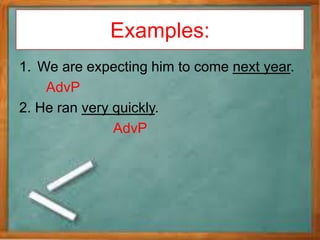
Examples:
1. We are expecting him to come next year.
AdvP
2. He ran very quickly.
AdvP
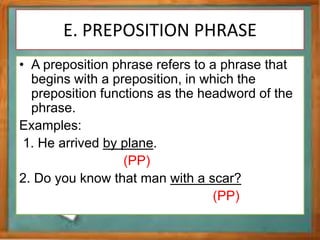
E. PREPOSITION PHRASE
• A preposition phrase refers to a phrase that
begins with a preposition, in which the
preposition functions as the headword of the
phrase.
Examples:
1. He arrived by plane.
(PP)
2. Do you know that man with a scar?
(PP)
PHRASE STRUCTURE TREE
• Phrase structure tree (also called
constituent structure tree), is a tree
diagram with syntactic category
information provided. A phrase structure
tree shows that a sentence is both linear
string of words and hierarchical structure
with phrases nested in phrases
(combination of phrase structures)
• A phrase structure tree is a formal device
for representing speaker’s knowledge
about phrase structure in speech.
For instance, we can make the phrase structure
tree the following sentence:
“The child found the puppy”
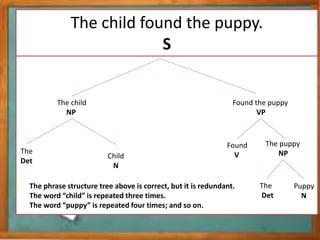
The child found the puppy.
S
The child
NP
Found the puppy
VP
The
Det
Child
N
Found
V
The puppy
NP
The
Det
Puppy
N
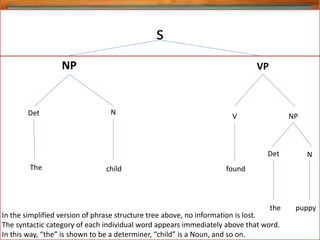
The phrase structure tree above is correct, but it is redundant.
The word “child” is repeated three times.
The word “puppy” is repeated four times; and so on.
• We can streamline by writing the words only
once at the bottom of the diagram.
• Thus, the phrase structure tree of the
sentence above can be shown below:
s
NP VP
Det N
V NP
Det N
The child found
the puppy
In the simplified version of phrase structure tree above, no information is lost.
The syntactic category of each individual word appears immediately above that word.
In this way, “the” is shown to be a determiner, “child” is a Noun, and so on.
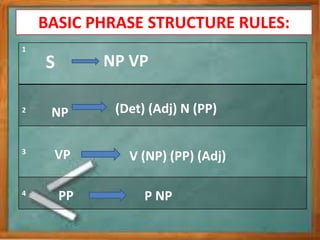
BASIC PHRASE STRUCTURE RULES:
1
2
3
4
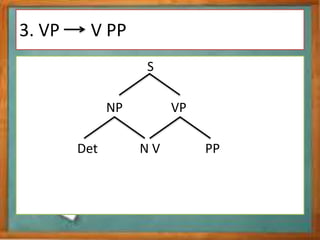
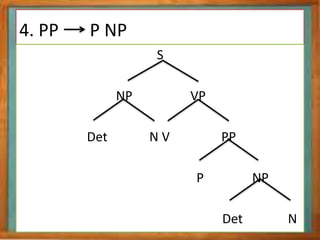
NP VPS
NP (Det) (Adj) N (PP)
VP V (NP) (PP) (Adj)
PP P NP
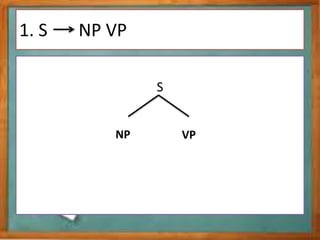
1. S NP VP
S
NP VP
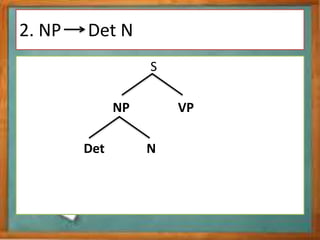
2. NP Det N
S
NP VP
Det N
3. VP V PP
S
NP VP
Det N V PP
4. PP P NP
S
NP VP
Det N V PP
P NP
Det N
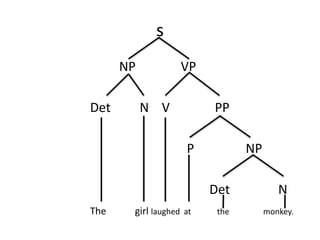
s
NP VP
Det N V PP
P NP
Det N
The girl laughed at the monkey.
LET’S TRY …
EXERCISES:
1. The angry bear chased the frightened
little squirrel.
2. The dog saw a man in the park.
3. Meagan is a trainer.
4. The dog is sleeping on the porch.
Syntax

Syntax

  • 2.
    Think ????? What isthat enables us to produce and understand an infinite number of sentences?
  • 3.
    Unlike words, sentencesare not finite in number, and are not learned individually. However, native speakers of a language can use and understand sentences in their language that they have not previously encountered.
  • 4.
  • 5.
    Knowing a languageincludes the ability to construct phrases and sentences out of morphemes and words. The part of grammar that represents a speaker’s knowledge of these structures and their formation is called SYNTAX. In other words, SYNTAX is the study of sentence patterns of language.
  • 6.
    • The aimof this study is to show you what syntactic structure is and what are the rules that determine syntactic structure are like. • What is meant by “structure” here, is word order. The meaning of a sentence depends on the order in which words occur in a sentence.
  • 7.
    Compare the followingsentences: I sing because I am happy. I am happy because I sing. The two sentences above have the same categories and number of words, but different in structure (word order):thus, they have different meanings.
  • 8.
    SYNTACTIC CATEGORY Syntactic Categoryis a set of words and/or phrases in a language which share a significant number of common characteristics. Syntactic categories commonly include: 1. Parts of Speech (Determiner,Adjective,Noun,Pronoun,Prepos ition,Adverb,Auxiliary,Verb),etc;
  • 9.
    2. Phrase StructureGrammars: (Noun, Phrase, Adjective Phrase, Verb Phrase, Adverb Phrase, Preposition Phrase);and 3. Sentence, as the core of the structure.
  • 10.
    • The syntactic categoriesare illustrated in a tree diagram, called phrase structure tree, by supplying the name of the syntactic category of each word grouping. Sentence Verb Phrase Noun Phrase Adjective Preposition Phrase Determiner Noun Verb Verb Phrase Preposition
  • 11.
    These names areoften referred to as syntactic labels(usually written by the initials of the categories ), such as:
  • 12.
    • Sentence :S • Determiner : Det • Adjective : Adj • Adverb : Adv • Noun : N • Verb : V • Pronoun : Pro • Preposition : P • Auxiliary Verb :Aux • Preposition Phrase : PP • Adverb Phrase :AdvP • Adjective Phrase : AdjP • Noun Phrase : NP • Verb Phrase :VP Syntactic Labels
  • 13.
    Dealing with thephrase structure grammars as a part of syntactic category, it is important to comprehend the concepts of: Noun Phrase (NP) Adjective Phrase (AdjP) Verb Phrase (VP) Adverb Phrase (AdvP), and Preposition Phrase (PP). But first of all, let us see what the definition of PHRASE is.
  • 14.
    PHRASE • A phraseis a sequence of words or a group of words arranged in a grammatical construction, and functions as a unit in a sentence. • There are five commonly occurring types of phrase. They are: Noun Phrase (NP) Adjective Phrase (AdjP) Verb Phrase ( VP) Adverb Phrase (AdvP) Preposition Phrase (PP)
  • 15.
    A. NOUN PHRASE •A noun phrase refers to a phrase that built upon a noun which functions as the headword of the phrase. • Example: 1. The young man threw the old dog a bone. (NP) (NP) (NP) 2. Pretty girls whispered softly. (NP)
  • 16.
    B. ADJECTIVE PHRASE •An adjective phrase refers to a phrase that modifies a noun. It built upon an adjective which functions as the headword of the phrase. Examples: 1. She seemed extremely pleasant. (aDjp) 2. You are much quicker than I. (AdjP)
  • 17.
    C. VERB PHARSE •A verb phrase refers to a phrase that composed of at least one verb and the dependents of the verb, in which the verb functions as the headword of the phrase. Examples: 1. He has been singing. (VP) 2. The child found the puppy. (VP)
  • 18.
    D. ADVERB PHRASE •An adverb phrase refers to a phrase that often plays the role of telling us when , where, why, or how an event occurred, in which the adverb functions as the headword of the phrase.
  • 19.
    Examples: 1. We areexpecting him to come next year. AdvP 2. He ran very quickly. AdvP
  • 20.
    E. PREPOSITION PHRASE •A preposition phrase refers to a phrase that begins with a preposition, in which the preposition functions as the headword of the phrase. Examples: 1. He arrived by plane. (PP) 2. Do you know that man with a scar? (PP)
  • 21.
    PHRASE STRUCTURE TREE •Phrase structure tree (also called constituent structure tree), is a tree diagram with syntactic category information provided. A phrase structure tree shows that a sentence is both linear string of words and hierarchical structure with phrases nested in phrases (combination of phrase structures)
  • 22.
    • A phrasestructure tree is a formal device for representing speaker’s knowledge about phrase structure in speech.
  • 23.
    For instance, wecan make the phrase structure tree the following sentence: “The child found the puppy”
  • 24.
    The child foundthe puppy. S The child NP Found the puppy VP The Det Child N Found V The puppy NP The Det Puppy N The phrase structure tree above is correct, but it is redundant. The word “child” is repeated three times. The word “puppy” is repeated four times; and so on.
  • 25.
    • We canstreamline by writing the words only once at the bottom of the diagram. • Thus, the phrase structure tree of the sentence above can be shown below:
  • 26.
    s NP VP Det N VNP Det N The child found the puppy In the simplified version of phrase structure tree above, no information is lost. The syntactic category of each individual word appears immediately above that word. In this way, “the” is shown to be a determiner, “child” is a Noun, and so on.
  • 27.
    BASIC PHRASE STRUCTURERULES: 1 2 3 4 NP VPS NP (Det) (Adj) N (PP) VP V (NP) (PP) (Adj) PP P NP
  • 28.
    1. S NPVP S NP VP
  • 29.
    2. NP DetN S NP VP Det N
  • 30.
    3. VP VPP S NP VP Det N V PP
  • 31.
    4. PP PNP S NP VP Det N V PP P NP Det N
  • 32.
    s NP VP Det NV PP P NP Det N The girl laughed at the monkey.
  • 33.
  • 34.
    EXERCISES: 1. The angrybear chased the frightened little squirrel. 2. The dog saw a man in the park. 3. Meagan is a trainer. 4. The dog is sleeping on the porch.