Current Issues on Education

Outcomes-Based Education
Theory, Curriculum and Practice

Presented by:
MARK P. ARMENTA
Survey about OBE
1. A teacher will not stop teaching until all
of the students learn.
2. Output with considerable time.
3. Product and practical exam.
4. Adjust program for assessments.
5. Ob-gynecologist
6. More on performance
7. We can teach in high school or college.
8. Assessment of outputs.
9. Extra income.
3 Different Views about OBE

1. As a theory in
education.
2. As a systemic
structure for education.
3. As a classroom
practice.
(From Dr. Roy Killen of the University of New Castle in Australia
Presupposition

Someone can
determine what things
are essential for all
students “to be able
to do”.
Example: Agriculturist
What do you think an agriculturist should
be able to do?
1. Soil Analysis
2. Fertilizer Computation
3. Proper use of Tools
4. Methods of Planting
5. Asexual Reproduction
6. Harvesting
7. Proper Handling in Transportation
Example: Doctor
What do you think a doctor should be able
to do?
1. Clinical Skills
2. Perform Practical Procedures
3. Investigate a Patient
4. Manage a Patient
5. Health Promotion and Disease Prevention

6. Skills of Communication
7. Retrieve and Handle Information
Two Common Approaches to OBE
1. Student mastery of traditional
subject-related academic
outcomes and some crossdiscipline.
2. Emphasizes long-term, crosscurricular outcomes that are
related to students’ future life
roles.
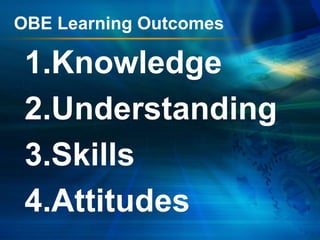
OBE Learning Outcomes

1.Knowledge
2.Understanding
3.Skills
4.Attitudes
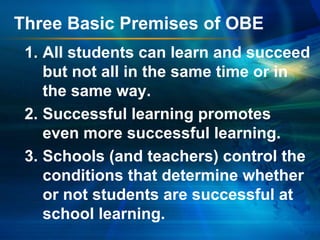
Three Basic Premises of OBE
1. All students can learn and succeed
but not all in the same time or in
the same way.
2. Successful learning promotes
even more successful learning.
3. Schools (and teachers) control the
conditions that determine whether
or not students are successful at
school learning.
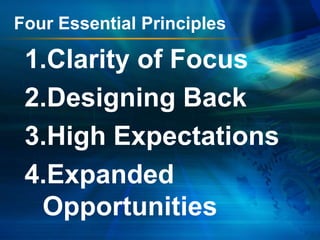
Four Essential Principles

1.Clarity of Focus
2.Designing Back
3.High Expectations
4.Expanded
Opportunities
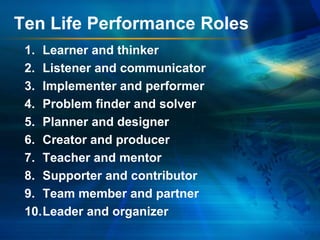
Ten Life Performance Roles
1. Learner and thinker
2. Listener and communicator
3. Implementer and performer
4. Problem finder and solver
5. Planner and designer
6. Creator and producer
7. Teacher and mentor
8. Supporter and contributor
9. Team member and partner
10.Leader and organizer
OBE as a curriculum

Three Basic Styles of
Programming
1. Content-based
2. Activities-based
3. Outcomes-based
OBE Programming
Rationale – explain why the program exists.
Aims – explain what the program can achieve.
Outcome Statements- indicate what students
are to learn
Content Statements – indicate what broad areas
of content will be used as vehicles for
student learning.
Teaching Strategy Statement – indicate how the
learning activities will be organized.
Assessment Guidelines – indicate how student
learning will be assessed and reported.
OBE vs. Content Based
OBE Curriculum Outcome
Skills in problem solving and decision making.
Individual lesson under OBE
Use a spreadsheet to develop a what-if scenario to
generate possible solutions to a financial problem.
Content Base Subject
Computer Studies
Individual lesson under content-based
Summarize the steps involved in producing a solution to
a problem.
The Issue of Integration
1. Key competencies were not based on
isolated subjects.
2. KLA (Key learning areas) will be used instead
of subjects through “clustering” process.

Example outcome: Learners show critical
awareness of language usage.
Question: Can an English subject alone
accomplish the
learning outcome?
OBE in the Classrooms
1. Review essential prerequisites.
2. Create a positive learning environment.
3. Help students to understand what they have
to learn.
4. Use a variety of methods.
- Whole class instruction
- Group instruction
- Individual instruction

5. Provide sufficient opportunities
6. Personal closure to the lesson.
Assessment in OBE
1. A student can have a grade of
incomplete.
2. Emphasizes the record keeping by the
students.
3. Uses criterion-referenced assessment.
4. Uses SOLO taxonomy – an
individualized assessment procedure.
SOLO – Structure of Observed Learning
Outcomes
Questions?
Thank You!
For listening and cooperating!

Outcomes based education

  • 1.
    Current Issues onEducation Outcomes-Based Education Theory, Curriculum and Practice Presented by: MARK P. ARMENTA
  • 2.
    Survey about OBE 1.A teacher will not stop teaching until all of the students learn. 2. Output with considerable time. 3. Product and practical exam. 4. Adjust program for assessments. 5. Ob-gynecologist 6. More on performance 7. We can teach in high school or college. 8. Assessment of outputs. 9. Extra income.
  • 3.
    3 Different Viewsabout OBE 1. As a theory in education. 2. As a systemic structure for education. 3. As a classroom practice. (From Dr. Roy Killen of the University of New Castle in Australia
  • 4.
    Presupposition Someone can determine whatthings are essential for all students “to be able to do”.
  • 5.
    Example: Agriculturist What doyou think an agriculturist should be able to do? 1. Soil Analysis 2. Fertilizer Computation 3. Proper use of Tools 4. Methods of Planting 5. Asexual Reproduction 6. Harvesting 7. Proper Handling in Transportation
  • 6.
    Example: Doctor What doyou think a doctor should be able to do? 1. Clinical Skills 2. Perform Practical Procedures 3. Investigate a Patient 4. Manage a Patient 5. Health Promotion and Disease Prevention 6. Skills of Communication 7. Retrieve and Handle Information
  • 7.
    Two Common Approachesto OBE 1. Student mastery of traditional subject-related academic outcomes and some crossdiscipline. 2. Emphasizes long-term, crosscurricular outcomes that are related to students’ future life roles.
  • 8.
  • 9.
    Three Basic Premisesof OBE 1. All students can learn and succeed but not all in the same time or in the same way. 2. Successful learning promotes even more successful learning. 3. Schools (and teachers) control the conditions that determine whether or not students are successful at school learning.
  • 10.
    Four Essential Principles 1.Clarityof Focus 2.Designing Back 3.High Expectations 4.Expanded Opportunities
  • 11.
    Ten Life PerformanceRoles 1. Learner and thinker 2. Listener and communicator 3. Implementer and performer 4. Problem finder and solver 5. Planner and designer 6. Creator and producer 7. Teacher and mentor 8. Supporter and contributor 9. Team member and partner 10.Leader and organizer
  • 12.
    OBE as acurriculum Three Basic Styles of Programming 1. Content-based 2. Activities-based 3. Outcomes-based
  • 13.
    OBE Programming Rationale –explain why the program exists. Aims – explain what the program can achieve. Outcome Statements- indicate what students are to learn Content Statements – indicate what broad areas of content will be used as vehicles for student learning. Teaching Strategy Statement – indicate how the learning activities will be organized. Assessment Guidelines – indicate how student learning will be assessed and reported.
  • 14.
    OBE vs. ContentBased OBE Curriculum Outcome Skills in problem solving and decision making. Individual lesson under OBE Use a spreadsheet to develop a what-if scenario to generate possible solutions to a financial problem. Content Base Subject Computer Studies Individual lesson under content-based Summarize the steps involved in producing a solution to a problem.
  • 15.
    The Issue ofIntegration 1. Key competencies were not based on isolated subjects. 2. KLA (Key learning areas) will be used instead of subjects through “clustering” process. Example outcome: Learners show critical awareness of language usage. Question: Can an English subject alone accomplish the learning outcome?
  • 16.
    OBE in theClassrooms 1. Review essential prerequisites. 2. Create a positive learning environment. 3. Help students to understand what they have to learn. 4. Use a variety of methods. - Whole class instruction - Group instruction - Individual instruction 5. Provide sufficient opportunities 6. Personal closure to the lesson.
  • 17.
    Assessment in OBE 1.A student can have a grade of incomplete. 2. Emphasizes the record keeping by the students. 3. Uses criterion-referenced assessment. 4. Uses SOLO taxonomy – an individualized assessment procedure. SOLO – Structure of Observed Learning Outcomes
  • 18.
  • 19.
    Thank You! For listeningand cooperating!