INTRODUCTION
• Change is a constant of nature. It always bring improvement.
It always occurs continuously. Technological advancement
and explosion of knowledge is the basic reasons for wearing
styles of change. Change is an ongoing almost unconscious
process that involve reworking familiar elements into new
relationship
DEFINITION
Curriculum change can be defined as an efforts made by
education authorities to change and adapt there aims and
objectives of teaching and learning according to the
values, culture, philosophy as well the resources at their
disposal.
( the common wealth secretariat Module 3 1998)
Curriculum changes can be defined as , making
the curriculum different in some way, to give it a
new position or direction.
NEED FOR CURRICULUM CHANGE
 To restructure the curriculum according to the needs of
the learners society
 To eliminate unnecessary units , teaching methods and
contents
 To introduce latest and update method of teaching and
content , new knowledge and practices.
 To add or delete number of clinical hours of
instruction.
 There is too much emphasize on the subject matter.
FACTORS INFLUENCING THE CURRICULUM CHANGE
• Influential individuals
strong leadership accepted
by the academic staff. That
have the capacity to attract
other academic staff to rally
behind principled
educational objectives that
are supported within the
environment.
•FINANCIAL
PRESSURES
Clearly there are
powerful budgetary
forces that influence
our decisions .
•STAFFING ISSUES
Including workload
we have commented
on financial matters,
and the effect that they
can have on
curriculum decisions.
•Student abilities
In an ideal world, our programs
would be dictated by our
desires to create graduates of
the highest possible calibre.
And, were we capable of
sourcing the correct raw
material in sufficient quantity,
perhaps we could achieve that
goal
• UNIVERSITY AND GOVERNMENT REGULATION
University administration increasingly push
the case for efficient use of resources.
While the number of programs offered in
our discipline has been growing for a long
time, and the closing down of programs is
uncommon.There is usually considerable
pressure to discontinue low-enrolment
subjects.
PHASES OF CURRICULUM CHANGE
Planning phase
• During this phase the curriculum should be reviewed by a
committee to identify areas that need to be changed.
• The objectives, learning experiences provided, teaching and
learning activities need to be studied.
• The objectives and philosophies should be examined
• The changes takes place at various levels
• It may be necessary to arrange for orientation programme for
the staff to prepare them for change and to overcome resistance
to change.
Implementation phase
• Once the curriculum plan has been finalized the course
modification steps have to be taken
• The change plan will be implemented by formulating
objectives, course content, learning method, teaching
approaches and evaluation procedures.
• Appropriate learning experience have to be provided to the
students. New teaching methods also may have to be
accepted according to change.
Evaluation phase
• Evaluation must be used to monitor the progress of the
students learning to determine the extent to which the
objectives have been achieved and to find ways of improving
teaching learning methods.
• This will be give feedback to the planners and should be
made to further improvement of curriculum.
• Most of the changes in education in India come as a result of
National of state government recommendation or directions
from university or Board of Education
Process of Adoption
INNOVATION
Insiders,
faculty of
CON
ADOPTION
Outsiders,staff from
clinicals, validatory
agencies.
Change
stategies
STAGES OF CURRICULUM CHANGES
• Stage 1
Formulating curriculum
committee
Stage 2
• Appraise the existing nursing and
educational practices which are
representative of the currently operating
curriculum. Study carefully the existing
curriculum and identify its strength and
weakness by considering its overall
intension and purposes, including the
basic values and beliefs which are
currently the part of the institutes
philosophies.
Stage 3
• Make a detailed study of the
existing curriculum content
to see whether it is still
relevant and appropriate to
meet a knowledge base
adequate for the changing
role of the professional
nurse
Stage 4
• Establish criteria for
decisions about what needs
go into the curriculum and
what needs to come out
and how the curriculum
materials and methods
might be changed.
Stage 5
• This involves the design and
writing of the new curriculum
changes and these may include the
revised philosophy and aims of the
curriculum including the new
intension and purposes. it also
include the revised objectives and
the reformed content along with
any new teaching learning
approaches.
Stage 6
• Within this stage the actual
implementation of changes is
put into action
• implementing the changes
successfully involves
• having knowledge of the
changes and the securing of the
participation of those people
necessary to enable the
implementation
Stage 7
• Following the
implementation of the
new changes it is
important to evaluate the
effects of those changes
and it is with evaluation
that this final stage is
concerned
BEHAVIOUR OBJECTIVE MODEL
•PRODUCT MODEL OR BEHAVIOURAL-
OBJECTIVES MODEL
• One of the best known curriculum models is ‘The Tyler
Model’, introduced in 1949 by Ralph Tyler.
• He viewed education as “ a process of changing the
behavior patterns of people, using behavior in the broad
sense to include thinking & feeling as well as over
action.
STENHOUSE’S PROCESS MODEL
• Lawrence Stenhouse(1975) formulated the process model.
• It views curriculum as a process, and stressing on interaction
between teachers and pupil, pupils and pupils.
• Pupils are not passive objects, they should be given the
opportunity to voice their opinions and views.
• Teaching objectives and teaching methods are not
predetermined.
LAWTON’S CULTURAL ANALYSIS MODEL
• This model was a reaction against what he saw as the dangers of the
behavioural objectives model.
• This model proposals a curriculum plant on the technique of cultural
analysis.
• Culture is defined as the whole way of life of the society and the
purpose of education is to make available to the next generation what
we regard as the most important aspects of culture
• Curriculum developed from culture.
MODEL
• 1 . Cultural invariants – this examines all the aspects that
human societies have in common, such as economic and
model aspects, beliefs and other system.
• 2- cultural variables- involves analysing the differences
between cultures in each of the system.
• 3- selection from the culuture- this stage consists of the
cultural analysis of the system with the existing school
curriculum
• 4- curriculum organization – curriculum developed on the
basis of curriculum analysis.
Wheeler model
• Wheeler model upon curriculum design is an improvement upon
Tylers model.
• Instead of a linear model , Wheeler develop a cyclical model .
evaluation in wheelers model is not terminal.
• Finding from the evaluationare feedback into the objectives and the
goals, which influence other stages.
• Tyler model is vertical it did not recognize the relationship between
various curriculum elements.
Taba model
• Another approach to curriculum development was
proposed by Hilda Taba in 1962.
• Taba proposed 7 major steps to her grass root model in
which teachers would have major inputs through out
the curriculum development process.
Evaluation Diagnosis of
needs
Development
of objectives
Selection
of contentOrganization
of content
Selection of
learning
experience
Organization
of learning
experience
Taba
model
Teacher
input
Teacher
input
THE CLIMATE OF THE SCHOOL/
COLLEGE
1. Open
the head is hardworking,
flexible and prepared to make
rules and criticize when
necessary; monitoring is not
too close. Staff morale is high
and relationships are good.
2.Autonomous
the head is less obvious than the
Open style . Allowing staff more
autonomy but providing less
positive leadership. Staff special
needs are less well scattered for
but teachers feel a sense of
accomplishment of task.
3. Controlled
the head makes the
staff work hard and is a
directory with little
scope for staff
satisfaction socially. Staff
response to this end
gain task achievement
satisfaction.
4. Familiar
that gives very little
leadership but create a
happy atmosphere for staff.
Morale is low because they
lack direction.
5. Paternal
The head has little
influence over the staff
who see her as interfering
rather than leading. There
is not much achievement
even though staff gets on
with the job and the heads
approach to social needs is
seen as insincere.
6. Closed
The head is distant and
aloof. Giving no leadership
and taking no personal
interest in the staff as
people. There is little job
satisfaction.
R0LE OF PERSONELS
EDUCATIONALADMINISTRATORS ROLE
• To ensure the educational policies and goal and properly
reflected by the curriculum.
• Responsible for the realization of the curriculum goals
through its effective implementation.
• Try-out is made properly and necessary modifications are
carried out.
• Care of proper priorities to be given to different programmes
at different levels
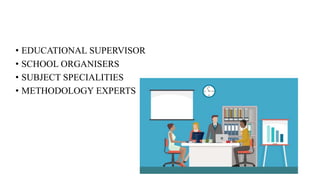
• EDUCATIONAL SUPERVISOR
• SCHOOL ORGANISERS
• SUBJECT SPECIALITIES
• METHODOLOGY EXPERTS
ROLE OF EDUCATIONAL SUPERVISOR
• active participants in curriculum development
• guides of Curriculum implementation
• evaluation of Curriculum
• curriculum reformers
ROLE OF SCHOOL ORGANISERS
• curriculum implementers
• curriculum evaluators
ROLE OF SUBJECT SPECIALITIES
• determine of the curriculum
• frames of the syllabus
• writers the textbook, hand books
ROLE OF METHODOLOGY EXPERTS
• curriculum planners
• syllabus makers
• text book and hand book writers
• curriculum evaluators curriculum reviews
Role of principal in curriculum change
• The role includes both administrative and leadership role.
• The principle should act as a passionate leader and role model
for educational renewal
• needs the knowledge expertise and experience to lead and
manage curriculum change
• understand the need for change as well as the steps that have
to be taken along the way.
• They should have in depth knowledge about the planed
change and of the implementation process
• They should be accessible and willing to communicate with
others involved in the process
• They should be able to convince parents on the merits of the
new curriculum and how the new pedagogical strategies can
become more meaningful for their children.
• They must be committed to the change and be able to employ
a variety of leadership strategies
ROLE OF TEACHERS
The teacher is the heart of the curriculum
• Teachers act as change agent where they find themselves at the
forefront of educational change
• To lead in the reviewing the faculty work annually
• Teachers should be given adequate opportunities to carry
instructional experimentalism in the classroom setting
• Publish current schemes of work and a departmental handbook and
ensure they are updated.
• The teacher has to study the course content and methods of teaching
and learning experience provides
ROLE OF THE STUDENTS
• Student should be the member of the curriculum change team
so that they can represents suggestions , ideas of the student
community.
• Opinion and interest of the students is very much important
regard with method of teaching.
• It is the responsibilities of the student to orient with up to date
health events, needs and problems of the student community.
CURRICULUM EVALUATION
Definition
•Evaluation is a process of ascertaining the worth or
significance of something by detailed study and
appraisal.
•It is a systematic process of determining the extent to
which educational objectives are achieved by pupil.
Need for curriculum evaluation
• It helps to clarify objectives and also to know the
extent of objectives achieved
• It leads to improvement of instruction and the teaching
learning process , motivates the students , determines
the student level of knowledge , skills and attitudes at
intervals and finally the learner can be promoted to
next grade.
• Diagnosis difficulty in curriculum process ; with the
individual student or class teachers as well as for
teaching learning activities.
•Helps in gathering information for administrative
purpose.
•It is a mean to assess the performance trends of
teachers and students in certain achievement areas.
•It provides quality control in education.
•It helps in finding out the usage of new material which
will satisfy the purpose and the objectives of
curriculum develops have in mind.
•Evaluation helps in modifying curriculum to
adequately meet the growing challenges.
LEVELS OF CURRICULUM EVALUATION
• Formative evaluation
• Summative evaluation
Formative evaluation
It measures the progress made by the student during the studies.
Advantages
• It is ongoing process.
• Its purpose is to improve the instructional methods and materials so
that greater student learning will result.
• It provides the teacher with qualitative and quantitative data for
modification of teaching.
• It helps the student to identify learning difficulties.
• It helps the teachers to plan according to the needs of the students.
• It measures the progress or gains made by the students from beginning
to the completion of the programme.
Summative evaluation
Summative evaluation is done after the planned curriculum is
implemented fully and to determine the degree to which curriculum is
effective in meeting the instructional objective.
• Purpose
• To appraise the overall effectiveness of a curriculum programme.
• To select most appropriate curriculum
• It is done at the end of the course to see if students achieved the course
objectives.
• It is done as a formal list covering the content of the course.
• It protect the society by preventing incompetent personnel from
practicing.
Curriculum change

Curriculum change

  • 2.
    INTRODUCTION • Change isa constant of nature. It always bring improvement. It always occurs continuously. Technological advancement and explosion of knowledge is the basic reasons for wearing styles of change. Change is an ongoing almost unconscious process that involve reworking familiar elements into new relationship
  • 3.
    DEFINITION Curriculum change canbe defined as an efforts made by education authorities to change and adapt there aims and objectives of teaching and learning according to the values, culture, philosophy as well the resources at their disposal. ( the common wealth secretariat Module 3 1998)
  • 4.
    Curriculum changes canbe defined as , making the curriculum different in some way, to give it a new position or direction.
  • 5.
    NEED FOR CURRICULUMCHANGE  To restructure the curriculum according to the needs of the learners society  To eliminate unnecessary units , teaching methods and contents  To introduce latest and update method of teaching and content , new knowledge and practices.  To add or delete number of clinical hours of instruction.  There is too much emphasize on the subject matter.
  • 6.
    FACTORS INFLUENCING THECURRICULUM CHANGE • Influential individuals strong leadership accepted by the academic staff. That have the capacity to attract other academic staff to rally behind principled educational objectives that are supported within the environment.
  • 7.
    •FINANCIAL PRESSURES Clearly there are powerfulbudgetary forces that influence our decisions .
  • 8.
    •STAFFING ISSUES Including workload wehave commented on financial matters, and the effect that they can have on curriculum decisions.
  • 9.
    •Student abilities In anideal world, our programs would be dictated by our desires to create graduates of the highest possible calibre. And, were we capable of sourcing the correct raw material in sufficient quantity, perhaps we could achieve that goal
  • 10.
    • UNIVERSITY ANDGOVERNMENT REGULATION University administration increasingly push the case for efficient use of resources. While the number of programs offered in our discipline has been growing for a long time, and the closing down of programs is uncommon.There is usually considerable pressure to discontinue low-enrolment subjects.
  • 11.
    PHASES OF CURRICULUMCHANGE Planning phase • During this phase the curriculum should be reviewed by a committee to identify areas that need to be changed. • The objectives, learning experiences provided, teaching and learning activities need to be studied. • The objectives and philosophies should be examined • The changes takes place at various levels • It may be necessary to arrange for orientation programme for the staff to prepare them for change and to overcome resistance to change.
  • 12.
    Implementation phase • Oncethe curriculum plan has been finalized the course modification steps have to be taken • The change plan will be implemented by formulating objectives, course content, learning method, teaching approaches and evaluation procedures. • Appropriate learning experience have to be provided to the students. New teaching methods also may have to be accepted according to change.
  • 13.
    Evaluation phase • Evaluationmust be used to monitor the progress of the students learning to determine the extent to which the objectives have been achieved and to find ways of improving teaching learning methods. • This will be give feedback to the planners and should be made to further improvement of curriculum. • Most of the changes in education in India come as a result of National of state government recommendation or directions from university or Board of Education
  • 14.
    Process of Adoption INNOVATION Insiders, facultyof CON ADOPTION Outsiders,staff from clinicals, validatory agencies. Change stategies
  • 15.
    STAGES OF CURRICULUMCHANGES • Stage 1 Formulating curriculum committee
  • 16.
    Stage 2 • Appraisethe existing nursing and educational practices which are representative of the currently operating curriculum. Study carefully the existing curriculum and identify its strength and weakness by considering its overall intension and purposes, including the basic values and beliefs which are currently the part of the institutes philosophies.
  • 17.
    Stage 3 • Makea detailed study of the existing curriculum content to see whether it is still relevant and appropriate to meet a knowledge base adequate for the changing role of the professional nurse
  • 18.
    Stage 4 • Establishcriteria for decisions about what needs go into the curriculum and what needs to come out and how the curriculum materials and methods might be changed.
  • 19.
    Stage 5 • Thisinvolves the design and writing of the new curriculum changes and these may include the revised philosophy and aims of the curriculum including the new intension and purposes. it also include the revised objectives and the reformed content along with any new teaching learning approaches.
  • 20.
    Stage 6 • Withinthis stage the actual implementation of changes is put into action • implementing the changes successfully involves • having knowledge of the changes and the securing of the participation of those people necessary to enable the implementation
  • 21.
    Stage 7 • Followingthe implementation of the new changes it is important to evaluate the effects of those changes and it is with evaluation that this final stage is concerned
  • 23.
    BEHAVIOUR OBJECTIVE MODEL •PRODUCTMODEL OR BEHAVIOURAL- OBJECTIVES MODEL • One of the best known curriculum models is ‘The Tyler Model’, introduced in 1949 by Ralph Tyler. • He viewed education as “ a process of changing the behavior patterns of people, using behavior in the broad sense to include thinking & feeling as well as over action.
  • 26.
    STENHOUSE’S PROCESS MODEL •Lawrence Stenhouse(1975) formulated the process model. • It views curriculum as a process, and stressing on interaction between teachers and pupil, pupils and pupils. • Pupils are not passive objects, they should be given the opportunity to voice their opinions and views. • Teaching objectives and teaching methods are not predetermined.
  • 27.
    LAWTON’S CULTURAL ANALYSISMODEL • This model was a reaction against what he saw as the dangers of the behavioural objectives model. • This model proposals a curriculum plant on the technique of cultural analysis. • Culture is defined as the whole way of life of the society and the purpose of education is to make available to the next generation what we regard as the most important aspects of culture • Curriculum developed from culture.
  • 28.
    MODEL • 1 .Cultural invariants – this examines all the aspects that human societies have in common, such as economic and model aspects, beliefs and other system. • 2- cultural variables- involves analysing the differences between cultures in each of the system. • 3- selection from the culuture- this stage consists of the cultural analysis of the system with the existing school curriculum • 4- curriculum organization – curriculum developed on the basis of curriculum analysis.
  • 29.
    Wheeler model • Wheelermodel upon curriculum design is an improvement upon Tylers model. • Instead of a linear model , Wheeler develop a cyclical model . evaluation in wheelers model is not terminal. • Finding from the evaluationare feedback into the objectives and the goals, which influence other stages. • Tyler model is vertical it did not recognize the relationship between various curriculum elements.
  • 31.
    Taba model • Anotherapproach to curriculum development was proposed by Hilda Taba in 1962. • Taba proposed 7 major steps to her grass root model in which teachers would have major inputs through out the curriculum development process.
  • 32.
    Evaluation Diagnosis of needs Development ofobjectives Selection of contentOrganization of content Selection of learning experience Organization of learning experience Taba model Teacher input Teacher input
  • 33.
    THE CLIMATE OFTHE SCHOOL/ COLLEGE 1. Open the head is hardworking, flexible and prepared to make rules and criticize when necessary; monitoring is not too close. Staff morale is high and relationships are good. 2.Autonomous the head is less obvious than the Open style . Allowing staff more autonomy but providing less positive leadership. Staff special needs are less well scattered for but teachers feel a sense of accomplishment of task.
  • 34.
    3. Controlled the headmakes the staff work hard and is a directory with little scope for staff satisfaction socially. Staff response to this end gain task achievement satisfaction. 4. Familiar that gives very little leadership but create a happy atmosphere for staff. Morale is low because they lack direction.
  • 35.
    5. Paternal The headhas little influence over the staff who see her as interfering rather than leading. There is not much achievement even though staff gets on with the job and the heads approach to social needs is seen as insincere. 6. Closed The head is distant and aloof. Giving no leadership and taking no personal interest in the staff as people. There is little job satisfaction.
  • 36.
    R0LE OF PERSONELS EDUCATIONALADMINISTRATORSROLE • To ensure the educational policies and goal and properly reflected by the curriculum. • Responsible for the realization of the curriculum goals through its effective implementation. • Try-out is made properly and necessary modifications are carried out. • Care of proper priorities to be given to different programmes at different levels
  • 37.
    • EDUCATIONAL SUPERVISOR •SCHOOL ORGANISERS • SUBJECT SPECIALITIES • METHODOLOGY EXPERTS
  • 38.
    ROLE OF EDUCATIONALSUPERVISOR • active participants in curriculum development • guides of Curriculum implementation • evaluation of Curriculum • curriculum reformers
  • 39.
    ROLE OF SCHOOLORGANISERS • curriculum implementers • curriculum evaluators ROLE OF SUBJECT SPECIALITIES • determine of the curriculum • frames of the syllabus • writers the textbook, hand books
  • 40.
    ROLE OF METHODOLOGYEXPERTS • curriculum planners • syllabus makers • text book and hand book writers • curriculum evaluators curriculum reviews
  • 41.
    Role of principalin curriculum change • The role includes both administrative and leadership role. • The principle should act as a passionate leader and role model for educational renewal • needs the knowledge expertise and experience to lead and manage curriculum change • understand the need for change as well as the steps that have to be taken along the way. • They should have in depth knowledge about the planed change and of the implementation process • They should be accessible and willing to communicate with others involved in the process
  • 42.
    • They shouldbe able to convince parents on the merits of the new curriculum and how the new pedagogical strategies can become more meaningful for their children. • They must be committed to the change and be able to employ a variety of leadership strategies
  • 43.
    ROLE OF TEACHERS Theteacher is the heart of the curriculum • Teachers act as change agent where they find themselves at the forefront of educational change • To lead in the reviewing the faculty work annually • Teachers should be given adequate opportunities to carry instructional experimentalism in the classroom setting • Publish current schemes of work and a departmental handbook and ensure they are updated. • The teacher has to study the course content and methods of teaching and learning experience provides
  • 44.
    ROLE OF THESTUDENTS • Student should be the member of the curriculum change team so that they can represents suggestions , ideas of the student community. • Opinion and interest of the students is very much important regard with method of teaching. • It is the responsibilities of the student to orient with up to date health events, needs and problems of the student community.
  • 45.
    CURRICULUM EVALUATION Definition •Evaluation isa process of ascertaining the worth or significance of something by detailed study and appraisal. •It is a systematic process of determining the extent to which educational objectives are achieved by pupil.
  • 46.
    Need for curriculumevaluation • It helps to clarify objectives and also to know the extent of objectives achieved • It leads to improvement of instruction and the teaching learning process , motivates the students , determines the student level of knowledge , skills and attitudes at intervals and finally the learner can be promoted to next grade. • Diagnosis difficulty in curriculum process ; with the individual student or class teachers as well as for teaching learning activities.
  • 47.
    •Helps in gatheringinformation for administrative purpose. •It is a mean to assess the performance trends of teachers and students in certain achievement areas. •It provides quality control in education. •It helps in finding out the usage of new material which will satisfy the purpose and the objectives of curriculum develops have in mind. •Evaluation helps in modifying curriculum to adequately meet the growing challenges.
  • 48.
    LEVELS OF CURRICULUMEVALUATION • Formative evaluation • Summative evaluation
  • 49.
    Formative evaluation It measuresthe progress made by the student during the studies. Advantages • It is ongoing process. • Its purpose is to improve the instructional methods and materials so that greater student learning will result. • It provides the teacher with qualitative and quantitative data for modification of teaching. • It helps the student to identify learning difficulties. • It helps the teachers to plan according to the needs of the students. • It measures the progress or gains made by the students from beginning to the completion of the programme.
  • 50.
    Summative evaluation Summative evaluationis done after the planned curriculum is implemented fully and to determine the degree to which curriculum is effective in meeting the instructional objective. • Purpose • To appraise the overall effectiveness of a curriculum programme. • To select most appropriate curriculum • It is done at the end of the course to see if students achieved the course objectives. • It is done as a formal list covering the content of the course. • It protect the society by preventing incompetent personnel from practicing.