ESP and Writing
Ken Hyland
by: Jennefer Edrozo
Jane Camingao
Michelle Piquero
Discussion Overview
• Short Review
• The Challenge of ESP Writing
• ESP Conceptions of Writing
• ESP Approaches to Writing
Research
• Research in ESP Writing
• Legal English
Macro skills
1. Listening
2. Speaking
3. Reading
4. Writing
5. Viewing
Babies develop language skills by
first listening and then speaking,
followed by reading and writing
• Writing is a form of communication that
allows students to put their feelings and
ideas on paper, to organize their
knowledge and beliefs into convincing
arguments, and to convey meaning
through well-constructed text.
• Writing is perhaps the most complex
of the communication skills and takes
the most time to master.
The Challenge/s of
ESP Writing
ESP Writing: Modern Academic &
Corporate Life
• Writing is perhaps the central activity of
institutions. Complex social activities like
educating students, keeping records,
engaging with customers, selling products,
demonstrating learning and disseminating
ideas largely depend on it.
• Essays
• Commercial letters
• Emails
• Medical reports
• Minutes of meetings
ESP Writing: Modern Academic &
Corporate Life
• But writing is also a key feature to every
student’s life..
• Because while multimedia and electronic
technologies are beginning to influence
learning and how we assess it, in many
domains conventional writing remains the
way in which students both consolidate
their learning and demonstrate their
understanding of their subjects.
WHY?
• Written texts, in fact, dominate the lives of
all students, even those in emergent,
practice-based courses not previously
thought as involving heavy literacy
demands (Baynham 2000:17)
• These kinds of experiences are extremely
challenging to students and can be
especially daunting to those who are
writing in a second language.
WHY?
ESP Conceptions of
Writing
• ESP conceptions of writing focus on
assisting students towards competence in
particular target genres.
• Teachers do not simply “teach writing” but
teach particular kinds of writing which are
valued and expected in some academic or
professional contexts.
• In recent years the field of ESP has become
increasingly sensitive to the ways in which texts
are written and responded to by individuals
acting as members of social groups.
• Ideas such as communicative competence in
applied linguistics Canale and Swain 1980),
situated learning in education (Lave and Wenger
1991), and social constructionism in the social
sciences (Berger and Luckman 1966) have
contributed to a view that places community at
the heart of writing and speech.
Of relevance here is the notion of
“academic literacies”, which rejects:
the ways language is treated as though it were
a thing, distanced from both teacher and learner
and imposing on them external rules and
requirements as though they were but passive
recipients
-(Street 1995:114)
• One problem for students, however, is that
while achievement is assessed by various
institutionalized forms of writing, what it
means to write in this way is rarely made
explicit to students.
• The academic literacies position, therefore,
encourages us to see that writing must be
understood as the crucial process by which
students make sense not only of the subject
knowledge they encounter through their
studies, but also how they can make it mean
something for themselves.
-(Lea and Street 1999)
Gee (1966:155)
“Someone cannot engage in a discourse in a less
than fluent manner. You are either in it or you’re
not. Discourses are connected with displays of
identity-failing to display an identity fully is
tantamount to announcing you do not have that
identity- at best you are a pretender or a
beginner.”
An important implication of these
observations has been a commitment to
contextual relevance in ESP.
1. Finding ways to help students gain control
over texts
2. Involving them in their studies and
encouraging them to take active
responsibility for their learning
3. Helping learners see the assumptions and
values which are implicit in those genres
ESP Approaches to Writing
Research
1. Textual Studies
• A genre approach to writing looks beyond the
struggles of individual writers to make meanings
and delves beneath the surface structures of
texts as products to understand how writing
actually works as communication.
• This is an approach that assumes that texts are
always a response to a particular communicative
setting and which attempts to reveal the
purposes and functions which linguistic forms
serves in texts.
• Genres in ESP are usually regarded as staged,
structured events, designed to perform
various communicative purposes by specific
discourse communities (Swales 2004).
• ESP research into texts thus seeks to show
how language forms work as resources for
accomplishing goals by describing the stages
which help writers to set out their thoughts in
ways readers can easily follow, and identifying
salient features of texts which allow them to
engage effectively with their readers.
• Genre approaches in ESP therefore attempt to
explicate the lexico-grammatical and
discursive patterns of particular genres to
identify their recognizable structural identity.
2. Contextual Studies
• ESP research has not been entirely focused on
the printed page, however. Treating texts as
purely textual artifacts can mean that while
students are often able to handle the forms of
professional genres when they go out to work,
they are often unprepared “for the discursive
realities of the professional world”
- (Bhatia 2008:161)
• Such approach infuses text analyses with
greater validity and offer richer
understandings about the production and use
of genres in different contexts.
3. Critical Studies
• Although they take a number of different
forms drawing on diverse theoretical concepts
and methods, it is conventional to lump these
together under the heading of critical
discourse analysis (CDA).
• This views language as a form of social
practice and attempts “to unpack the
ideological underpinnings of discourse that
have become so naturalized over time that we
begin to treat them as common, acceptable
and natural features of discourse
- ( Teo 2000:1)
• It attempts to show that discourses of the
academy and the workplace are not
transparent or impartial means for getting
things done or describing the world, but work
to construct, regulate and control knowledge,
social relations and institutions.
• While CDA does not subscribe to any
single method, Fairclough (2003) draws on
Systematic Functional Linguistics (SFL)
(Halliday 1994) to analyze concrete
instances of discourse. In this model,
language is seen as systems of linguistic
features offering choices to users, but
these choices are circumscribed in
situations of unequal power.
To examine actual instances of texts, CDA
typically looks at features such as:
1. Vocabulary
2. Transitivity
3. Nominalization and passivization
4. Mood and modality
5. Theme
6. Text structure
7. Intertextuality and interdiscursivity
• There are, however, several studies that show
how language is used to influence readers or
achieve control in written professional writing
in different contexts.
• Harrison and Young’s (2004) analysis of the
phrasal construction of a memo from a senior
manager, for example, shows how he uses
bureaucratic language to distance himself
from unpopular decisions.
• In academic contexts, research has explored
the ways that the conventions of disciplinary
writing can create tensions for students.
• This critically-oriented research thus re-
establishes the intrinsic relationship between
knowledge, writing and identity and raises
issues of relevance and legitimacy in relation
to writing practices.
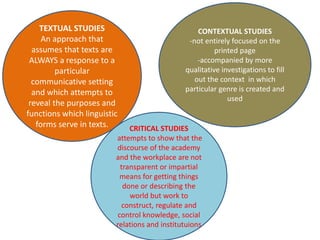
TEXTUAL STUDIES
An approach that
assumes that texts are
ALWAYS a response to a
particular
communicative setting
and which attempts to
reveal the purposes and
functions which linguistic
forms serve in texts. CRITICAL STUDIES
attempts to show that the
discourse of the academy
and the workplace are not
transparent or impartial
means for getting things
done or describing the
world but work to
construct, regulate and
control knowledge, social
relations and institutuions
CONTEXTUAL STUDIES
-not entirely focused on the
printed page
-accompanied by more
qualitative investigations to fill
out the context in which
particular genre is created and
used
Research in ESP
Writing
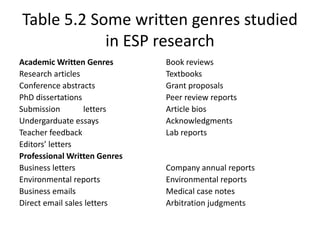
Table 5.2 Some written genres studied
in ESP research
Academic Written Genres
Research articles
Conference abstracts
PhD dissertations
Submission letters
Undergarduate essays
Teacher feedback
Editors’ letters
Professional Written Genres
Business letters
Environmental reports
Business emails
Direct email sales letters
Book reviews
Textbooks
Grant proposals
Peer review reports
Article bios
Acknowledgments
Lab reports
Company annual reports
Environmental reports
Medical case notes
Arbitration judgments
• Research on professional written genres has
tended to focus mainly on the business letter ,
and more recently on how this is recycled as
part of other genres such as emails and
annual reports (Gotti ang Gillaerts 2005).
• Research has also pointed to cultural
specificity in rhetorical preferences (e.g
Connor 2002). Although culture remains a
controversial term, one influential version of
culture regards it as historically transmitted
and systematic network of meanings.
Five broad findings:
1. That texts are systematically structured to
secure readers’ agreement or understanding;
2. That these community-specific ways of
producing agreement represent rhetorical
preferences that are specific to particular
contexts
3. That language groups have different ways of
expressing ideas and negotiating writer-
reader relationships and that this represents
serious challenges to students understanding of
themselves and their fields;
4. That professional writing is distinguished by
its expert character, its specialized goal
orientation, and its conventionalized from;
5. That there is frequently a disconnect between
authentic written language and that in
textbooks.
Looking to the Future
• Predictions are never easy, but one certainty is
that ESP’s concern with mapping the
discourses and communicative challenges of
the modern workplace and classroom will
continue.
Possible developments in the incoming
years..
1. Expansion of studies into new specialist
professional fields and written genre will
continue.
2. Much remains to be learned and
considerable research undertaken
3. ESP conceptions of literacy and writing
instruction need to come to terms with
challenges
4. Understanding the increasing role of
multimodal and electronic texts in professional
contexts.
5. ESP writing instruction needs to pay greater
attention to the contexts of professional writing
Conclusion
• ESP writing instruction is essentially a
practically oriented activity committed to
demystifying prestigious forms of discourse,
unlocking students’ creative and expressive
abilities, and facilitating their access to greater
life chances.
Esp and Writing

Esp and Writing

  • 1.
    ESP and Writing KenHyland by: Jennefer Edrozo Jane Camingao Michelle Piquero
  • 2.
    Discussion Overview • ShortReview • The Challenge of ESP Writing • ESP Conceptions of Writing • ESP Approaches to Writing Research • Research in ESP Writing • Legal English
  • 3.
    Macro skills 1. Listening 2.Speaking 3. Reading 4. Writing 5. Viewing Babies develop language skills by first listening and then speaking, followed by reading and writing
  • 4.
    • Writing isa form of communication that allows students to put their feelings and ideas on paper, to organize their knowledge and beliefs into convincing arguments, and to convey meaning through well-constructed text. • Writing is perhaps the most complex of the communication skills and takes the most time to master.
  • 5.
  • 6.
    ESP Writing: ModernAcademic & Corporate Life • Writing is perhaps the central activity of institutions. Complex social activities like educating students, keeping records, engaging with customers, selling products, demonstrating learning and disseminating ideas largely depend on it.
  • 7.
    • Essays • Commercialletters • Emails • Medical reports • Minutes of meetings ESP Writing: Modern Academic & Corporate Life
  • 8.
    • But writingis also a key feature to every student’s life.. • Because while multimedia and electronic technologies are beginning to influence learning and how we assess it, in many domains conventional writing remains the way in which students both consolidate their learning and demonstrate their understanding of their subjects. WHY?
  • 9.
    • Written texts,in fact, dominate the lives of all students, even those in emergent, practice-based courses not previously thought as involving heavy literacy demands (Baynham 2000:17)
  • 10.
    • These kindsof experiences are extremely challenging to students and can be especially daunting to those who are writing in a second language. WHY?
  • 11.
  • 12.
    • ESP conceptionsof writing focus on assisting students towards competence in particular target genres. • Teachers do not simply “teach writing” but teach particular kinds of writing which are valued and expected in some academic or professional contexts.
  • 13.
    • In recentyears the field of ESP has become increasingly sensitive to the ways in which texts are written and responded to by individuals acting as members of social groups. • Ideas such as communicative competence in applied linguistics Canale and Swain 1980), situated learning in education (Lave and Wenger 1991), and social constructionism in the social sciences (Berger and Luckman 1966) have contributed to a view that places community at the heart of writing and speech.
  • 14.
    Of relevance hereis the notion of “academic literacies”, which rejects: the ways language is treated as though it were a thing, distanced from both teacher and learner and imposing on them external rules and requirements as though they were but passive recipients -(Street 1995:114)
  • 15.
    • One problemfor students, however, is that while achievement is assessed by various institutionalized forms of writing, what it means to write in this way is rarely made explicit to students.
  • 16.
    • The academicliteracies position, therefore, encourages us to see that writing must be understood as the crucial process by which students make sense not only of the subject knowledge they encounter through their studies, but also how they can make it mean something for themselves. -(Lea and Street 1999)
  • 17.
    Gee (1966:155) “Someone cannotengage in a discourse in a less than fluent manner. You are either in it or you’re not. Discourses are connected with displays of identity-failing to display an identity fully is tantamount to announcing you do not have that identity- at best you are a pretender or a beginner.”
  • 18.
    An important implicationof these observations has been a commitment to contextual relevance in ESP. 1. Finding ways to help students gain control over texts 2. Involving them in their studies and encouraging them to take active responsibility for their learning 3. Helping learners see the assumptions and values which are implicit in those genres
  • 19.
    ESP Approaches toWriting Research
  • 20.
    1. Textual Studies •A genre approach to writing looks beyond the struggles of individual writers to make meanings and delves beneath the surface structures of texts as products to understand how writing actually works as communication. • This is an approach that assumes that texts are always a response to a particular communicative setting and which attempts to reveal the purposes and functions which linguistic forms serves in texts.
  • 21.
    • Genres inESP are usually regarded as staged, structured events, designed to perform various communicative purposes by specific discourse communities (Swales 2004).
  • 22.
    • ESP researchinto texts thus seeks to show how language forms work as resources for accomplishing goals by describing the stages which help writers to set out their thoughts in ways readers can easily follow, and identifying salient features of texts which allow them to engage effectively with their readers.
  • 23.
    • Genre approachesin ESP therefore attempt to explicate the lexico-grammatical and discursive patterns of particular genres to identify their recognizable structural identity.
  • 24.
    2. Contextual Studies •ESP research has not been entirely focused on the printed page, however. Treating texts as purely textual artifacts can mean that while students are often able to handle the forms of professional genres when they go out to work, they are often unprepared “for the discursive realities of the professional world” - (Bhatia 2008:161)
  • 25.
    • Such approachinfuses text analyses with greater validity and offer richer understandings about the production and use of genres in different contexts.
  • 26.
    3. Critical Studies •Although they take a number of different forms drawing on diverse theoretical concepts and methods, it is conventional to lump these together under the heading of critical discourse analysis (CDA).
  • 27.
    • This viewslanguage as a form of social practice and attempts “to unpack the ideological underpinnings of discourse that have become so naturalized over time that we begin to treat them as common, acceptable and natural features of discourse - ( Teo 2000:1)
  • 28.
    • It attemptsto show that discourses of the academy and the workplace are not transparent or impartial means for getting things done or describing the world, but work to construct, regulate and control knowledge, social relations and institutions.
  • 29.
    • While CDAdoes not subscribe to any single method, Fairclough (2003) draws on Systematic Functional Linguistics (SFL) (Halliday 1994) to analyze concrete instances of discourse. In this model, language is seen as systems of linguistic features offering choices to users, but these choices are circumscribed in situations of unequal power.
  • 30.
    To examine actualinstances of texts, CDA typically looks at features such as: 1. Vocabulary 2. Transitivity 3. Nominalization and passivization 4. Mood and modality 5. Theme 6. Text structure 7. Intertextuality and interdiscursivity
  • 31.
    • There are,however, several studies that show how language is used to influence readers or achieve control in written professional writing in different contexts. • Harrison and Young’s (2004) analysis of the phrasal construction of a memo from a senior manager, for example, shows how he uses bureaucratic language to distance himself from unpopular decisions.
  • 32.
    • In academiccontexts, research has explored the ways that the conventions of disciplinary writing can create tensions for students. • This critically-oriented research thus re- establishes the intrinsic relationship between knowledge, writing and identity and raises issues of relevance and legitimacy in relation to writing practices.
  • 33.
    TEXTUAL STUDIES An approachthat assumes that texts are ALWAYS a response to a particular communicative setting and which attempts to reveal the purposes and functions which linguistic forms serve in texts. CRITICAL STUDIES attempts to show that the discourse of the academy and the workplace are not transparent or impartial means for getting things done or describing the world but work to construct, regulate and control knowledge, social relations and institutuions CONTEXTUAL STUDIES -not entirely focused on the printed page -accompanied by more qualitative investigations to fill out the context in which particular genre is created and used
  • 34.
  • 35.
    Table 5.2 Somewritten genres studied in ESP research Academic Written Genres Research articles Conference abstracts PhD dissertations Submission letters Undergarduate essays Teacher feedback Editors’ letters Professional Written Genres Business letters Environmental reports Business emails Direct email sales letters Book reviews Textbooks Grant proposals Peer review reports Article bios Acknowledgments Lab reports Company annual reports Environmental reports Medical case notes Arbitration judgments
  • 36.
    • Research onprofessional written genres has tended to focus mainly on the business letter , and more recently on how this is recycled as part of other genres such as emails and annual reports (Gotti ang Gillaerts 2005).
  • 37.
    • Research hasalso pointed to cultural specificity in rhetorical preferences (e.g Connor 2002). Although culture remains a controversial term, one influential version of culture regards it as historically transmitted and systematic network of meanings.
  • 38.
    Five broad findings: 1.That texts are systematically structured to secure readers’ agreement or understanding; 2. That these community-specific ways of producing agreement represent rhetorical preferences that are specific to particular contexts 3. That language groups have different ways of expressing ideas and negotiating writer- reader relationships and that this represents
  • 39.
    serious challenges tostudents understanding of themselves and their fields; 4. That professional writing is distinguished by its expert character, its specialized goal orientation, and its conventionalized from; 5. That there is frequently a disconnect between authentic written language and that in textbooks.
  • 40.
  • 41.
    • Predictions arenever easy, but one certainty is that ESP’s concern with mapping the discourses and communicative challenges of the modern workplace and classroom will continue.
  • 42.
    Possible developments inthe incoming years.. 1. Expansion of studies into new specialist professional fields and written genre will continue. 2. Much remains to be learned and considerable research undertaken 3. ESP conceptions of literacy and writing instruction need to come to terms with challenges
  • 43.
    4. Understanding theincreasing role of multimodal and electronic texts in professional contexts. 5. ESP writing instruction needs to pay greater attention to the contexts of professional writing
  • 44.
    Conclusion • ESP writinginstruction is essentially a practically oriented activity committed to demystifying prestigious forms of discourse, unlocking students’ creative and expressive abilities, and facilitating their access to greater life chances.