Aims, goals and objective purpose in
curriculum development
Aims, goals and objectives
 Education is purposeful. It concern with outcomes that
are expressed at several levels
Aims : the most general level
Goals: reflect the purpose with outcomes in mind.
Objectives: reflect the most specific levels of
educational outcomes
 Wilson(2004) defines AIMS as " general statements that
provide direction or intent to educational action".
 Orstein and Hunkins concluded that AIMS serve to:
1 Be general statements that provide shape and
direction to the more specific actions designed
to achieve future product and behavior.
2. Be starting point for ideal/inspirational vision of
the good future
 Develop moral character and personal discipline.
 Encourage creative and critical thinking.
 Broaden scientific and technological knowledge.
 Foster love of humanity.
 Teach the rights and duties of citizenship
 Promote respect for human right.
 Strengthen ethical and spiritual values.
Aims of Elementary Education
 Provide knowledge and develop skills , attitudes,values
essential to personal development and necessary for living
in and contributing to a developing and changing society.
 Provide learning experiences which increase the child's
awareness of and responsiveness to the changes in the
society.
 Promote and intensify knowledge, identification with and
love for the nation and the people to which he belongs.
 Promote work experiences which develop orientation to
the world of work and prepare the learner to honest and
gainful work.
Aims of Secondary Education
 Continue to promote the objective of elementary
education.
 Discover and enhance the different aptitudes and
interests of students in order to equip them with
skills for productive endeavor and or to prepare
them for tertiary schooling.
Aims of Tertiary Education
 Provide general education programs which will
promote national identity, cultural consciousness,
moral integrity and spiritual vigor.
 Train the nation's manpower in the skills required
for national development.
 Develop the professions that will provide leadership
for nation.
 Advance knowledge through research and apply new
knowledge for improving the quality of human life
and respond effectively to changing society.
 Goals are statements or intent to be accomplished.
 Goals are statement of purpose with some outcomes in
mind.
 According to Wilson(2005), goals are " the statement of
educational intention which are more specific than
aim.
 Oliva(2001) distinguishes between curriculum goal and
instructional goals.
 Curriculum goal: a purpose in general terms without
criteria of achievement.
 Instructional curriculum: a statement of performance
expected of each student
 Goals can be written broadly and specifically.
 Examples
 To develop a skill in reading,writting ,speaking and listening
 To be able to verbally and visually express a point of view
 Objectives are usually specific statement of educational
intention which delineate either general or specific
outcomes.
 Benjamin Bloom and Robert Magyar defined educational
objective in two ways:
1 Explicit formulations of the ways in which
students are expected to be changed by
educative process.
2. Intent communicated by statement describing
proposed change in learner
 Taba(1962) states that there are two types of objectives:
1 General objective:
Those objectives that describe school- wide outcomes.
E.g. Improving students skills
2 Specific objective:
Those objectives that describe behavior to be attained in a
particular unit, a subject/course or particular programmed
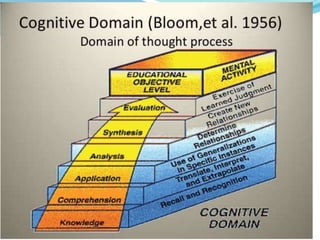
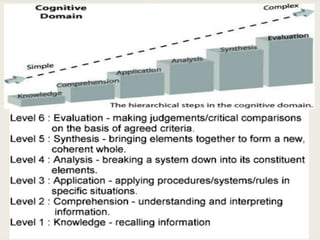
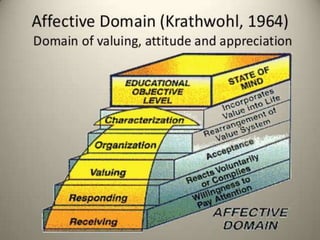
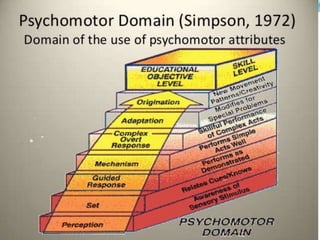
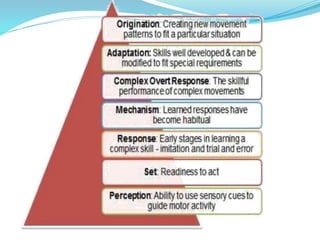
E.g. cognitive, affective and psychomotor domain
Three Big Domain of Objectives
Cognitive
Affective
Psychomotor
To conclude the topic we come to know that
without Aims, Goals and Objective we are unable
to Execute any work.
Reference
 Johnritz.html
 thesecondprinciple.com/instructional-design/writing-
curriculum/

Aims, goals and objective purpose in curriculum development

  • 1.
    Aims, goals andobjective purpose in curriculum development
  • 2.
    Aims, goals andobjectives  Education is purposeful. It concern with outcomes that are expressed at several levels Aims : the most general level Goals: reflect the purpose with outcomes in mind. Objectives: reflect the most specific levels of educational outcomes
  • 3.
     Wilson(2004) definesAIMS as " general statements that provide direction or intent to educational action".  Orstein and Hunkins concluded that AIMS serve to: 1 Be general statements that provide shape and direction to the more specific actions designed to achieve future product and behavior. 2. Be starting point for ideal/inspirational vision of the good future
  • 4.
     Develop moralcharacter and personal discipline.  Encourage creative and critical thinking.  Broaden scientific and technological knowledge.  Foster love of humanity.  Teach the rights and duties of citizenship  Promote respect for human right.  Strengthen ethical and spiritual values.
  • 5.
    Aims of ElementaryEducation  Provide knowledge and develop skills , attitudes,values essential to personal development and necessary for living in and contributing to a developing and changing society.  Provide learning experiences which increase the child's awareness of and responsiveness to the changes in the society.  Promote and intensify knowledge, identification with and love for the nation and the people to which he belongs.  Promote work experiences which develop orientation to the world of work and prepare the learner to honest and gainful work.
  • 6.
    Aims of SecondaryEducation  Continue to promote the objective of elementary education.  Discover and enhance the different aptitudes and interests of students in order to equip them with skills for productive endeavor and or to prepare them for tertiary schooling.
  • 7.
    Aims of TertiaryEducation  Provide general education programs which will promote national identity, cultural consciousness, moral integrity and spiritual vigor.  Train the nation's manpower in the skills required for national development.  Develop the professions that will provide leadership for nation.  Advance knowledge through research and apply new knowledge for improving the quality of human life and respond effectively to changing society.
  • 8.
     Goals arestatements or intent to be accomplished.  Goals are statement of purpose with some outcomes in mind.  According to Wilson(2005), goals are " the statement of educational intention which are more specific than aim.  Oliva(2001) distinguishes between curriculum goal and instructional goals.  Curriculum goal: a purpose in general terms without criteria of achievement.  Instructional curriculum: a statement of performance expected of each student
  • 9.
     Goals canbe written broadly and specifically.  Examples  To develop a skill in reading,writting ,speaking and listening  To be able to verbally and visually express a point of view
  • 10.
     Objectives areusually specific statement of educational intention which delineate either general or specific outcomes.  Benjamin Bloom and Robert Magyar defined educational objective in two ways: 1 Explicit formulations of the ways in which students are expected to be changed by educative process. 2. Intent communicated by statement describing proposed change in learner
  • 11.
     Taba(1962) statesthat there are two types of objectives: 1 General objective: Those objectives that describe school- wide outcomes. E.g. Improving students skills 2 Specific objective: Those objectives that describe behavior to be attained in a particular unit, a subject/course or particular programmed E.g. cognitive, affective and psychomotor domain
  • 12.
    Three Big Domainof Objectives Cognitive Affective Psychomotor
  • 18.
    To conclude thetopic we come to know that without Aims, Goals and Objective we are unable to Execute any work.
  • 19.