Outcome Based Education
A Practitioner's Experience
https://www.youtube.com/user/dastikop
Ravindra Dastikop
http://dastikop.blogspot.in
Agenda
•OBE- What is it and Why?
•OBE- Scope of Application
•OBE in action in a course(Cloud Computing)
•Implementing OBE on a cloud Platform
Background
● I introduced the first course in cloud computing in 2010 for
the first batch of autonomous students
● Industry oriented Programming and Practices course was
introduced in 2012. It provides a basic knowledge of cloud
computing and cloud services
● I taught a cloud computing course prescribed by VTU for the
M.Tech Degree during 2013-14
● I taught a revised cloud computing course by VTU M.Tech I
semester during 2015-15
Introdcution to Cloud Engineering - Ravindra Dastikop http://introduction-to-cloud-engineering.blogspot.in
OBE
What is it and Why?
OBE Meaning
Outcome-based education means clearly
focussing and organizing everything in an
education system around what is essential
for all students to be able to do successfully
at the end of their learning experience
Outcome- meaning
•Outcomes means - Goal, Purpose, End
•Outcomes, the end-products of instructional
process, may be observable or internal
changes in the learner
OBE- applied to Cake Cooking Course
output outcome
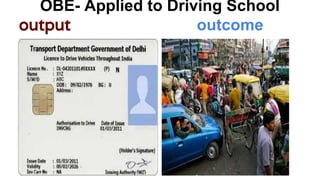
OBE- Applied to Driving School
output outcome
Examples of Outcome-based Models
● Apprentice training in Skilled Trades ( NTTF)
● Military training programs
● Karate Instructions
● Professional License
● Flight schools
● Bharatanatyam dance
Why education is not using OBE yet?
Education model were based on industrial models
•WHEN and HOW students learned took
precedence over
•WHAT is learned and WHETHER it is learned well
?
OBE
Scope of Application
OBE
● OBE is an organizing principle.
● It organizes the process of education around
outcomes.
● It operates at institutional level
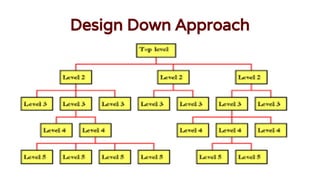
● It is based on “ design-down”
Design Down Approach
Program Objective ( SDMCET)
A. Ability to Identify the requirements by analyzing the
problem domain, to solve real life problems in computing
systems, to address the engineering issues of both hardware
and software through the fundamental engineering
techniques of mathematics, logic and procedural
approaches.
B. Ability to Conceptualize the new and innovative system
requirements to build the quality systems in line with the
Program Objective ( SDMCET)
A. Ability to Identify the requirements by analyzing the problem domain, to solve real life problems in computing systems, to
address the engineering issues of both hardware and software through the fundamental engineering techniques of
mathematics, logic and procedural approaches.
B. Ability to Conceptualize the new and innovative system requirements to build the quality systems in line with the
technological/research trends.
C. Ability to Model and Design the systems / sub-systems (architecture/behavior ), process and conduct experiments and
interpret data using standards, tools, techniques and modern computational concepts / mathematical formulations.
D. Ability to Transform the system model to working system by constructing the deployable system using appropriate
programming paradigm and the state-of-the-art technology.
E. Ability to Verify and validate the correctness of system using various testing and verification techniques and tools.
F. Ability to Manage: Product and process development processes, Team structuring and coordination, Estimation and
costing, and Capability to address the issues of maintenance of the system both adaptive and corrective in nature to meet
the quality requirements and standards.
G. Ability to Communicate effectively.
H. H Ability to Engage in self-education by clearly understanding the value of lifelong learning.
I. Ability to Demonstrate ethics and code of practice of both professional and social concern to be a socially and
professionally a valuable citizen of the country contributing globally.
J. Ability to Understand the impact of contemporary engineering solutions and sustainable development in global, economic,
environmental, and societal context to be a leader / an entrepreneur
PEO’s ( Computer Science & Engg)
1. To build technical competence by providing necessary background and foundation
in Computer Science and Engineering domain, so that students are acceptable
globally to industries,premier institutions of higher studies and research.
2. To create awareness of technological trends and tools to provide an experience of
developing computing systems through development phases like: inception,
elaboration, construction and transition, with higher quality and standards.
3. To prepare students to be committed citizen with social and professional concern.
4. To prepare students to be independent lifelong learners.
5. To prepare students to demonstrate leadership qualities and managerial skills, thus
contributing their knowledge globally at various levels of responsibilities in
heterogeneous teams.
Course Objectives ( Cloud Computing)
● CO 1: able to understand the impact of cloud computing solutions in
global, economic, environmental and societal context [J]
● CO 2: able to identity the requirements by analysing cloud computing and
engineering domain to solve real-life problems [A]
● CO 3: able to model and design cloud systems using standards, tools,
techniques and cloud engineering concepts [C]
● C0 4: Ability to transform the cloud system model to working system by
constructing the deployable models [D]
OBE
History
A Brief History of OBE-1
● OBE is based on ISO 9000 principles of continuous quality improvement
(CQI) and was introduced in response to industry request for better
prepared graduates.
● The movement began in the early-nineteen nineties and it was first
introduced in 1997
● Based a realization that all institutes/universities do not share identical
objectives/missions; rather they should be based on stake-holder
needs/requirements
A Brief History of OBE-1
● ABET requirements were too prescriptive and were not permitting
universities to be responsive to their constituencies
● Students were being subjected to too much of basic and engineering
sciences to meet ABET criteria and not sufficient emphasis on design
and soft-skills •
● Engineering curricula were becoming too big and students were not
able to finish in 4 years.
● Differences between teaching and learning were not clearly
understood
OBE
Process
OBE as a Process-1
● Outcomes based education, if implemented properly, is an enabler of
change
● The objectives and outcomes are formulated after consultation with all
stakeholders; faculty, alumni, students and employers are the important
stakeholders. It will be a mistake if they are simply copied from each other
● Programs are evaluated against the attainment of their own objectives
and outcomes
OBE as a Process-1
● A variety of universities and colleges must be available that cater to
students with different levels of preparation and capabilities with a
flexible system that allows students to move up the ladder
progressively
● Research funding provided by the government must be by a
transparent competitive process based on strong conflicts of interest
policies and research must become an integral part of the educational
pedagogy in all universities, public or private
You May Ask Question Now
Interaction
Time
OBE
The Implementation
OBE
A Practitioner's Experience
OBE
Principle Practice
A system based on outcomes
gives top priority to ends,
purposes, learning,
accomplishments,and results
Purpose
● To produce cloud
competent professionals
to be absorbed by the
industry
● Proof- students placed
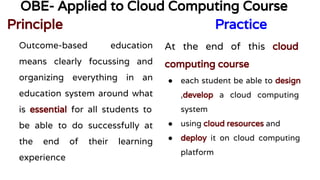
OBE- Applied to Cloud Computing Course
Principle Practice
Outcome-based education
means clearly focussing and
organizing everything in an
education system around what
is essential for all students to
be able to do successfully at
the end of their learning
experience
At the end of this cloud
computing course
● each student be able to design
,develop a cloud computing
system
● using cloud resources and
● deploy it on cloud computing
platform
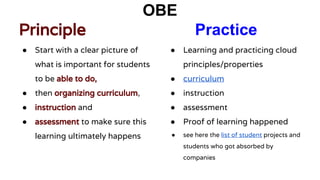
OBE
Principle Practice
● Start with a clear picture of
what is important for students
to be able to do,
● then organizing curriculum,
● instruction and
● assessment to make sure this
learning ultimately happens
● Learning and practicing cloud
principles/properties
● curriculum
● instruction
● assessment
● Proof of learning happened
● see here the list of student projects and
students who got absorbed by
companies
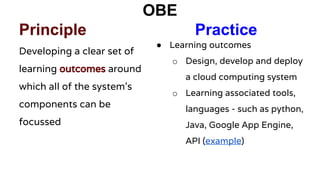
OBE
Principle Practice
Developing a clear set of
learning outcomes around
which all of the system’s
components can be
focussed
● Learning outcomes
o Design, develop and deploy
a cloud computing system
o Learning associated tools,
languages - such as python,
Java, Google App Engine,
API (example)
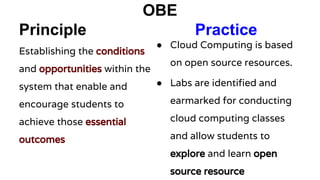
OBE
Principle Practice
Establishing the conditions
and opportunities within the
system that enable and
encourage students to
achieve those essential
outcomes
● Cloud Computing is based
on open source resources.
● Labs are identified and
earmarked for conducting
cloud computing classes
and allow students to
explore and learn open
source resource
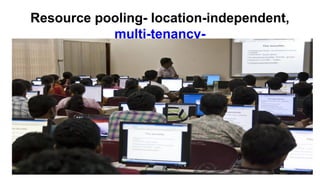
Resource pooling- location-independent,
multi-tenancy-
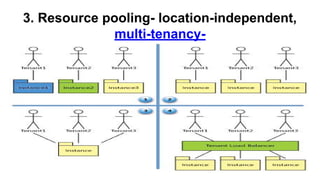
3. Resource pooling- location-independent,
multi-tenancy-
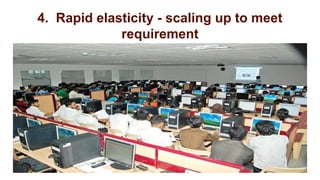
4. Rapid elasticity - scaling up to meet
requirement
Projects done by students at the end
Weather Reporter
http:
//weatherreport4u.
appspot.com/
This Project uses
Google Map API and
Weather API from
Yahoo
Projects done by students at the end
LearnMate- A self help
system for a Learner
http://7.self-learning.
appspot.com/
Uses Google Search
API
Projects done by students at the end
Cloud based Teaching
System
Project URL:
http://sdmcetcon1.appspot.
com/
This is based on Google
App engine(GAE) and
uses data store feature-
databases on the cloud
platform
OBE
Principle Practice
Outcomes are what learner
can actually do with what
they know and have
learned- they are tangible
applications of what they
have learned
● The student will deploy a
cloud computing system or
unit or functionality - a
tangible proof of what they
have learned
OBE
Principle Practice
Outcomes are actions and
performance that embody
and reflect learners
competence in using
content, information , ideas,
and tools successfully
● Contents
o cloud computing
service/deployment models
● Information
o inspirational examples
● Ideas
o cloud application
● Tools
o Google App Engine
OBE
Principle Practice
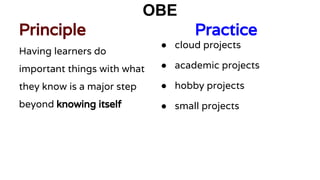
Having learners do
important things with what
they know is a major step
beyond knowing itself
● cloud projects
● academic projects
● hobby projects
● small projects
OBE
Principle Practice
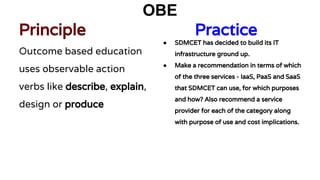
Outcome based education
uses observable action
verbs like describe, explain,
design or produce
● SDMCET has decided to build its IT
infrastructure ground up.
● Make a recommendation in terms of which
of the three services - IaaS, PaaS and SaaS
that SDMCET can use, for which purposes
and how? Also recommend a service
provider for each of the category along
with purpose of use and cost implications.
OBE
Principle Practice
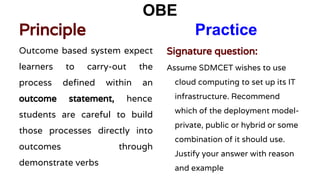
Outcome based system expect
learners to carry-out the
process defined within an
outcome statement, hence
students are careful to build
those processes directly into
outcomes through
demonstrate verbs
Signature question:
Assume SDMCET wishes to use
cloud computing to set up its IT
infrastructure. Recommend
which of the deployment model-
private, public or hybrid or some
combination of it should use.
Justify your answer with reason
and example
OBE
Principle Practice
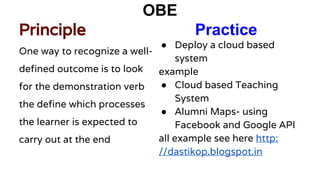
One way to recognize a well-
defined outcome is to look
for the demonstration verb
the define which processes
the learner is expected to
carry out at the end
● Deploy a cloud based
system
example
● Cloud based Teaching
System
● Alumni Maps- using
Facebook and Google API
all example see here http:
//dastikop.blogspot.in
OBE
Principle Practice
Because outcome occur at
or after the end of learning
experience , it is useful to
think them representing the
ultimate result that is sought
from the learning
● Ultimate Result
o able design and
develop a cloud based
system
o able to analyse a
situation and
recommend a suitable
cloud solution (
compare a cloud set up
for SDMCET)
Outcomes
● Since 2010, students have completed more than 200 Cloud based projects
○ List 1- http://dastikop.blogspot.in
○ List 2- http://qloudcomputing.blogspot.in
● I have conducted more than 200 cloud computing workshops in various
institutions across south India
Students are inspired to do projects in visiting college - http://ghlstest.
appspot.com/
● One of my students has started a cloud based enterprise - http://pixuate.
com
You May Ask Question Now
Interaction
Time
OBE
Implementing OBE on a cloud Platform
You May Ask Question Now
Interaction
Time
Conclusion
• Engineering education needs Focus
• OBE is a great tool to determine focus, implement it at
institution, department and course level
• Platform such as Inpods help us automate the process
Contact Information
Visit
http://dastikop.blogspot.in
email: ravindra.dastikop@gmail.com
http://youtube.com/user/dastikop
References
1. Achievement of the Program Outcomes in Outcomes Based Education
Implementation - A Meta-Analysis
2. http://www.polyu.edu.hk/obe/10_1_Resources.php#UsefulL3
References
1. Achievement of the Program Outcomes in Outcomes Based Education
Implementation - A Meta-Analysis
2. http://www.polyu.edu.hk/obe/10_1_Resources.php#UsefulL3

Outcome Based Education (OBE) - A practitioner's experience

  • 1.
    Outcome Based Education APractitioner's Experience https://www.youtube.com/user/dastikop Ravindra Dastikop http://dastikop.blogspot.in
  • 2.
    Agenda •OBE- What isit and Why? •OBE- Scope of Application •OBE in action in a course(Cloud Computing) •Implementing OBE on a cloud Platform
  • 3.
    Background ● I introducedthe first course in cloud computing in 2010 for the first batch of autonomous students ● Industry oriented Programming and Practices course was introduced in 2012. It provides a basic knowledge of cloud computing and cloud services ● I taught a cloud computing course prescribed by VTU for the M.Tech Degree during 2013-14 ● I taught a revised cloud computing course by VTU M.Tech I semester during 2015-15 Introdcution to Cloud Engineering - Ravindra Dastikop http://introduction-to-cloud-engineering.blogspot.in
  • 4.
  • 5.
    OBE Meaning Outcome-based educationmeans clearly focussing and organizing everything in an education system around what is essential for all students to be able to do successfully at the end of their learning experience
  • 6.
    Outcome- meaning •Outcomes means- Goal, Purpose, End •Outcomes, the end-products of instructional process, may be observable or internal changes in the learner
  • 7.
    OBE- applied toCake Cooking Course output outcome
  • 8.
    OBE- Applied toDriving School output outcome
  • 9.
    Examples of Outcome-basedModels ● Apprentice training in Skilled Trades ( NTTF) ● Military training programs ● Karate Instructions ● Professional License ● Flight schools ● Bharatanatyam dance
  • 10.
    Why education isnot using OBE yet? Education model were based on industrial models •WHEN and HOW students learned took precedence over •WHAT is learned and WHETHER it is learned well ?
  • 11.
  • 12.
    OBE ● OBE isan organizing principle. ● It organizes the process of education around outcomes. ● It operates at institutional level ● It is based on “ design-down”
  • 13.
  • 14.
    Program Objective (SDMCET) A. Ability to Identify the requirements by analyzing the problem domain, to solve real life problems in computing systems, to address the engineering issues of both hardware and software through the fundamental engineering techniques of mathematics, logic and procedural approaches. B. Ability to Conceptualize the new and innovative system requirements to build the quality systems in line with the
  • 15.
    Program Objective (SDMCET) A. Ability to Identify the requirements by analyzing the problem domain, to solve real life problems in computing systems, to address the engineering issues of both hardware and software through the fundamental engineering techniques of mathematics, logic and procedural approaches. B. Ability to Conceptualize the new and innovative system requirements to build the quality systems in line with the technological/research trends. C. Ability to Model and Design the systems / sub-systems (architecture/behavior ), process and conduct experiments and interpret data using standards, tools, techniques and modern computational concepts / mathematical formulations. D. Ability to Transform the system model to working system by constructing the deployable system using appropriate programming paradigm and the state-of-the-art technology. E. Ability to Verify and validate the correctness of system using various testing and verification techniques and tools. F. Ability to Manage: Product and process development processes, Team structuring and coordination, Estimation and costing, and Capability to address the issues of maintenance of the system both adaptive and corrective in nature to meet the quality requirements and standards. G. Ability to Communicate effectively. H. H Ability to Engage in self-education by clearly understanding the value of lifelong learning. I. Ability to Demonstrate ethics and code of practice of both professional and social concern to be a socially and professionally a valuable citizen of the country contributing globally. J. Ability to Understand the impact of contemporary engineering solutions and sustainable development in global, economic, environmental, and societal context to be a leader / an entrepreneur
  • 16.
    PEO’s ( ComputerScience & Engg) 1. To build technical competence by providing necessary background and foundation in Computer Science and Engineering domain, so that students are acceptable globally to industries,premier institutions of higher studies and research. 2. To create awareness of technological trends and tools to provide an experience of developing computing systems through development phases like: inception, elaboration, construction and transition, with higher quality and standards. 3. To prepare students to be committed citizen with social and professional concern. 4. To prepare students to be independent lifelong learners. 5. To prepare students to demonstrate leadership qualities and managerial skills, thus contributing their knowledge globally at various levels of responsibilities in heterogeneous teams.
  • 17.
    Course Objectives (Cloud Computing) ● CO 1: able to understand the impact of cloud computing solutions in global, economic, environmental and societal context [J] ● CO 2: able to identity the requirements by analysing cloud computing and engineering domain to solve real-life problems [A] ● CO 3: able to model and design cloud systems using standards, tools, techniques and cloud engineering concepts [C] ● C0 4: Ability to transform the cloud system model to working system by constructing the deployable models [D]
  • 18.
  • 19.
    A Brief Historyof OBE-1 ● OBE is based on ISO 9000 principles of continuous quality improvement (CQI) and was introduced in response to industry request for better prepared graduates. ● The movement began in the early-nineteen nineties and it was first introduced in 1997 ● Based a realization that all institutes/universities do not share identical objectives/missions; rather they should be based on stake-holder needs/requirements
  • 20.
    A Brief Historyof OBE-1 ● ABET requirements were too prescriptive and were not permitting universities to be responsive to their constituencies ● Students were being subjected to too much of basic and engineering sciences to meet ABET criteria and not sufficient emphasis on design and soft-skills • ● Engineering curricula were becoming too big and students were not able to finish in 4 years. ● Differences between teaching and learning were not clearly understood
  • 21.
  • 22.
    OBE as aProcess-1 ● Outcomes based education, if implemented properly, is an enabler of change ● The objectives and outcomes are formulated after consultation with all stakeholders; faculty, alumni, students and employers are the important stakeholders. It will be a mistake if they are simply copied from each other ● Programs are evaluated against the attainment of their own objectives and outcomes
  • 23.
    OBE as aProcess-1 ● A variety of universities and colleges must be available that cater to students with different levels of preparation and capabilities with a flexible system that allows students to move up the ladder progressively ● Research funding provided by the government must be by a transparent competitive process based on strong conflicts of interest policies and research must become an integral part of the educational pedagogy in all universities, public or private
  • 24.
    You May AskQuestion Now Interaction Time
  • 25.
  • 26.
  • 27.
    OBE Principle Practice A systembased on outcomes gives top priority to ends, purposes, learning, accomplishments,and results Purpose ● To produce cloud competent professionals to be absorbed by the industry ● Proof- students placed
  • 28.
    OBE- Applied toCloud Computing Course Principle Practice Outcome-based education means clearly focussing and organizing everything in an education system around what is essential for all students to be able to do successfully at the end of their learning experience At the end of this cloud computing course ● each student be able to design ,develop a cloud computing system ● using cloud resources and ● deploy it on cloud computing platform
  • 29.
    OBE Principle Practice ● Startwith a clear picture of what is important for students to be able to do, ● then organizing curriculum, ● instruction and ● assessment to make sure this learning ultimately happens ● Learning and practicing cloud principles/properties ● curriculum ● instruction ● assessment ● Proof of learning happened ● see here the list of student projects and students who got absorbed by companies
  • 30.
    OBE Principle Practice Developing aclear set of learning outcomes around which all of the system’s components can be focussed ● Learning outcomes o Design, develop and deploy a cloud computing system o Learning associated tools, languages - such as python, Java, Google App Engine, API (example)
  • 31.
    OBE Principle Practice Establishing theconditions and opportunities within the system that enable and encourage students to achieve those essential outcomes ● Cloud Computing is based on open source resources. ● Labs are identified and earmarked for conducting cloud computing classes and allow students to explore and learn open source resource
  • 32.
  • 33.
    3. Resource pooling-location-independent, multi-tenancy-
  • 34.
    4. Rapid elasticity- scaling up to meet requirement
  • 35.
    Projects done bystudents at the end Weather Reporter http: //weatherreport4u. appspot.com/ This Project uses Google Map API and Weather API from Yahoo
  • 36.
    Projects done bystudents at the end LearnMate- A self help system for a Learner http://7.self-learning. appspot.com/ Uses Google Search API
  • 37.
    Projects done bystudents at the end Cloud based Teaching System Project URL: http://sdmcetcon1.appspot. com/ This is based on Google App engine(GAE) and uses data store feature- databases on the cloud platform
  • 38.
    OBE Principle Practice Outcomes arewhat learner can actually do with what they know and have learned- they are tangible applications of what they have learned ● The student will deploy a cloud computing system or unit or functionality - a tangible proof of what they have learned
  • 39.
    OBE Principle Practice Outcomes areactions and performance that embody and reflect learners competence in using content, information , ideas, and tools successfully ● Contents o cloud computing service/deployment models ● Information o inspirational examples ● Ideas o cloud application ● Tools o Google App Engine
  • 40.
    OBE Principle Practice Having learnersdo important things with what they know is a major step beyond knowing itself ● cloud projects ● academic projects ● hobby projects ● small projects
  • 41.
    OBE Principle Practice Outcome basededucation uses observable action verbs like describe, explain, design or produce ● SDMCET has decided to build its IT infrastructure ground up. ● Make a recommendation in terms of which of the three services - IaaS, PaaS and SaaS that SDMCET can use, for which purposes and how? Also recommend a service provider for each of the category along with purpose of use and cost implications.
  • 42.
    OBE Principle Practice Outcome basedsystem expect learners to carry-out the process defined within an outcome statement, hence students are careful to build those processes directly into outcomes through demonstrate verbs Signature question: Assume SDMCET wishes to use cloud computing to set up its IT infrastructure. Recommend which of the deployment model- private, public or hybrid or some combination of it should use. Justify your answer with reason and example
  • 43.
    OBE Principle Practice One wayto recognize a well- defined outcome is to look for the demonstration verb the define which processes the learner is expected to carry out at the end ● Deploy a cloud based system example ● Cloud based Teaching System ● Alumni Maps- using Facebook and Google API all example see here http: //dastikop.blogspot.in
  • 44.
    OBE Principle Practice Because outcomeoccur at or after the end of learning experience , it is useful to think them representing the ultimate result that is sought from the learning ● Ultimate Result o able design and develop a cloud based system o able to analyse a situation and recommend a suitable cloud solution ( compare a cloud set up for SDMCET)
  • 45.
    Outcomes ● Since 2010,students have completed more than 200 Cloud based projects ○ List 1- http://dastikop.blogspot.in ○ List 2- http://qloudcomputing.blogspot.in ● I have conducted more than 200 cloud computing workshops in various institutions across south India Students are inspired to do projects in visiting college - http://ghlstest. appspot.com/ ● One of my students has started a cloud based enterprise - http://pixuate. com
  • 46.
    You May AskQuestion Now Interaction Time
  • 47.
    OBE Implementing OBE ona cloud Platform
  • 48.
    You May AskQuestion Now Interaction Time
  • 49.
    Conclusion • Engineering educationneeds Focus • OBE is a great tool to determine focus, implement it at institution, department and course level • Platform such as Inpods help us automate the process
  • 50.
  • 51.
    References 1. Achievement ofthe Program Outcomes in Outcomes Based Education Implementation - A Meta-Analysis 2. http://www.polyu.edu.hk/obe/10_1_Resources.php#UsefulL3
  • 52.
    References 1. Achievement ofthe Program Outcomes in Outcomes Based Education Implementation - A Meta-Analysis 2. http://www.polyu.edu.hk/obe/10_1_Resources.php#UsefulL3