OBE Principles and Process
Definition
There is a significant difference between outcome-based
education and simply producing outcome for an existing
curriculum. OB does not mean curriculum based with
outcome sprinkled on top. It is a transformational way of
doing business in education (Spady, 1993).
Outcome-
is a culminating
demonstration of
learning. It is what
the student should
be able to do at
the end of the
course.
‘product defines
process’ Harden (1999)
OBE Principles (Spady, 1994)
An OBE curriculum means starting with a clear picture of what is important for students to be able to do, then
organizing the curriculum, instruction and assessment to make sure this learning ultimately happens
Clarity of focus
This means that everything teachers
do must be clearly focused on what
they want students to know,
understand and be able to do. In other
words, teachers should focus on
helping students to develop the
knowledge, skills and personalities
that will enable them to achieve the
intended outcomes that have been
clearly articulated.
High expectations
It means that teachers should establish
high, challenging standards of
performance in order to encourage
students to engage deeply in what they
are learning. Helping students to
achieve high standards is linked very
closely with the idea that successful
learning promotes more successful
learning.
OBE Principles (Spady, 1994)
An OBE curriculum means starting with a clear picture of what is important for students to be able to do, then
organizing the curriculum, instruction and assessment to make sure this learning ultimately happens
Designing down
It means that the curriculum design
must start with a clear definition of
the intended outcomes that
students are to achieve by the end
of the program. Once this has been
done, all instructional decisions are
then made to ensure achieve this
desired end result.
Expanded opportunities
Teachers must strive to provide
expanded opportunities for all
students. This principle is based on
the idea that not all learners can
learn the same thing in the same
way and in the same time.
However, most students can
achieve high standards if they are
given appropriate opportunities.
OBE Process
•'Constructive alignment’( Biggs ,1999) refers to the process to
create a learning environment that supports the learning
activities appropriate to achieving the desired learning
outcomes.
•The word 'constructive' refers to what the learner does to
construct meaning through relevant learning activities. The
'alignment' aspect refers to what the teacher does. The key to
the alignment is that the components in the teaching system,
especially the teaching methods used and the assessment
tasks are aligned to the learning activities assumed in the
intended outcomes.
Defining Curriculum Objective and Intended Learning Outcomes (ILO)
A learning outcome is what a student CAN DO as a result
of a learning experience. It describes a specific task that
he/she is able to perform at a given level of competence
under a certain situation. The three broad types of
learning outcomes are:
•Disciplinary knowledge and skills
•Generic skills
•Attitudes and values
Guidelines for Producing Effective ILO Statements
• Outcomes are about performance, and this implies:
• There must be a performer – the student, not the
teacher
• There must be something performable (thus
demonstrable or assessable) to perform
• The focus is on the performance, not the activity or
task to be performed
Designing Assessment Tasks
Outcome-based assessment asks us to first identify what it is we
expect students to be able to do once they have completed a course
or program.
It then asks us to provide evidence that they are able to do so. In
other words, how will each learning outcome be assessed?
What evidence of student learning is most relevant for each learning
outcome and what standard or criteria will be used to evaluate that
evidence?
Assessment is therefore a key part of outcome-based education and
used to determine whether or not a qualification has been achieved.
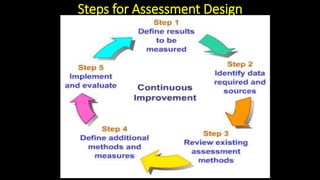
Steps for Assessment Design
Obe principles and process

Obe principles and process

  • 1.
  • 2.
    Definition There is asignificant difference between outcome-based education and simply producing outcome for an existing curriculum. OB does not mean curriculum based with outcome sprinkled on top. It is a transformational way of doing business in education (Spady, 1993). Outcome- is a culminating demonstration of learning. It is what the student should be able to do at the end of the course. ‘product defines process’ Harden (1999)
  • 3.
    OBE Principles (Spady,1994) An OBE curriculum means starting with a clear picture of what is important for students to be able to do, then organizing the curriculum, instruction and assessment to make sure this learning ultimately happens Clarity of focus This means that everything teachers do must be clearly focused on what they want students to know, understand and be able to do. In other words, teachers should focus on helping students to develop the knowledge, skills and personalities that will enable them to achieve the intended outcomes that have been clearly articulated. High expectations It means that teachers should establish high, challenging standards of performance in order to encourage students to engage deeply in what they are learning. Helping students to achieve high standards is linked very closely with the idea that successful learning promotes more successful learning.
  • 4.
    OBE Principles (Spady,1994) An OBE curriculum means starting with a clear picture of what is important for students to be able to do, then organizing the curriculum, instruction and assessment to make sure this learning ultimately happens Designing down It means that the curriculum design must start with a clear definition of the intended outcomes that students are to achieve by the end of the program. Once this has been done, all instructional decisions are then made to ensure achieve this desired end result. Expanded opportunities Teachers must strive to provide expanded opportunities for all students. This principle is based on the idea that not all learners can learn the same thing in the same way and in the same time. However, most students can achieve high standards if they are given appropriate opportunities.
  • 5.
    OBE Process •'Constructive alignment’(Biggs ,1999) refers to the process to create a learning environment that supports the learning activities appropriate to achieving the desired learning outcomes. •The word 'constructive' refers to what the learner does to construct meaning through relevant learning activities. The 'alignment' aspect refers to what the teacher does. The key to the alignment is that the components in the teaching system, especially the teaching methods used and the assessment tasks are aligned to the learning activities assumed in the intended outcomes.
  • 6.
    Defining Curriculum Objectiveand Intended Learning Outcomes (ILO) A learning outcome is what a student CAN DO as a result of a learning experience. It describes a specific task that he/she is able to perform at a given level of competence under a certain situation. The three broad types of learning outcomes are: •Disciplinary knowledge and skills •Generic skills •Attitudes and values
  • 7.
    Guidelines for ProducingEffective ILO Statements • Outcomes are about performance, and this implies: • There must be a performer – the student, not the teacher • There must be something performable (thus demonstrable or assessable) to perform • The focus is on the performance, not the activity or task to be performed
  • 8.
    Designing Assessment Tasks Outcome-basedassessment asks us to first identify what it is we expect students to be able to do once they have completed a course or program. It then asks us to provide evidence that they are able to do so. In other words, how will each learning outcome be assessed? What evidence of student learning is most relevant for each learning outcome and what standard or criteria will be used to evaluate that evidence? Assessment is therefore a key part of outcome-based education and used to determine whether or not a qualification has been achieved.
  • 9.