STUDENT LEARNING
OUTCOMES:
Exploring Process and Content for Our Field
LOOKING BACK
●In 1986, community service was organized mostly via voluntary
groups (76%) - often student led!
●Placements were often supported through an informational
clearinghouse (66%)
●Fewer than half of colleges and universities had a designated
center
●In the 1990s when the Bonner Scholar Program was launched, it
was often out of a chaplain’s office
Source: Collegiate Community Service: The Status of Public and
Community Service at Selected Colleges and Universities (1986)
CHANGING CONTEXT
●In 2015, over 1,100 colleges and universities have expressly
shared a commitment to civic engagement
●Of these, 94% of institutions have a dedicated coordinating
unit, but 3.4 units coordinate curricular and co-curricular
engagement on average at a single institution
●Across institutions, there is wide variety of vehicles for both
curricular and co-curricular engagement including:
●residence-hall based service (91%)
●disciplinary CBL courses (71%)
●capstone service courses (57%)
Source: Preparing to Accelerate Change: Understanding Our Starting
Line (Campus Compact Annual Member Survey, 2015)
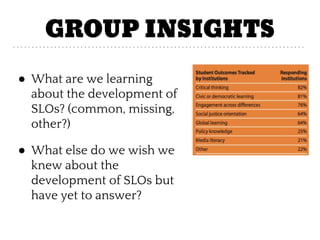
OUTCOMES
●More than half (53%) of institutions indicated that they have specific
student outcomes for community engagement. Common outcomes
include those pertaining to:
●critical thinking (82%);
●civic or democratic learning (81%);
●engagement across differences (diversity) (76%);
●social justice orientation (64%);
●global learning (64%);
●policy knowledge (25%); and media literacy (21%).
●An additional 22% noted that they track student outcomes for engagement
including problem solving, communication, and civic skills.
Source: Preparing to Accelerate Change: Understanding Our Starting
Line (Campus Compact Annual Member Survey, 2015)
SESSION GOALS
Share, engage with, and reflect on four
institutions’ examples of their:
●Outcomes
●Process
●Who was involved
FUTURE AIM
Move “best practice” to “common practice”
●Strategic plan
●Articulated student outcomes
●Assessment and impact evaluation
“
The Great Commitments of Berea College
Berea College Mission
“
To provide an educational opportunity primarily for students from Appalachia, black and
white, who have great promise and limited economic resources.
To provide an education of high quality with a liberal arts foundation and outlook.
To stimulate understanding of the Christian faith and its many expressions and to
emphasize the Christian ethic and the motive of service to others.
To provide for all students through the labor program experiences for learning and
serving in community, and to demonstrate that labor, mental and manual, has dignity as
well as utility.
To assert the kinship of all people and to provide interracial education with a particular
emphasis on understanding and equality among blacks and whites.
To create a democratic community dedicated to education and equality for women and
men.
To maintain a residential campus and to encourage in all members of the community a
way of life characterized by plain living, pride in labor well done, zest for learning, high
personal standards, and concern for the welfare of others.
To serve the Appalachian region primarily through education but also by other
appropriate services.
The Great Commitments of Berea College
PROCESS
● Timeline: Intermittently over the course of 2 years
● Involvement:
○ Process driven by CELTS staff
○ Gathered input from all stakeholder groups
■ Started with students
■ Faculty, academic administrators, community
partners, students were part of HII Initiative
■ Reviewed results of external center-wide
assessment, which included members of all
stakeholder groups
■ Consulted with Dir. of Academic Assessment
PROCESS
● Process:
○ Started with grounding in existing vision, mission,
Common Commitments, CELTS Shared Values
○ Gathered ideas from existing examples
○ Process dovetailed with other parallel/supportive
initiatives
○ Hosted Kristin Norris of IUPUI on campus for
assessment workshops and consultations
● Highlight:
○ Each SLO ties to one or more center-wide goal
PROCESS
● What’s happened since?
○ Develop student awareness
○ Develop faculty awareness
● What’s next?
○ Review and refine; streamline
○ Develop and implement assessment plan
○ Develop opportunities for daily use by staff,
students, faculty
BEREA OUTCOMES
• Work and communicate effectively across differences
• Engage constructively in conflict situations
• Plan and implement community-based service
activities or programs
• Demonstrate ability to think critically about social
issues
• Work effectively in teams
BEREA OUTCOMES
• Integrate the values of service and social justice into
career and life goals
• Use reflection as a means for learning and personal
growth
• Demonstrate understanding of the importance of
institutional and regional context to service at Berea
College
• Act as ambassadors for service at Berea College and
beyond
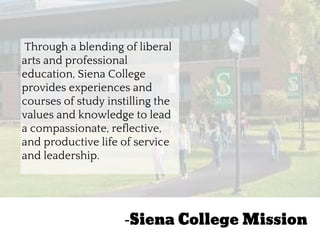
“
Through a blending of liberal
arts and professional
education, Siena College
provides experiences and
courses of study instilling the
values and knowledge to lead
a compassionate, reflective,
and productive life of service
and leadership.
-Siena College Mission
PROCESS
•Following our Data Lab in Spring 2016, made
the decision to reassess learning outcomes
•Utilized Siena College learning outcomes,
previous ACE learning outcomes and
AAC&U values
•About a month and a half from start to
finish- with some additional editing and
wordsmithing that needed to take place
•Closely aligns with mission of the college
and mission of the center
INVOLVEMENT
● ACE Admin and Staff - All Directors and
Program Coordinators
● Process lead mostly by Director of
Programs, Allison Schultz, Director of
Academic Integration, Dr. Paul Thurston
and Assistant Director of ACE, Dr. Ruth
Kassel
● Shared with VPAA and AVPAA and Director
of Office of Institutional Effectiveness
SIENA OUTCOMES
• 1. Critical and creative reasoning. Explores problems/opportunities through
the analysis of evidence from a variety of sources and perspectives;
increases understanding by breaking complex topics into manageable
parts; and, combines ideas in ways that demonstrate creativity and
innovation.
• 2. Collaborative action. Applies knowledge, disciplinary expertise and
professional skills to collaboratively work with diverse partners to produce
meaningful, sustainable, and beneficial change in their local, regional, and
global communities.
• 3. Ethical reasoning. Recognizes ethical issues in a variety of settings;
considers the ramifications of actions to individuals, communities and the
environment; relies on Franciscan Concerns for diversity, heritage, justice,
and nature to make informed decisions and guide sustainable action.
SIENA OUTCOMES
• 4. Oral and written communication. Develops and expresses ideas in
professional settings which effectively increases knowledge, fosters
understanding, and promotes change in attitudes, values, beliefs, or
behaviors.
• 5. Teamwork and leadership. Contributes toward goals, interacts with
others in a respectful manner, manages processes, and motivates
others to achieve collaborative objectives in a variety of situations and
cultural contexts.
• 6. Reflection and lifelong learning. Explores and integrates knowledge
gained across a variety of experiences to understand preconceptions
and privileges, and how these shape perspective; applies knowledge
to improve competence and transfers learning to new situations.
“A Richmond education prepares
students for lives of purpose,
thoughtful inquiry, and responsible
leadership in a diverse world.
-University of Richmond Mission
PROCESS
Bottom-up / Grassroots
Process as important as the product
(culture of inquiry)
Iterative (What is the answer?)
PROCESS
Conducted data lab to identify big outcome categories (March 2012)
● People, privilege and diversity, self-efficacy, complexity,
context, action
Contracted with private firm to host focus groups (April 2012)
● Students and site supervisors participated
● Refined big outcome categories
Conducted data lab to draft student learning outcomes (May 2012)
● Small groups reviewed focus group summary report and
drafted three learning outcome statements
Finalized student learning outcomes and rubric (November 2012)
INVOLVEMENT
Intentional Impact Working Group (5 staff) drove
process
● Secured artifacts, planned data labs, contracted
focus groups, drafted SLOs and rubrics
CCE staff participated by providing feedback (9 staff)
● Produced artifacts, participated in data labs, drafted
initial outcomes, tested rubrics
Alan Newman Research conducted focus groups (24
students and 10 community partner staff)
UR OUTCOMES
1. The Bonner Center for Civic Engagement helps students
understand the ways that difference, privilege, and power work in
their own lives and in our society.
2. The Bonner Center for Civic Engagement broadens and deepens
students’ thinking about complex and interconnected social issues
affecting our world today.
3. The Bonner Center for Civic Engagement prepares students for
active citizenship. (civic identity, active participation, well-being)
4. The Bonner Center for Civic Engagement prepares students for
lives of active learning. (self-motivated, communication and
professional skills)
“
The mission of Warren Wilson College
is to provide a distinctive undergraduate
and graduate liberal arts education. Our
undergraduate education combines
academics, work, and service in a
learning community committed to
environmental responsibility,
cross-cultural understanding, and the
common good.
-Warren Wilson College Mission
PROCESS
• Collective agreement within CCE staff and its
advisory committee to shift to a new model; coupled
with the College’s strategic planning process
(2009-2010)
• Benchmarking study including interviews with 15
schools and literature review of models (Fall 2010)
• Surveys and focus groups with students, faculty,
staff, and community partners (2010-2011)
• Model development, member checks, and final
approval through Shared Governance (2010-11)
• Plan for Implementation (2011-12)
INVOLVEMENT
•Committee formerly known as the Service
Program Advisory Committee (now the
Community Engagement Advisory
Committee)
•Students, staff, faculty, and community
partners
•Final approval required from the various
elements of shared governance
WARREN WILSON
OUTCOMES
POINTS OF ENGAGEMENT AND GROWTH (PEGs)
Self-knowledge
○ Explore and clarify interests, passions, skills, and values.
Understanding of complex issues
○ Examine why a social/environmental issue exists and how service
addresses it.
Collaboration for community impact
○ Provide significant and substantial engagement with an issue
and/or partner agency that involves initiative and communication.
Commitment to community engagement
○ Demonstrate a sense of civic responsibility through intentional
engagement in the community.
PROCESS
• Requirement phased in each year, beginning
Fall 2012
• Annual assessment through student surveys after
each PEG and evaluations from community
partners
• Continuing to refine and build upon our
assessment so that both the requirement and
assessment are do-able
DATA LAB
Visit the four stations with the
common recipe card and make
notes about…
● Common ingredients
● Missing ingredients (for
distinctive flavor)
● Other insights
GROUP INSIGHTS
● What are we learning
about the development of
SLOs? (common, missing,
other?)
● What else do we wish we
knew about the
development of SLOs but
have yet to answer?
NEW RESOURCES
3 rubrics now for civic work...see Bonner
wiki
● Civic engagement (AAC&U)
● Civic knowledge (through Massachusetts)
● Civic values (through Massachusetts)
Foundation plans to work with a team of
Institutional Research representatives to
articulate common set (recommended)
GROUP WORK
Four groups…
● If your institution does not have student learning
outcomes (tied to CE)
● If your institution is in the process of crafting
student learning outcomes (tied to CE)
● If your institution has student learning outcomes
(tied to CE) but not yet assessed
● If your institution has student learning outcomes
(tied to CE) and has begun or done assessment

Bonner Directors 2016 - Student Learning Outcomes

  • 1.
  • 2.
    LOOKING BACK ●In 1986,community service was organized mostly via voluntary groups (76%) - often student led! ●Placements were often supported through an informational clearinghouse (66%) ●Fewer than half of colleges and universities had a designated center ●In the 1990s when the Bonner Scholar Program was launched, it was often out of a chaplain’s office Source: Collegiate Community Service: The Status of Public and Community Service at Selected Colleges and Universities (1986)
  • 3.
    CHANGING CONTEXT ●In 2015,over 1,100 colleges and universities have expressly shared a commitment to civic engagement ●Of these, 94% of institutions have a dedicated coordinating unit, but 3.4 units coordinate curricular and co-curricular engagement on average at a single institution ●Across institutions, there is wide variety of vehicles for both curricular and co-curricular engagement including: ●residence-hall based service (91%) ●disciplinary CBL courses (71%) ●capstone service courses (57%) Source: Preparing to Accelerate Change: Understanding Our Starting Line (Campus Compact Annual Member Survey, 2015)
  • 4.
    OUTCOMES ●More than half(53%) of institutions indicated that they have specific student outcomes for community engagement. Common outcomes include those pertaining to: ●critical thinking (82%); ●civic or democratic learning (81%); ●engagement across differences (diversity) (76%); ●social justice orientation (64%); ●global learning (64%); ●policy knowledge (25%); and media literacy (21%). ●An additional 22% noted that they track student outcomes for engagement including problem solving, communication, and civic skills. Source: Preparing to Accelerate Change: Understanding Our Starting Line (Campus Compact Annual Member Survey, 2015)
  • 5.
    SESSION GOALS Share, engagewith, and reflect on four institutions’ examples of their: ●Outcomes ●Process ●Who was involved
  • 6.
    FUTURE AIM Move “bestpractice” to “common practice” ●Strategic plan ●Articulated student outcomes ●Assessment and impact evaluation
  • 7.
    “ The Great Commitmentsof Berea College Berea College Mission
  • 8.
    “ To provide aneducational opportunity primarily for students from Appalachia, black and white, who have great promise and limited economic resources. To provide an education of high quality with a liberal arts foundation and outlook. To stimulate understanding of the Christian faith and its many expressions and to emphasize the Christian ethic and the motive of service to others. To provide for all students through the labor program experiences for learning and serving in community, and to demonstrate that labor, mental and manual, has dignity as well as utility. To assert the kinship of all people and to provide interracial education with a particular emphasis on understanding and equality among blacks and whites. To create a democratic community dedicated to education and equality for women and men. To maintain a residential campus and to encourage in all members of the community a way of life characterized by plain living, pride in labor well done, zest for learning, high personal standards, and concern for the welfare of others. To serve the Appalachian region primarily through education but also by other appropriate services. The Great Commitments of Berea College
  • 9.
    PROCESS ● Timeline: Intermittentlyover the course of 2 years ● Involvement: ○ Process driven by CELTS staff ○ Gathered input from all stakeholder groups ■ Started with students ■ Faculty, academic administrators, community partners, students were part of HII Initiative ■ Reviewed results of external center-wide assessment, which included members of all stakeholder groups ■ Consulted with Dir. of Academic Assessment
  • 10.
    PROCESS ● Process: ○ Startedwith grounding in existing vision, mission, Common Commitments, CELTS Shared Values ○ Gathered ideas from existing examples ○ Process dovetailed with other parallel/supportive initiatives ○ Hosted Kristin Norris of IUPUI on campus for assessment workshops and consultations ● Highlight: ○ Each SLO ties to one or more center-wide goal
  • 11.
    PROCESS ● What’s happenedsince? ○ Develop student awareness ○ Develop faculty awareness ● What’s next? ○ Review and refine; streamline ○ Develop and implement assessment plan ○ Develop opportunities for daily use by staff, students, faculty
  • 12.
    BEREA OUTCOMES • Workand communicate effectively across differences • Engage constructively in conflict situations • Plan and implement community-based service activities or programs • Demonstrate ability to think critically about social issues • Work effectively in teams
  • 13.
    BEREA OUTCOMES • Integratethe values of service and social justice into career and life goals • Use reflection as a means for learning and personal growth • Demonstrate understanding of the importance of institutional and regional context to service at Berea College • Act as ambassadors for service at Berea College and beyond
  • 14.
    “ Through a blendingof liberal arts and professional education, Siena College provides experiences and courses of study instilling the values and knowledge to lead a compassionate, reflective, and productive life of service and leadership. -Siena College Mission
  • 15.
    PROCESS •Following our DataLab in Spring 2016, made the decision to reassess learning outcomes •Utilized Siena College learning outcomes, previous ACE learning outcomes and AAC&U values •About a month and a half from start to finish- with some additional editing and wordsmithing that needed to take place •Closely aligns with mission of the college and mission of the center
  • 16.
    INVOLVEMENT ● ACE Adminand Staff - All Directors and Program Coordinators ● Process lead mostly by Director of Programs, Allison Schultz, Director of Academic Integration, Dr. Paul Thurston and Assistant Director of ACE, Dr. Ruth Kassel ● Shared with VPAA and AVPAA and Director of Office of Institutional Effectiveness
  • 17.
    SIENA OUTCOMES • 1.Critical and creative reasoning. Explores problems/opportunities through the analysis of evidence from a variety of sources and perspectives; increases understanding by breaking complex topics into manageable parts; and, combines ideas in ways that demonstrate creativity and innovation. • 2. Collaborative action. Applies knowledge, disciplinary expertise and professional skills to collaboratively work with diverse partners to produce meaningful, sustainable, and beneficial change in their local, regional, and global communities. • 3. Ethical reasoning. Recognizes ethical issues in a variety of settings; considers the ramifications of actions to individuals, communities and the environment; relies on Franciscan Concerns for diversity, heritage, justice, and nature to make informed decisions and guide sustainable action.
  • 18.
    SIENA OUTCOMES • 4.Oral and written communication. Develops and expresses ideas in professional settings which effectively increases knowledge, fosters understanding, and promotes change in attitudes, values, beliefs, or behaviors. • 5. Teamwork and leadership. Contributes toward goals, interacts with others in a respectful manner, manages processes, and motivates others to achieve collaborative objectives in a variety of situations and cultural contexts. • 6. Reflection and lifelong learning. Explores and integrates knowledge gained across a variety of experiences to understand preconceptions and privileges, and how these shape perspective; applies knowledge to improve competence and transfers learning to new situations.
  • 19.
    “A Richmond educationprepares students for lives of purpose, thoughtful inquiry, and responsible leadership in a diverse world. -University of Richmond Mission
  • 20.
    PROCESS Bottom-up / Grassroots Processas important as the product (culture of inquiry) Iterative (What is the answer?)
  • 21.
    PROCESS Conducted data labto identify big outcome categories (March 2012) ● People, privilege and diversity, self-efficacy, complexity, context, action Contracted with private firm to host focus groups (April 2012) ● Students and site supervisors participated ● Refined big outcome categories Conducted data lab to draft student learning outcomes (May 2012) ● Small groups reviewed focus group summary report and drafted three learning outcome statements Finalized student learning outcomes and rubric (November 2012)
  • 22.
    INVOLVEMENT Intentional Impact WorkingGroup (5 staff) drove process ● Secured artifacts, planned data labs, contracted focus groups, drafted SLOs and rubrics CCE staff participated by providing feedback (9 staff) ● Produced artifacts, participated in data labs, drafted initial outcomes, tested rubrics Alan Newman Research conducted focus groups (24 students and 10 community partner staff)
  • 23.
    UR OUTCOMES 1. TheBonner Center for Civic Engagement helps students understand the ways that difference, privilege, and power work in their own lives and in our society. 2. The Bonner Center for Civic Engagement broadens and deepens students’ thinking about complex and interconnected social issues affecting our world today. 3. The Bonner Center for Civic Engagement prepares students for active citizenship. (civic identity, active participation, well-being) 4. The Bonner Center for Civic Engagement prepares students for lives of active learning. (self-motivated, communication and professional skills)
  • 24.
    “ The mission ofWarren Wilson College is to provide a distinctive undergraduate and graduate liberal arts education. Our undergraduate education combines academics, work, and service in a learning community committed to environmental responsibility, cross-cultural understanding, and the common good. -Warren Wilson College Mission
  • 25.
    PROCESS • Collective agreementwithin CCE staff and its advisory committee to shift to a new model; coupled with the College’s strategic planning process (2009-2010) • Benchmarking study including interviews with 15 schools and literature review of models (Fall 2010) • Surveys and focus groups with students, faculty, staff, and community partners (2010-2011) • Model development, member checks, and final approval through Shared Governance (2010-11) • Plan for Implementation (2011-12)
  • 26.
    INVOLVEMENT •Committee formerly knownas the Service Program Advisory Committee (now the Community Engagement Advisory Committee) •Students, staff, faculty, and community partners •Final approval required from the various elements of shared governance
  • 27.
    WARREN WILSON OUTCOMES POINTS OFENGAGEMENT AND GROWTH (PEGs) Self-knowledge ○ Explore and clarify interests, passions, skills, and values. Understanding of complex issues ○ Examine why a social/environmental issue exists and how service addresses it. Collaboration for community impact ○ Provide significant and substantial engagement with an issue and/or partner agency that involves initiative and communication. Commitment to community engagement ○ Demonstrate a sense of civic responsibility through intentional engagement in the community.
  • 28.
    PROCESS • Requirement phasedin each year, beginning Fall 2012 • Annual assessment through student surveys after each PEG and evaluations from community partners • Continuing to refine and build upon our assessment so that both the requirement and assessment are do-able
  • 29.
    DATA LAB Visit thefour stations with the common recipe card and make notes about… ● Common ingredients ● Missing ingredients (for distinctive flavor) ● Other insights
  • 30.
    GROUP INSIGHTS ● Whatare we learning about the development of SLOs? (common, missing, other?) ● What else do we wish we knew about the development of SLOs but have yet to answer?
  • 31.
    NEW RESOURCES 3 rubricsnow for civic work...see Bonner wiki ● Civic engagement (AAC&U) ● Civic knowledge (through Massachusetts) ● Civic values (through Massachusetts) Foundation plans to work with a team of Institutional Research representatives to articulate common set (recommended)
  • 32.
    GROUP WORK Four groups… ●If your institution does not have student learning outcomes (tied to CE) ● If your institution is in the process of crafting student learning outcomes (tied to CE) ● If your institution has student learning outcomes (tied to CE) but not yet assessed ● If your institution has student learning outcomes (tied to CE) and has begun or done assessment