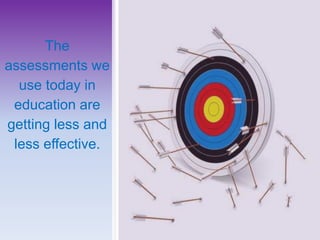
The
assessments we
use today in
education are
getting less and
less effective.
Whether you accept it or not,
Our education system is
Broken.
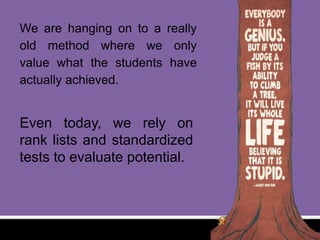
We are hanging on to a really
old method where we only
value what the students have
actually achieved.
Even today, we rely on
rank lists and standardized
tests to evaluate potential.
That’s where comes inOBE
Outcome Based
Education
(OBE)-
The holistic approach to
convert a student into a
great person, based on
desired outcomes &
defined goals.
It is a student-centered
approach to education that
focuses on the intended
learning outcomes from
instruction(Nicholson, 2011).
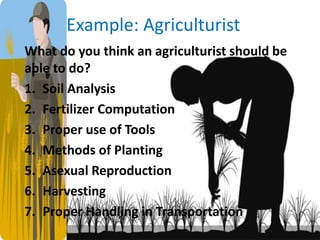
Example: Agriculturist
What do you think an agriculturist should be
able to do?
1. Soil Analysis
2. Fertilizer Computation
3. Proper use of Tools
4. Methods of Planting
5. Asexual Reproduction
6. Harvesting
7. Proper Handling in Transportation
Example: Doctor
What do you think a doctor should be able to
do?
1. Clinical Skills
2. Perform Practical Procedures
3. Investigate a Patient
4. Manage a Patient
5. Health Promotion and Disease Prevention
6. Skills of Communication
7. Retrieve and Handle Information
3 Different Views about OBE
1. As a theory in education.
2. As a systemic structure for
education.
3. As a classroom practice.
Why is it important to
know the outcomes prior to
planning and teaching?
Why Learning Outcomes?
• Provide direction in the planning of a learning
activity
• Focus learner’s behavior on that is to be
changed
• Serve as guidelines for content, instruction
and evaluation
• Identify specifically what should be learned
• Convey to learners exactly what is to be
accomplished
Objective: To provide participants with a good
understanding of outcome-based education
Outcome: Participants must be able to demonstrate
their grasp of OBE by, e.g. writing learning outcomes
for the courses they teach
Sample…
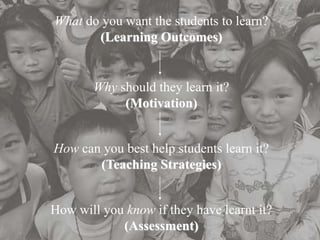
What do you want the students to learn?
(Learning Outcomes)
Why should they learn it?
(Motivation)
How can you best help students learn it?
(Teaching Strategies)
How will you know if they have learnt it?
(Assessment)
What are the characteristics of
good learning outcomes?
Achievable
Observable
Measurable / Accessible
Challenging
Once the intended
outcomes are clear,
the teacher now
design instruction.
Outcomes are the end targets of OBE. Various
authors claim outcomes as:
HEIs define OBE as a means
of describing the attributes of
their ideal graduates based
on their visions and missions
as part of their institutional
goals or outcomes, and using
these as bases for developing
specific program outcomes.HEI (Higher Educational Institution)
Outcomes are the end targets of OBE. Various
authors claim outcomes as:
CHED defines Outcomes-based
Education as an approach that focuses
and organizes the educational system
around what is essential for all learners
to know, value, and be able to do to
achieve a desired level of competence.
OBE “is open to incorporating
discipline-based learning areas that
currently structure HEI curricula.”
CHED
Outcomes are the end targets of OBE. Various
authors claim outcomes as:
Butler, Mollie (2004)
Outcomes are the end targets of OBE. Various
authors claim outcomes as:
Geyser (1999)
Outcomes are the end targets of OBE. Various
authors claim outcomes as:
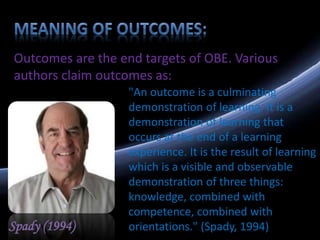
Spady (1994)
"An outcome is a culminating
demonstration of learning. It is a
demonstration of learning that
occurs at the end of a learning
experience. It is the result of learning
which is a visible and observable
demonstration of three things:
knowledge, combined with
competence, combined with
orientations." (Spady, 1994)
Outcomes are the end targets of OBE. Various
authors claim outcomes as:
Spady (1994)
Exit outcomes and
enabling outcomes.
Exit outcomes are the
big outcomes while
the enabling
outcomes are the
small outcomes.
Outcomes are the end targets of OBE. Various
authors claim outcomes as:
Spady (1994)
According to William
Spady, a reform
advocate, outcomes can
be written with
“traditional/transitional
” OBE and
“transformational” OBE.
The traditional/transitional approach emphasizes student
mastery of traditional subject-related academic outcomes
(usually with a strong focus on subject-specific content) and
some cross-discipline outcomes (such as the ability to solve
problems or to work cooperatively)
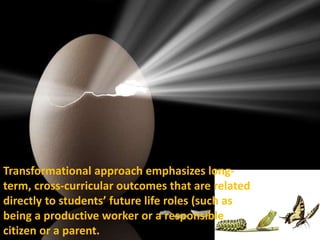
Transformational approach emphasizes long-
term, cross-curricular outcomes that are related
directly to students’ future life roles (such as
being a productive worker or a responsible
citizen or a parent.
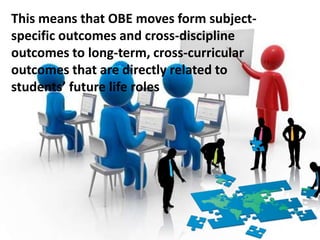
This means that OBE moves form subject-
specific outcomes and cross-discipline
outcomes to long-term, cross-curricular
outcomes that are directly related to
students’ future life roles
Spady premised thatin Outcomes-Based Education:
• Allstudentscan learn and succeed, but not at thesame timeor
in thesame way.
• Successful learningpromotes even more successfullearning.
• Schools and teachers control the conditions thatwill determine
if thestudents are successful in school learning.
Teaching-Learning in OBE
Teaching is teaching if learners learn. Learning is
measured by its outcome
Teaching-Learning in OBE
Whatever approach to teaching is used, the intent
should focus on learning rather than on
teaching. Subjects do not exist in isolation, but
links between them should be made.
Teaching-Learning in OBE
It is important that students learn how to learn,
hence a teacher should be innovative. How
then should teaching-learning be done in OBE?
Teaching-Learning in OBE
Teachers must prepare students adequately. This can be
done if the teachers know what they want the students
to learn and what learning outcomes to achieve.
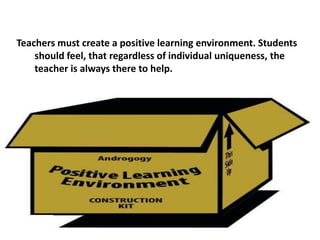
Teachers must create a positive learning environment. Students
should feel, that regardless of individual uniqueness, the
teacher is always there to help.
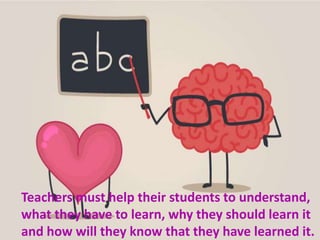
Teachers must help their students to understand,
what they have to learn, why they should learn it
and how will they know that they have learned it.
Teachers must provide students enough opportunities to
use the new knowledge and skills that they gain. When
students do this, they can explore with new learning,
correct errors and adjust their thinking.
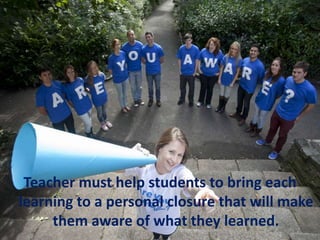
Teacher must help students to bring each
learning to a personal closure that will make
them aware of what they learned.
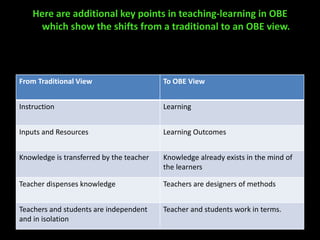
Here are additional key points in teaching-learning in OBE
which show the shifts from a traditional to an OBE view.
From Traditional View To OBE View
Instruction Learning
Inputs and Resources Learning Outcomes
Knowledge is transferred by the teacher Knowledge already exists in the mind of
the learners
Teacher dispenses knowledge Teachers are designers of methods
Teachers and students are independent
and in isolation
Teacher and students work in terms.
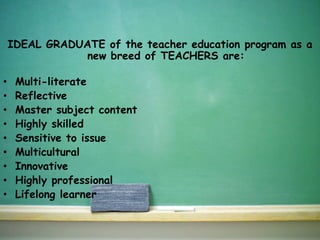
IDEAL GRADUATE of the teacher education program as a
new breed of TEACHERS are:
• Multi-literate
• Reflective
• Master subject content
• Highly skilled
• Sensitive to issue
• Multicultural
• Innovative
• Highly professional
• Lifelong learner
TIPS ON HOW TEACHING-LEARNING
BE DONE IN OUTCOMES-BASED
EDUCATION
• Teachers mustprepare studentsadequately.
• Teachers mustcreate a positive learning environment.
• Teachers musthelp their studentsto understand, whatthey
have to learn, why they should learn it and how will they
know thatthey have learned.
• Teachers mustuse a variety of teachingmethods.
• Teachers mustprovide studentswith enoughopportunities to
use the new knowledge and skills thatthey gain.
• Teachers musthelp studentsto bring each learningto a
personal closure thatwill makethemaware of whatthey
learned.
ASSESSMENT OF LEARNING
OUTCOMES IN OBE
To be useful in OBE systems, assessmentshouldbe
guided bythe followingprinciples:
1. Assessment procedure shouldbe valid.Procedure &
toolsshouldactuallyassess what one intends to
test.
2. Assessment procedure shouldbe reliable.The
results shouldbe consistent.
3. Assessment procedure shouldbe fair. Cultural
background & other factors shouldnotinfluence
assessmentprocedure.
4. Assessment should reflect the knowledgeand skills thatare
importantto thestudents.
5. Assessment should tellboth theteachers and studentshow
studentsare progressing.
6. Assessment should support every student’s opportunity to
learn things thatare important.
7. Assessment should allow individuality or uniquenessto be
demonstrated.
8. Assessment should becomprehensive to cover a wide range of
learning outcomes.
LEARNER’S RESPONSIBILITY
FOR LEARNING
“If you are not willing to learn, no
one canhelp you. If you are
determined to learn no one can
stop you.”
ThankYou 

Outcomes-Based Education

  • 10.
    The assessments we use todayin education are getting less and less effective.
  • 11.
    Whether you acceptit or not, Our education system is Broken.
  • 12.
    We are hangingon to a really old method where we only value what the students have actually achieved. Even today, we rely on rank lists and standardized tests to evaluate potential.
  • 13.
  • 16.
    Outcome Based Education (OBE)- The holisticapproach to convert a student into a great person, based on desired outcomes & defined goals.
  • 17.
    It is astudent-centered approach to education that focuses on the intended learning outcomes from instruction(Nicholson, 2011).
  • 18.
    Example: Agriculturist What doyou think an agriculturist should be able to do? 1. Soil Analysis 2. Fertilizer Computation 3. Proper use of Tools 4. Methods of Planting 5. Asexual Reproduction 6. Harvesting 7. Proper Handling in Transportation
  • 19.
    Example: Doctor What doyou think a doctor should be able to do? 1. Clinical Skills 2. Perform Practical Procedures 3. Investigate a Patient 4. Manage a Patient 5. Health Promotion and Disease Prevention 6. Skills of Communication 7. Retrieve and Handle Information
  • 20.
    3 Different Viewsabout OBE 1. As a theory in education. 2. As a systemic structure for education. 3. As a classroom practice.
  • 21.
    Why is itimportant to know the outcomes prior to planning and teaching?
  • 22.
    Why Learning Outcomes? •Provide direction in the planning of a learning activity • Focus learner’s behavior on that is to be changed • Serve as guidelines for content, instruction and evaluation • Identify specifically what should be learned • Convey to learners exactly what is to be accomplished
  • 23.
    Objective: To provideparticipants with a good understanding of outcome-based education Outcome: Participants must be able to demonstrate their grasp of OBE by, e.g. writing learning outcomes for the courses they teach Sample…
  • 24.
    What do youwant the students to learn? (Learning Outcomes) Why should they learn it? (Motivation) How can you best help students learn it? (Teaching Strategies) How will you know if they have learnt it? (Assessment)
  • 25.
    What are thecharacteristics of good learning outcomes?
  • 26.
  • 27.
  • 28.
  • 29.
  • 32.
    Once the intended outcomesare clear, the teacher now design instruction.
  • 35.
    Outcomes are theend targets of OBE. Various authors claim outcomes as: HEIs define OBE as a means of describing the attributes of their ideal graduates based on their visions and missions as part of their institutional goals or outcomes, and using these as bases for developing specific program outcomes.HEI (Higher Educational Institution)
  • 36.
    Outcomes are theend targets of OBE. Various authors claim outcomes as: CHED defines Outcomes-based Education as an approach that focuses and organizes the educational system around what is essential for all learners to know, value, and be able to do to achieve a desired level of competence. OBE “is open to incorporating discipline-based learning areas that currently structure HEI curricula.” CHED
  • 37.
    Outcomes are theend targets of OBE. Various authors claim outcomes as: Butler, Mollie (2004)
  • 38.
    Outcomes are theend targets of OBE. Various authors claim outcomes as: Geyser (1999)
  • 39.
    Outcomes are theend targets of OBE. Various authors claim outcomes as: Spady (1994) "An outcome is a culminating demonstration of learning. It is a demonstration of learning that occurs at the end of a learning experience. It is the result of learning which is a visible and observable demonstration of three things: knowledge, combined with competence, combined with orientations." (Spady, 1994)
  • 40.
    Outcomes are theend targets of OBE. Various authors claim outcomes as: Spady (1994) Exit outcomes and enabling outcomes. Exit outcomes are the big outcomes while the enabling outcomes are the small outcomes.
  • 41.
    Outcomes are theend targets of OBE. Various authors claim outcomes as: Spady (1994) According to William Spady, a reform advocate, outcomes can be written with “traditional/transitional ” OBE and “transformational” OBE.
  • 42.
    The traditional/transitional approachemphasizes student mastery of traditional subject-related academic outcomes (usually with a strong focus on subject-specific content) and some cross-discipline outcomes (such as the ability to solve problems or to work cooperatively)
  • 43.
    Transformational approach emphasizeslong- term, cross-curricular outcomes that are related directly to students’ future life roles (such as being a productive worker or a responsible citizen or a parent.
  • 44.
    This means thatOBE moves form subject- specific outcomes and cross-discipline outcomes to long-term, cross-curricular outcomes that are directly related to students’ future life roles
  • 45.
    Spady premised thatinOutcomes-Based Education: • Allstudentscan learn and succeed, but not at thesame timeor in thesame way. • Successful learningpromotes even more successfullearning. • Schools and teachers control the conditions thatwill determine if thestudents are successful in school learning.
  • 46.
    Teaching-Learning in OBE Teachingis teaching if learners learn. Learning is measured by its outcome
  • 47.
    Teaching-Learning in OBE Whateverapproach to teaching is used, the intent should focus on learning rather than on teaching. Subjects do not exist in isolation, but links between them should be made.
  • 48.
    Teaching-Learning in OBE Itis important that students learn how to learn, hence a teacher should be innovative. How then should teaching-learning be done in OBE? Teaching-Learning in OBE
  • 50.
    Teachers must preparestudents adequately. This can be done if the teachers know what they want the students to learn and what learning outcomes to achieve.
  • 51.
    Teachers must createa positive learning environment. Students should feel, that regardless of individual uniqueness, the teacher is always there to help.
  • 52.
    Teachers must helptheir students to understand, what they have to learn, why they should learn it and how will they know that they have learned it.
  • 54.
    Teachers must providestudents enough opportunities to use the new knowledge and skills that they gain. When students do this, they can explore with new learning, correct errors and adjust their thinking.
  • 55.
    Teacher must helpstudents to bring each learning to a personal closure that will make them aware of what they learned.
  • 56.
    Here are additionalkey points in teaching-learning in OBE which show the shifts from a traditional to an OBE view. From Traditional View To OBE View Instruction Learning Inputs and Resources Learning Outcomes Knowledge is transferred by the teacher Knowledge already exists in the mind of the learners Teacher dispenses knowledge Teachers are designers of methods Teachers and students are independent and in isolation Teacher and students work in terms.
  • 57.
    IDEAL GRADUATE ofthe teacher education program as a new breed of TEACHERS are: • Multi-literate • Reflective • Master subject content • Highly skilled • Sensitive to issue • Multicultural • Innovative • Highly professional • Lifelong learner
  • 58.
    TIPS ON HOWTEACHING-LEARNING BE DONE IN OUTCOMES-BASED EDUCATION
  • 59.
    • Teachers mustpreparestudentsadequately. • Teachers mustcreate a positive learning environment. • Teachers musthelp their studentsto understand, whatthey have to learn, why they should learn it and how will they know thatthey have learned. • Teachers mustuse a variety of teachingmethods.
  • 60.
    • Teachers mustprovidestudentswith enoughopportunities to use the new knowledge and skills thatthey gain. • Teachers musthelp studentsto bring each learningto a personal closure thatwill makethemaware of whatthey learned.
  • 61.
  • 62.
    To be usefulin OBE systems, assessmentshouldbe guided bythe followingprinciples: 1. Assessment procedure shouldbe valid.Procedure & toolsshouldactuallyassess what one intends to test. 2. Assessment procedure shouldbe reliable.The results shouldbe consistent. 3. Assessment procedure shouldbe fair. Cultural background & other factors shouldnotinfluence assessmentprocedure.
  • 63.
    4. Assessment shouldreflect the knowledgeand skills thatare importantto thestudents. 5. Assessment should tellboth theteachers and studentshow studentsare progressing. 6. Assessment should support every student’s opportunity to learn things thatare important. 7. Assessment should allow individuality or uniquenessto be demonstrated. 8. Assessment should becomprehensive to cover a wide range of learning outcomes.
  • 64.
  • 65.
    “If you arenot willing to learn, no one canhelp you. If you are determined to learn no one can stop you.”
  • 66.