OPTICAL TWEEZERS: THE
FORCE OF LIGHT
Introduction
General description
Working
Vedio of traping particle
Diagrams of instrument
Application
INTRODUCTION
Optical tweezers:
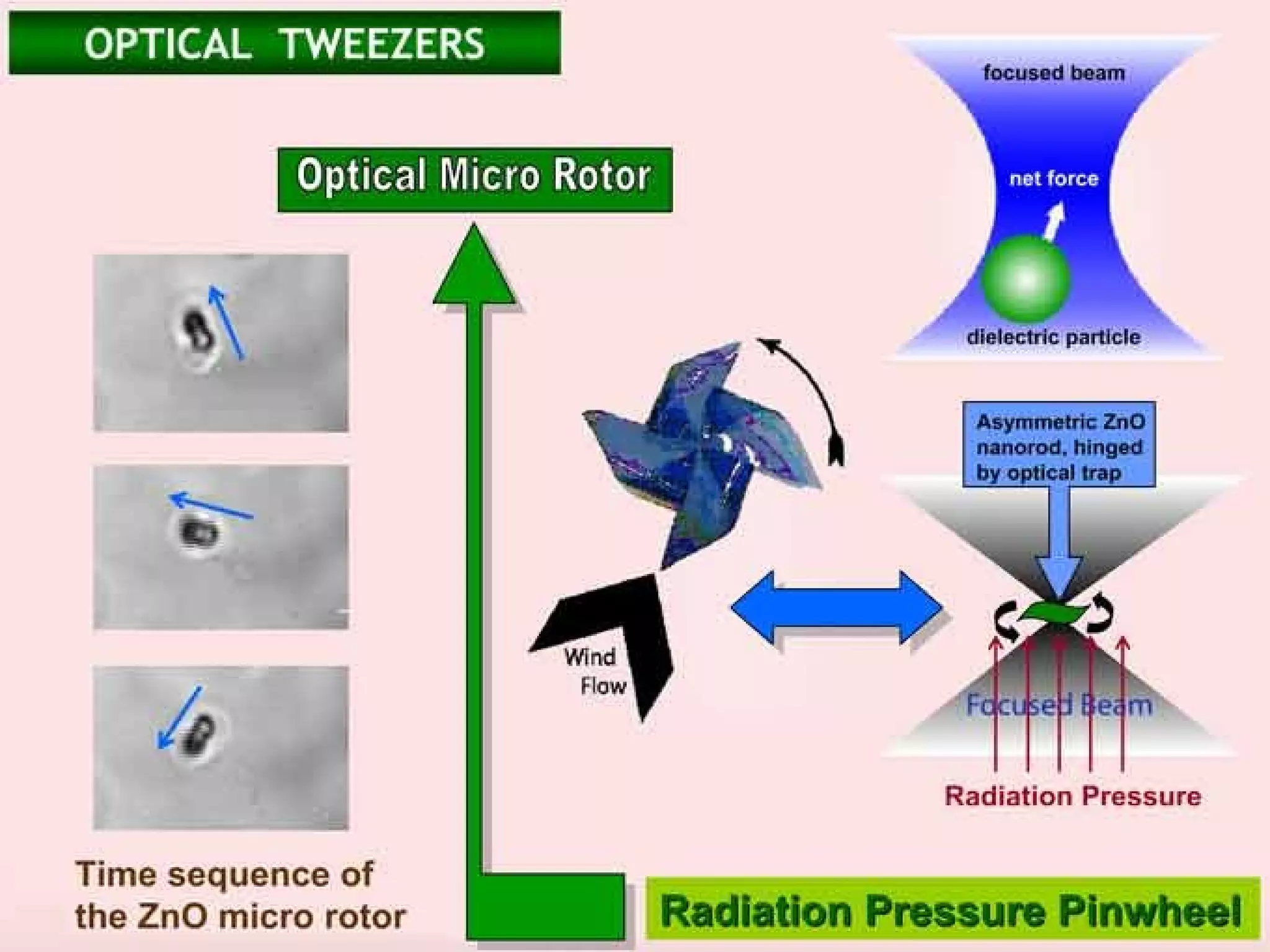
Light can exert forces on small dielectric
objects1, A tightly focused beam of light can
trap micron-sized objects, such as latex beads.
This “optical trapping” principle has found
many applications in chemistry, physics and
biology. It has found its most prominent use in
OPTICAL TWEEZERS ?
An optical tweezer is a scientific instrument that
uses a focused laser beam to provide an attractive
or repulsive force, depending on the index mismatch
(typically on the order of piconewtons) to physically
hold and move microscopic dielectric objects. Optical
tweezers have been particularly successful in
studying a variety of biological systems in recent
years.
Dielectric objects are attracted to the center of the
beam, slightly above the beam waist, as described
in the text. The force applied on the object depends
linearly on its displacement from the trap center
Trapping a particle with light

5
Optical Tweezers
rolf

6
WORKING OF TWEEZER

YouTube - Protein crystal in optical tweezers.flv
WORKING
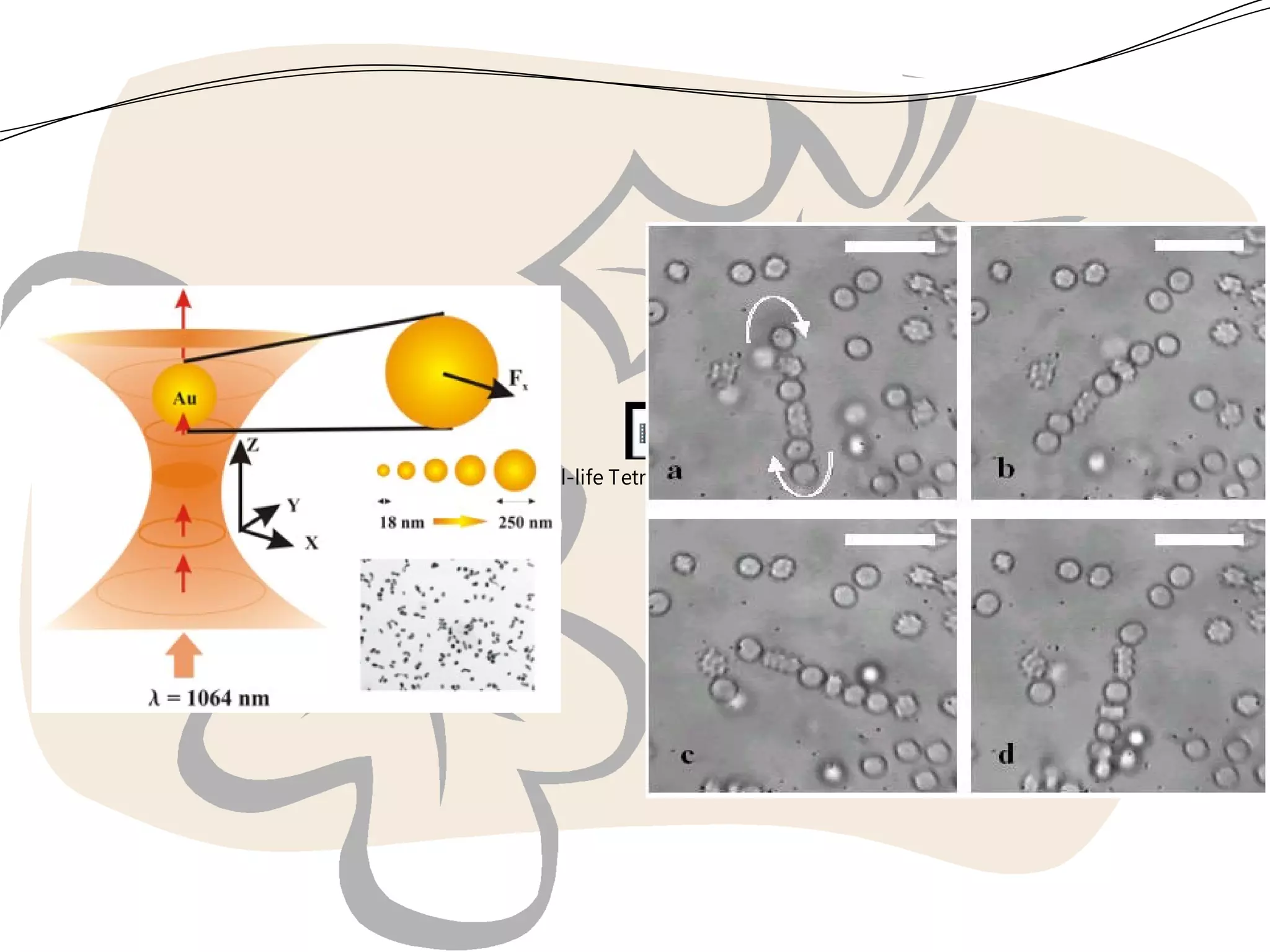
The Nd:YAG laser (1064 nm wavelength) is the
most common laser choice because biological
specimens
are most transparent to laser wavelengths
around 1000 nm. This assures as low an absorption
coefficient as possible, minimizing damage to
the specimen, sometimes referred to as opticution.
Perhaps the most important consideration in optical
tweezer design is the choice of the objective.
Basic Components
Laser

L1

L2
f1 + f2

L3

Objective Lens
f3

16 cm

Image created from Physlet at
http://webphysics.davidson.edu/Course_Material/Py230L/optics/lenses.htm Physlet by Dr. Wolfgang
Christian and Mike Lee
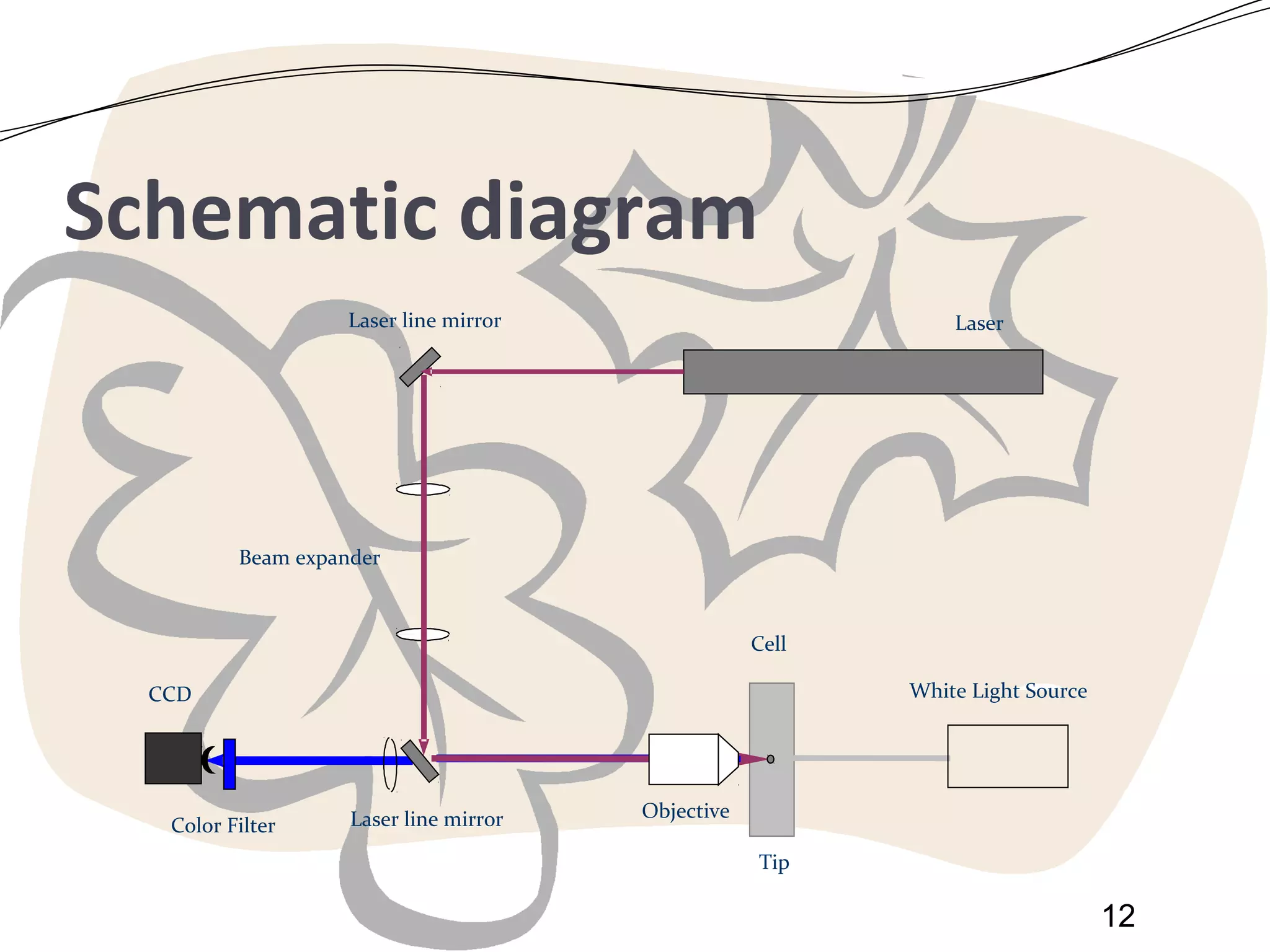
Schematic diagram
Laser line mirror

Laser

Beam expander

Cell
White Light Source

CCD

Color Filter

Laser line mirror

Objective
Tip

12
Dual beam tweezer design

13
Kinesin motor
motion

RAY OPTICS RADIATION
PATTERN
•A laser beam is expanded
and collimated. This
collimated beam is directed
through a microscope
objective into a flow cell.
Spheres with a higher index of
refraction than the medium in
the cell (water) will be
trapped at the focus of the
beam.
YouTube - real-life Tetris under a microscope.flv
APPLICATIONS
We will calibrate the strength of an optical

trap (Optical Tweezer)
Optical Tweezers may be used to measure

very small forces (femtoNewton, 10-15N)
Applications include Biophysics
16
k
YOU
FOR YOUR
ATTENTIO
N

Optical tweezers

  • 1.
  • 2.
    Introduction General description Working Vedio oftraping particle Diagrams of instrument Application
  • 3.
    INTRODUCTION Optical tweezers: Light canexert forces on small dielectric objects1, A tightly focused beam of light can trap micron-sized objects, such as latex beads. This “optical trapping” principle has found many applications in chemistry, physics and biology. It has found its most prominent use in
  • 4.
    OPTICAL TWEEZERS ? Anoptical tweezer is a scientific instrument that uses a focused laser beam to provide an attractive or repulsive force, depending on the index mismatch (typically on the order of piconewtons) to physically hold and move microscopic dielectric objects. Optical tweezers have been particularly successful in studying a variety of biological systems in recent years. Dielectric objects are attracted to the center of the beam, slightly above the beam waist, as described in the text. The force applied on the object depends linearly on its displacement from the trap center
  • 5.
    Trapping a particlewith light 5
  • 6.
  • 7.
    WORKING OF TWEEZER YouTube- Protein crystal in optical tweezers.flv
  • 8.
    WORKING The Nd:YAG laser(1064 nm wavelength) is the most common laser choice because biological specimens are most transparent to laser wavelengths around 1000 nm. This assures as low an absorption coefficient as possible, minimizing damage to the specimen, sometimes referred to as opticution. Perhaps the most important consideration in optical tweezer design is the choice of the objective.
  • 11.
    Basic Components Laser L1 L2 f1 +f2 L3 Objective Lens f3 16 cm Image created from Physlet at http://webphysics.davidson.edu/Course_Material/Py230L/optics/lenses.htm Physlet by Dr. Wolfgang Christian and Mike Lee
  • 12.
    Schematic diagram Laser linemirror Laser Beam expander Cell White Light Source CCD Color Filter Laser line mirror Objective Tip 12
  • 13.
  • 14.
    Kinesin motor motion RAY OPTICSRADIATION PATTERN •A laser beam is expanded and collimated. This collimated beam is directed through a microscope objective into a flow cell. Spheres with a higher index of refraction than the medium in the cell (water) will be trapped at the focus of the beam.
  • 15.
    YouTube - real-lifeTetris under a microscope.flv
  • 16.
    APPLICATIONS We will calibratethe strength of an optical trap (Optical Tweezer) Optical Tweezers may be used to measure very small forces (femtoNewton, 10-15N) Applications include Biophysics 16
  • 17.