SELF ORGANIZATION OF
NANOSTRUCTURED
MATERIALS
Presented by
Najiya KPP
INTRODUCTION
SELF ORGANIZATION
KINDS OF SELF ORGANIZATION
MICELLE,LIPID BILAYER
EPITAXIAL GROWTH
SELF ORGANIZATION OF NANOSTRUCTURES
ON INTERLAYER SURFACES
CONCLUSION
OVERVIEW
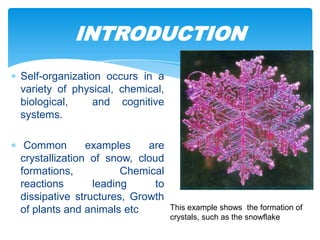
Self-organization occurs in a
variety of physical, chemical,
biological, and cognitive
systems.
Common examples are
crystallization of snow, cloud
formations, Chemical
reactions leading to
dissipative structures, Growth
of plants and animals etc
INTRODUCTION
This example shows the formation of
crystals, such as the snowflake
Are there general principles for
self-organization?
Self Organization
Process of formation of ordered nanostructures
using atoms as small building blocks without any
external energy.
Some form of global order or coordination arises
out of the local interactions between the
components of an initially disordered system.
This process is spontaneous: it is not directed or
controlled by any agent or subsystem inside or
outside of the system; however, the laws
followed by the process and its initial conditions
may have been chosen or caused by an agent.
Principle – Bottom up approach
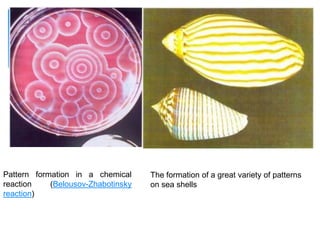
Pattern formation in a chemical
reaction (Belousov-Zhabotinsky
reaction)
The formation of a great variety of patterns
on sea shells
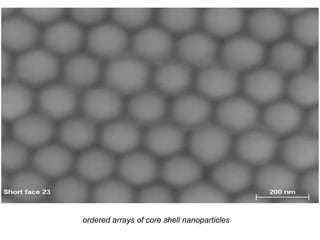
ordered arrays of core shell nanoparticles
By self-organization, individual molecules are built-up and integrated into
larger units and hierarchical structures with unique functionalities.
Natural systems become structured by their own internal processes – self
organizing systems
Different nano-morphologies such as quantum dots, formation of
nanowires, nanotubes etc are possible by self organization.
SELF ORGANIZATION
Thermodynamically stable nanostructures
-- Micelle
-- Lipid bilayer
Kinetically self organized
-- Molecular beam epitaxy
KINDS OF SELF
ORGANIZATION
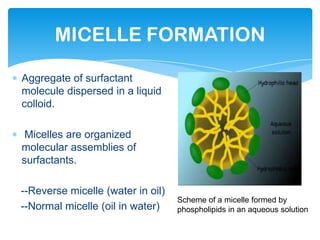
Aggregate of surfactant
molecule dispersed in a liquid
colloid.
Micelles are organized
molecular assemblies of
surfactants.
--Reverse micelle (water in oil)
--Normal micelle (oil in water)
MICELLE FORMATION
Scheme of a micelle formed by
phospholipids in an aqueous solution
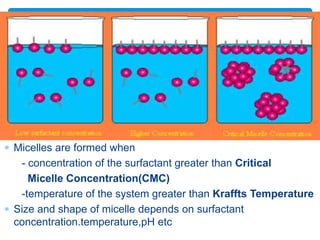
Micelles are formed when
- concentration of the surfactant greater than Critical
Micelle Concentration(CMC)
-temperature of the system greater than Kraffts Temperature
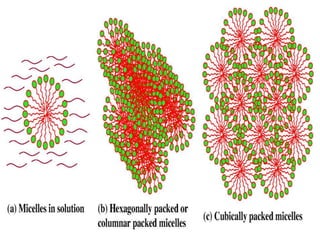
Size and shape of micelle depends on surfactant
concentration.temperature,pH etc
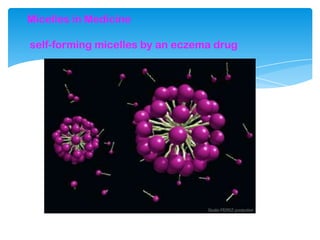
Micelles in Medicine
self-forming micelles by an eczema drug
LIPID BILAYER
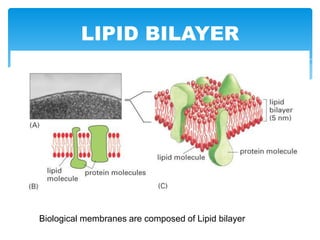
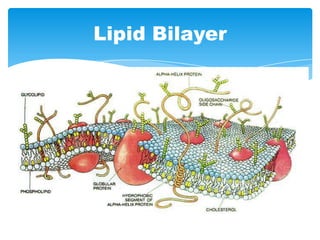
Biological membranes are composed of Lipid bilayer
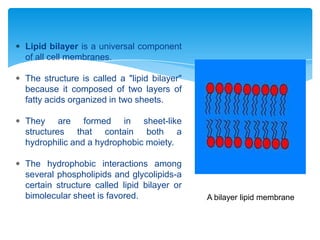
Lipid bilayer is a universal component
of all cell membranes.
The structure is called a "lipid bilayer"
because it composed of two layers of
fatty acids organized in two sheets.
They are formed in sheet-like
structures that contain both a
hydrophilic and a hydrophobic moiety.
The hydrophobic interactions among
several phospholipids and glycolipids-a
certain structure called lipid bilayer or
bimolecular sheet is favored. A bilayer lipid membrane
Lipid Bilayer
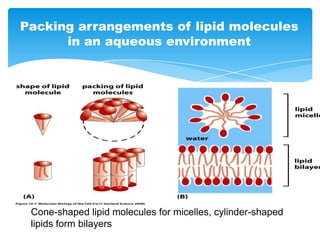
Cone-shaped lipid molecules for micelles, cylinder-shaped
lipids form bilayers
Packing arrangements of lipid molecules
in an aqueous environment
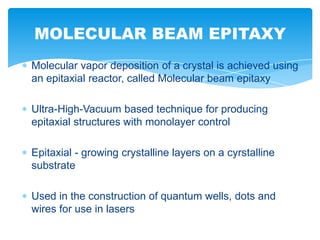
MOLECULAR BEAM EPITAXY
Molecular vapor deposition of a crystal is achieved using
an epitaxial reactor, called Molecular beam epitaxy
Ultra-High-Vacuum based technique for producing
epitaxial structures with monolayer control
Epitaxial - growing crystalline layers on a cyrstalline
substrate
Used in the construction of quantum wells, dots and
wires for use in lasers
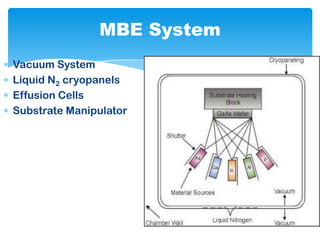
MBE System
Vacuum System
Liquid N2 cryopanels
Effusion Cells
Substrate Manipulator
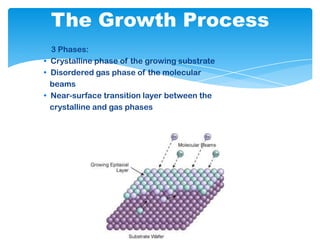
The Growth Process
3 Phases:
• Crystalline phase of the growing substrate
• Disordered gas phase of the molecular
beams
• Near-surface transition layer between the
crystalline and gas phases
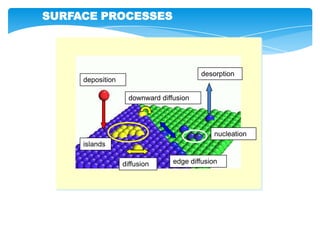
desorption
islands
diffusion
nucleation
deposition
downward diffusion
edge diffusion
SURFACE PROCESSES
Self organization of
nanostructures on interlayer
surfaces
 Formation of arrays of interlayer nanostructures in layered crystals
 Sb2Te3 and Bi2Te3 layers are shown to contain step layered structures
with nanostructured islands on them
 Cu is incorporated into the layers Bi2Te3 as into nanocontainers, without
interacting with excess components of Bi2Te3.Te–Te spaces in Bi2Te3 act
as nanocontainers for copper.
 Particles execute Brownian motion in Te–Te spaces along the Bi2Te3〈Cu〉
surface and merge upon the first collision.
 Nanocell formation begins during impurity diffusion along the basal plane
and whisker growth on the surface at Te vacancies in the same telluride
fivelayer slabs.
 The spontaneous diffusion into layers can be termed self intercalation and
considered evidence of selforganization.
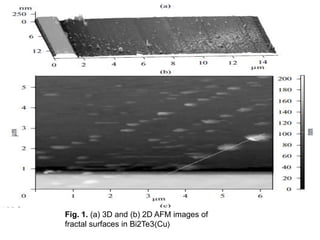
Fig. 1. (a) 3D and (b) 2D AFM images of
fractal surfaces in Bi2Te3〈Cu〉
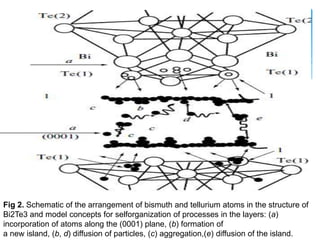
Fig 2. Schematic of the arrangement of bismuth and tellurium atoms in the structure of
Bi2Te3 and model concepts for selforganization of processes in the layers: (а)
incorporation of atoms along the (0001) plane, (b) formation of
a new island, (b, d) diffusion of particles, (c) aggregation,(e) diffusion of the island.
Currently,much effort has been undertaken to develop an
effective and technologically simple method used for the
synthesis of nanostructures over a macroscopic surface area.
Today, the research spotlight is especially focused on self-
organized nanostructured materials
Self organization can be utilized as an efficient synthetic route
for the construction of nanometre-scale architectures
Self organization research explodes drawing the interest of
researchers from every imaginable field.
CONCLUSION
Nanostructured materials- basic concepts and
microstructures - H. GLEITER,Forschungszentrum
Karlsruhe, Institute of Nanotechnology, D-76021
Karlsruhe, Germany
Epitaxial self-organization: from surfaces to magnetic
materials-Olivier Fruchart Laboratoire Louis Néel
(CNRS), 25, avenue des Martyrs, BP166, 38042 Grenoble
cedex 9, France
Growth and SelfOrganization of Nanostructures on Interlayer
Surfaces of A2B3 Layered Crystals - A. N. Georgobiania, A.
M. Pashaevb, B. G. Tagievb, F. K. Aleskerovc, O. B.
Tagievd, and K. Sh. Kakhramanovc
http://www.scholarpedia.org/article/Self-organization
http://www.chemie.uni-
hamburg.de/pc/klinke/publications/Press-release-english.pdf
http://www.sciencedirect.com
REFERENCES
THANK YOU FOR YOUR
KIND ATTENTION 

Self organization of nanostructured materials

  • 1.
  • 2.
    INTRODUCTION SELF ORGANIZATION KINDS OFSELF ORGANIZATION MICELLE,LIPID BILAYER EPITAXIAL GROWTH SELF ORGANIZATION OF NANOSTRUCTURES ON INTERLAYER SURFACES CONCLUSION OVERVIEW
  • 3.
    Self-organization occurs ina variety of physical, chemical, biological, and cognitive systems. Common examples are crystallization of snow, cloud formations, Chemical reactions leading to dissipative structures, Growth of plants and animals etc INTRODUCTION This example shows the formation of crystals, such as the snowflake
  • 4.
    Are there generalprinciples for self-organization?
  • 5.
    Self Organization Process offormation of ordered nanostructures using atoms as small building blocks without any external energy. Some form of global order or coordination arises out of the local interactions between the components of an initially disordered system. This process is spontaneous: it is not directed or controlled by any agent or subsystem inside or outside of the system; however, the laws followed by the process and its initial conditions may have been chosen or caused by an agent. Principle – Bottom up approach
  • 6.
    Pattern formation ina chemical reaction (Belousov-Zhabotinsky reaction) The formation of a great variety of patterns on sea shells
  • 7.
    ordered arrays ofcore shell nanoparticles
  • 8.
    By self-organization, individualmolecules are built-up and integrated into larger units and hierarchical structures with unique functionalities. Natural systems become structured by their own internal processes – self organizing systems Different nano-morphologies such as quantum dots, formation of nanowires, nanotubes etc are possible by self organization. SELF ORGANIZATION
  • 9.
    Thermodynamically stable nanostructures --Micelle -- Lipid bilayer Kinetically self organized -- Molecular beam epitaxy KINDS OF SELF ORGANIZATION
  • 10.
    Aggregate of surfactant moleculedispersed in a liquid colloid. Micelles are organized molecular assemblies of surfactants. --Reverse micelle (water in oil) --Normal micelle (oil in water) MICELLE FORMATION Scheme of a micelle formed by phospholipids in an aqueous solution
  • 11.
    Micelles are formedwhen - concentration of the surfactant greater than Critical Micelle Concentration(CMC) -temperature of the system greater than Kraffts Temperature Size and shape of micelle depends on surfactant concentration.temperature,pH etc
  • 13.
    Micelles in Medicine self-formingmicelles by an eczema drug
  • 14.
    LIPID BILAYER Biological membranesare composed of Lipid bilayer
  • 15.
    Lipid bilayer isa universal component of all cell membranes. The structure is called a "lipid bilayer" because it composed of two layers of fatty acids organized in two sheets. They are formed in sheet-like structures that contain both a hydrophilic and a hydrophobic moiety. The hydrophobic interactions among several phospholipids and glycolipids-a certain structure called lipid bilayer or bimolecular sheet is favored. A bilayer lipid membrane
  • 16.
  • 17.
    Cone-shaped lipid moleculesfor micelles, cylinder-shaped lipids form bilayers Packing arrangements of lipid molecules in an aqueous environment
  • 18.
    MOLECULAR BEAM EPITAXY Molecularvapor deposition of a crystal is achieved using an epitaxial reactor, called Molecular beam epitaxy Ultra-High-Vacuum based technique for producing epitaxial structures with monolayer control Epitaxial - growing crystalline layers on a cyrstalline substrate Used in the construction of quantum wells, dots and wires for use in lasers
  • 19.
    MBE System Vacuum System LiquidN2 cryopanels Effusion Cells Substrate Manipulator
  • 20.
    The Growth Process 3Phases: • Crystalline phase of the growing substrate • Disordered gas phase of the molecular beams • Near-surface transition layer between the crystalline and gas phases
  • 21.
  • 22.
  • 23.
     Formation ofarrays of interlayer nanostructures in layered crystals  Sb2Te3 and Bi2Te3 layers are shown to contain step layered structures with nanostructured islands on them  Cu is incorporated into the layers Bi2Te3 as into nanocontainers, without interacting with excess components of Bi2Te3.Te–Te spaces in Bi2Te3 act as nanocontainers for copper.  Particles execute Brownian motion in Te–Te spaces along the Bi2Te3〈Cu〉 surface and merge upon the first collision.  Nanocell formation begins during impurity diffusion along the basal plane and whisker growth on the surface at Te vacancies in the same telluride fivelayer slabs.  The spontaneous diffusion into layers can be termed self intercalation and considered evidence of selforganization.
  • 24.
    Fig. 1. (a)3D and (b) 2D AFM images of fractal surfaces in Bi2Te3〈Cu〉
  • 25.
    Fig 2. Schematicof the arrangement of bismuth and tellurium atoms in the structure of Bi2Te3 and model concepts for selforganization of processes in the layers: (а) incorporation of atoms along the (0001) plane, (b) formation of a new island, (b, d) diffusion of particles, (c) aggregation,(e) diffusion of the island.
  • 26.
    Currently,much effort hasbeen undertaken to develop an effective and technologically simple method used for the synthesis of nanostructures over a macroscopic surface area. Today, the research spotlight is especially focused on self- organized nanostructured materials Self organization can be utilized as an efficient synthetic route for the construction of nanometre-scale architectures Self organization research explodes drawing the interest of researchers from every imaginable field. CONCLUSION
  • 27.
    Nanostructured materials- basicconcepts and microstructures - H. GLEITER,Forschungszentrum Karlsruhe, Institute of Nanotechnology, D-76021 Karlsruhe, Germany Epitaxial self-organization: from surfaces to magnetic materials-Olivier Fruchart Laboratoire Louis Néel (CNRS), 25, avenue des Martyrs, BP166, 38042 Grenoble cedex 9, France Growth and SelfOrganization of Nanostructures on Interlayer Surfaces of A2B3 Layered Crystals - A. N. Georgobiania, A. M. Pashaevb, B. G. Tagievb, F. K. Aleskerovc, O. B. Tagievd, and K. Sh. Kakhramanovc http://www.scholarpedia.org/article/Self-organization http://www.chemie.uni- hamburg.de/pc/klinke/publications/Press-release-english.pdf http://www.sciencedirect.com REFERENCES
  • 28.
    THANK YOU FORYOUR KIND ATTENTION 

Editor's Notes

  • #4 Many systems in nature show organisation e.g. galaxies, planets, compounds, cells, organisms and societies. Traditional scientific fields attempt to explain these features by reference to the micro properties or laws applicable to their component parts, for example gravitation or chemical bonds.
  • #17 The most important property of the lipid bilayer is that it is a highly impermeable structure. Impermeable simply means that it does not allow molecules to freely pass across it. Only water and gases can easily pass through the bilayer. This property means that large molecules and small polar molecules cannot cross the bilayer, and thus the cell membrane, without the assistance of other structures. This property of the lipid bilayer balance water and other organic molecules from influx/exflux through the cell and environment.
  • #23 The purpose of this work was to find growthnanosteps with nanostructures on the basal surface ofBi2Te3 and Sb2Te3 crystals by atomic force microscopy-Bismuth Telluride,Antimony Telluride