AMITY UNIVERSITY
MICELLE
PRESENTATION
PRESENT BY
SUBHRANGSU SEKHAR DEY
In Presences of
DR. RENU UPODHYAY AND DR. SHASHI VERMA
.
Contents of this Presentation:
•
•
•
•
Definition.
How to form?
Surfactant
Some video for example
“
”
Definition of Micelle
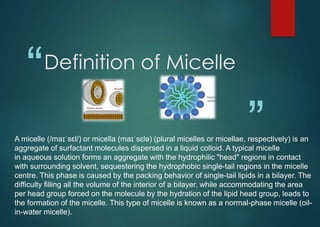
A micelle (/maɪˈsɛl/) or micella (maɪˈsɛlə) (plural micelles or micellae, respectively) is an
aggregate of surfactant molecules dispersed in a liquid colloid. A typical micelle
in aqueous solution forms an aggregate with the hydrophilic "head" regions in contact
with surrounding solvent, sequestering the hydrophobic single-tail regions in the micelle
centre. This phase is caused by the packing behavior of single-tail lipids in a bilayer. The
difficulty filling all the volume of the interior of a bilayer, while accommodating the area
per head group forced on the molecule by the hydration of the lipid head group, leads to
the formation of the micelle. This type of micelle is known as a normal-phase micelle (oil-
in-water micelle).
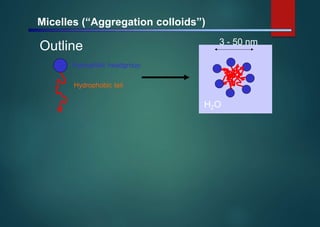
Micelles (“Aggregation colloids”)
3 - 50 nm
Outline
Hydrophilic headgroup
Hydrophobic tail
H2O
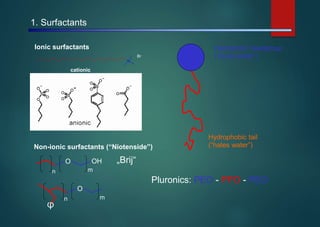
1. Surfactants
Ionic surfactants Hydrophilic headgroup
(“loves water”)Br
+
N
cationic
Hydrophobic tail
(“hates water”)Non-ionic surfactants (“Niotenside”)
„Brij“OH
m
O
n
Pluronics: PEO - PPO - PEO
O
mn
ϕ
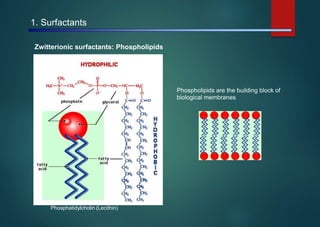
1. Surfactants
Zwitterionic surfactants: Phospholipids
Phospholipids are the building block of
biological membranes
Phosphatidylcholin (Lecithin)
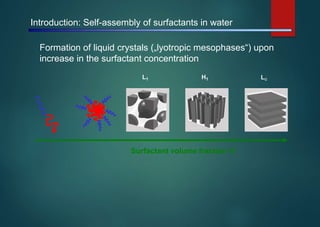
Introduction: Self-assembly of surfactants in water
Formation of liquid crystals („lyotropic mesophases“) upon
increase in the surfactant concentration
L1 H1 Lα
Surfactant volume fraction φ
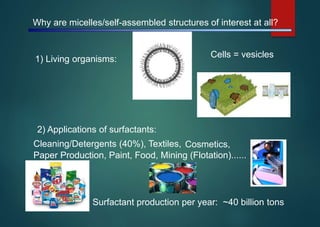
Why are micelles/self-assembled structures of interest at all?
Cells = vesicles
1) Living organisms:
2) Applications of surfactants:
Cleaning/Detergents (40%), Textiles, Cosmetics,
Paper Production, Paint, Food, Mining (Flotation)......
Surfactant production per year: ~40 billion tons
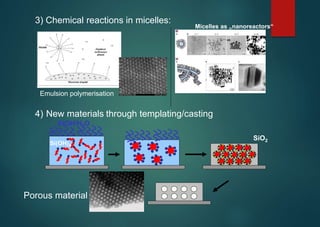
3) Chemical reactions in micelles:
Micelles as „nanoreactors“
Emulsion polymerisation
4) New materials
EtOH/H2O
through templating/casting
SiO2
4
Porous material
Si(OH)
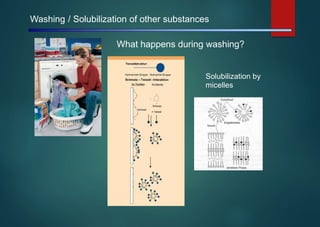
Washing / Solubilization of other substances
What happens during washing?
Solubilization
micelles
by
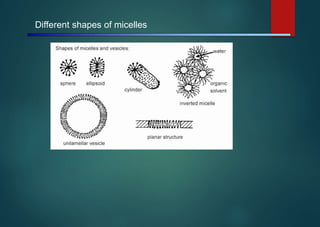
Different shapes of micelles
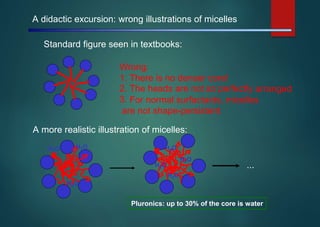
A didactic excursion: wrong illustrations of micelles
Standard figure seen in textbooks:
Wrong:
1.
2.
3.
There is no denser core!
The heads are not so perfectly arranged
For normal surfactants, micelles
are not shape-persistent
A more realistic illustration of micelles:
H2O H2OH2O
H2O
...H2O
H2O
H2O
Pluronics: up to 30% of the core is water
Visualization of self-assembled structures
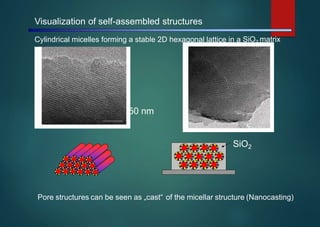
Cylindrical micelles forming a stable 2D hexagonal lattice in a SiO2 matrix
50 nm
SiO2
Pore structures can be seen as „cast“ of the micellar structure (Nanocasting)
Shape persistent micelles
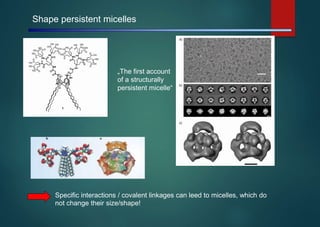
„The first account
of a structurally
persistent micelle“
Specific interactions / covalent linkages can leed to micelles, which do
not change their size/shape!
Entropie/enthalpy of micellization
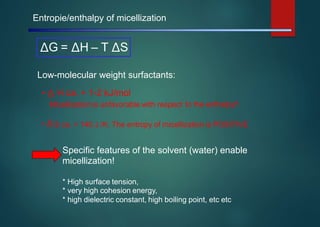
Low-molecular weight surfactants:
• Δ H ca. + 1-2 kJ/mol
Micellization is unfavorable with respect to the enthalpy!!
• ΔS ca. + 140 J /K: The entropy of micellization is POSITIVE
Specific features of the solvent (water) enable
micellization!
*
*
*
High surface tension,
very high cohesion energy,
high dielectric constant, high boiling point, etc etc
ΔG = ΔH – T ΔS
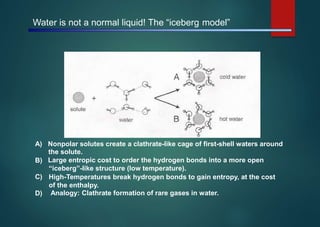
Water is not a normal liquid! The “iceberg model”
A) Nonpolar solutes create a clathrate-like cage of first-shell waters around
the solute.
Large entropic cost to order the hydrogen bonds into a more open
“iceberg”-like structure (low temperature).
High-Temperatures break hydrogen bonds to gain entropy, at the cost
of the enthalpy.
Analogy: Clathrate formation of rare gases in water.
B)
C)
D)
Thank you!

Micelle presentation

  • 1.
    AMITY UNIVERSITY MICELLE PRESENTATION PRESENT BY SUBHRANGSUSEKHAR DEY In Presences of DR. RENU UPODHYAY AND DR. SHASHI VERMA
  • 2.
    . Contents of thisPresentation: • • • • Definition. How to form? Surfactant Some video for example
  • 3.
    “ ” Definition of Micelle Amicelle (/maɪˈsɛl/) or micella (maɪˈsɛlə) (plural micelles or micellae, respectively) is an aggregate of surfactant molecules dispersed in a liquid colloid. A typical micelle in aqueous solution forms an aggregate with the hydrophilic "head" regions in contact with surrounding solvent, sequestering the hydrophobic single-tail regions in the micelle centre. This phase is caused by the packing behavior of single-tail lipids in a bilayer. The difficulty filling all the volume of the interior of a bilayer, while accommodating the area per head group forced on the molecule by the hydration of the lipid head group, leads to the formation of the micelle. This type of micelle is known as a normal-phase micelle (oil- in-water micelle).
  • 4.
    Micelles (“Aggregation colloids”) 3- 50 nm Outline Hydrophilic headgroup Hydrophobic tail H2O
  • 5.
    1. Surfactants Ionic surfactantsHydrophilic headgroup (“loves water”)Br + N cationic Hydrophobic tail (“hates water”)Non-ionic surfactants (“Niotenside”) „Brij“OH m O n Pluronics: PEO - PPO - PEO O mn ϕ
  • 6.
    1. Surfactants Zwitterionic surfactants:Phospholipids Phospholipids are the building block of biological membranes Phosphatidylcholin (Lecithin)
  • 7.
    Introduction: Self-assembly ofsurfactants in water Formation of liquid crystals („lyotropic mesophases“) upon increase in the surfactant concentration L1 H1 Lα Surfactant volume fraction φ
  • 8.
    Why are micelles/self-assembledstructures of interest at all? Cells = vesicles 1) Living organisms: 2) Applications of surfactants: Cleaning/Detergents (40%), Textiles, Cosmetics, Paper Production, Paint, Food, Mining (Flotation)...... Surfactant production per year: ~40 billion tons
  • 9.
    3) Chemical reactionsin micelles: Micelles as „nanoreactors“ Emulsion polymerisation 4) New materials EtOH/H2O through templating/casting SiO2 4 Porous material Si(OH)
  • 10.
    Washing / Solubilizationof other substances What happens during washing? Solubilization micelles by
  • 11.
  • 12.
    A didactic excursion:wrong illustrations of micelles Standard figure seen in textbooks: Wrong: 1. 2. 3. There is no denser core! The heads are not so perfectly arranged For normal surfactants, micelles are not shape-persistent A more realistic illustration of micelles: H2O H2OH2O H2O ...H2O H2O H2O Pluronics: up to 30% of the core is water
  • 13.
    Visualization of self-assembledstructures Cylindrical micelles forming a stable 2D hexagonal lattice in a SiO2 matrix 50 nm SiO2 Pore structures can be seen as „cast“ of the micellar structure (Nanocasting)
  • 14.
    Shape persistent micelles „Thefirst account of a structurally persistent micelle“ Specific interactions / covalent linkages can leed to micelles, which do not change their size/shape!
  • 15.
    Entropie/enthalpy of micellization Low-molecularweight surfactants: • Δ H ca. + 1-2 kJ/mol Micellization is unfavorable with respect to the enthalpy!! • ΔS ca. + 140 J /K: The entropy of micellization is POSITIVE Specific features of the solvent (water) enable micellization! * * * High surface tension, very high cohesion energy, high dielectric constant, high boiling point, etc etc ΔG = ΔH – T ΔS
  • 16.
    Water is nota normal liquid! The “iceberg model” A) Nonpolar solutes create a clathrate-like cage of first-shell waters around the solute. Large entropic cost to order the hydrogen bonds into a more open “iceberg”-like structure (low temperature). High-Temperatures break hydrogen bonds to gain entropy, at the cost of the enthalpy. Analogy: Clathrate formation of rare gases in water. B) C) D)
  • 17.