Green Synthesis of Fluorescent
Carbon Quantum Dots and Applications
Akash Mishra
M.Sc. Applied Physics
Contents
Introduction1
Conclusion and References6
Quantum dots and their properties2
Synthesis method3
Applications and Future Scope5
Plan of work and Methodology4
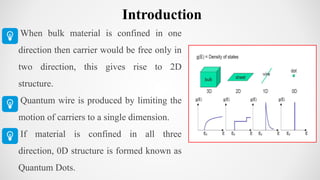
When bulk material is confined in one
direction then carrier would be free only in
two direction, this gives rise to 2D
structure.
Quantum wire is produced by limiting the
motion of carriers to a single dimension.
If material is confined in all three
direction, 0D structure is formed known as
Quantum Dots.
Introduction
Extremely small semiconductor structures.
Range from 2-10 nm in diameter.
Highly fluorescence and highly soluble in water.
Principle of quantum confinement.
Quantum Dots
Quantum Confinement
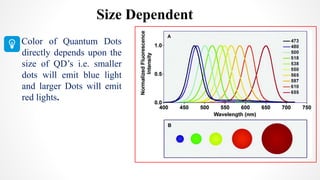
Color of Quantum Dots
directly depends upon the
size of QD’s i.e. smaller
dots will emit blue light
and larger Dots will emit
red lights.
Size Dependent
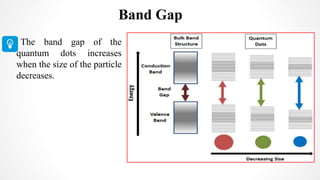
The band gap of the
quantum dots increases
when the size of the particle
decreases.
Band Gap
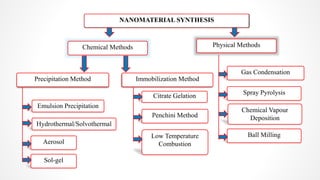
NANOMATERIAL SYNTHESIS
Chemical Methods Physical Methods
Precipitation Method Immobilization Method
Aerosol
Sol-gel
Citrate Gelation
Low Temperature
Combustion
Penchini Method
Ball Milling
Chemical Vapour
Deposition
Spray Pyrolysis
Gas Condensation
Emulsion Precipitation
Hydrothermal/Solvothermal
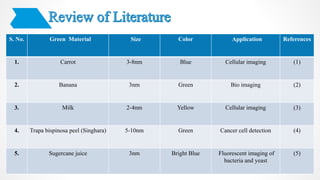
S. No. Green Material Size Color Application References
1. Carrot 3-8nm Blue Cellular imaging (1)
2. Banana 3nm Green Bio imaging (2)
3. Milk 2-4nm Yellow Cellular imaging (3)
4. Trapa bispinosa peel (Singhara) 5-10nm Green Cancer cell detection (4)
5. Sugercane juice 3nm Bright Blue Fluorescent imaging of
bacteria and yeast
(5)
S.No. Green Material Size Color Application References
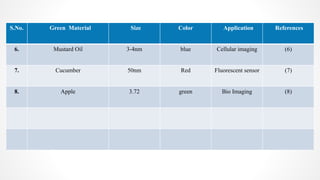
6. Mustard Oil 3-4nm blue Cellular imaging (6)
7. Cucumber 50nm Red Fluorescent sensor (7)
8. Apple 3.72 green Bio Imaging (8)
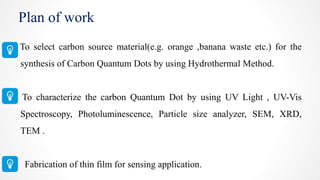
Plan of work
To select carbon source material(e.g. orange ,banana waste etc.) for the
synthesis of Carbon Quantum Dots by using Hydrothermal Method.
To characterize the carbon Quantum Dot by using UV Light , UV-Vis
Spectroscopy, Photoluminescence, Particle size analyzer, SEM, XRD,
TEM .
Fabrication of thin film for sensing application.
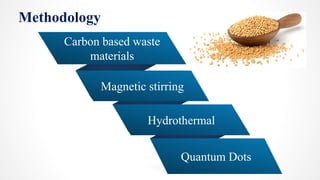
Methodology
Magnetic stirring
Carbon based waste
materials
Quantum Dots
Hydrothermal
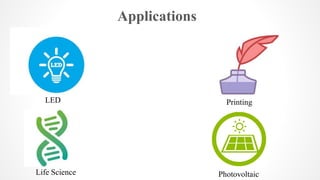
Applications
LED Printing
PhotovoltaicLife Science
Future Application
White LEDs
Active LEDs
Life Sciences
Conclusion
Quantum Dots are a new and innovative perspective on traditional
semiconductors.
Quantum Dots can be synthesized easily of any size, and therefore,
produce essentially any wavelength of light.
There are many possible applications of Quantum Dots in many
different areas of industry/science.
The future looks bright and exciting on all the possible applications
of Quantum Dots.
(1) Yang Liu , Yanan Liu , Mira Park et al, Green synthesis of fluorescent carbon dots from
carrot juice for in vitro cellular imaging, CARBONLETT, vol. 21, no. 1, pp.61-67, 2017.
(2). Green synthesis of highly fluorescent carbon quantum dots from sugarcane bagasse pulp
S.Thambiraj,D.Ravi Shankaran, Applied Surface Science, 390 (2016) 435–443
•Adhimoorthy Prasannan and Toyoko Imae,One-Pot Synthesis of Fluorescent Carbon Dots
from Orange Waste Peels,Ind. Eng. Chem. Res., 2013, 15673-15678
• A.S.Bhatia, Nano Electronics, Deep and Deep Publications Pvt. Ltd, 2011.
(3). Li Wang and H. Susan Zhou, Green Synthesis of Luminescent Nitrogen-Doped
Carbon Dots from Milk and Its Imaging Application, Analytical Chemistry,2014..
(4). Ashmi Mewada, Sunil Pandey , Sachin Shinde, et al.,Green synthesis of
biocompatible carbon dots using aqueous extract of Trapa bispinosa peel, Materials
Science and Engineering C33,2013.
(5). Vaibhav Kumar, N Mehta, Sanjav Jha, Suresh Kumar et al.
, One-pot green synthesis of carbon dots by using Saccharum officinarum juice for
fluorescent imaging of bacteria (Escherichia coli) and yeast (Saccharomyces cerevisiae)
cells, Materials Science and Engineering C33,2014.
Thank You !

Quantum Dots PPT

  • 1.
    Green Synthesis ofFluorescent Carbon Quantum Dots and Applications Akash Mishra M.Sc. Applied Physics
  • 2.
    Contents Introduction1 Conclusion and References6 Quantumdots and their properties2 Synthesis method3 Applications and Future Scope5 Plan of work and Methodology4
  • 3.
    When bulk materialis confined in one direction then carrier would be free only in two direction, this gives rise to 2D structure. Quantum wire is produced by limiting the motion of carriers to a single dimension. If material is confined in all three direction, 0D structure is formed known as Quantum Dots. Introduction
  • 4.
    Extremely small semiconductorstructures. Range from 2-10 nm in diameter. Highly fluorescence and highly soluble in water. Principle of quantum confinement. Quantum Dots
  • 5.
  • 6.
    Color of QuantumDots directly depends upon the size of QD’s i.e. smaller dots will emit blue light and larger Dots will emit red lights. Size Dependent
  • 7.
    The band gapof the quantum dots increases when the size of the particle decreases. Band Gap
  • 8.
    NANOMATERIAL SYNTHESIS Chemical MethodsPhysical Methods Precipitation Method Immobilization Method Aerosol Sol-gel Citrate Gelation Low Temperature Combustion Penchini Method Ball Milling Chemical Vapour Deposition Spray Pyrolysis Gas Condensation Emulsion Precipitation Hydrothermal/Solvothermal
  • 9.
    S. No. GreenMaterial Size Color Application References 1. Carrot 3-8nm Blue Cellular imaging (1) 2. Banana 3nm Green Bio imaging (2) 3. Milk 2-4nm Yellow Cellular imaging (3) 4. Trapa bispinosa peel (Singhara) 5-10nm Green Cancer cell detection (4) 5. Sugercane juice 3nm Bright Blue Fluorescent imaging of bacteria and yeast (5)
  • 10.
    S.No. Green MaterialSize Color Application References 6. Mustard Oil 3-4nm blue Cellular imaging (6) 7. Cucumber 50nm Red Fluorescent sensor (7) 8. Apple 3.72 green Bio Imaging (8)
  • 11.
    Plan of work Toselect carbon source material(e.g. orange ,banana waste etc.) for the synthesis of Carbon Quantum Dots by using Hydrothermal Method. To characterize the carbon Quantum Dot by using UV Light , UV-Vis Spectroscopy, Photoluminescence, Particle size analyzer, SEM, XRD, TEM . Fabrication of thin film for sensing application.
  • 12.
    Methodology Magnetic stirring Carbon basedwaste materials Quantum Dots Hydrothermal
  • 13.
  • 14.
  • 15.
    Conclusion Quantum Dots area new and innovative perspective on traditional semiconductors. Quantum Dots can be synthesized easily of any size, and therefore, produce essentially any wavelength of light. There are many possible applications of Quantum Dots in many different areas of industry/science. The future looks bright and exciting on all the possible applications of Quantum Dots.
  • 16.
    (1) Yang Liu, Yanan Liu , Mira Park et al, Green synthesis of fluorescent carbon dots from carrot juice for in vitro cellular imaging, CARBONLETT, vol. 21, no. 1, pp.61-67, 2017. (2). Green synthesis of highly fluorescent carbon quantum dots from sugarcane bagasse pulp S.Thambiraj,D.Ravi Shankaran, Applied Surface Science, 390 (2016) 435–443 •Adhimoorthy Prasannan and Toyoko Imae,One-Pot Synthesis of Fluorescent Carbon Dots from Orange Waste Peels,Ind. Eng. Chem. Res., 2013, 15673-15678 • A.S.Bhatia, Nano Electronics, Deep and Deep Publications Pvt. Ltd, 2011.
  • 17.
    (3). Li Wangand H. Susan Zhou, Green Synthesis of Luminescent Nitrogen-Doped Carbon Dots from Milk and Its Imaging Application, Analytical Chemistry,2014.. (4). Ashmi Mewada, Sunil Pandey , Sachin Shinde, et al.,Green synthesis of biocompatible carbon dots using aqueous extract of Trapa bispinosa peel, Materials Science and Engineering C33,2013. (5). Vaibhav Kumar, N Mehta, Sanjav Jha, Suresh Kumar et al. , One-pot green synthesis of carbon dots by using Saccharum officinarum juice for fluorescent imaging of bacteria (Escherichia coli) and yeast (Saccharomyces cerevisiae) cells, Materials Science and Engineering C33,2014.
  • 18.