Optical Sculpting
     Inventors:
  Dr. Andy Ward
  Prof. Colin Bain
  Sponsored by:
Introduction


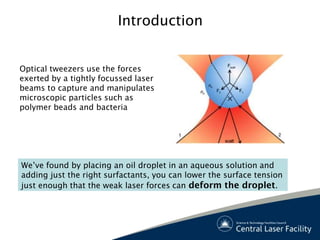
Optical tweezers use the forces
exerted by a tightly focussed laser
beams to capture and manipulates
microscopic particles such as
polymer beads and bacteria


We’ve found by placing an oil droplet in an aqueous solution and
adding just the right surfactants, you can lower the surface tension
just enough that the weak laser forces can deform the droplet.
Key Features
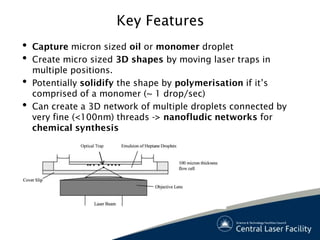
•   Capture micron sized oil or monomer droplet
•   Create micro sized 3D shapes by moving laser traps in
    multiple positions.
•   Potentially solidify the shape by polymerisation if it’s
    comprised of a monomer (~ 1 drop/sec)
•   Can create a 3D network of multiple droplets connected by
    very fine (<100nm) threads -> nanofludic networks for
    chemical synthesis
Shape formation
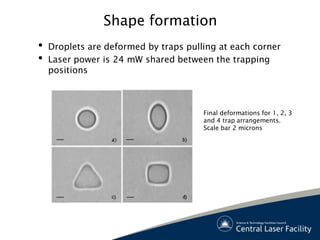
•   Droplets are deformed by traps pulling at each corner
•   Laser power is 24 mW shared between the trapping
    positions


                                       Final deformations for 1, 2, 3
                                       and 4 trap arrangements.
                                       Scale bar 2 microns
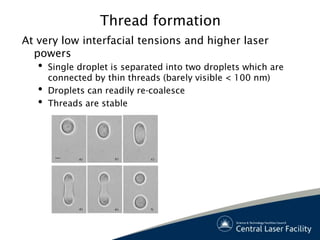
Thread formation
At very low interfacial tensions and higher laser
  powers
   •   Single droplet is separated into two droplets which are
       connected by thin threads (barely visible < 100 nm)
   •   Droplets can readily re-coalesce
   •   Threads are stable


              a)      b)       c)


              d)      e)       f)
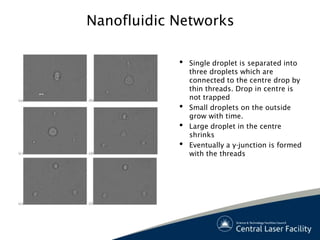
Nanofluidic Networks

            •   Single droplet is separated into
                three droplets which are
                connected to the centre drop by
                thin threads. Drop in centre is
                not trapped
            •   Small droplets on the outside
                grow with time.
            •   Large droplet in the centre
                shrinks
            •   Eventually a y-junction is formed
                with the threads
Thanks to:


• STFC funding of facility access beam-time for Prof Colin
  Bain
• EPSRC current funding (EP/I013377/ 1)


And of course our challenge sponsors!

Optical tweezers Jan 13

  • 1.
    Optical Sculpting Inventors: Dr. Andy Ward Prof. Colin Bain Sponsored by:
  • 2.
    Introduction Optical tweezers usethe forces exerted by a tightly focussed laser beams to capture and manipulates microscopic particles such as polymer beads and bacteria We’ve found by placing an oil droplet in an aqueous solution and adding just the right surfactants, you can lower the surface tension just enough that the weak laser forces can deform the droplet.
  • 3.
    Key Features • Capture micron sized oil or monomer droplet • Create micro sized 3D shapes by moving laser traps in multiple positions. • Potentially solidify the shape by polymerisation if it’s comprised of a monomer (~ 1 drop/sec) • Can create a 3D network of multiple droplets connected by very fine (<100nm) threads -> nanofludic networks for chemical synthesis
  • 4.
    Shape formation • Droplets are deformed by traps pulling at each corner • Laser power is 24 mW shared between the trapping positions Final deformations for 1, 2, 3 and 4 trap arrangements. Scale bar 2 microns
  • 5.
    Thread formation At verylow interfacial tensions and higher laser powers • Single droplet is separated into two droplets which are connected by thin threads (barely visible < 100 nm) • Droplets can readily re-coalesce • Threads are stable a) b) c) d) e) f)
  • 6.
    Nanofluidic Networks • Single droplet is separated into three droplets which are connected to the centre drop by thin threads. Drop in centre is not trapped • Small droplets on the outside grow with time. • Large droplet in the centre shrinks • Eventually a y-junction is formed with the threads
  • 7.
    Thanks to: • STFCfunding of facility access beam-time for Prof Colin Bain • EPSRC current funding (EP/I013377/ 1) And of course our challenge sponsors!