Micelles are relatively small, spherical structures composed of anywhere from a few dozen to a few thousand molecules that attract one another to reduce surface tension within the membrane of a cell.
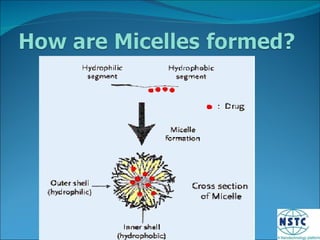
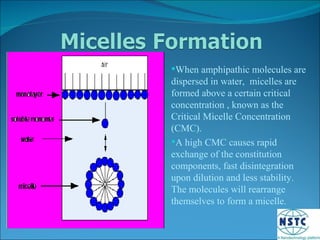
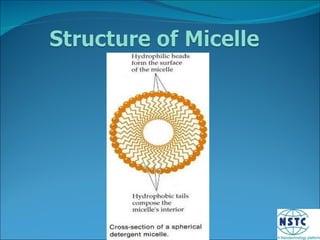
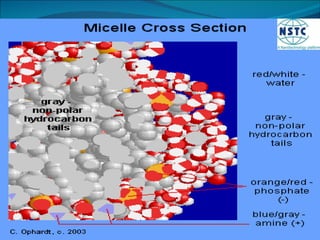
When the concentration of surfactant reaches a critical concentration, the hydrophobe of the surfactant will organize to form micelle. In the micelle, the lipophilic hydrocarbon chains are orientated towards the interior of the micelle, leaving the hydrophilic groups on contact with the aqueous medium. The concentration above which micelle formation becomes appreciable is termed the critical micelle concentration (CMC).
 
When amphipathic molecules are dispersed in water,  micelles are formed above a certain critical concentration , known as the Critical Micelle Concentration (CMC). A high CMC causes rapid exchange of the constitution components, fast disintegration upon dilution and less stability. The molecules will rearrange themselves to form a micelle.
A low CMC indicates that the micelles are stable and hence do not disintegrate readily. Micelles used as drug delivery carrier systems must be sufficiently stable in blood circulation and should not disintegrate upon contact with blood components. Therefore the CMC should be low as possible.
Micelles  made of block co-polymers are used as drug carriers, e.g. Doxorubicin These block-copolymers are composed of a hydrophilic PEG block and a hydrophobic block based on poly(aspartic acid) or poly( β -benzyl L-aspartate) with doxorubicin conjugation. The diameter of the micelles can be manipulated so as to allow the EPR effect to be observed i.e. less than 0.2  µm. This will allow accumulation of the drug in target site, such as tumour tissue, inflamed tissue.
 
 
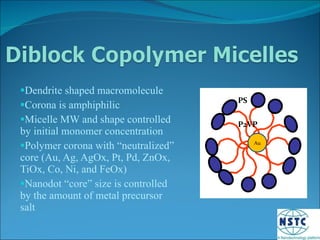
Dendrite shaped macromolecule Corona is amphiphilic Micelle MW and shape controlled by initial monomer concentration Polymer corona with “neutralized” core (Au, Ag, AgOx, Pt, Pd, ZnOx, TiOx, Co, Ni, and FeOx) Nanodot “core” size is controlled by the amount of metal precursor salt Au Au P2VP PS
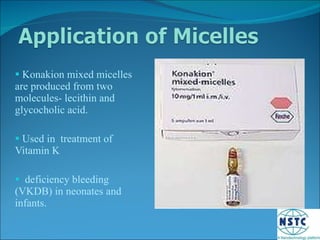
Konakion mixed micelles are produced from two molecules- lecithin and glycocholic acid. Used in  treatment of Vitamin K deficiency bleeding (VKDB) in neonates and infants.
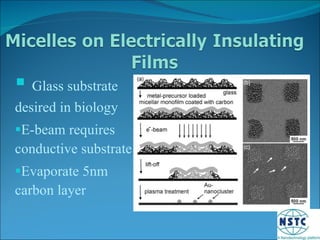
Glass substrate desired in biology E-beam requires conductive substrate Evaporate 5nm carbon layer

Polymeric Micelles and Their Applications

  • 1.
  • 2.
    Micelles are relativelysmall, spherical structures composed of anywhere from a few dozen to a few thousand molecules that attract one another to reduce surface tension within the membrane of a cell.
  • 3.
    When the concentrationof surfactant reaches a critical concentration, the hydrophobe of the surfactant will organize to form micelle. In the micelle, the lipophilic hydrocarbon chains are orientated towards the interior of the micelle, leaving the hydrophilic groups on contact with the aqueous medium. The concentration above which micelle formation becomes appreciable is termed the critical micelle concentration (CMC).
  • 4.
  • 5.
    When amphipathic moleculesare dispersed in water, micelles are formed above a certain critical concentration , known as the Critical Micelle Concentration (CMC). A high CMC causes rapid exchange of the constitution components, fast disintegration upon dilution and less stability. The molecules will rearrange themselves to form a micelle.
  • 6.
    A low CMCindicates that the micelles are stable and hence do not disintegrate readily. Micelles used as drug delivery carrier systems must be sufficiently stable in blood circulation and should not disintegrate upon contact with blood components. Therefore the CMC should be low as possible.
  • 7.
    Micelles madeof block co-polymers are used as drug carriers, e.g. Doxorubicin These block-copolymers are composed of a hydrophilic PEG block and a hydrophobic block based on poly(aspartic acid) or poly( β -benzyl L-aspartate) with doxorubicin conjugation. The diameter of the micelles can be manipulated so as to allow the EPR effect to be observed i.e. less than 0.2 µm. This will allow accumulation of the drug in target site, such as tumour tissue, inflamed tissue.
  • 8.
  • 9.
  • 10.
    Dendrite shaped macromoleculeCorona is amphiphilic Micelle MW and shape controlled by initial monomer concentration Polymer corona with “neutralized” core (Au, Ag, AgOx, Pt, Pd, ZnOx, TiOx, Co, Ni, and FeOx) Nanodot “core” size is controlled by the amount of metal precursor salt Au Au P2VP PS
  • 11.
    Konakion mixed micellesare produced from two molecules- lecithin and glycocholic acid. Used in treatment of Vitamin K deficiency bleeding (VKDB) in neonates and infants.
  • 12.
    Glass substrate desiredin biology E-beam requires conductive substrate Evaporate 5nm carbon layer