POWER PLANT TECHNOLOGY

The engineering & technology involve in the
production or generation of electricity is called as
Power Plant Technology.

TYPES OF POWER PLANT


THERMAL POWER PLANT



HYDROELECTRIC POWER PLANT



NUCLEAR POWER PLANT
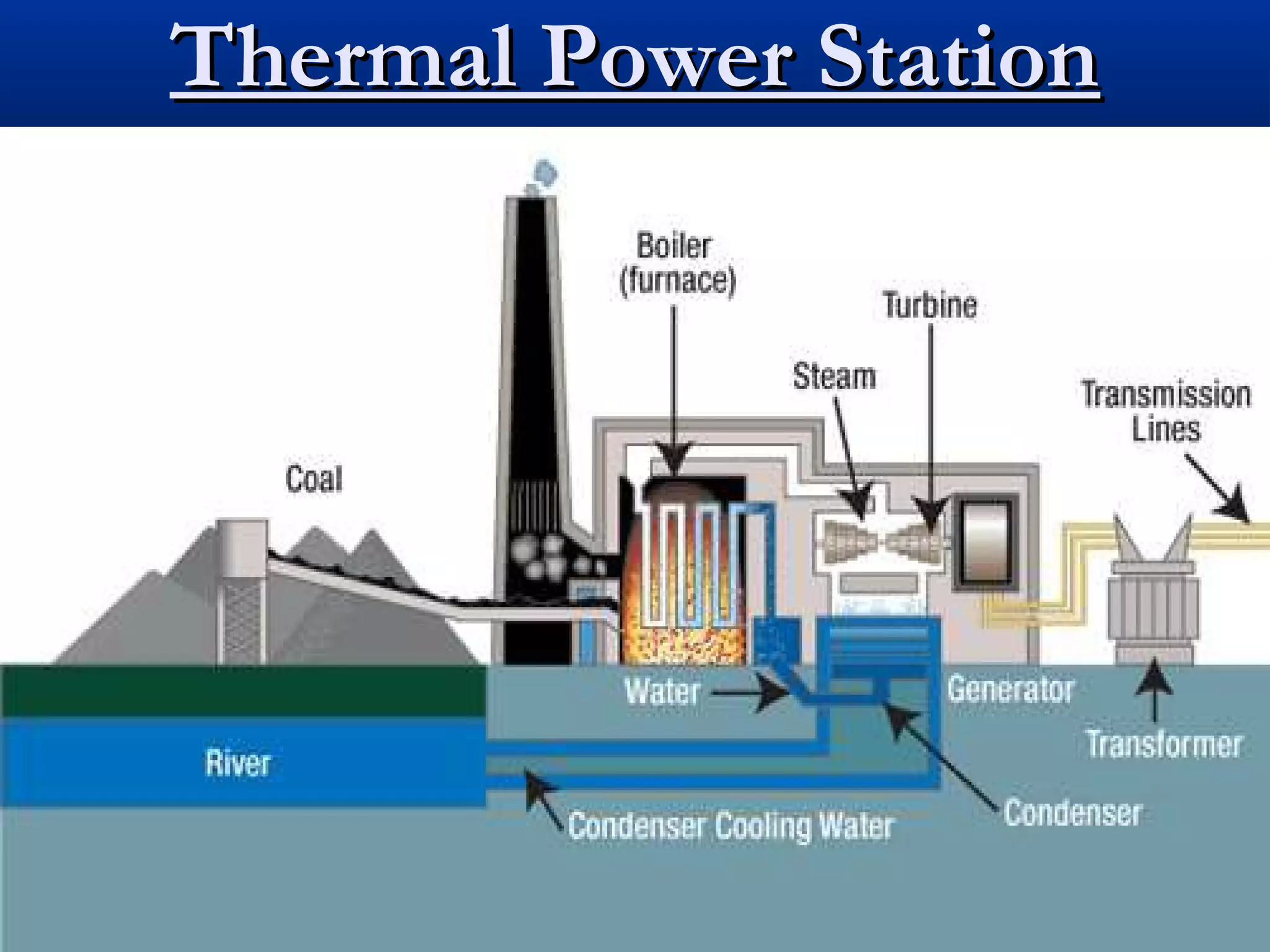
Thermal Power Station
Thermal Power Plant Consist Of
following Parts:










Boiler
Turbine
Deaerator
Heat Exchangers
Super Heater
Economizers
Condenser
Feed water heater
Electrical generator
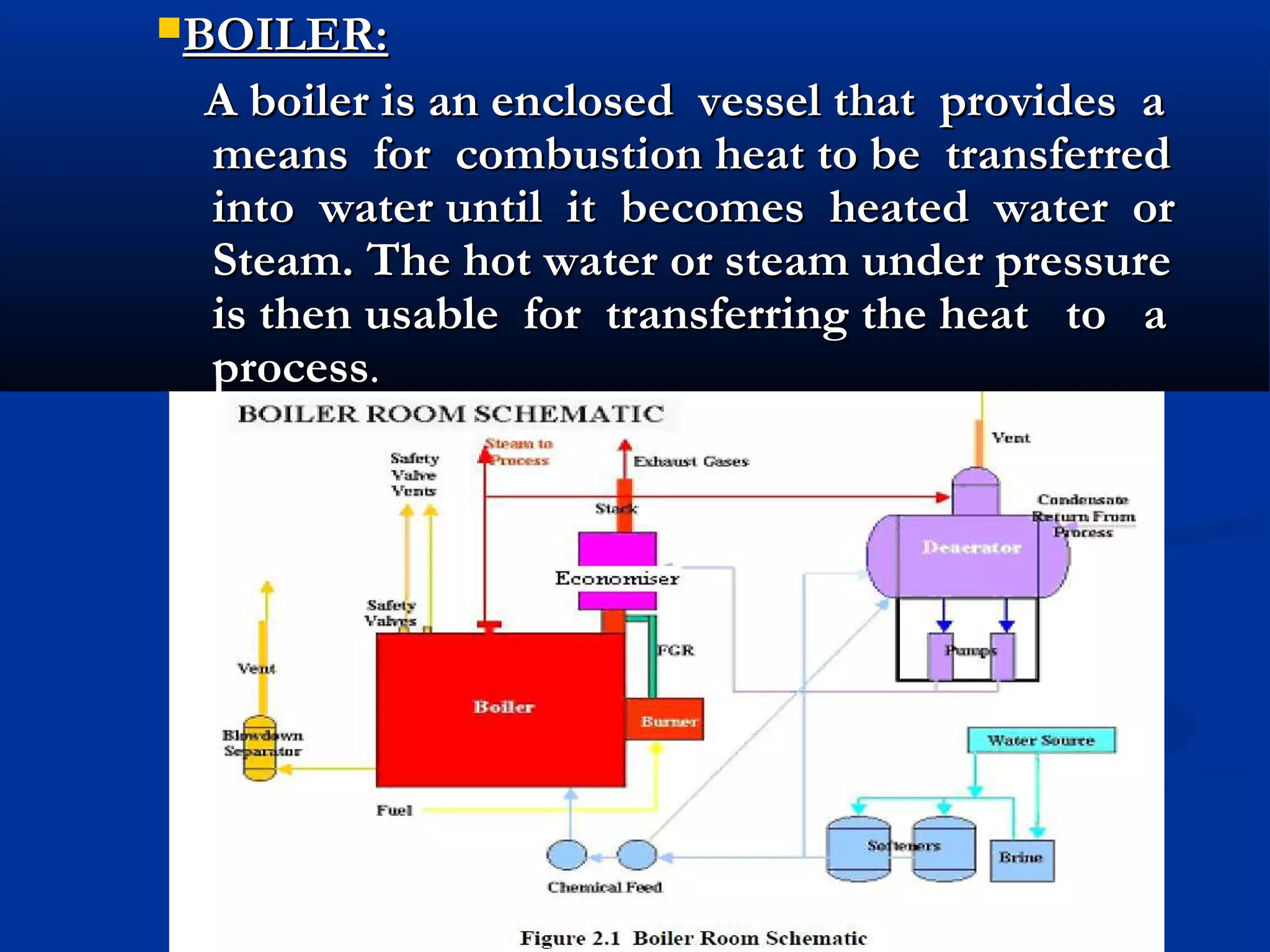
BOILER:

A boiler is an enclosed vessel that provides a
means for combustion heat to be transferred
into water until it becomes heated water or
Steam. The hot water or steam under pressure
is then usable for transferring the heat to a
process.
2. Turbine:


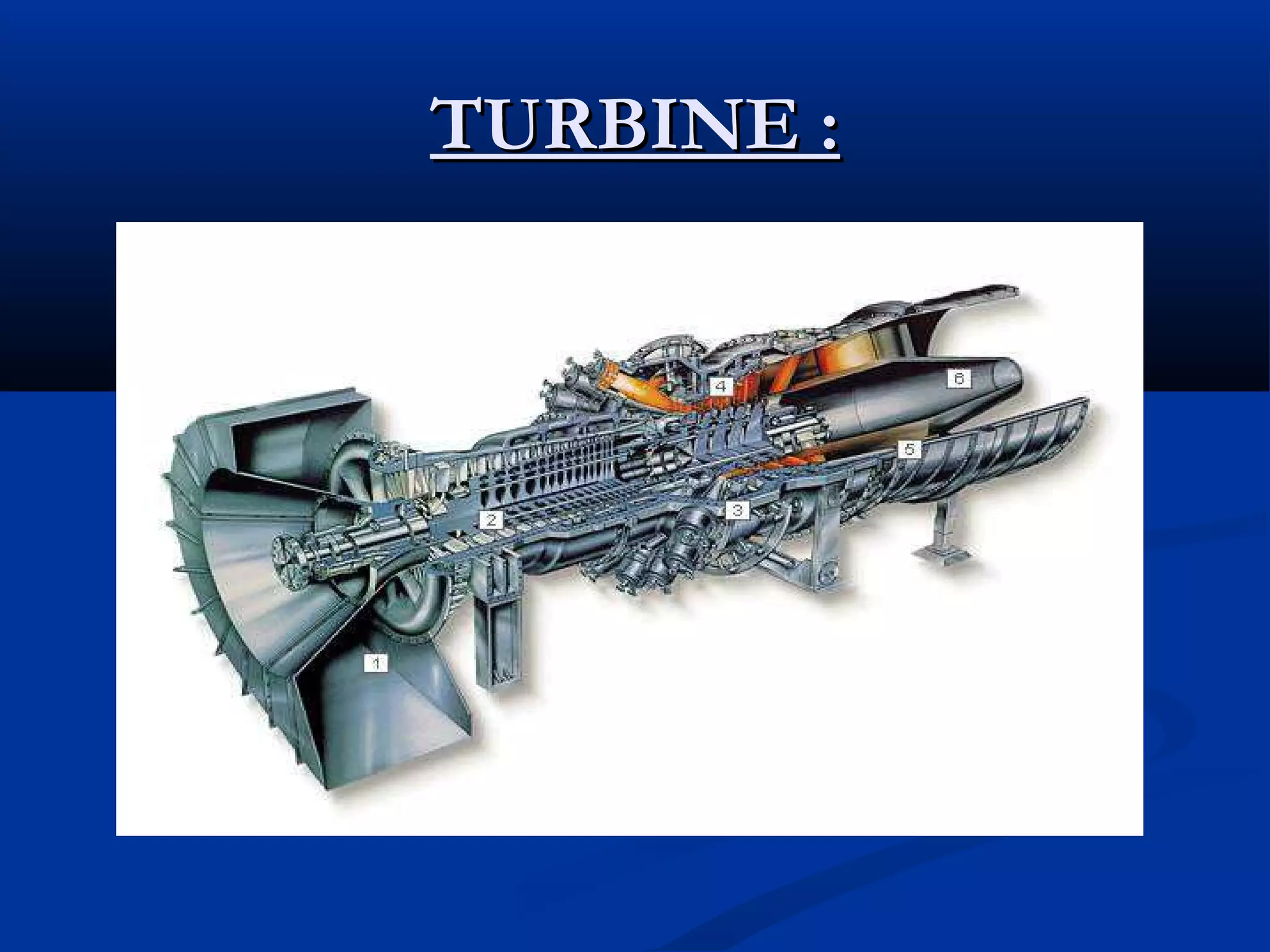
Turbine, rotary engine that converts the energy of a moving
stream of water, steam, or gas into mechanical energy.



The basic element in a turbine is a wheel or rotor with
paddles, propellers, blades, or buckets arranged on its
circumference in such a fashion that the moving fluid
exerts a tangential force that turns the wheel and imparts
energy to it. This mechanical energy is then transferred
through a drive shaft to operate a machine, compressor,
electric generator, or propeller.



Turbines are classified as hydraulic,
turbines,steam turbines, or gas turbines.

or

water,
TURBINE :
3. Deaerator:

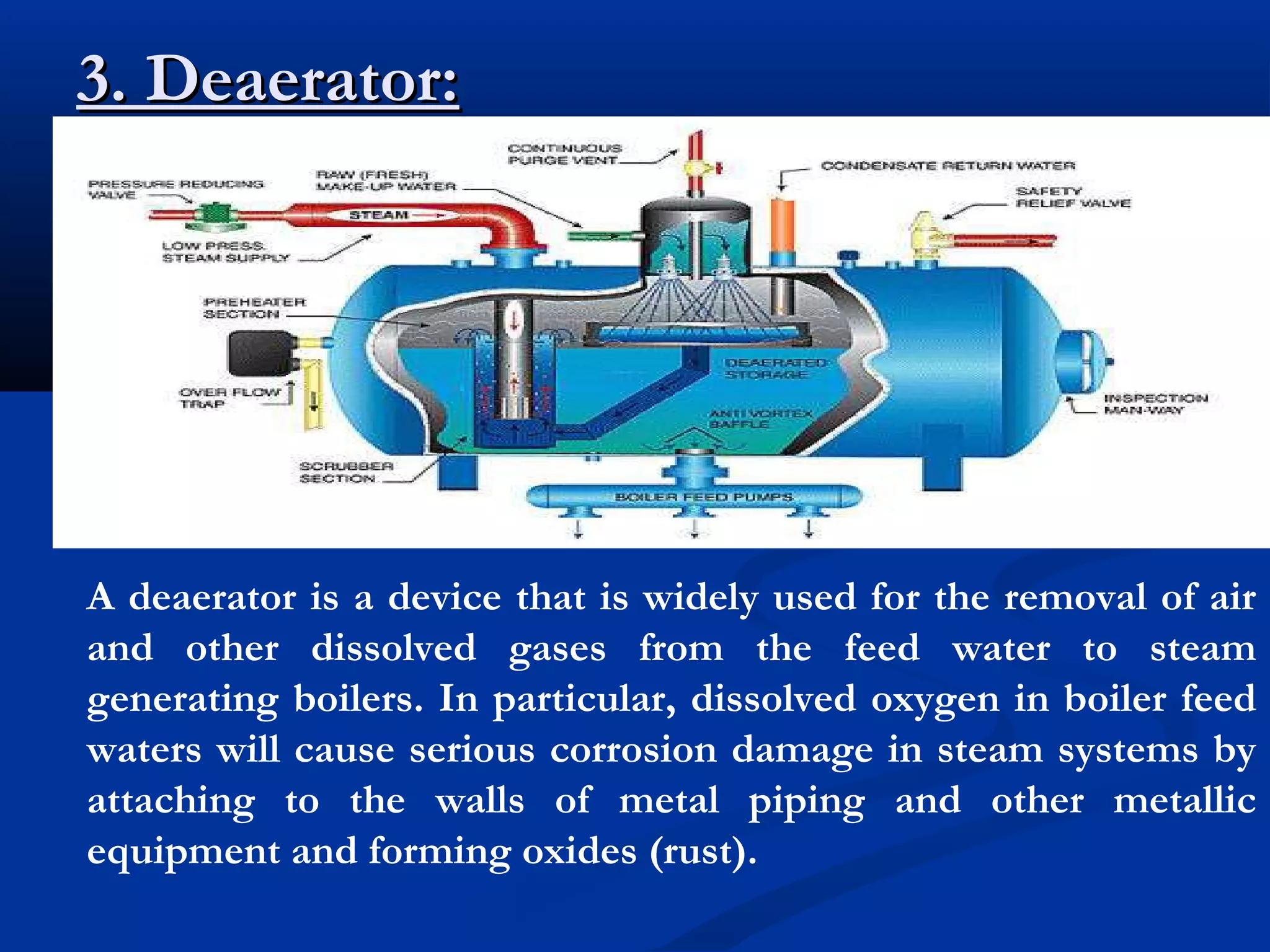
A deaerator is a device that is widely used for the removal of air
and other dissolved gases from the feed water to steam
generating boilers. In particular, dissolved oxygen in boiler feed
waters will cause serious corrosion damage in steam systems by
attaching to the walls of metal piping and other metallic
equipment and forming oxides (rust).
4. Heat Exchangers :









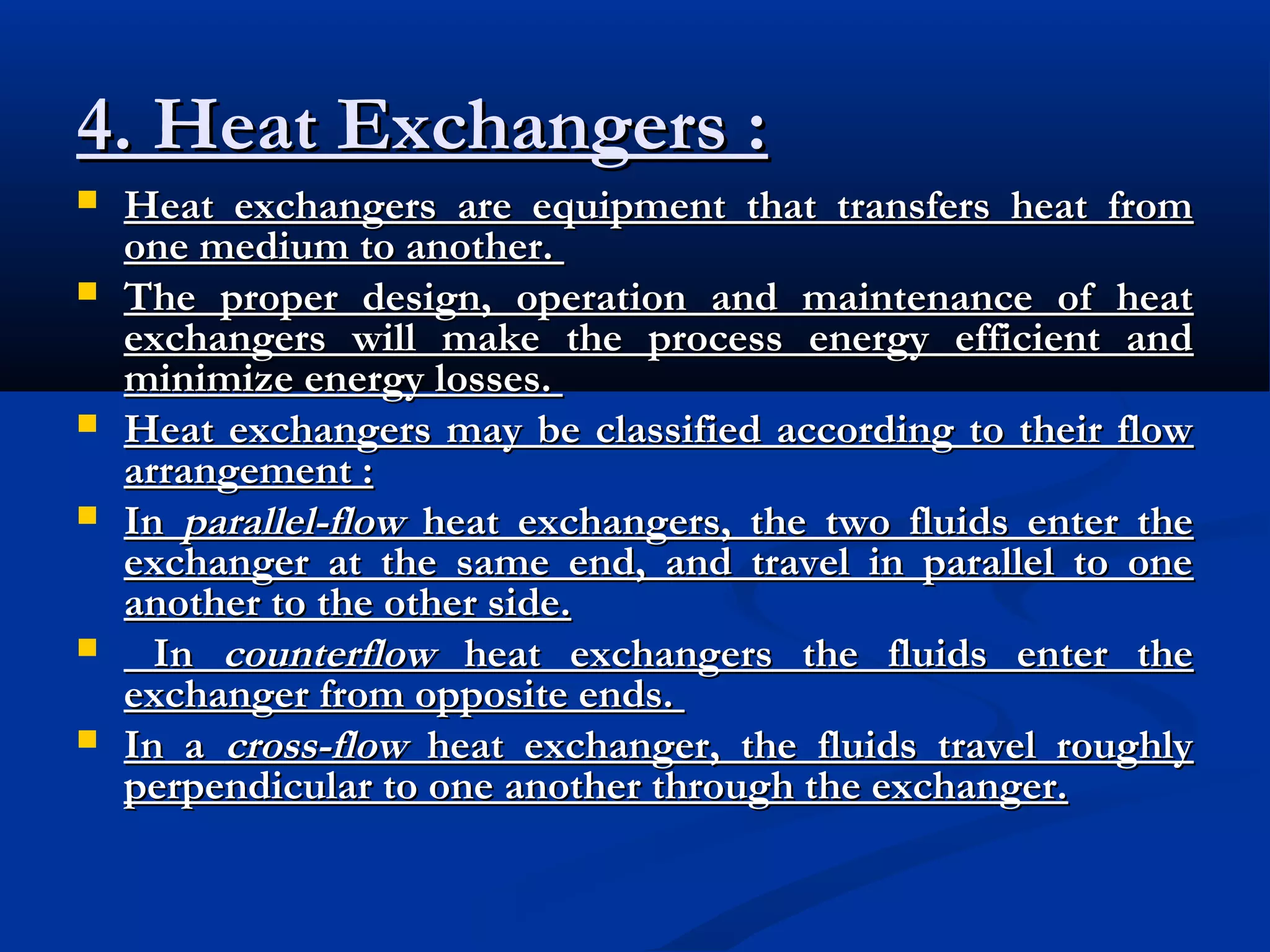
Heat exchangers are equipment that transfers heat from
one medium to another.
The proper design, operation and maintenance of heat
exchangers will make the process energy efficient and
minimize energy losses.
Heat exchangers may be classified according to their flow
arrangement :
In parallel-flow heat exchangers, the two fluids enter the
exchanger at the same end, and travel in parallel to one
another to the other side.
In counterflow heat exchangers the fluids enter the
exchanger from opposite ends.
In a cross-flow heat exchanger, the fluids travel roughly
perpendicular to one another through the exchanger.
Heat Exchangers:
5. Super Heater:


A super heater is a device in a steam engine that
heats the steam generated by the boiler again,
increasing its thermal energy and decreasing the
likelihood that it will condense inside the engine.



Super heaters increase the efficiency of the steam
engine, and were widely adopted.



Steam which has been superheated is logically
known as superheated steam; non-superheated
steam is called saturated steam or wet steam.
SUPER HEATER:
6. Condenser:

•The surface condenser is a shell and tube heat exchanger in which
cooling water is circulated through the tubes.
•The exhaust steam from the low pressure turbine enters the shell
where it is cooled and converted to condensate (water) by flowing
over the tubes as shown in the adjacent diagram.
•Such condensers use steam ejectors or rotary motor-driven
exhausters for continuous removal of air and gases from the steam
side to maintain vacuum.
7.Economizers


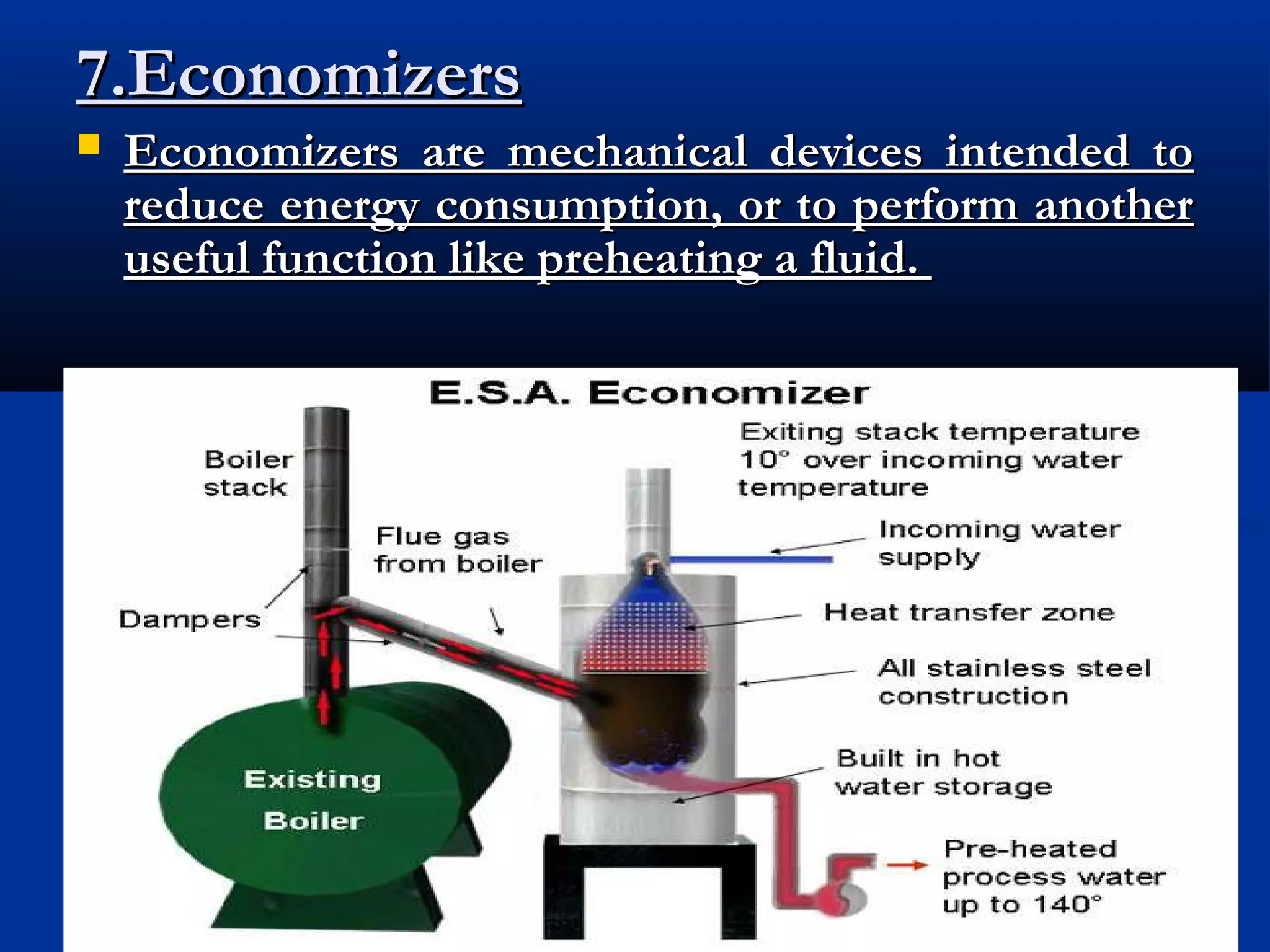
Economizers are mechanical devices intended to
reduce energy consumption, or to perform another
useful function like preheating a fluid.
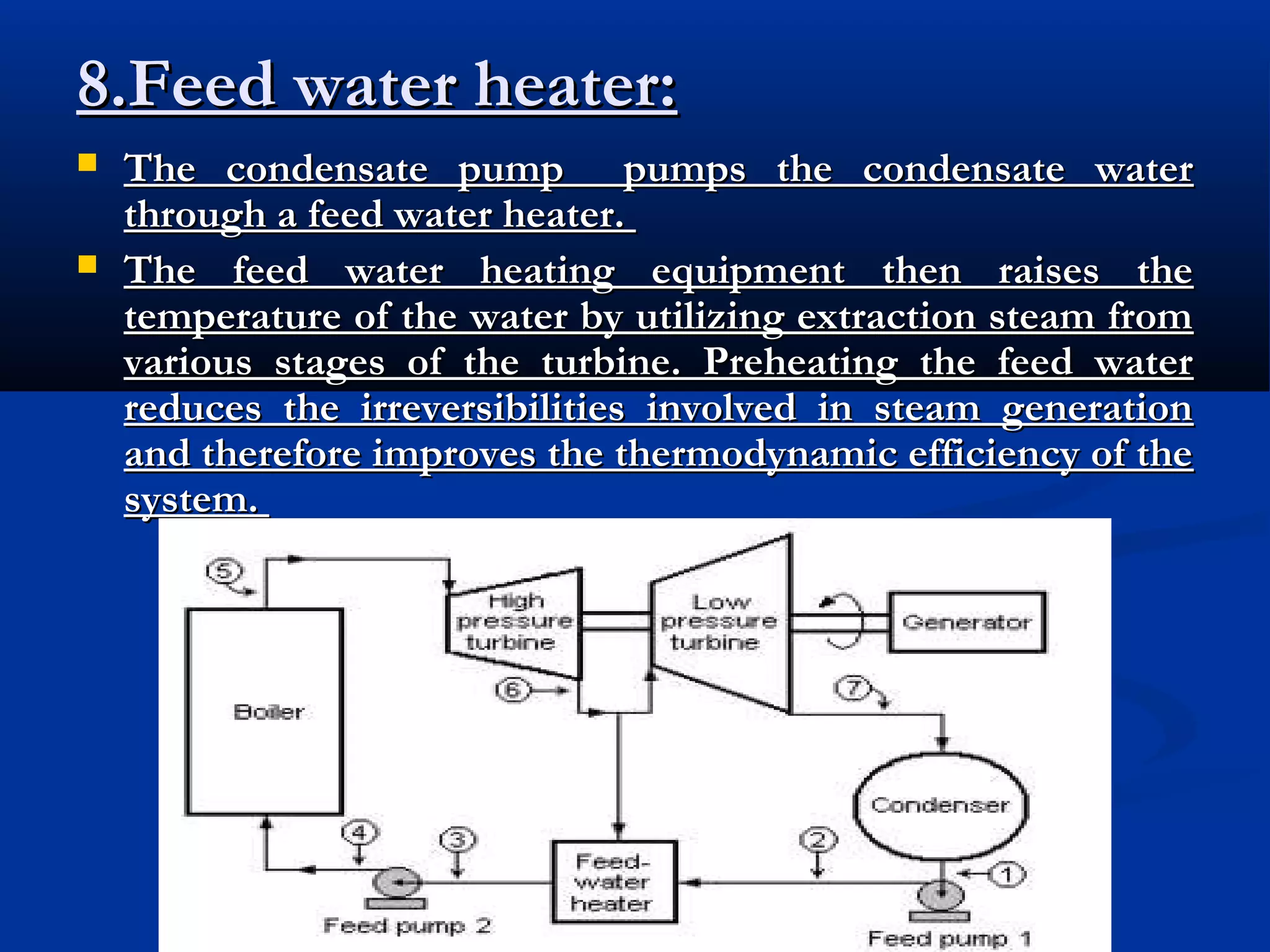
8.Feed water heater:



The condensate pump pumps the condensate water
through a feed water heater.
The feed water heating equipment then raises the
temperature of the water by utilizing extraction steam from
various stages of the turbine. Preheating the feed water
reduces the irreversibilities involved in steam generation
and therefore improves the thermodynamic efficiency of the
system.
9. Electrical generator:



In electricity generation, an electrical generator is a
device that converts mechanical energy to
electrical energy, generally using electromagnetic
induction.
ADVANTAGES OF THERMAL POWER PLANT:









Fuel used is cheaper.
Less space required in setup in comparison to
hydroelectric power plant.
They can be located conveniently near the load
centre.
A portion of steam generated can be used as a
process steam in different industries.
As these plants can be set up near industries,
therefore the transmission costs are reduced.
DISADVANTAGES OF THERMAL POWER PLANT:







Maintenance & operating costs are high.
Cost of plant increases with increase in
temperature & pressure.
Long time required for erection & putting into
action.
Greatly difficulty experienced in cool handling.
Presence of troubles due to smoke & heat in the
plant.
Smoke & gaseous emission cause pollution in the
environment.
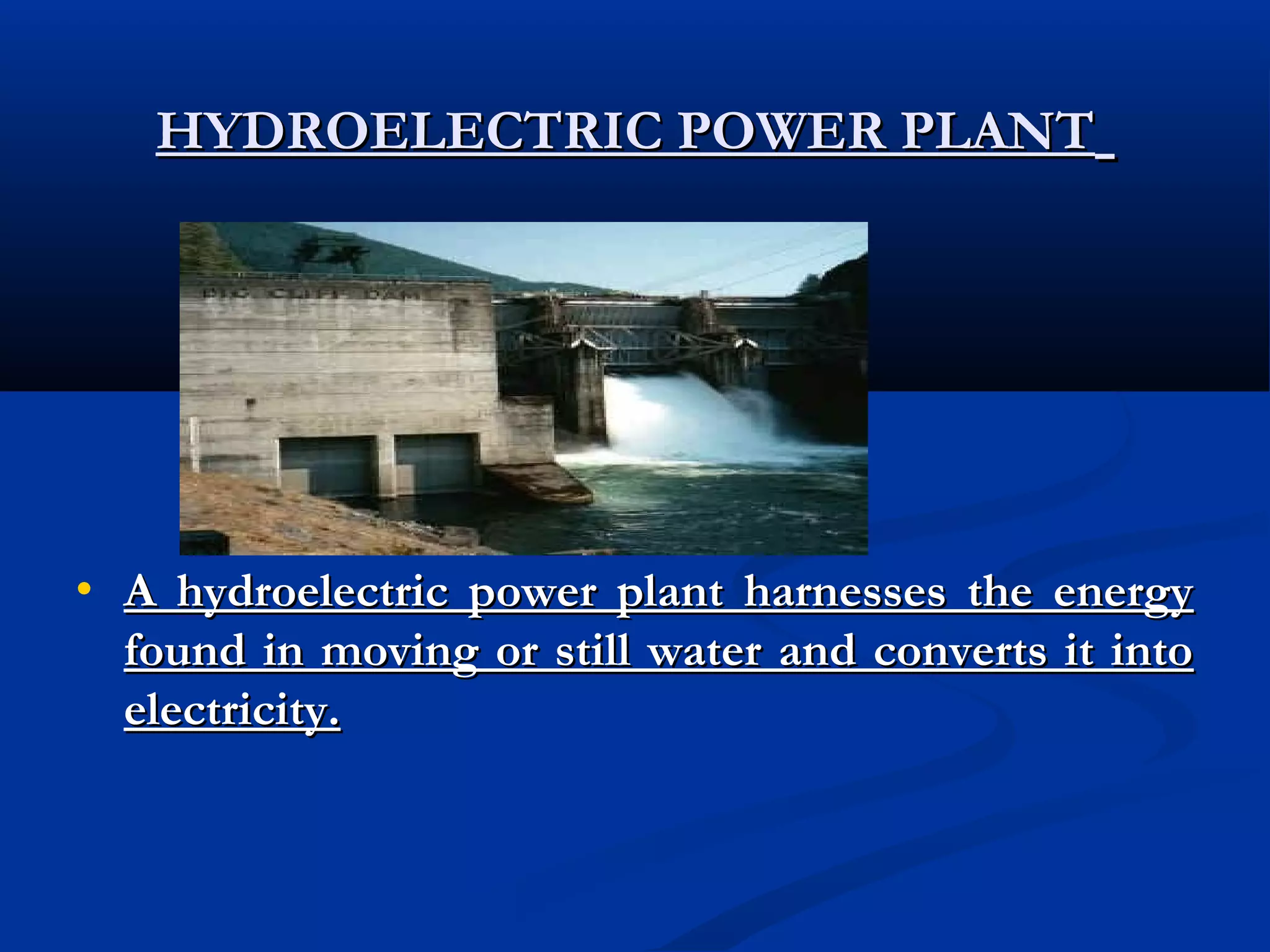
HYDROELECTRIC POWER PLANT

•

A hydroelectric power plant harnesses the energy
found in moving or still water and converts it into
electricity.
HOW HYDROELECTRIC POWER PLANT
WORKS?






A dam is built to trap water, usually in a valley where there
is an existing lake. Water is allowed to flow through tunnels
into the dam, to turn turbines and thus drive generators.
Water from the reservoir flows due to gravity to drive the
turbine. Turbine is connected to a generator.
Power generated is transmitted over power lines.
A water turbine that convert the energy of flowing or falling
water into mechanical energy that drives a generator, which
generates electrical power. This is a heart of hydropower
power plant.
COMPONENTS OF HYDROELECTRIC POWERPLANT










Catchment area
Dam and Reservoir
Penstock
Trash rack
Turbine
Control gates
Draft tube
Fore bay
Surge tank


CATCHMENT AREA:
The rain water falls on a large area called catchment area,
gets collected in the form of streams and flows as runoff
to plant site.



DAM:
The dam is usually built on a large river that has a drop in
elevation, so as to use the forces of gravity to aid in the
process of creating electricity. A dam is built to trap
water, usually in a valley where there is an existing lake.
An artificial storage reservoir is formed by constructing a
dam across a river.


RESERVOIR:
The area behind the dam where water is stored is called the
reservoir. The water there has gravitational potential
energy. The water is in a stored position above the rest of
the dam facility so as to allow gravity to carry the water
down to the turbines.



PENSTOCK:
It carries water from reservoir to the hydraulic turbine. The
penstock is a long shaft that carries the water towards the
turbines where the kinetic energy becomes mechanical
energy. The force of the water is used to turn the turbines
that turn the generator shaft
Trash rack, Gates and anchorages:






Trash rack prevent the entry of debris into the
penstock. These debris would otherwise damage
the gates, nozzles and turbine blades by erosion.
Gates control and regulate the flow of water into
the penstock.
Anchorages prevent the movement of penstock due
to dynamic forces at vertical and horizontal bends
and on slopes.





Draft tube is a kind of a diverging passage. Because of
this shape, the water flows through this tube is
deaccelerated and it comes out of tube with minimum
kinetic energy.
The exit of draft tube is submerged in tail race.







Control Gates & Spillway:

Control gates arrangement is provided with Spillways.
Spillway is constructed to act as a safety valve. It
discharge the overflow water to the down stream side
when the reservoir is full.




Draft tube and tail race:

SURGE TANK:

It is a safety device.
SURGE TANK acts as a temporary reservoir. It helps in
stabilizing the velocity and pressure in penstock and
thereby saves penstock from getting damaged
ADVANTAGES OF HYDROELECTRIC POWER PLANT:









No fuel charges.
An HEP is highly reliable & has long life.
Maintenance & operation charges are very low.
Running cost of the plant is low.
No ash problem & atmosphere is not polluted
since no smoke is produced in the plant.
In addition to power generation these plants can
also be used for flood control & irrigation
purposes.
These are set up away from the developed area
hence cost of land is not a major problem.
DISADVANTAGES OF HYDROELECTRIC POWER PLANT:







Initial cost of plant for set up is very high.
It takes considerably long time for the
erection of such plants.
Since such plants are usually located in hilly areas
& far away from the load centre, so they require
long transmission lines to deliver power
subsequently the cost of transmission lines &
losses in them will be more.
NUCLEAR POWER PLANT


The Nuclear power plant converts nuclear energy into
electrical energy.



Nuclear power reactors or nuclear power plants create
electricity by combining chemical reactions and heat.
Nuclear fission: The fuel most widely used by nuclear
power plants for nuclear fission is uranium.



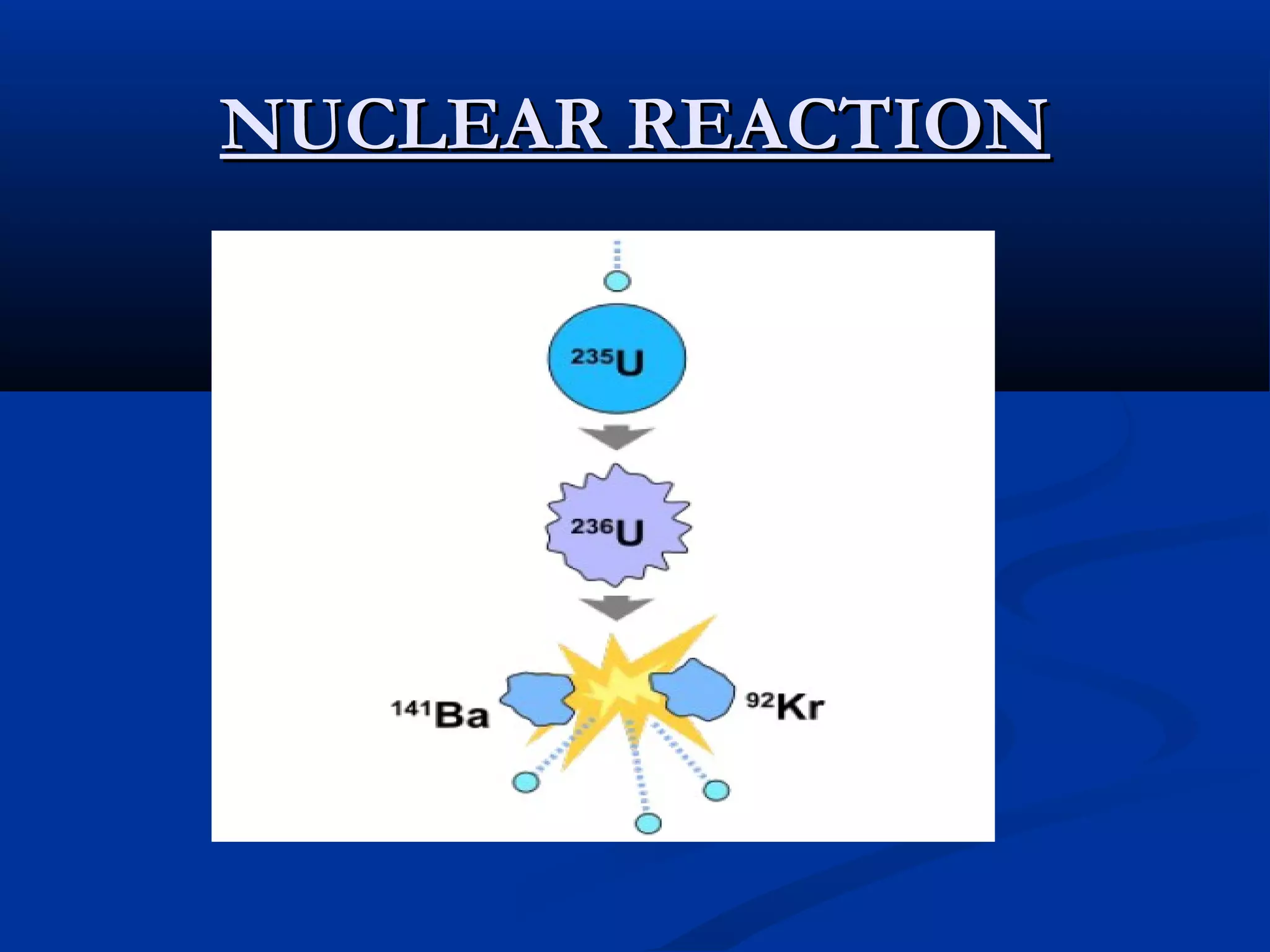
In nuclear fission, a small particle called a neutron hits the
uranium atom and it splits, releasing a great amount of
energy as heat and radiation. As more neutrons are released
they bombard other uranium atoms, and the process of
nuclear fission repeats itself over and over again. This is
called a chain reaction. Nuclear plants use the heat given
off during fission as fuel. Fission takes place inside the
reactor of a nuclear power plant
COMPONENTS OF NUCLEAR POWER PLANT:









Nuclear Reactor
Control rods
Steam turbine
Steam Generator
Coolant pump
Feed pump
Condenser
Cooling tower
NUCLEAR REACTOR:

A nuclear reactor is a device in which nuclear chain
reactions are
initiated, controlled, and sustained at a
steady rate.
NUCLEAR REACTION
Advantages of nuclear power plant:








It avoids the wide variety of environmental
problems arising from burning fossil fuels - coal,
oil, and gas.
It is possible to generate a high amount of
electrical energy in one single plant using small
amount of fuel.
Nuclear power is reliable. This technology is
readily a available.
Produces small amounts of waste.
Nuclear power is also not so expensive as compare
to power from coal.
DISADVANTAGES OF NUCLEAR POWER PLANT:


The problem of radioactive waste is still an
unsolved one.



High risks: It is technically impossible to build a
plant with 100% security.



The energy source for nuclear energy is Uranium.
Uranium is a scarce resource; its supply is
estimated to last only for the next 30 to 60 years
depending on the actual demand.
Power plant technology

Power plant technology

  • 2.
    POWER PLANT TECHNOLOGY Theengineering & technology involve in the production or generation of electricity is called as Power Plant Technology. TYPES OF POWER PLANT  THERMAL POWER PLANT  HYDROELECTRIC POWER PLANT  NUCLEAR POWER PLANT
  • 3.
  • 4.
    Thermal Power PlantConsist Of following Parts:          Boiler Turbine Deaerator Heat Exchangers Super Heater Economizers Condenser Feed water heater Electrical generator
  • 5.
    BOILER: A boiler isan enclosed vessel that provides a means for combustion heat to be transferred into water until it becomes heated water or Steam. The hot water or steam under pressure is then usable for transferring the heat to a process.
  • 6.
    2. Turbine:  Turbine, rotaryengine that converts the energy of a moving stream of water, steam, or gas into mechanical energy.  The basic element in a turbine is a wheel or rotor with paddles, propellers, blades, or buckets arranged on its circumference in such a fashion that the moving fluid exerts a tangential force that turns the wheel and imparts energy to it. This mechanical energy is then transferred through a drive shaft to operate a machine, compressor, electric generator, or propeller.  Turbines are classified as hydraulic, turbines,steam turbines, or gas turbines. or water,
  • 7.
  • 8.
    3. Deaerator: A deaeratoris a device that is widely used for the removal of air and other dissolved gases from the feed water to steam generating boilers. In particular, dissolved oxygen in boiler feed waters will cause serious corrosion damage in steam systems by attaching to the walls of metal piping and other metallic equipment and forming oxides (rust).
  • 9.
    4. Heat Exchangers:       Heat exchangers are equipment that transfers heat from one medium to another. The proper design, operation and maintenance of heat exchangers will make the process energy efficient and minimize energy losses. Heat exchangers may be classified according to their flow arrangement : In parallel-flow heat exchangers, the two fluids enter the exchanger at the same end, and travel in parallel to one another to the other side. In counterflow heat exchangers the fluids enter the exchanger from opposite ends. In a cross-flow heat exchanger, the fluids travel roughly perpendicular to one another through the exchanger.
  • 10.
  • 11.
    5. Super Heater:  Asuper heater is a device in a steam engine that heats the steam generated by the boiler again, increasing its thermal energy and decreasing the likelihood that it will condense inside the engine.  Super heaters increase the efficiency of the steam engine, and were widely adopted.  Steam which has been superheated is logically known as superheated steam; non-superheated steam is called saturated steam or wet steam.
  • 12.
  • 13.
    6. Condenser: •The surfacecondenser is a shell and tube heat exchanger in which cooling water is circulated through the tubes. •The exhaust steam from the low pressure turbine enters the shell where it is cooled and converted to condensate (water) by flowing over the tubes as shown in the adjacent diagram. •Such condensers use steam ejectors or rotary motor-driven exhausters for continuous removal of air and gases from the steam side to maintain vacuum.
  • 14.
    7.Economizers  Economizers are mechanicaldevices intended to reduce energy consumption, or to perform another useful function like preheating a fluid.
  • 15.
    8.Feed water heater:   Thecondensate pump pumps the condensate water through a feed water heater. The feed water heating equipment then raises the temperature of the water by utilizing extraction steam from various stages of the turbine. Preheating the feed water reduces the irreversibilities involved in steam generation and therefore improves the thermodynamic efficiency of the system.
  • 16.
    9. Electrical generator:  Inelectricity generation, an electrical generator is a device that converts mechanical energy to electrical energy, generally using electromagnetic induction.
  • 17.
    ADVANTAGES OF THERMALPOWER PLANT:      Fuel used is cheaper. Less space required in setup in comparison to hydroelectric power plant. They can be located conveniently near the load centre. A portion of steam generated can be used as a process steam in different industries. As these plants can be set up near industries, therefore the transmission costs are reduced.
  • 18.
    DISADVANTAGES OF THERMALPOWER PLANT:       Maintenance & operating costs are high. Cost of plant increases with increase in temperature & pressure. Long time required for erection & putting into action. Greatly difficulty experienced in cool handling. Presence of troubles due to smoke & heat in the plant. Smoke & gaseous emission cause pollution in the environment.
  • 19.
    HYDROELECTRIC POWER PLANT • Ahydroelectric power plant harnesses the energy found in moving or still water and converts it into electricity.
  • 20.
    HOW HYDROELECTRIC POWERPLANT WORKS?    A dam is built to trap water, usually in a valley where there is an existing lake. Water is allowed to flow through tunnels into the dam, to turn turbines and thus drive generators. Water from the reservoir flows due to gravity to drive the turbine. Turbine is connected to a generator. Power generated is transmitted over power lines. A water turbine that convert the energy of flowing or falling water into mechanical energy that drives a generator, which generates electrical power. This is a heart of hydropower power plant.
  • 21.
    COMPONENTS OF HYDROELECTRICPOWERPLANT          Catchment area Dam and Reservoir Penstock Trash rack Turbine Control gates Draft tube Fore bay Surge tank
  • 22.
     CATCHMENT AREA: The rainwater falls on a large area called catchment area, gets collected in the form of streams and flows as runoff to plant site.  DAM: The dam is usually built on a large river that has a drop in elevation, so as to use the forces of gravity to aid in the process of creating electricity. A dam is built to trap water, usually in a valley where there is an existing lake. An artificial storage reservoir is formed by constructing a dam across a river.
  • 23.
     RESERVOIR: The area behindthe dam where water is stored is called the reservoir. The water there has gravitational potential energy. The water is in a stored position above the rest of the dam facility so as to allow gravity to carry the water down to the turbines.  PENSTOCK: It carries water from reservoir to the hydraulic turbine. The penstock is a long shaft that carries the water towards the turbines where the kinetic energy becomes mechanical energy. The force of the water is used to turn the turbines that turn the generator shaft
  • 24.
    Trash rack, Gatesand anchorages:    Trash rack prevent the entry of debris into the penstock. These debris would otherwise damage the gates, nozzles and turbine blades by erosion. Gates control and regulate the flow of water into the penstock. Anchorages prevent the movement of penstock due to dynamic forces at vertical and horizontal bends and on slopes.
  • 25.
       Draft tube isa kind of a diverging passage. Because of this shape, the water flows through this tube is deaccelerated and it comes out of tube with minimum kinetic energy. The exit of draft tube is submerged in tail race.     Control Gates & Spillway: Control gates arrangement is provided with Spillways. Spillway is constructed to act as a safety valve. It discharge the overflow water to the down stream side when the reservoir is full.   Draft tube and tail race: SURGE TANK: It is a safety device. SURGE TANK acts as a temporary reservoir. It helps in stabilizing the velocity and pressure in penstock and thereby saves penstock from getting damaged
  • 26.
    ADVANTAGES OF HYDROELECTRICPOWER PLANT:        No fuel charges. An HEP is highly reliable & has long life. Maintenance & operation charges are very low. Running cost of the plant is low. No ash problem & atmosphere is not polluted since no smoke is produced in the plant. In addition to power generation these plants can also be used for flood control & irrigation purposes. These are set up away from the developed area hence cost of land is not a major problem.
  • 27.
    DISADVANTAGES OF HYDROELECTRICPOWER PLANT:    Initial cost of plant for set up is very high. It takes considerably long time for the erection of such plants. Since such plants are usually located in hilly areas & far away from the load centre, so they require long transmission lines to deliver power subsequently the cost of transmission lines & losses in them will be more.
  • 28.
    NUCLEAR POWER PLANT  TheNuclear power plant converts nuclear energy into electrical energy.  Nuclear power reactors or nuclear power plants create electricity by combining chemical reactions and heat. Nuclear fission: The fuel most widely used by nuclear power plants for nuclear fission is uranium.  In nuclear fission, a small particle called a neutron hits the uranium atom and it splits, releasing a great amount of energy as heat and radiation. As more neutrons are released they bombard other uranium atoms, and the process of nuclear fission repeats itself over and over again. This is called a chain reaction. Nuclear plants use the heat given off during fission as fuel. Fission takes place inside the reactor of a nuclear power plant
  • 29.
    COMPONENTS OF NUCLEARPOWER PLANT:         Nuclear Reactor Control rods Steam turbine Steam Generator Coolant pump Feed pump Condenser Cooling tower
  • 30.
    NUCLEAR REACTOR: A nuclearreactor is a device in which nuclear chain reactions are initiated, controlled, and sustained at a steady rate.
  • 31.
  • 32.
    Advantages of nuclearpower plant:      It avoids the wide variety of environmental problems arising from burning fossil fuels - coal, oil, and gas. It is possible to generate a high amount of electrical energy in one single plant using small amount of fuel. Nuclear power is reliable. This technology is readily a available. Produces small amounts of waste. Nuclear power is also not so expensive as compare to power from coal.
  • 33.
    DISADVANTAGES OF NUCLEARPOWER PLANT:  The problem of radioactive waste is still an unsolved one.  High risks: It is technically impossible to build a plant with 100% security.  The energy source for nuclear energy is Uranium. Uranium is a scarce resource; its supply is estimated to last only for the next 30 to 60 years depending on the actual demand.