Small Angle X-ray Scattering
Kalyan Jyoti Kalita
16IP011
1
CH-3206: Instrumentation in Chemistry
“When the scientist have learned how to control
the arrangement of matter at a very small
scale they will see materials take an
enormously richer variety of properties”
- Richard Feynmenn (1929)
2
Overview
• Introduction
• History
• Applications of SAXS
• Structural information obtained by SAXS
(Guinier Plot)
• Instrumentation
• Advantage/Disadvantage
3
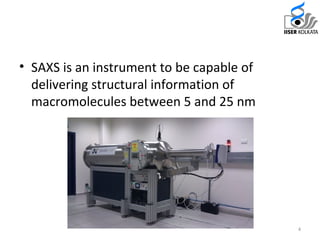
• SAXS is an instrument to be capable of
delivering structural information of
macromolecules between 5 and 25 nm
4
History
• Krisnamurty (1930): P. Krisnamurty, Ind. J.
Phys., 5, 473
• Hendricks(1932), Mark (1932), Warren (1936)
• A. Guinier(1937): Interpretation of
inhomogenities in Al alloys
• G. Porod(1942): Description of dense system
of colloidal particles, micelles, and fibers.
5
Applications
• Size of particulate systems viz. Colloids,
globular proteins etc.
• Inhomogeneous structure such as polymer
chain
• Distorted crystalline structure like crystal of
soft matter.
• Gives information about macromolecular
folding, unfolding, aggregation, different
conformations.
6
• Supramolecular complexes
• Dynamic molecular machines
• Critical for mechanistic analysis of proteins
• Nanomaterials
7
Lee B. et al. Small Angle X-ray Scattering for Nanoparticle Research Chem.Rev., 2016, 116 (18),11128-11180Lee B. et al. Small Angle X-ray Scattering for Nanoparticle Research Chem.Rev., 2016, 116 (18),11128-11180
8
Nano structured
materials
Nano structured
materials
Multilayer Films,
Polycrystalline,
Nanocomposites,
Patterned structures,
Bulk structures,
Liquid crystals,
Biological samples,
Fractals, Gels etc.
Monochromatic
X-Rays
Scattered
X-Rays
Lee B. et al. Small Angle X-ray Scattering for Nanoparticle Research Chem.Rev., 2016, 116 (18),11128-11180Lee B. et al. Small Angle X-ray Scattering for Nanoparticle Research Chem.Rev., 2016, 116 (18),11128-11180
• Technique where elastic scattering of X-rays
(wavelength 0.1-0.2 nm) are used
• Capable of delivering structural information of
macromolecules between 5 and 25 nm (in
partially ordered system upto 150 nm)
• Ultra-SAXS can resolve even larger dimensions
9
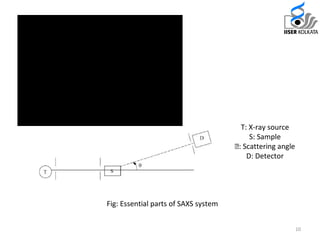
10
T: X-ray source
S: Sample
�: Scattering angle
D: Detector
Fig: Essential parts of SAXS system
11
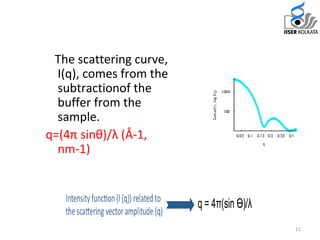
The scattering curve,
I(q), comes from the
subtractionof the
buffer from the
sample.
q=(4π sinθ)/λ (Å-1,
nm-1)
12
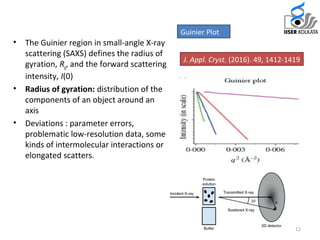
Guinier Plot
J. Appl. Cryst. (2016). 49, 1412-1419
• The Guinier region in small-angle X-ray
scattering (SAXS) defines the radius of
gyration, Rg, and the forward scattering
intensity, I(0)
• Radius of gyration: distribution of the
components of an object around an
axis
• Deviations : parameter errors,
problematic low-resolution data, some
kinds of intermolecular interactions or
elongated scatters.
13
Curtesy: Inés Muñoz, Spanish National Cancer Research Centre
Sample preparation
• Proper buffer solution should be used
• Minimum concentration is 1 mg/ml
• Maximal concentration is 10 mg/ml
14
SAXS vs XRD
• SAXS and x-ray diffraction are fundamentally similar.
• Both methods make use intense beam of x-rays to obtain
structural information about the sample.
• Differences arise from making measurements of target
molecules in solution (SAXS) or embedded in a crystal
(diffraction).
• X-ray diffraction from a crystal yields much higher resolution
and a better signal-to-noise ratio.
• SAXS analysis can be applied to flexible proteins that don’t
easily crystallize.
15
SAXS Vs XRD
• SAXS data collection is rapid (seconds).
• SAXS requires microliters of a ~1-20 mg ml-1
solutionof protein. Very economical.
• SAXS in combination with x-ray
crystallographic data can be very powerful for
the analysis of large multi component
systems.
• SAXS requires microliters of a ~1-20 mg ml-1
solution of protein. Very economical.
16
• Alba K, Bingham RJ, Kontogiorgos V. Mesoscopic structure of
pectin in solution. Biopolymers. 2017;107:e23016.
Mesoscopic: materials of an intermediate length. The scale of
these materials can be described as being between the size of
an atom and of materials measuring micrometres. (Bruker
nanostar 1-125 nm)
Pectin is a structural heteropolysacharide contained in the
primary cell walls of terrestrial plants
Slide No17
18
Alba K, Bingham RJ, Kontogiorgos V. Mesoscopic structure of pectin in solution. Biopolymers. 2017;107:e23016Alba K, Bingham RJ, Kontogiorgos V. Mesoscopic structure of pectin in solution. Biopolymers. 2017;107:e23016
a) Sample b) with NaCl
Advantage/Disadvantage
• Advantage of SAXS over crystallography is
that a crystalline sample is not needed.
• Particle range: Bruker NANOSTAR (1-125 nm)
• Kind of a complementary technique
• Cost of SAXS: High
19
References
1. David A. Jacques and Jill Trewhella, Protein Science; 2010;
19; 642—657
2. Christopher D. Putnam et al. X-ray solution scattering (SAXS)
combined with crystallography and computation: defining
accurate macromolecular structures, conformations and
assemblies in solution, Quaterly Reviews in Biophysics, 2017
3. Christopher D. Putnam Guinier peak analysis for visual and
automated inspection of small-angle X-ray scattering data J.
Appl. Cryst. (2016). 49, 1412-1419
4. http://smallangle.org/
20

Small angle x ray scattering

  • 1.
    Small Angle X-rayScattering Kalyan Jyoti Kalita 16IP011 1 CH-3206: Instrumentation in Chemistry
  • 2.
    “When the scientisthave learned how to control the arrangement of matter at a very small scale they will see materials take an enormously richer variety of properties” - Richard Feynmenn (1929) 2
  • 3.
    Overview • Introduction • History •Applications of SAXS • Structural information obtained by SAXS (Guinier Plot) • Instrumentation • Advantage/Disadvantage 3
  • 4.
    • SAXS isan instrument to be capable of delivering structural information of macromolecules between 5 and 25 nm 4
  • 5.
    History • Krisnamurty (1930):P. Krisnamurty, Ind. J. Phys., 5, 473 • Hendricks(1932), Mark (1932), Warren (1936) • A. Guinier(1937): Interpretation of inhomogenities in Al alloys • G. Porod(1942): Description of dense system of colloidal particles, micelles, and fibers. 5
  • 6.
    Applications • Size ofparticulate systems viz. Colloids, globular proteins etc. • Inhomogeneous structure such as polymer chain • Distorted crystalline structure like crystal of soft matter. • Gives information about macromolecular folding, unfolding, aggregation, different conformations. 6
  • 7.
    • Supramolecular complexes •Dynamic molecular machines • Critical for mechanistic analysis of proteins • Nanomaterials 7 Lee B. et al. Small Angle X-ray Scattering for Nanoparticle Research Chem.Rev., 2016, 116 (18),11128-11180Lee B. et al. Small Angle X-ray Scattering for Nanoparticle Research Chem.Rev., 2016, 116 (18),11128-11180
  • 8.
    8 Nano structured materials Nano structured materials MultilayerFilms, Polycrystalline, Nanocomposites, Patterned structures, Bulk structures, Liquid crystals, Biological samples, Fractals, Gels etc. Monochromatic X-Rays Scattered X-Rays Lee B. et al. Small Angle X-ray Scattering for Nanoparticle Research Chem.Rev., 2016, 116 (18),11128-11180Lee B. et al. Small Angle X-ray Scattering for Nanoparticle Research Chem.Rev., 2016, 116 (18),11128-11180
  • 9.
    • Technique whereelastic scattering of X-rays (wavelength 0.1-0.2 nm) are used • Capable of delivering structural information of macromolecules between 5 and 25 nm (in partially ordered system upto 150 nm) • Ultra-SAXS can resolve even larger dimensions 9
  • 10.
    10 T: X-ray source S:Sample �: Scattering angle D: Detector Fig: Essential parts of SAXS system
  • 11.
    11 The scattering curve, I(q),comes from the subtractionof the buffer from the sample. q=(4π sinθ)/λ (Å-1, nm-1)
  • 12.
    12 Guinier Plot J. Appl.Cryst. (2016). 49, 1412-1419 • The Guinier region in small-angle X-ray scattering (SAXS) defines the radius of gyration, Rg, and the forward scattering intensity, I(0) • Radius of gyration: distribution of the components of an object around an axis • Deviations : parameter errors, problematic low-resolution data, some kinds of intermolecular interactions or elongated scatters.
  • 13.
    13 Curtesy: Inés Muñoz,Spanish National Cancer Research Centre
  • 14.
    Sample preparation • Properbuffer solution should be used • Minimum concentration is 1 mg/ml • Maximal concentration is 10 mg/ml 14
  • 15.
    SAXS vs XRD •SAXS and x-ray diffraction are fundamentally similar. • Both methods make use intense beam of x-rays to obtain structural information about the sample. • Differences arise from making measurements of target molecules in solution (SAXS) or embedded in a crystal (diffraction). • X-ray diffraction from a crystal yields much higher resolution and a better signal-to-noise ratio. • SAXS analysis can be applied to flexible proteins that don’t easily crystallize. 15
  • 16.
    SAXS Vs XRD •SAXS data collection is rapid (seconds). • SAXS requires microliters of a ~1-20 mg ml-1 solutionof protein. Very economical. • SAXS in combination with x-ray crystallographic data can be very powerful for the analysis of large multi component systems. • SAXS requires microliters of a ~1-20 mg ml-1 solution of protein. Very economical. 16
  • 17.
    • Alba K,Bingham RJ, Kontogiorgos V. Mesoscopic structure of pectin in solution. Biopolymers. 2017;107:e23016. Mesoscopic: materials of an intermediate length. The scale of these materials can be described as being between the size of an atom and of materials measuring micrometres. (Bruker nanostar 1-125 nm) Pectin is a structural heteropolysacharide contained in the primary cell walls of terrestrial plants Slide No17
  • 18.
    18 Alba K, BinghamRJ, Kontogiorgos V. Mesoscopic structure of pectin in solution. Biopolymers. 2017;107:e23016Alba K, Bingham RJ, Kontogiorgos V. Mesoscopic structure of pectin in solution. Biopolymers. 2017;107:e23016 a) Sample b) with NaCl
  • 19.
    Advantage/Disadvantage • Advantage ofSAXS over crystallography is that a crystalline sample is not needed. • Particle range: Bruker NANOSTAR (1-125 nm) • Kind of a complementary technique • Cost of SAXS: High 19
  • 20.
    References 1. David A.Jacques and Jill Trewhella, Protein Science; 2010; 19; 642—657 2. Christopher D. Putnam et al. X-ray solution scattering (SAXS) combined with crystallography and computation: defining accurate macromolecular structures, conformations and assemblies in solution, Quaterly Reviews in Biophysics, 2017 3. Christopher D. Putnam Guinier peak analysis for visual and automated inspection of small-angle X-ray scattering data J. Appl. Cryst. (2016). 49, 1412-1419 4. http://smallangle.org/ 20