Presentation on
Quark Particles
Quark
A quark is an elementary particle and a

fundamental constituent of matter.
Quarks combine to form composite particles
called hadrons, the most stable of which are
protons and neutrons, the components of atomic
nuclei.
Quarks are never found in isolation.
Composition:

Elementary particle

Statistical behavior: Fermion
Generation:

1st, 2nd, 3rd

Interaction:

Electromagnetis
m, Gravitation,
Strong, Weak

Symbol(s):

q

Antiparticle:

Antiquark (q)

Discovered:

(~1968)
+2⁄3 e, −1⁄3 e

Electric charge:
Color charge:
Spin:

Yes
1
⁄2

A proton composed of two up
quarks and one down quark
Quarks
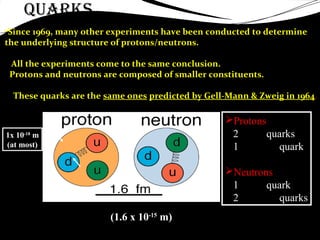
•Since 1969, many other experiments have been conducted to determine
the underlying structure of protons/neutrons.
All the experiments come to the same conclusion.
Protons and neutrons are composed of smaller constituents.
These quarks are the same ones predicted by Gell-Mann & Zweig in 1964.

Protons
2 “up” quarks
1 “down” quark

1x 10-18 m
(at most)

Neutrons
1 “up” quark
2 “down” quarks
(1.6 x 10⁻¹⁵ m)
.

HistorY
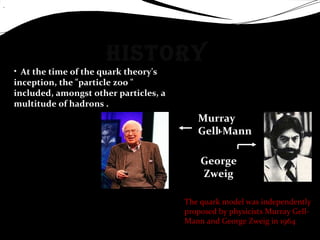
• At the time of the quark theory's

inception, the "particle zoo "
included, amongst other particles, a
multitude of hadrons .

Murray
Gell-Mann
George
Zweig
The quark model was independently
proposed by physicists Murray GellMann and George Zweig in 1964
TYPES OF QUARK
PARTICLES
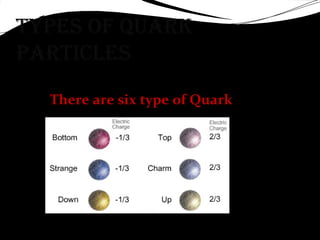
There are six type of Quark
whERE…
Quark

Date

Where

Mass
[GeV/c2]

Comment

up,
down

-

-

~0.005,
~0.010

Constituents of hadrons,
most prominently, proton
and neutrons.

strange

1947

-

~0.2

discovered in cosmic rays

1974

SLAC/
BNL

~1.5

Discovered simultaneously
in both pp and e+ecollisions.

bottom

1977

Fermilab

~4.5

Discovered in collisions of
protons on nuclei

top

1995

Fermilab

~175

Discovered in pp collisions

charm

SLAC = Stanford Linear Accelerator
BNL = Brookhaven National Lab
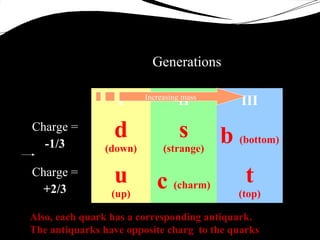
GEnERATIOn OF QUARKS
Generations
I
Charge =
-1/3
Charge =
+2/3

d

(down)

u

(up)

II

III

s

b (bottom)

c (charm)

t

Increasing mass

(strange)

(top)

Also, each quark has a corresponding antiquark.
The antiquarks have opposite charg to the quarks
Six of the particles in the Standard
Model are quarks (shown in purple).
The Standard Model is the theoretical framework

describing all the currently known elementary
particles, as well as the unobserved Higgs boson.
 This model contains six flavors of quarks (q),
named up(u), down (d), charm (c), strange (s),
top (t), and bottom (b).
Antiparticles of quarks are called antiquarks and
are denoted by a bar over the symbol for the
corresponding quark, such as u for an up
antiquark.
PROPERTIES OF QUARK
QUARK POSSESS FIVE PROPERTIES
ELECTRIC CHARGE
SPIN
WEAK INTERACTION
STRONG INTERACTION & COLOR CHARGE
MASS
ELETRIC CHARGE
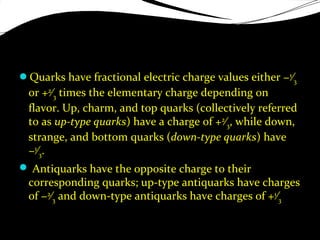
Quarks have fractional electric charge values either − 1⁄3

or +2⁄3 times the elementary charge depending on
flavor. Up, charm, and top quarks (collectively referred
to as up-type quarks) have a charge of +2⁄3, while down,
strange, and bottom quarks (down-type quarks) have
−1⁄3.
 Antiquarks have the opposite charge to their

corresponding quarks; up-type antiquarks have charges
of −2⁄3 and down-type antiquarks have charges of +1⁄3
SPIn
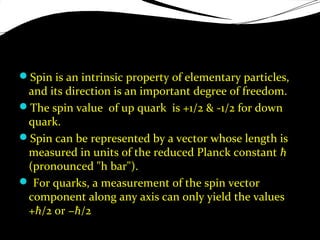
Spin is an intrinsic property of elementary particles,

and its direction is an important degree of freedom.
The spin value of up quark is +1/2 & -1/2 for down
quark.
Spin can be represented by a vector whose length is
measured in units of the reduced Planck constant ħ
(pronounced "h bar").
 For quarks, a measurement of the spin vector
component along any axis can only yield the values
+ħ/2 or −ħ/2
WEAK InTERACTIOn
A quark of one flavor can transform into a quark of

another flavor only through the weak interaction.
 By absorbing or emitting a W boson, any up-type quark
(up, charm, and top quarks) can change into any downtype quark (down, strange, and bottom quarks) and vice
versa.
. This flavor transformation mechanism causes the
radioactive process of beta decay in which a neutron (n)
"splits" into a proton (p), an electron (e−) and an electron
antineutrino(νe) .

n→ p + e

−

+ νe (Beta decay, hadron notation)
STROnG InTERACTIOn And COLOUR
CHARGE
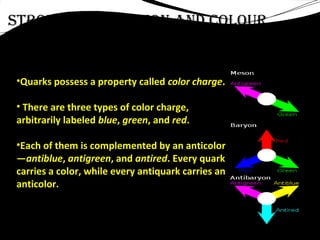
•Quarks possess a property called color charge.
• There are three types of color charge,
arbitrarily labeled blue, green, and red.
•Each of them is complemented by an anticolor
—antiblue, antigreen, and antired. Every quark
carries a color, while every antiquark carries an
anticolor.
mass
Two terms are used in referring to a quark's mass:

current quark mass refers to the mass of a quark by
itself, while constituent quark mass refers to the
current quark mass plus the mass of the gluon
particle field surrounding the quark.
These masses typically have very different value.
aDVaNTaGE
Quarks, gluons, neutrinos and all sorts

of other things much smaller than
protons and electrons.
Gluons only exist to hold quarks
together, so we can't do anything with
them.
REFERENCES:-
THANK YOU

Quark particles

  • 1.
  • 2.
    Quark A quark isan elementary particle and a fundamental constituent of matter. Quarks combine to form composite particles called hadrons, the most stable of which are protons and neutrons, the components of atomic nuclei. Quarks are never found in isolation.
  • 3.
    Composition: Elementary particle Statistical behavior:Fermion Generation: 1st, 2nd, 3rd Interaction: Electromagnetis m, Gravitation, Strong, Weak Symbol(s): q Antiparticle: Antiquark (q) Discovered: (~1968) +2⁄3 e, −1⁄3 e Electric charge: Color charge: Spin: Yes 1 ⁄2 A proton composed of two up quarks and one down quark
  • 4.
    Quarks •Since 1969, manyother experiments have been conducted to determine the underlying structure of protons/neutrons. All the experiments come to the same conclusion. Protons and neutrons are composed of smaller constituents. These quarks are the same ones predicted by Gell-Mann & Zweig in 1964. Protons 2 “up” quarks 1 “down” quark 1x 10-18 m (at most) Neutrons 1 “up” quark 2 “down” quarks (1.6 x 10⁻¹⁵ m)
  • 5.
    . HistorY • At thetime of the quark theory's inception, the "particle zoo " included, amongst other particles, a multitude of hadrons . Murray Gell-Mann George Zweig The quark model was independently proposed by physicists Murray GellMann and George Zweig in 1964
  • 6.
    TYPES OF QUARK PARTICLES Thereare six type of Quark
  • 7.
    whERE… Quark Date Where Mass [GeV/c2] Comment up, down - - ~0.005, ~0.010 Constituents of hadrons, mostprominently, proton and neutrons. strange 1947 - ~0.2 discovered in cosmic rays 1974 SLAC/ BNL ~1.5 Discovered simultaneously in both pp and e+ecollisions. bottom 1977 Fermilab ~4.5 Discovered in collisions of protons on nuclei top 1995 Fermilab ~175 Discovered in pp collisions charm SLAC = Stanford Linear Accelerator BNL = Brookhaven National Lab
  • 8.
    GEnERATIOn OF QUARKS Generations I Charge= -1/3 Charge = +2/3 d (down) u (up) II III s b (bottom) c (charm) t Increasing mass (strange) (top) Also, each quark has a corresponding antiquark. The antiquarks have opposite charg to the quarks
  • 9.
    Six of theparticles in the Standard Model are quarks (shown in purple).
  • 10.
    The Standard Modelis the theoretical framework describing all the currently known elementary particles, as well as the unobserved Higgs boson.  This model contains six flavors of quarks (q), named up(u), down (d), charm (c), strange (s), top (t), and bottom (b). Antiparticles of quarks are called antiquarks and are denoted by a bar over the symbol for the corresponding quark, such as u for an up antiquark.
  • 11.
    PROPERTIES OF QUARK QUARKPOSSESS FIVE PROPERTIES ELECTRIC CHARGE SPIN WEAK INTERACTION STRONG INTERACTION & COLOR CHARGE MASS
  • 12.
    ELETRIC CHARGE Quarks havefractional electric charge values either − 1⁄3 or +2⁄3 times the elementary charge depending on flavor. Up, charm, and top quarks (collectively referred to as up-type quarks) have a charge of +2⁄3, while down, strange, and bottom quarks (down-type quarks) have −1⁄3.  Antiquarks have the opposite charge to their corresponding quarks; up-type antiquarks have charges of −2⁄3 and down-type antiquarks have charges of +1⁄3
  • 13.
    SPIn Spin is anintrinsic property of elementary particles, and its direction is an important degree of freedom. The spin value of up quark is +1/2 & -1/2 for down quark. Spin can be represented by a vector whose length is measured in units of the reduced Planck constant ħ (pronounced "h bar").  For quarks, a measurement of the spin vector component along any axis can only yield the values +ħ/2 or −ħ/2
  • 14.
    WEAK InTERACTIOn A quarkof one flavor can transform into a quark of another flavor only through the weak interaction.  By absorbing or emitting a W boson, any up-type quark (up, charm, and top quarks) can change into any downtype quark (down, strange, and bottom quarks) and vice versa. . This flavor transformation mechanism causes the radioactive process of beta decay in which a neutron (n) "splits" into a proton (p), an electron (e−) and an electron antineutrino(νe) . n→ p + e − + νe (Beta decay, hadron notation)
  • 15.
    STROnG InTERACTIOn AndCOLOUR CHARGE •Quarks possess a property called color charge. • There are three types of color charge, arbitrarily labeled blue, green, and red. •Each of them is complemented by an anticolor —antiblue, antigreen, and antired. Every quark carries a color, while every antiquark carries an anticolor.
  • 16.
    mass Two terms areused in referring to a quark's mass: current quark mass refers to the mass of a quark by itself, while constituent quark mass refers to the current quark mass plus the mass of the gluon particle field surrounding the quark. These masses typically have very different value.
  • 17.
    aDVaNTaGE Quarks, gluons, neutrinosand all sorts of other things much smaller than protons and electrons. Gluons only exist to hold quarks together, so we can't do anything with them.
  • 18.
  • 19.