SCINTILLATION
COUNTER
JEEVANANTHAM P
I MSc Chemistry,
SRMV College,
Coimbatore.
jeevananthamche@gmail.com
History
The modern electronic scintillation counter was
invented in 1944 by Sir Samuel Curran(UK)
 Previously scintillation events had to be laboriously
detected by eye using a spinthariscope which was a
simple microscope to observe light flashes in the
scintillator
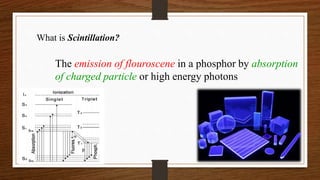
What is Scintillation?
The emission of flouroscene in a phosphor by absorption
of charged particle or high energy photons
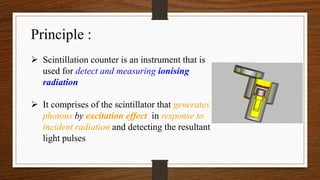
Principle :
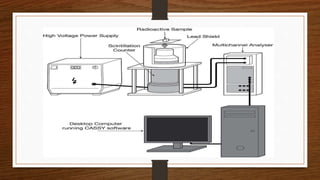
 Scintillation counter is an instrument that is
used for detect and measuring ionising
radiation
 It comprises of the scintillator that generates
photons by excitation effect in response to
incident radiation and detecting the resultant
light pulses
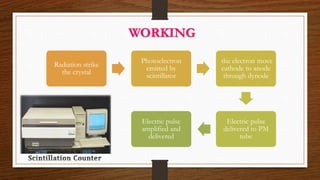
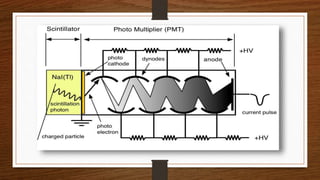
Radiation strike
the crystal
Photoelectron
emitted by
scintillator
the electron move
cathode to anode
through dynode
Electric pulse
delivered to PM
tube
Electric pulse
amplified and
delivered
WORKING
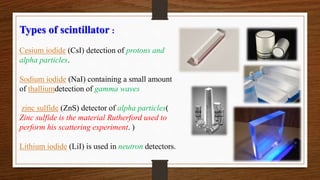
Types of scintillator :
Cesium iodide (CsI) detection of protons and
alpha particles.
Sodium iodide (NaI) containing a small amount
of thalliumdetection of gamma waves
zinc sulfide (ZnS) detector of alpha particles(
Zinc sulfide is the material Rutherford used to
perform his scattering experiment. )
Lithium iodide (LiI) is used in neutron detectors.
QUESTN......
Which is the correct representation for “SINGLET” &
“TRIPLET” ?
A)
B)
C)
D)
E)
F)
Ans:
SINGLET =B
TRIPLET =D,E
SEMICONDUTOR
DEDUCTOR
Semiconductor detector
 A detector which is used to detect the ionising
radiation by using semiondutors (usually silicon or
germanium)
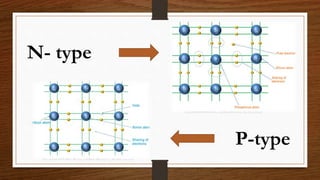
 The detecting is a single crystal consisting of a
sandwich of intrinsic silicon between a P-Type layer and
N-Type layer forming p-i-n diode.
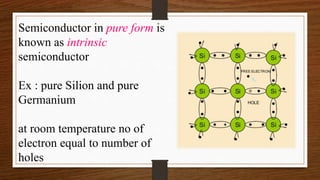
Semiconductor in pure form is
known as intrinsic
semiconductor
Ex : pure Silion and pure
Germanium
at room temperature no of
electron equal to number of
holes
N- type
P-type
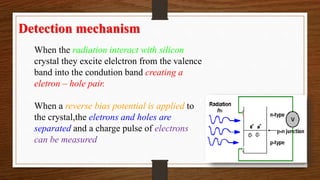
When the radiation interact with silicon
crystal they excite elelctron from the valence
band into the condution band creating a
eletron – hole pair.
When a reverse bias potential is applied to
the crystal,the eletrons and holes are
separated and a charge pulse of electrons
can be measured
Detection mechanism
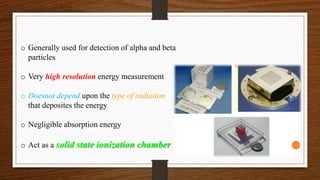
o Generally used for detection of alpha and beta
particles
o Very high resolution energy measurement
o Doesnot depend upon the type of radiation
that deposites the energy
o Negligible absorption energy
o Act as a solid state ionization chamber
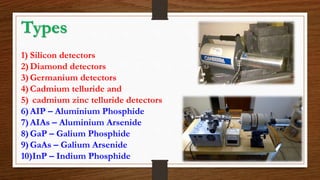
Types
1) Silicon detectors
2)Diamond detectors
3)Germanium detectors
4)Cadmium telluride and
5) cadmium zinc telluride detectors
6)AIP – Aluminium Phosphide
7)AIAs – Aluminium Arsenide
8)GaP – Galium Phosphide
9)GaAs – Galium Arsenide
10)InP – Indium Phosphide
advantages
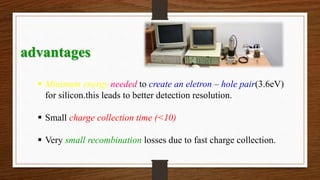
 Minimum energy needed to create an eletron – hole pair(3.6eV)
for silicon.this leads to better detection resolution.
 Small charge collection time (<10)
 Very small recombination losses due to fast charge collection.
In the ciruit diagram, the direction of eletron moves
____________ direction to the current
a) Same b)opposite
c) +ve to –ve d) –ve to +ve
QUESTN…
Ans : B & C
Scintillation Counter and Semiconductor Detector

Scintillation Counter and Semiconductor Detector

  • 1.
    SCINTILLATION COUNTER JEEVANANTHAM P I MScChemistry, SRMV College, Coimbatore. jeevananthamche@gmail.com
  • 2.
    History The modern electronicscintillation counter was invented in 1944 by Sir Samuel Curran(UK)  Previously scintillation events had to be laboriously detected by eye using a spinthariscope which was a simple microscope to observe light flashes in the scintillator
  • 3.
    What is Scintillation? Theemission of flouroscene in a phosphor by absorption of charged particle or high energy photons
  • 4.
    Principle :  Scintillationcounter is an instrument that is used for detect and measuring ionising radiation  It comprises of the scintillator that generates photons by excitation effect in response to incident radiation and detecting the resultant light pulses
  • 5.
    Radiation strike the crystal Photoelectron emittedby scintillator the electron move cathode to anode through dynode Electric pulse delivered to PM tube Electric pulse amplified and delivered WORKING
  • 8.
    Types of scintillator: Cesium iodide (CsI) detection of protons and alpha particles. Sodium iodide (NaI) containing a small amount of thalliumdetection of gamma waves zinc sulfide (ZnS) detector of alpha particles( Zinc sulfide is the material Rutherford used to perform his scattering experiment. ) Lithium iodide (LiI) is used in neutron detectors.
  • 10.
    QUESTN...... Which is thecorrect representation for “SINGLET” & “TRIPLET” ? A) B) C) D) E) F) Ans: SINGLET =B TRIPLET =D,E
  • 11.
  • 12.
    Semiconductor detector  Adetector which is used to detect the ionising radiation by using semiondutors (usually silicon or germanium)  The detecting is a single crystal consisting of a sandwich of intrinsic silicon between a P-Type layer and N-Type layer forming p-i-n diode.
  • 13.
    Semiconductor in pureform is known as intrinsic semiconductor Ex : pure Silion and pure Germanium at room temperature no of electron equal to number of holes
  • 14.
  • 15.
    When the radiationinteract with silicon crystal they excite elelctron from the valence band into the condution band creating a eletron – hole pair. When a reverse bias potential is applied to the crystal,the eletrons and holes are separated and a charge pulse of electrons can be measured Detection mechanism
  • 16.
    o Generally usedfor detection of alpha and beta particles o Very high resolution energy measurement o Doesnot depend upon the type of radiation that deposites the energy o Negligible absorption energy o Act as a solid state ionization chamber
  • 17.
    Types 1) Silicon detectors 2)Diamonddetectors 3)Germanium detectors 4)Cadmium telluride and 5) cadmium zinc telluride detectors 6)AIP – Aluminium Phosphide 7)AIAs – Aluminium Arsenide 8)GaP – Galium Phosphide 9)GaAs – Galium Arsenide 10)InP – Indium Phosphide
  • 18.
    advantages  Minimum energyneeded to create an eletron – hole pair(3.6eV) for silicon.this leads to better detection resolution.  Small charge collection time (<10)  Very small recombination losses due to fast charge collection.
  • 19.
    In the ciruitdiagram, the direction of eletron moves ____________ direction to the current a) Same b)opposite c) +ve to –ve d) –ve to +ve QUESTN… Ans : B & C