Robotics in
army
Where AI meets the real world.
What is a Robot ?


“A re-programmable, multifunctional manipulator designed
to move
material, parts, tools, or specialized devices through various
programmed
motions for the performance of a variety of tasks.”
History




Robots were first introduced in army during second world
war in the form German Goliath tracked mines and russian
teletanks
MQ-1 predator drone was the first aerial robot used to
collect the intelligence.
A robot must have the following essential
characteristics:







Mobility: It possesses some form of
mobility.
Programmability: implying computational
or symbol- manipulative capabilities that a
designer can combine as desired (a robot
is a computer). It can be programmed to
accomplish a large variety of tasks. After
being programmed, it operates
automatically.
Sensors: on or around the device that are
able to sense the environment and give
useful feedback to the device
Mechanical capability: enabling it to act on
its environment rather than merely
function as a data processing or
computational device (a robot is a
machine); and
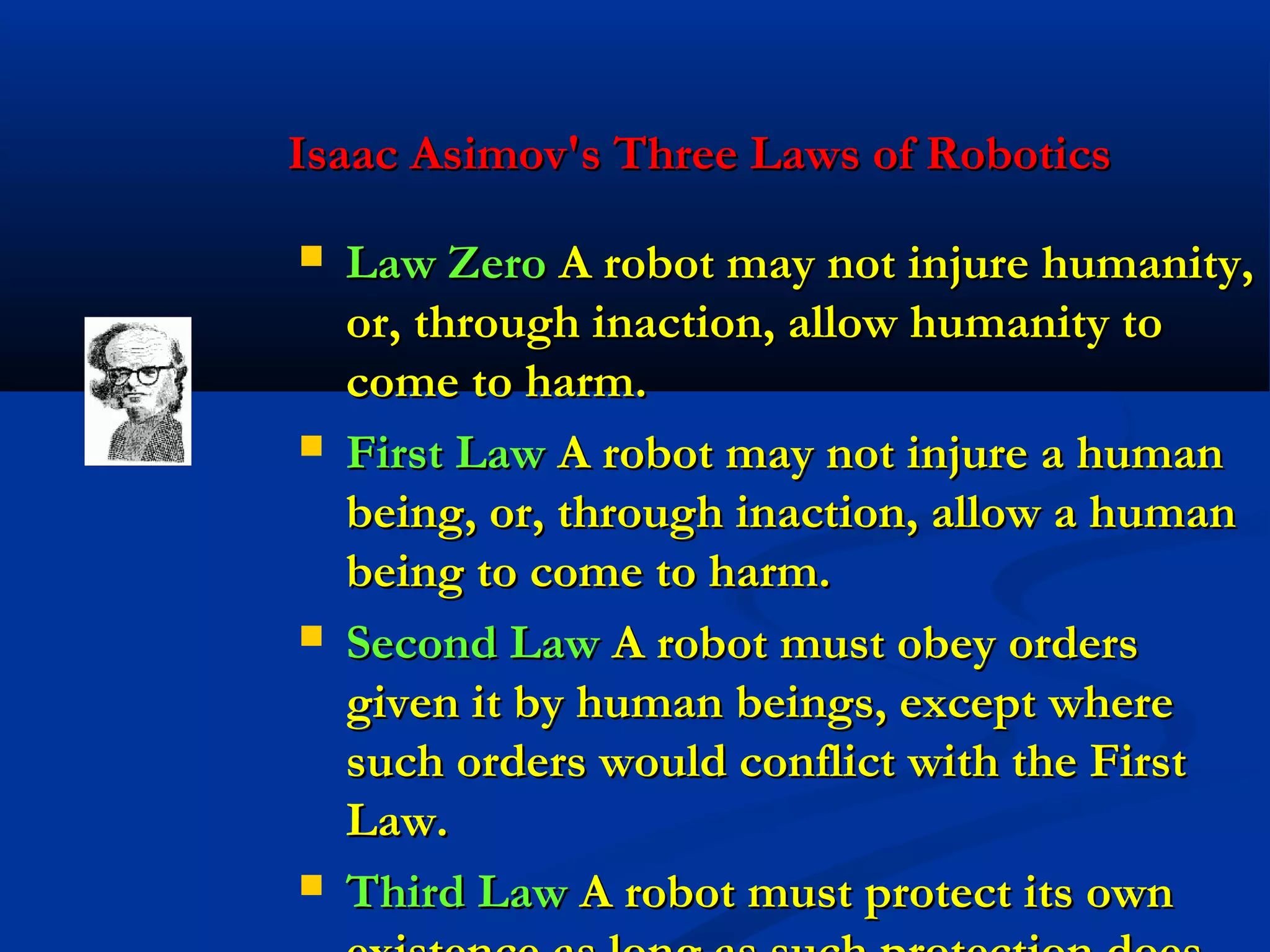
Isaac Asimov's Three Laws of Robotics








Law Zero A robot may not injure humanity,
or, through inaction, allow humanity to
come to harm.
First Law A robot may not injure a human
being, or, through inaction, allow a human
being to come to harm.
Second Law A robot must obey orders
given it by human beings, except where
such orders would conflict with the First
Law.
Third Law A robot must protect its own
Construction & Working of the Robot
Mechanical platforms
Sensors
Motors
Power supplies
Electronic Controls
Microcontroller systems
Languages
Pneumatics
Controllers
Sensors

Sensors are the parts that act like senses and
can detect objects or things like heat and
light and convert the object information into
symbols or in analog or digital form so that
computers understand. And then Robots
react according to information provided by
the sensory system

Vision Sensor
Proximity Sensors
Proprioceptive Sensors
Logical Sensors
Artificial Intelligence


What is artificial intelligence?
It is the science and engineering of
making intelligent machines, especially
intelligent computer programs
UNITED STATES ARMY ENGINEER CENTER

Robotics Philosophy: Do the
Analysis of Alternatives first
Remember the 4 points that must be sold to Army decision
makers to justify why a required operational capability should
be roboticized:
1.It reduces soldier risk/exposure to threat weapons.
2.It improves deployability and/or reduces the
footprint of the force.
3.It is cost and operationally effective.
4.It does not create an operational, maintenance and
interoperability burden on gaining units.

ESSAYONS
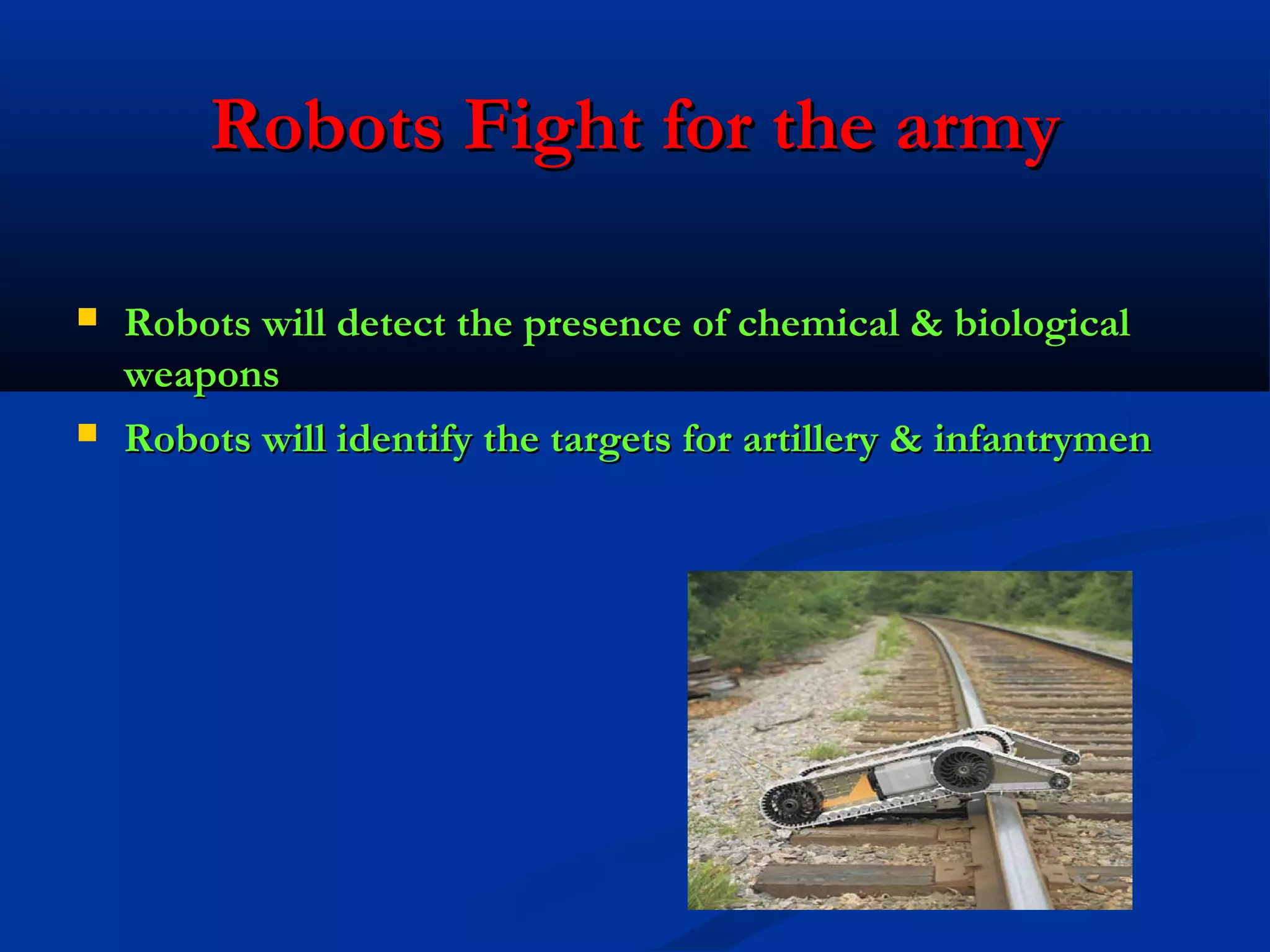
Robots Fight for the army




Robots will detect the presence of chemical & biological
weapons
Robots will identify the targets for artillery & infantrymen
Military use of robot increases





Robots in the military are no longer the stuff of science
fiction.
Army’s robotic force is teleoperated.
How are robots use in the army





EOD Robots
Robots For Rescue
Aerial Robots
Military robots of future




In the future military can deploy a robot that can drive itself
around a corner.using sensors to detect an enemy fighter on
the move & destroy targets all without human intervention.
According to the report the army goal is to have approx.
30% of the army comprised of robotic forces by 2020.
Effects and impacts




Advantages
Potential Risks
Summary
Nothing is totally impossible. Perhaps one day
we will be able to produce robots that are
practically indistinguishable
from ourselves.

Advantages
 Disadvantages


Roboticsin army

  • 1.
    Robotics in army Where AImeets the real world.
  • 2.
    What is aRobot ?  “A re-programmable, multifunctional manipulator designed to move material, parts, tools, or specialized devices through various programmed motions for the performance of a variety of tasks.”
  • 3.
    History   Robots were firstintroduced in army during second world war in the form German Goliath tracked mines and russian teletanks MQ-1 predator drone was the first aerial robot used to collect the intelligence.
  • 4.
    A robot musthave the following essential characteristics:     Mobility: It possesses some form of mobility. Programmability: implying computational or symbol- manipulative capabilities that a designer can combine as desired (a robot is a computer). It can be programmed to accomplish a large variety of tasks. After being programmed, it operates automatically. Sensors: on or around the device that are able to sense the environment and give useful feedback to the device Mechanical capability: enabling it to act on its environment rather than merely function as a data processing or computational device (a robot is a machine); and
  • 5.
    Isaac Asimov's ThreeLaws of Robotics     Law Zero A robot may not injure humanity, or, through inaction, allow humanity to come to harm. First Law A robot may not injure a human being, or, through inaction, allow a human being to come to harm. Second Law A robot must obey orders given it by human beings, except where such orders would conflict with the First Law. Third Law A robot must protect its own
  • 6.
    Construction & Workingof the Robot Mechanical platforms Sensors Motors Power supplies Electronic Controls Microcontroller systems Languages Pneumatics Controllers
  • 7.
    Sensors Sensors are theparts that act like senses and can detect objects or things like heat and light and convert the object information into symbols or in analog or digital form so that computers understand. And then Robots react according to information provided by the sensory system Vision Sensor Proximity Sensors Proprioceptive Sensors Logical Sensors
  • 8.
    Artificial Intelligence  What isartificial intelligence? It is the science and engineering of making intelligent machines, especially intelligent computer programs
  • 9.
    UNITED STATES ARMYENGINEER CENTER Robotics Philosophy: Do the Analysis of Alternatives first Remember the 4 points that must be sold to Army decision makers to justify why a required operational capability should be roboticized: 1.It reduces soldier risk/exposure to threat weapons. 2.It improves deployability and/or reduces the footprint of the force. 3.It is cost and operationally effective. 4.It does not create an operational, maintenance and interoperability burden on gaining units. ESSAYONS
  • 10.
    Robots Fight forthe army   Robots will detect the presence of chemical & biological weapons Robots will identify the targets for artillery & infantrymen
  • 11.
    Military use ofrobot increases   Robots in the military are no longer the stuff of science fiction. Army’s robotic force is teleoperated.
  • 12.
    How are robotsuse in the army    EOD Robots Robots For Rescue Aerial Robots
  • 13.
    Military robots offuture   In the future military can deploy a robot that can drive itself around a corner.using sensors to detect an enemy fighter on the move & destroy targets all without human intervention. According to the report the army goal is to have approx. 30% of the army comprised of robotic forces by 2020.
  • 14.
  • 15.
    Summary Nothing is totallyimpossible. Perhaps one day we will be able to produce robots that are practically indistinguishable from ourselves. Advantages  Disadvantages 