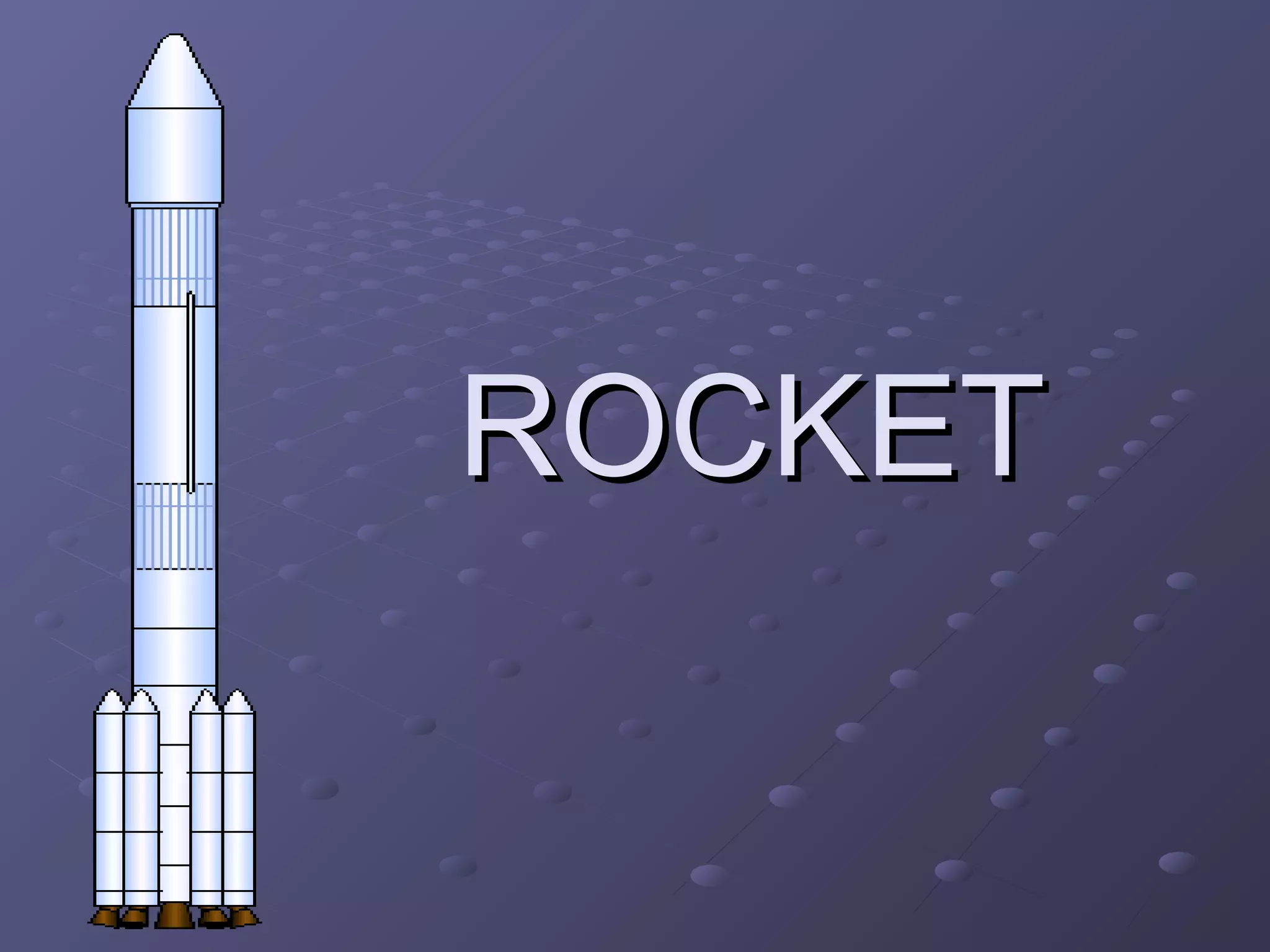
ROCKET
INTRODUCTION
 Rocket, self-propelled device that
carries its own fuel.
 Rocket engine is the most
powerful engine for its weight.
 Rockets can operate in space,
because they carry their own
oxygen.
 Rockets are presently the only
How Rocket works….?
 Action and Reaction
 Thrust and Efficiency
 Staging
Action and Reaction

 Rockets produces the force that moves them
forward by burning their fuel inside a chamber.

 Rocket, like the balloon, has an opening called a
nozzle from which the exhaust gases exit.
Thrust and Efficiency
 Thrust is a measurement of the
force of a rocket, or the amount of
“push” exerted backward to move a
rocket forward.
 Specific impulse measures the
efficiency and power of rocket
Staging
 In some rockets that use stages,
the first stage has additional
rockets attached to the outside,
acting as boosters to further
increase the thrust.
 The first and most powerful stage
lifts the launch vehicle into the
TYPES OF ROCKET
PROPULSION
 Chemical Rockets




Solid-Fueled Rockets
Liquid-Fueled Rocket
Hybrid Chemical Rocket

 Nuclear Rockets
 Electric Rockets
ROCKET FLIGHT
 Launching
 Missiles
 Sounding Rockets
 Launch Vehicles
 Stability and Control
ROCKET USES
 Missiles
 Sounding Rockets
 Launch Vehicles
 Thrusters
Missiles
 The term missile actually means
any object thrown at an enemy
and includes arrows, bullets, and
other weapons.
Sounding Rockets
 Scientists use sounding rockets
to carry scientific instruments into
the upper atmosphere to take
measurements of air quality,
radiation from space, and other
data.
Launch Vehicles

Launch vehicles send satellites
and other spacecraft into space.
 These vehicles must be far
more powerful than other types
of rockets, because they carry
more cargo farther and faster
Thrusters

 Many spacecraft use small rockets
called thrusters to move around in
space.

 Thrusters can change the speed
and direction of a spacecraft.
THANK YOU ..!!

Rocket

  • 1.
  • 2.
    INTRODUCTION  Rocket, self-propelleddevice that carries its own fuel.  Rocket engine is the most powerful engine for its weight.  Rockets can operate in space, because they carry their own oxygen.  Rockets are presently the only
  • 3.
    How Rocket works….? Action and Reaction  Thrust and Efficiency  Staging
  • 4.
    Action and Reaction Rockets produces the force that moves them forward by burning their fuel inside a chamber.  Rocket, like the balloon, has an opening called a nozzle from which the exhaust gases exit.
  • 5.
    Thrust and Efficiency Thrust is a measurement of the force of a rocket, or the amount of “push” exerted backward to move a rocket forward.  Specific impulse measures the efficiency and power of rocket
  • 6.
    Staging  In somerockets that use stages, the first stage has additional rockets attached to the outside, acting as boosters to further increase the thrust.  The first and most powerful stage lifts the launch vehicle into the
  • 7.
    TYPES OF ROCKET PROPULSION Chemical Rockets    Solid-Fueled Rockets Liquid-Fueled Rocket Hybrid Chemical Rocket  Nuclear Rockets  Electric Rockets
  • 8.
    ROCKET FLIGHT  Launching Missiles  Sounding Rockets  Launch Vehicles  Stability and Control
  • 9.
    ROCKET USES  Missiles Sounding Rockets  Launch Vehicles  Thrusters
  • 10.
    Missiles  The termmissile actually means any object thrown at an enemy and includes arrows, bullets, and other weapons.
  • 11.
    Sounding Rockets  Scientistsuse sounding rockets to carry scientific instruments into the upper atmosphere to take measurements of air quality, radiation from space, and other data.
  • 12.
    Launch Vehicles  Launch vehiclessend satellites and other spacecraft into space.  These vehicles must be far more powerful than other types of rockets, because they carry more cargo farther and faster
  • 13.
    Thrusters  Many spacecraftuse small rockets called thrusters to move around in space.  Thrusters can change the speed and direction of a spacecraft.
  • 14.