




Learn about AccelerometerThe Indian Way - Low Cost and QuickAccelerometer
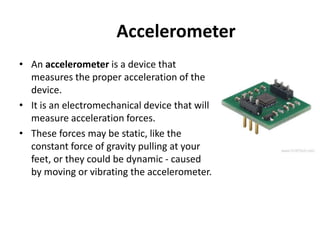
      AccelerometerAn accelerometer is a device that measures the proper acceleration of the device.It is an electromechanical device that will measure acceleration forces.These forces may be static, like the constant force of gravity pulling at your feet, or they could be dynamic - caused by moving or vibrating the accelerometer.
Conti..An accelerometer measures weight per unit of (test) mass, a quantity also known as specific force, or g-force.Most accelerometers do not display the value they measure, but supply it to other devices.Conceptually, an accelerometer behaves as a damped mass on a spring. When the accelerometer experiences an acceleration, the mass is displaced to the point that the spring is able to accelerate the mass at the same rate as the casing. The displacement is then measured to give the acceleration.
What are accelerometers useful for?By measuring the amount of static acceleration due to gravity, you can find out the angle the device is tilted at with respect to the earth.By sensing the amount of dynamic acceleration, you can analyze the way the device is moving.An accelerometer can help your project understand its surroundings better.
Conti..In the computing world, IBM and Apple have recently started using accelerometers in their laptops to protect hard drives from damage.If you accidentally drop the laptop, the accelerometer detects the sudden freefall, and switches the hard drive off so the heads don't crash on the platters.In a similar fashion, high g accelerometers are the industry standard way of detecting car crashes and deploying airbags at just the right time.
 ApplicationsEngineeringBiologyIndustryBuilding and structural monitoringMedical applicationsNavigationTransportAnd more…
Types of Accelerometers2-Axis Accelerometers3-Axis Accelerometers
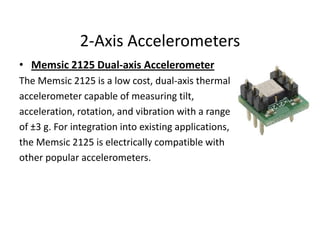
2-Axis AccelerometersMemsic 2125 Dual-axis AccelerometerThe Memsic 2125 is a low cost, dual-axis thermalaccelerometer capable of measuring tilt,acceleration, rotation, and vibration with a rangeof ±3 g. For integration into existing applications,the Memsic 2125 is electrically compatible withother popular accelerometers.
Conti..Features:- Measures ±3 g on each axis 	- Simple pulse output of g-force for each axis 		- Convenient 6-pin 0.1" spacing DIP module 	- Analog output fo temperature (Tout pin) 	- Low current at 3.3 or 5 V operation: less than 4 mA at 5 	   VDC .
Sample Applications:	 	-Dual-axis tilt sensing for autonomous robotics 	   	   applications 		- Single-axis rotational position sensing		- Movement/Lack-of-movement sensing for alarm 		   systems 		- R/C hobby projects such as autopilots
Key Specifications:		- Power requirements: +3.3 to +5 VDC 		- Communication: TTL/CMOS compatible 100 Hz PWM 	- output signal with duty cycle proportional to 		   acceleration 		- Dimensions: 0.42 x 0.42 x 0.45 in (10.7 x 10.7 x 11.8 	   mm) 		- Operating temp range: 32 to +158 °F (0 to +70 °C)
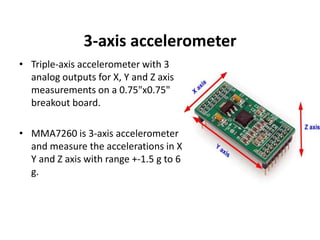
3-axis accelerometerTriple-axis accelerometer with 3 analog outputs for X, Y and Z axis measurements on a 0.75"x0.75" breakout board.MMA7260 is 3-axis accelerometer and measure the accelerations in X Y and Z axis with range +-1.5 g to 6 g.
Conti..Features		-Selectable Sensitivity (1.5g/2g/4g/6g)	-Low Current Consumption: 500 μA		-Sleep Mode: 3 μA		-Low Voltage Operation: 2.2 V – 3.6 V		-6mm x 6mm x 1.45mm QFN		-High Sensitivity (800 mV/g @ 1.5g)		-Fast Turn On Time		-Integral Signal Conditioning with Low Pass Filter		-Robust Design, High Shocks Survivability		-Pb-Free Terminations		-Low Cost
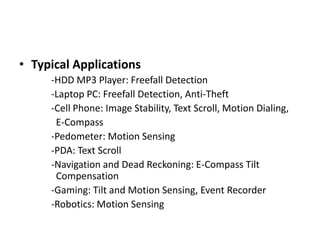
Typical Applications		-HDD MP3 Player: Freefall Detection		-Laptop PC: Freefall Detection, Anti-Theft		-Cell Phone: Image Stability, Text Scroll, Motion Dialing,	  E-Compass		-Pedometer: Motion Sensing		-PDA: Text Scroll		-Navigation and Dead Reckoning: E-Compass Tilt 		  Compensation		-Gaming: Tilt and Motion Sensing, Event Recorder		-Robotics: Motion Sensing
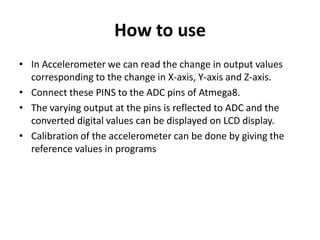
How to useIn Accelerometer we can read the change in output values corresponding to the change in X-axis, Y-axis and Z-axis.Connect these PINS to the ADC pins of Atmega8.The varying output at the pins is reflected to ADC and the converted digital values can be displayed on LCD display. Calibration of the accelerometer can be done by giving the reference values in programs
Thank you…
About Open.EmbeddedThis is an initiative of group of professionals, students and hobbyists  to share their knowledge among others using low cost open source software.We think it criminal when students are taught 8085 and 8051 in college when world is moving forward and technology changes are happening every where in the world. Join us at  facebook.com/open.embedded Buy low cost kits at stores.ebay.in/openembedded 
MADE BY     SUMIT BALGUVHARM.TECH-EMBEDDED SYSTEM TECHNOLOGYsumitbalguvhar783@gmail.com
Accelerometer 1

Accelerometer 1

  • 1.
    Learn about AccelerometerTheIndian Way - Low Cost and QuickAccelerometer
  • 2.
    AccelerometerAn accelerometer is a device that measures the proper acceleration of the device.It is an electromechanical device that will measure acceleration forces.These forces may be static, like the constant force of gravity pulling at your feet, or they could be dynamic - caused by moving or vibrating the accelerometer.
  • 3.
    Conti..An accelerometer measures weightper unit of (test) mass, a quantity also known as specific force, or g-force.Most accelerometers do not display the value they measure, but supply it to other devices.Conceptually, an accelerometer behaves as a damped mass on a spring. When the accelerometer experiences an acceleration, the mass is displaced to the point that the spring is able to accelerate the mass at the same rate as the casing. The displacement is then measured to give the acceleration.
  • 4.
    What are accelerometersuseful for?By measuring the amount of static acceleration due to gravity, you can find out the angle the device is tilted at with respect to the earth.By sensing the amount of dynamic acceleration, you can analyze the way the device is moving.An accelerometer can help your project understand its surroundings better.
  • 5.
    Conti..In the computingworld, IBM and Apple have recently started using accelerometers in their laptops to protect hard drives from damage.If you accidentally drop the laptop, the accelerometer detects the sudden freefall, and switches the hard drive off so the heads don't crash on the platters.In a similar fashion, high g accelerometers are the industry standard way of detecting car crashes and deploying airbags at just the right time.
  • 6.
    ApplicationsEngineeringBiologyIndustryBuilding andstructural monitoringMedical applicationsNavigationTransportAnd more…
  • 7.
    Types of Accelerometers2-AxisAccelerometers3-Axis Accelerometers
  • 8.
    2-Axis AccelerometersMemsic 2125Dual-axis AccelerometerThe Memsic 2125 is a low cost, dual-axis thermalaccelerometer capable of measuring tilt,acceleration, rotation, and vibration with a rangeof ±3 g. For integration into existing applications,the Memsic 2125 is electrically compatible withother popular accelerometers.
  • 9.
    Conti..Features:- Measures ±3g on each axis - Simple pulse output of g-force for each axis - Convenient 6-pin 0.1" spacing DIP module - Analog output fo temperature (Tout pin) - Low current at 3.3 or 5 V operation: less than 4 mA at 5 VDC .
  • 10.
    Sample Applications: -Dual-axistilt sensing for autonomous robotics applications - Single-axis rotational position sensing - Movement/Lack-of-movement sensing for alarm systems - R/C hobby projects such as autopilots
  • 11.
    Key Specifications: - Powerrequirements: +3.3 to +5 VDC - Communication: TTL/CMOS compatible 100 Hz PWM - output signal with duty cycle proportional to acceleration - Dimensions: 0.42 x 0.42 x 0.45 in (10.7 x 10.7 x 11.8 mm) - Operating temp range: 32 to +158 °F (0 to +70 °C)
  • 12.
    3-axis accelerometerTriple-axis accelerometerwith 3 analog outputs for X, Y and Z axis measurements on a 0.75"x0.75" breakout board.MMA7260 is 3-axis accelerometer and measure the accelerations in X Y and Z axis with range +-1.5 g to 6 g.
  • 13.
    Conti..Features -Selectable Sensitivity (1.5g/2g/4g/6g) -LowCurrent Consumption: 500 μA -Sleep Mode: 3 μA -Low Voltage Operation: 2.2 V – 3.6 V -6mm x 6mm x 1.45mm QFN -High Sensitivity (800 mV/g @ 1.5g) -Fast Turn On Time -Integral Signal Conditioning with Low Pass Filter -Robust Design, High Shocks Survivability -Pb-Free Terminations -Low Cost
  • 14.
    Typical Applications -HDD MP3Player: Freefall Detection -Laptop PC: Freefall Detection, Anti-Theft -Cell Phone: Image Stability, Text Scroll, Motion Dialing, E-Compass -Pedometer: Motion Sensing -PDA: Text Scroll -Navigation and Dead Reckoning: E-Compass Tilt Compensation -Gaming: Tilt and Motion Sensing, Event Recorder -Robotics: Motion Sensing
  • 15.
    How to useInAccelerometer we can read the change in output values corresponding to the change in X-axis, Y-axis and Z-axis.Connect these PINS to the ADC pins of Atmega8.The varying output at the pins is reflected to ADC and the converted digital values can be displayed on LCD display. Calibration of the accelerometer can be done by giving the reference values in programs
  • 16.
  • 17.
    About Open.EmbeddedThis isan initiative of group of professionals, students and hobbyists  to share their knowledge among others using low cost open source software.We think it criminal when students are taught 8085 and 8051 in college when world is moving forward and technology changes are happening every where in the world. Join us at  facebook.com/open.embedded Buy low cost kits at stores.ebay.in/openembedded 
  • 18.
    MADE BY SUMIT BALGUVHARM.TECH-EMBEDDED SYSTEM TECHNOLOGYsumitbalguvhar783@gmail.com