Non linear Optics
&
Harmonic
Generations
Linear Optics vs Non Linear Optics
 Linear optics- ‘Optics of weak light’:
Light is deflected or delayed but its
frequency is unchanged.
 Non-Linear optics-‘Optics of intense
light’:
We are concerned with the effects that
light itself induces as it propagates
through the medium.
Non-Linear optics produces many exotic
events
•Nonlinear optics allows us to
change the color of a light beam,
to change its shape in space and
time, to switch telecommunica-
tions systems, and to create the
shortest events ever made by
Man
Ex: Sending infrared light into a
crystal yielded this display of
green light
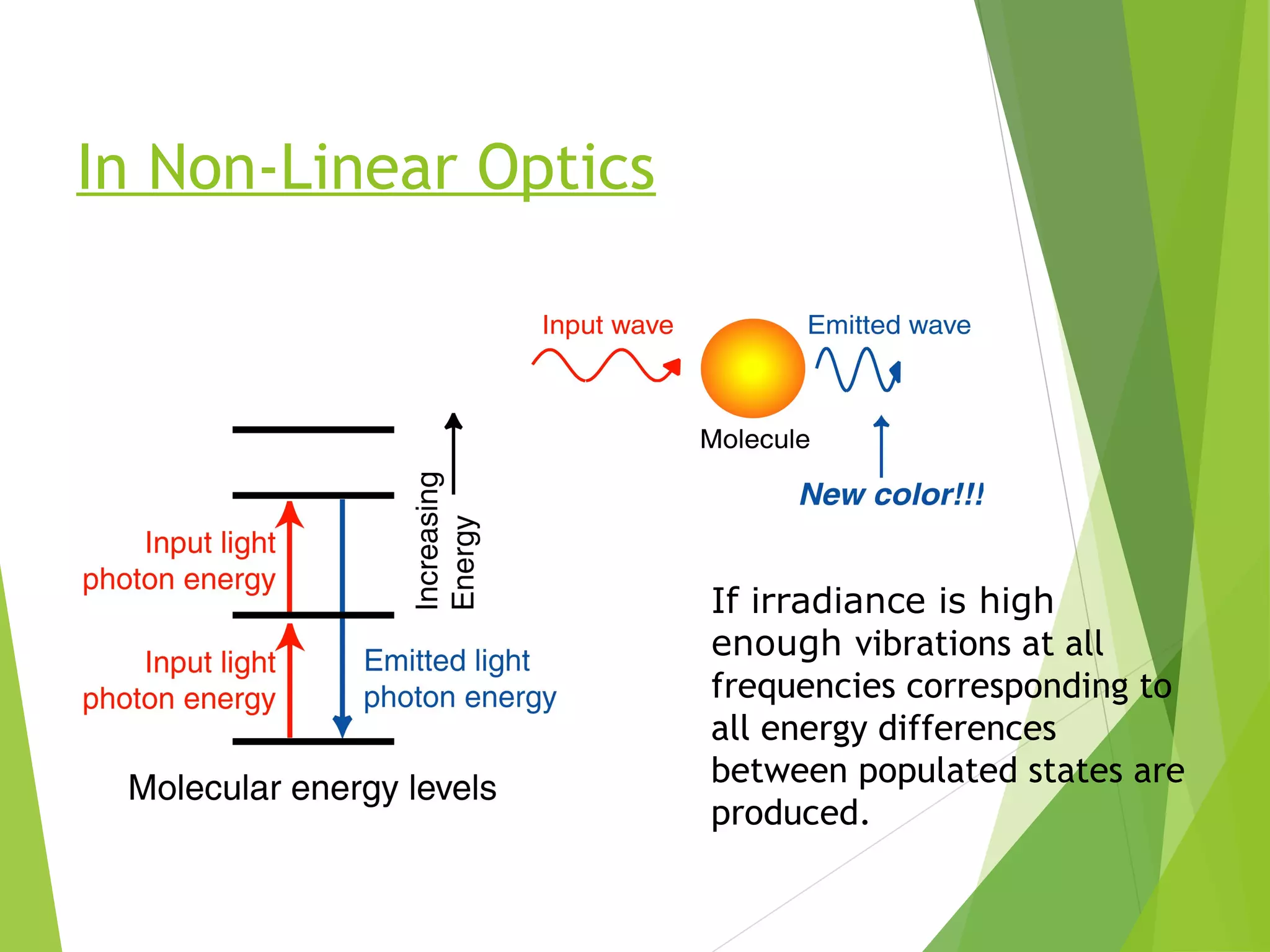
In Non-Linear Optics
If irradiance is high
enough vibrations at all
frequencies corresponding to
all energy differences
between populated states are
produced.
Introduction
 Nonlinear Optics: Study of interaction of
light in matter
 We can control “n” by the light itself or
manipulate one beam with the other.
 Leads to a Great variety of technical
innovations.
Importance of ‘NLO’
 Optical wave manipulation is one of
the future technologies for optical
processing.
 It has various applications in fiber-
optic communications and
optoelectronics which makes it an
increasingly important topic among
electrical engineers.
Nonlinear polarization
 Linear medium: low field intensity
 Nonlinear medium: high field intensity
PED += 0ε EED r 0εεε =⋅=
Linear polarization
PED += 0ε
Nonlinear polarization
EP ⋅= χε0
NLL PPEEEP +=+⋅+⋅+⋅= ...3)3(2)2(
0 χχχε
NLLlkjijklkjijkjiji PPEEEEEDEP +=++⋅+⋅= ...420 χχε
Linear
susceptibility
tensor
2nd order
nonlinear
susceptibility
tensor
3rd order
nonlinear
susceptibility
tensor
Summation over
repeated indices
χε +=1r
i, j, k = x, y, z
Sum frequency generation (SFG)
Difference frequency generation
(DFG)
 2nd order optical nonlinearity
 Start with two beams ω = ω1
and ω = ω2
 SFG: ω3 = ω1 + ω2 , k3 = k1 + k2
 DFG: ω3 = ω1 - ω2 , k3 = k1 - k2
 SFG/DFG for photodetection
 Use a 1060 nm laser to convert 10
μm mid-infrared radiation to 960
nm near-infrared radiation that
can be handled by low-cost
detectors
Sum frequency Pump laser
Laser emissionSHG
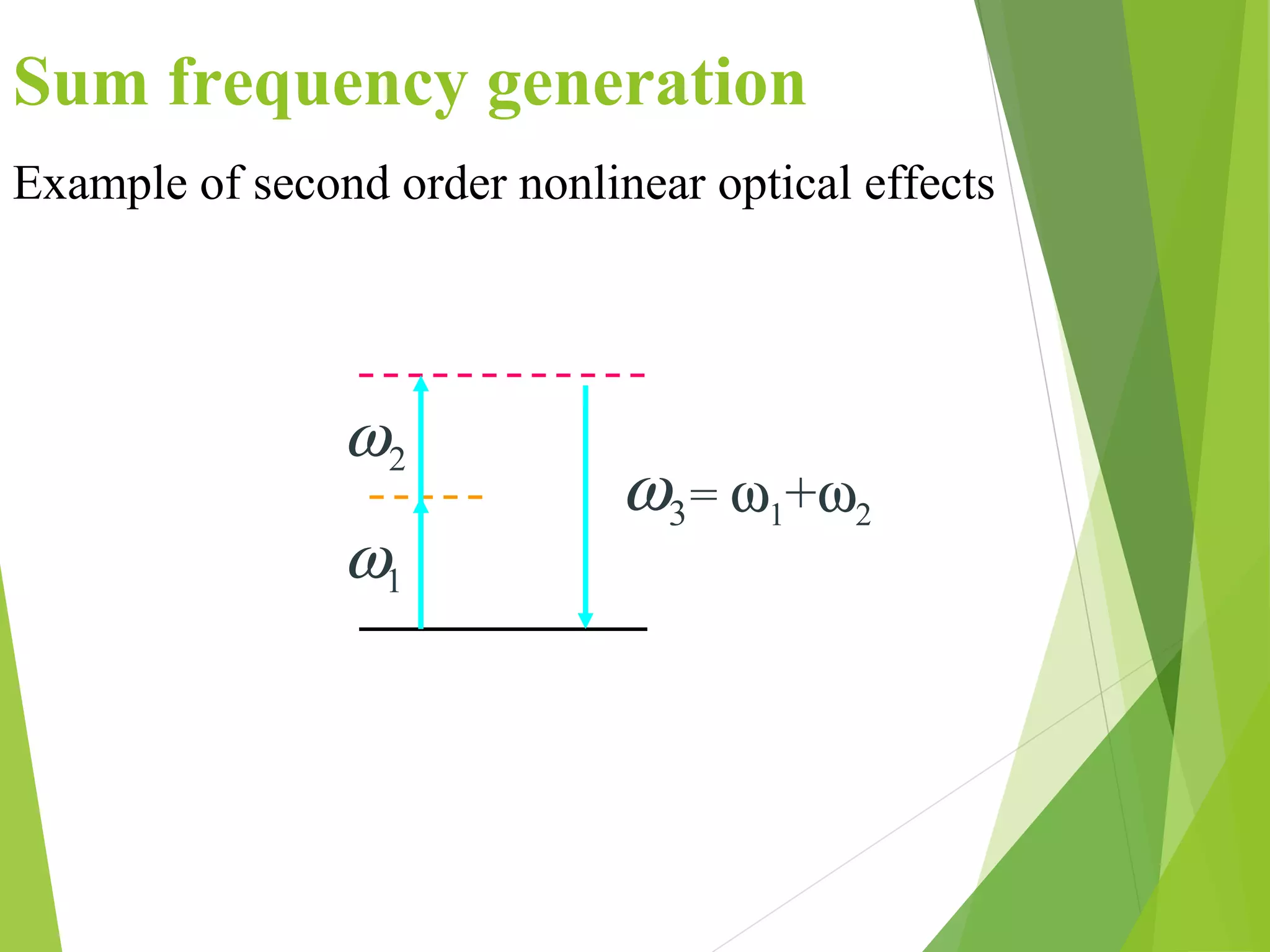
Sum frequency generation
Example of second order nonlinear optical effects
1ω
3ω
2ω
= ω1+ω2
Second harmonic generation
(also called frequency doubling
or abbreviated SHG)
is a nonlinear optical process, in which photons with the same
frequency interacting with a nonlinear material are
effectively "combined" to generate new photons with twice
the energy, and therefore twice the frequency and half the
wavelength of the initial photons. Second harmonic
generation, as an even-order nonlinear optical effect, is only
allowed in media without inversion symmetry. It is a special
case of sum frequency generation and is the inverse of half-
harmonic generation.
∑=
γβ
γβαβγα ωωωωωχω
,
)2(
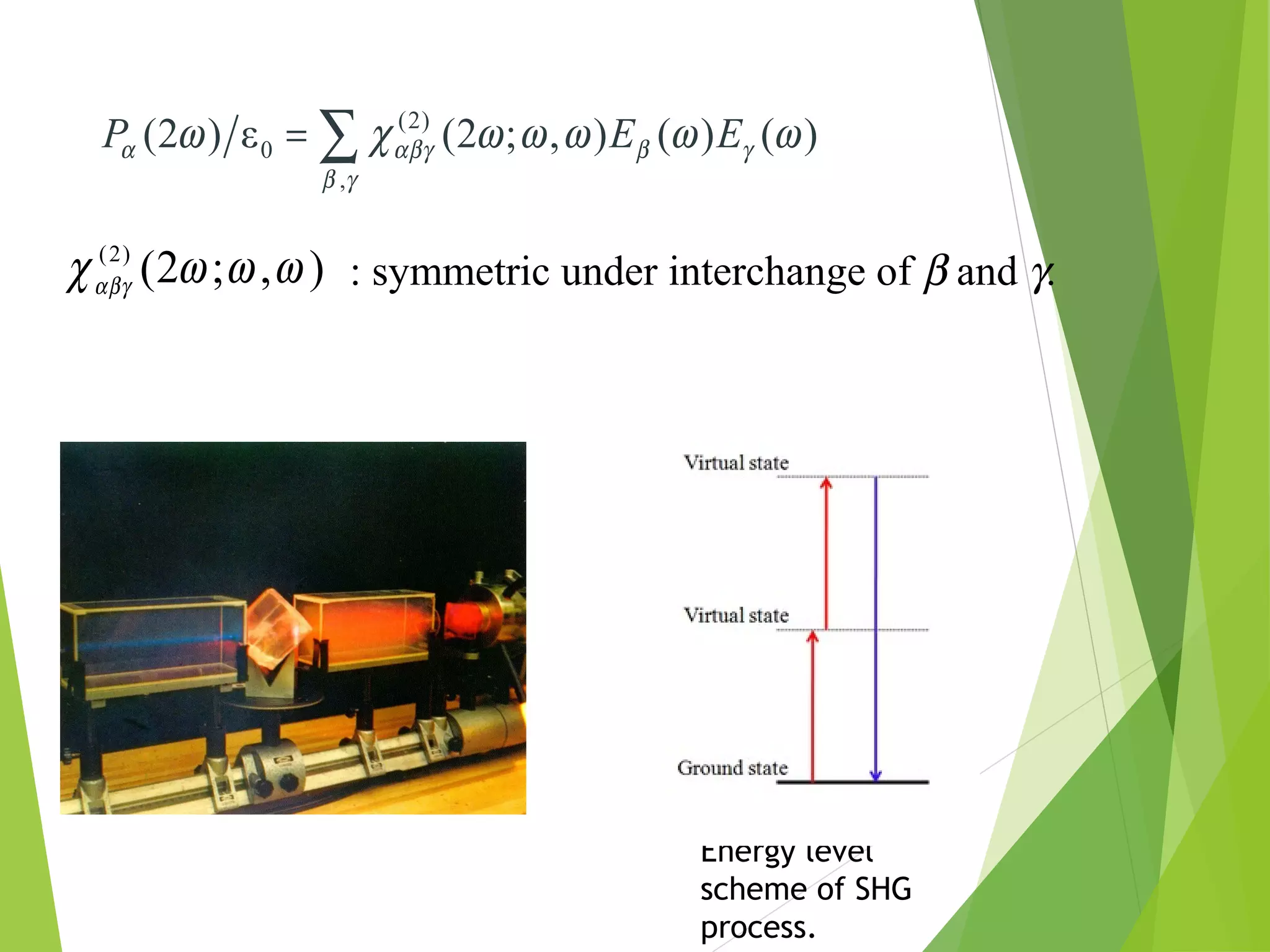
0 )()(),;2(ε)2( EEP
),;2()2(
ωωωχαβγ : symmetric under interchange of β and γ.
Energy level
scheme of SHG
process.
Common SHG materials
 800 nm: BBO
 806 nm: lithium iodate (LiIO3)
 860 nm: potassium niobate (KNbO3)
 980 nm: KNbO3
 1064 nm: monopotassium phosphate (KH2PO4, KDP),
lithium triborate (LBO) and β-barium borate (BBO)
 1300 nm: gallium selenide (GaSe)
 1319 nm: KNbO3, BBO, KDP, potassium titanyl
phosphate (KTP), lithium niobate (LiNbO3), LiIO3, and
ammonium dihydrogen phosphate (ADP)
 1550 nm: potassium titanyl phosphate (KTP), lithium
niobate (LiNbO3)
SHG Analysis
 The Second harmonic generation efficiency of TMPP was
examined by Kurtz and Perry powder technique. A Q-
switched mode locked Nd: YAG laser of wavelength
1064 nm with a pulse width of 8 ns and a repetition rate
of 10 Hz was allowed to pass through the powdered
sample which is kept in a capillary tube. The emission
of green light with a wavelength of 532 nm confirms the
second harmonic generation efficiency of TMPP. A
second harmonic out signal of 64 mV was obtained for
an input beam of energy 2.149 mJ /pulse. For the same
incident radiation the output signal was observed as 79
mV for KDP. Hence it is found that the SHG efficiency of
TMPP crystal is 0.8 times that of standard potassium
dihydrogen phosphate (KDP). From this it is evident that
the TMPP is a good NLO crystal
High harmonic generation
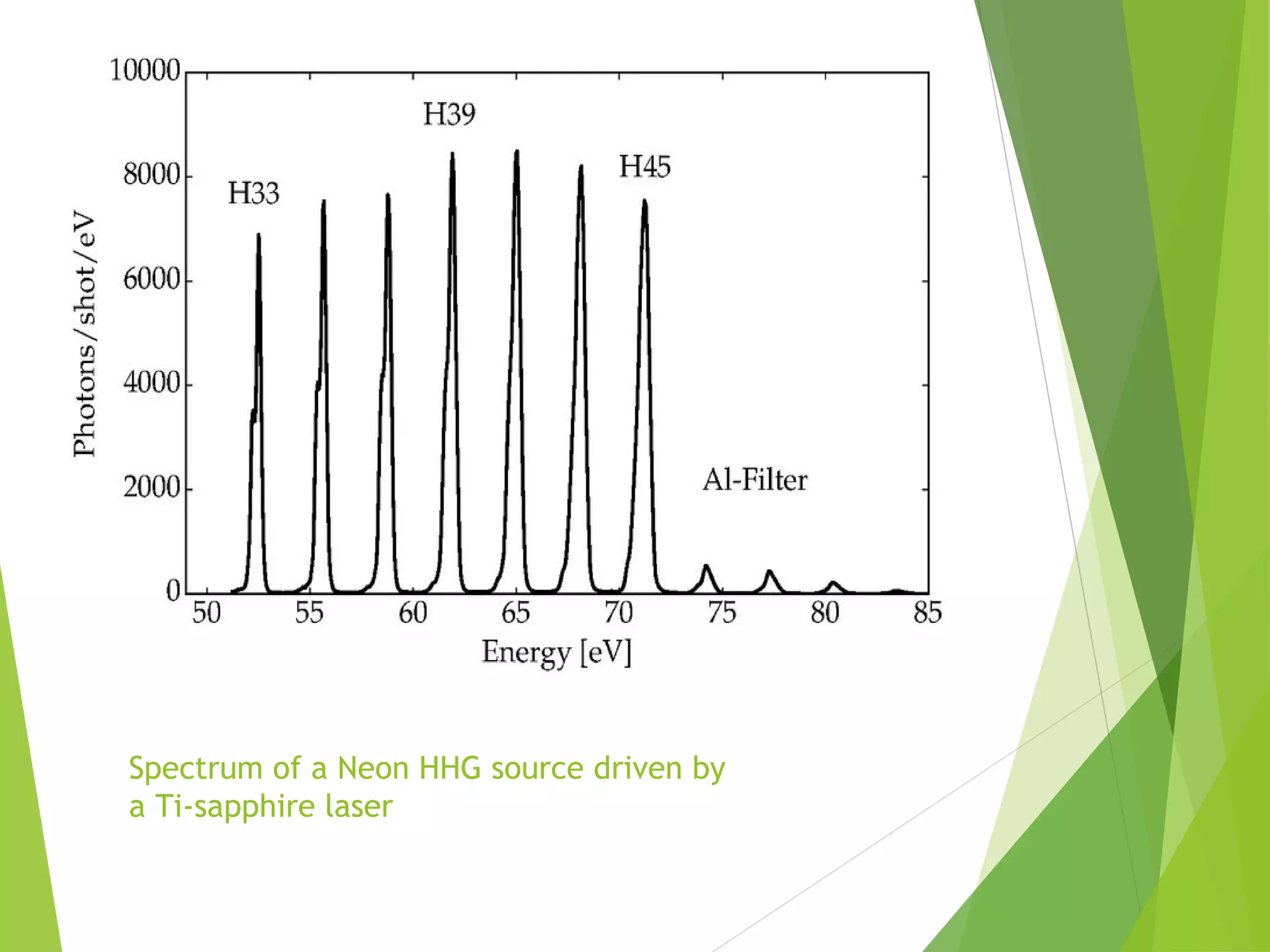
Spectrum of a Neon HHG source driven by a Ti-sapphire
laser.
High harmonic generation (HHG) is a non-linear process
during which a target (gas, plasma or solid sample) is
illuminated by an intense laser pulse. Under such
conditions, the sample will emit the high harmonics of the
generation beam (above the fifth harmonics). Due to the
coherent nature of the process, high harmonics generation
is a prerequisite of atto physics.
Spectrum of a Neon HHG source driven by
a Ti-sapphire laser
Properties
High harmonics have a number of interesting
properties. They are a tunable table-top source of
XUV/Soft X-rays, synchronized with the driving laser
and produced with the same repetition rate. The
harmonic cut-off varies linearly with increasing laser
intensity up until the saturation intensity Isat where
harmonic generation stops . The saturation intensity
can be increased by changing the atomic species to
lighter noble gases but these have a lower conversion
efficiency so there is a balance to be found depending
on the photon energies required.
High harmonic generation strongly depends on the driving
laser field and as a result the harmonics have similar
temporal and spatial coherence properties . High harmonics
are often generated with pulse durations shorter than that of
the driving laser. This is due to the nonlinearity of the
generation process, phase matching and ionization. Often
harmonics are only produced in a very small temporal
window when the phase matching condition is met. Depletion
of the generating media due to ionization also means that
harmonic generation is mainly confined to the leading edge
of the driving pulse.
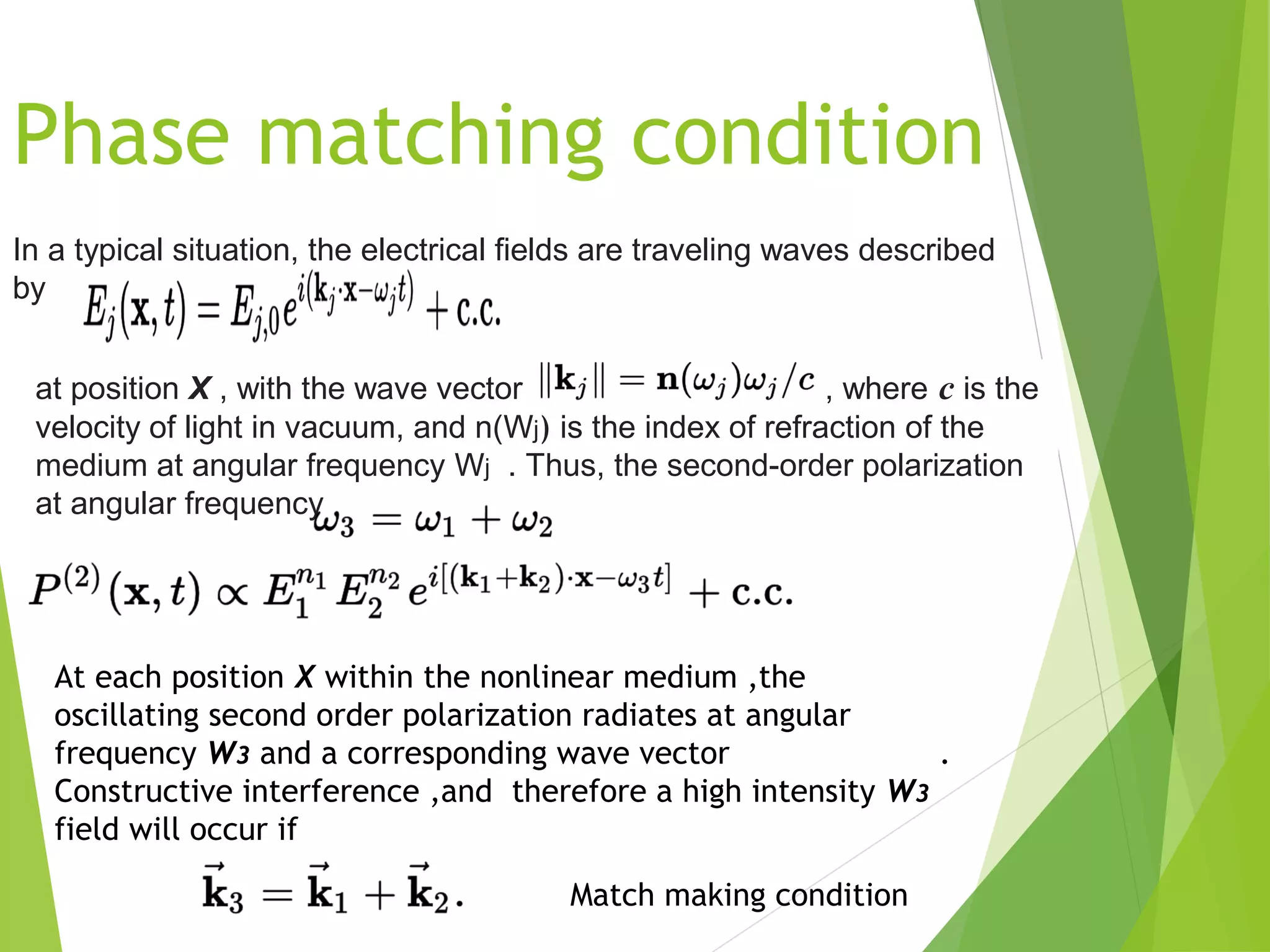
In a typical situation, the electrical fields are traveling waves described
by
at position X , with the wave vector  , where c is the
velocity of light in vacuum, and n(Wj) is the index of refraction of the
medium at angular frequency Wj . Thus, the second-order polarization
at angular frequency 
At each position X within the nonlinear medium ,the
oscillating second order polarization radiates at angular
frequency W3 and a corresponding wave vector .
Constructive interference ,and therefore a high intensity W3
field will occur if
Match making condition
Phase matching condition
efficiency
 Only when 2k1 = k2 will SHG be efficient
 n(λ1) = n(λ2)
 General rule for parametric processes
 SHG, SFG/DFG, THG, FWM
 momentum conservation
2k1 = k2
2k1 ≠ k2
~ 100% SHG conversion
efficiency is possible by
optimizing phase matching!
OPTICAL MIXING
 The generation of new frequencies with help of nonlinear phenomena is called
optical mixing. Suppose two coherent waves of unequal frequencies, ω1 and ω2
are traversing the material, then
 E = E1 cos ω1 t + E2 cos ω2 t
 Hence
 The second term gives rise to 2ω2. The last term can be expressed as
 2ε0 χ2 E1 E2 cos ω1t = ε0 χ2 E1 E2 [cos (ω1 + ω2) t + cos (ω1 – ω2) t]
 Thus waves of frequencies ω1, 2ω1, ω2, 2ω2, (ω1+ω2) and (ω1–ω2) are
generated. Using proper optical arrangement it is possible to get sufficiently
intense output at any one of these frequencies.
The generation of (ω1+ ω2) is called frequency-up conversion and
(ω1–ω2) is called frequency-down conversion Crystals like KDP,
ADP are used for up conversion while LiNbO3, quartz are used for
down conversion.
-- Arrangement for generating a new frequency by
optical mixing
Applications:
 Optical phase conjugation
 Optical parametric oscillators
 Optical computing
 Optical switching
 Optical data storage
Thank You
Presented By,
Sahil Rao
ASAS

Non linear optics and SHG

  • 1.
  • 2.
    Linear Optics vsNon Linear Optics  Linear optics- ‘Optics of weak light’: Light is deflected or delayed but its frequency is unchanged.  Non-Linear optics-‘Optics of intense light’: We are concerned with the effects that light itself induces as it propagates through the medium.
  • 3.
    Non-Linear optics producesmany exotic events •Nonlinear optics allows us to change the color of a light beam, to change its shape in space and time, to switch telecommunica- tions systems, and to create the shortest events ever made by Man Ex: Sending infrared light into a crystal yielded this display of green light
  • 4.
    In Non-Linear Optics Ifirradiance is high enough vibrations at all frequencies corresponding to all energy differences between populated states are produced.
  • 5.
    Introduction  Nonlinear Optics:Study of interaction of light in matter  We can control “n” by the light itself or manipulate one beam with the other.  Leads to a Great variety of technical innovations.
  • 6.
    Importance of ‘NLO’ Optical wave manipulation is one of the future technologies for optical processing.  It has various applications in fiber- optic communications and optoelectronics which makes it an increasingly important topic among electrical engineers.
  • 7.
    Nonlinear polarization  Linearmedium: low field intensity  Nonlinear medium: high field intensity PED += 0ε EED r 0εεε =⋅= Linear polarization PED += 0ε Nonlinear polarization EP ⋅= χε0 NLL PPEEEP +=+⋅+⋅+⋅= ...3)3(2)2( 0 χχχε NLLlkjijklkjijkjiji PPEEEEEDEP +=++⋅+⋅= ...420 χχε Linear susceptibility tensor 2nd order nonlinear susceptibility tensor 3rd order nonlinear susceptibility tensor Summation over repeated indices χε +=1r i, j, k = x, y, z
  • 8.
    Sum frequency generation(SFG) Difference frequency generation (DFG)  2nd order optical nonlinearity  Start with two beams ω = ω1 and ω = ω2  SFG: ω3 = ω1 + ω2 , k3 = k1 + k2  DFG: ω3 = ω1 - ω2 , k3 = k1 - k2  SFG/DFG for photodetection  Use a 1060 nm laser to convert 10 μm mid-infrared radiation to 960 nm near-infrared radiation that can be handled by low-cost detectors Sum frequency Pump laser Laser emissionSHG
  • 9.
    Sum frequency generation Exampleof second order nonlinear optical effects 1ω 3ω 2ω = ω1+ω2
  • 10.
    Second harmonic generation (alsocalled frequency doubling or abbreviated SHG) is a nonlinear optical process, in which photons with the same frequency interacting with a nonlinear material are effectively "combined" to generate new photons with twice the energy, and therefore twice the frequency and half the wavelength of the initial photons. Second harmonic generation, as an even-order nonlinear optical effect, is only allowed in media without inversion symmetry. It is a special case of sum frequency generation and is the inverse of half- harmonic generation.
  • 11.
    ∑= γβ γβαβγα ωωωωωχω , )2( 0 )()(),;2(ε)2(EEP ),;2()2( ωωωχαβγ : symmetric under interchange of β and γ. Energy level scheme of SHG process.
  • 12.
    Common SHG materials 800 nm: BBO  806 nm: lithium iodate (LiIO3)  860 nm: potassium niobate (KNbO3)  980 nm: KNbO3  1064 nm: monopotassium phosphate (KH2PO4, KDP), lithium triborate (LBO) and β-barium borate (BBO)  1300 nm: gallium selenide (GaSe)  1319 nm: KNbO3, BBO, KDP, potassium titanyl phosphate (KTP), lithium niobate (LiNbO3), LiIO3, and ammonium dihydrogen phosphate (ADP)  1550 nm: potassium titanyl phosphate (KTP), lithium niobate (LiNbO3)
  • 13.
    SHG Analysis  TheSecond harmonic generation efficiency of TMPP was examined by Kurtz and Perry powder technique. A Q- switched mode locked Nd: YAG laser of wavelength 1064 nm with a pulse width of 8 ns and a repetition rate of 10 Hz was allowed to pass through the powdered sample which is kept in a capillary tube. The emission of green light with a wavelength of 532 nm confirms the second harmonic generation efficiency of TMPP. A second harmonic out signal of 64 mV was obtained for an input beam of energy 2.149 mJ /pulse. For the same incident radiation the output signal was observed as 79 mV for KDP. Hence it is found that the SHG efficiency of TMPP crystal is 0.8 times that of standard potassium dihydrogen phosphate (KDP). From this it is evident that the TMPP is a good NLO crystal
  • 14.
    High harmonic generation Spectrumof a Neon HHG source driven by a Ti-sapphire laser. High harmonic generation (HHG) is a non-linear process during which a target (gas, plasma or solid sample) is illuminated by an intense laser pulse. Under such conditions, the sample will emit the high harmonics of the generation beam (above the fifth harmonics). Due to the coherent nature of the process, high harmonics generation is a prerequisite of atto physics.
  • 15.
    Spectrum of aNeon HHG source driven by a Ti-sapphire laser
  • 16.
    Properties High harmonics havea number of interesting properties. They are a tunable table-top source of XUV/Soft X-rays, synchronized with the driving laser and produced with the same repetition rate. The harmonic cut-off varies linearly with increasing laser intensity up until the saturation intensity Isat where harmonic generation stops . The saturation intensity can be increased by changing the atomic species to lighter noble gases but these have a lower conversion efficiency so there is a balance to be found depending on the photon energies required.
  • 17.
    High harmonic generationstrongly depends on the driving laser field and as a result the harmonics have similar temporal and spatial coherence properties . High harmonics are often generated with pulse durations shorter than that of the driving laser. This is due to the nonlinearity of the generation process, phase matching and ionization. Often harmonics are only produced in a very small temporal window when the phase matching condition is met. Depletion of the generating media due to ionization also means that harmonic generation is mainly confined to the leading edge of the driving pulse.
  • 18.
    In a typicalsituation, the electrical fields are traveling waves described by at position X , with the wave vector  , where c is the velocity of light in vacuum, and n(Wj) is the index of refraction of the medium at angular frequency Wj . Thus, the second-order polarization at angular frequency  At each position X within the nonlinear medium ,the oscillating second order polarization radiates at angular frequency W3 and a corresponding wave vector . Constructive interference ,and therefore a high intensity W3 field will occur if Match making condition Phase matching condition
  • 19.
    efficiency  Only when2k1 = k2 will SHG be efficient  n(λ1) = n(λ2)  General rule for parametric processes  SHG, SFG/DFG, THG, FWM  momentum conservation 2k1 = k2 2k1 ≠ k2 ~ 100% SHG conversion efficiency is possible by optimizing phase matching!
  • 20.
    OPTICAL MIXING  Thegeneration of new frequencies with help of nonlinear phenomena is called optical mixing. Suppose two coherent waves of unequal frequencies, ω1 and ω2 are traversing the material, then  E = E1 cos ω1 t + E2 cos ω2 t  Hence  The second term gives rise to 2ω2. The last term can be expressed as  2ε0 χ2 E1 E2 cos ω1t = ε0 χ2 E1 E2 [cos (ω1 + ω2) t + cos (ω1 – ω2) t]  Thus waves of frequencies ω1, 2ω1, ω2, 2ω2, (ω1+ω2) and (ω1–ω2) are generated. Using proper optical arrangement it is possible to get sufficiently intense output at any one of these frequencies.
  • 21.
    The generation of(ω1+ ω2) is called frequency-up conversion and (ω1–ω2) is called frequency-down conversion Crystals like KDP, ADP are used for up conversion while LiNbO3, quartz are used for down conversion. -- Arrangement for generating a new frequency by optical mixing
  • 22.
    Applications:  Optical phaseconjugation  Optical parametric oscillators  Optical computing  Optical switching  Optical data storage
  • 23.