Seminar On
Power System
Contingencies
Power System


Power System voltage control has a hierarchy structure with three
levels: the primary, secondary, and the tertiary voltage control.
Over the past 20 yrs, one of the most successful measures
proposed to improve Power System voltage regulation has been
the application of secondary voltage control, initiated by the
French Electricity Company.
Important Of Features
Power System











Flickers
Harmonics
Interruption
Long Lines
Long Cables
Loop Flow
Reactive Power
Sags & Swells
Unbalanced Load
Voltage Instability
Flickers
A

fluctuation in system voltage that can
lead to noticeable changes in light
output.

 Voltage

Flicker can either be a periodic
or non-periodic fluctuation in voltage
magnitude i.e. the fluctuation may
occur continuously at regular intervals
or only on occasions.
How To Reduce Flickers


Installation of a MiniCap to reduce flicker during large motor
starting .



Minicap is nothing but the Installation of
the feeder strengthens the network .

a series capacitor in
Benefits
•Reduced voltage fluctuations (flicker)
•Improved voltage profile along the line
•Easier starting of large motors
•Self-regulation
Harmonics


Harmonics are associated with steady-state
waveform distortion of currents and voltages.



Harmonics are components that make up a
waveform where each component has a
frequency that is an integral multiple of the
fundamental frequency. The term Harmonic is
normally applied to waveform components that
have frequencies other than the fundamental
frequency. For a 50 Hz or 60Hz system the
fundamental frequency is 50HZ or 60Hz. A
waveform that contains any components other
than the fundamental frequency is nonsinusoidal and considered to be distorted.
How To Reduce Harmonics

 Installing

filters near the harmonic
sources can effectively reduce
harmonics.
Benefits


Eliminates harmonics.



Improved Power Factor.



Reduced Transmission Losses.



Increased Transmission Capability.



Improved Voltage Control.



Improved Power Quality.
Interruptions
•

Occur when the supply voltage drops below 10% of the nominal
value.



An interruption is usually caused by downstream faults that are
cleared by breakers or fuses. A sustained interruption is caused
by upstream breaker or fuse operation. Upstream breakers may
operate due to short-circuits, overloads, and loss of stability on
the bulk power system.
Long Lines


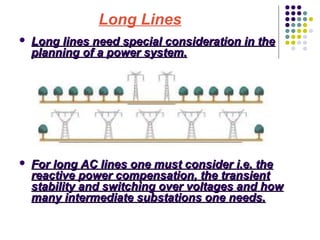
Long lines need special consideration in the
planning of a power system.



For long AC lines one must consider i.e. the
reactive power compensation, the transient
stability and switching over voltages and how
many intermediate substations one needs.
Area of application:-Expressway
for power


A HVDC transmission line costs less than
an AC line for the same transmission
capacity.
Benefits


Lower investment cost



Lower losses



Lower right-of-way requirement for DC lines than for AC lines



HVDC does not contribute to the short circuit current
Long cables


Basically Long cables are of two types



Submarine Cables



Under Ground Cables
Submarine Cables
Application


Submarine Cables are used for long distance water crossing.
Benefits


Lower investment cost



Lower losses
Loop flow
•

Unscheduled power flow on a given transmission path in an
interconnected electrical system.

•

Unscheduled power flows on transmission lines or facilities may
result in a violation of reliability criteria and decrease available
transfer capability between neighbouring control areas or utility
systems.
Area of application:
Interconnected power systems

Benefits


HVDC can be controlled to transmit contracted
amounts of power and alleviate unwanted loop
flows.



An HVDC link can alternatively be controlled to
minimize total network losses



An HVDC link can never be overloaded
Reactive Power Factor
•

Reactive power is defined as the product of the r.m.s. voltage,
current, and the sine of the difference in phase angle between the
two.

•

To maintain efficient transmission and distribution, it is necessary
to improve the reactive power factor.
How to Improve power factor
•

The use of the MiniCap on a distribution
feeder provides self-regulated reactive power
for improved power factor at the utility
source.
Benefits


Increased power factor at the utility source.



Easier starting of large motors .



Improved voltage regulation and reactive power
balance.



Self-regulation Improved power factor, Reduced
transmission losses, Increased transmission
capability.



Improved voltage control, Improved power quality,
Eliminates harmonics S.
Sags & Swells


Short duration decrease/increase (sag/swell) in
supply voltage.



Voltage sags are one of the most commonly
occurring power quality problems. They are
usually generated inside a facility but may also
be a result of a momentary voltage drop in the
distribution supply.



Electronic equipment is usually the main victim
of sags, as they do not contain sufficient internal
energy to ‘ride through’ the disturbance.
Voltage Instability
•

Post-disturbance excursions of voltages at some buses in the
power system out of the steady operation region.

•

Voltage instability is basically caused by an unavailability of
reactive power support in an area of the network, where the
voltage drops uncontrollably.
Unbalanced Load
•

A load which does not draw balanced current from a balanced
three-phases supply.



A single-phase load, since it does not draw a balanced threephase current, will create unequal voltage drops across the
series impedances of the delivery system.
Area of application:-Railway
Feeder connected to the Public
Grid
Modern electric rail system is a major source
of unbalanced loads.
 STATCOM can elegantly be used to restore
voltage and current balance in the grid, and
to mitigate voltage fluctuations generated by
the traction loads.

Benefits


Voltage Balancing



Harmonic Filtering



Power Factor Correction
Other applications:



Power Quality Improvement, Flicker Mitigation



Grid Voltage Support
Summary


The new electricity supply industry presents increasing
challenges for stable and secure operation of power systems.



State-of-the-art methods and tools have advanced our
capabilities significantly facing the challenges

comprehensive stability analysis tools



coordinated design of robust stability controls



on-line dynamic security assessment

Industry yet to take full advantage of these developments!


Need to review and improve


The reliability criteria.
Thank You …..!

Power system contingencies

  • 1.
  • 2.
    Power System  Power Systemvoltage control has a hierarchy structure with three levels: the primary, secondary, and the tertiary voltage control. Over the past 20 yrs, one of the most successful measures proposed to improve Power System voltage regulation has been the application of secondary voltage control, initiated by the French Electricity Company.
  • 3.
    Important Of Features PowerSystem           Flickers Harmonics Interruption Long Lines Long Cables Loop Flow Reactive Power Sags & Swells Unbalanced Load Voltage Instability
  • 4.
    Flickers A fluctuation in systemvoltage that can lead to noticeable changes in light output.  Voltage Flicker can either be a periodic or non-periodic fluctuation in voltage magnitude i.e. the fluctuation may occur continuously at regular intervals or only on occasions.
  • 5.
    How To ReduceFlickers  Installation of a MiniCap to reduce flicker during large motor starting .  Minicap is nothing but the Installation of the feeder strengthens the network . a series capacitor in
  • 6.
    Benefits •Reduced voltage fluctuations(flicker) •Improved voltage profile along the line •Easier starting of large motors •Self-regulation
  • 7.
    Harmonics  Harmonics are associatedwith steady-state waveform distortion of currents and voltages.  Harmonics are components that make up a waveform where each component has a frequency that is an integral multiple of the fundamental frequency. The term Harmonic is normally applied to waveform components that have frequencies other than the fundamental frequency. For a 50 Hz or 60Hz system the fundamental frequency is 50HZ or 60Hz. A waveform that contains any components other than the fundamental frequency is nonsinusoidal and considered to be distorted.
  • 9.
    How To ReduceHarmonics  Installing filters near the harmonic sources can effectively reduce harmonics.
  • 10.
    Benefits  Eliminates harmonics.  Improved PowerFactor.  Reduced Transmission Losses.  Increased Transmission Capability.  Improved Voltage Control.  Improved Power Quality.
  • 11.
    Interruptions • Occur when thesupply voltage drops below 10% of the nominal value.  An interruption is usually caused by downstream faults that are cleared by breakers or fuses. A sustained interruption is caused by upstream breaker or fuse operation. Upstream breakers may operate due to short-circuits, overloads, and loss of stability on the bulk power system.
  • 12.
    Long Lines  Long linesneed special consideration in the planning of a power system.  For long AC lines one must consider i.e. the reactive power compensation, the transient stability and switching over voltages and how many intermediate substations one needs.
  • 13.
    Area of application:-Expressway forpower  A HVDC transmission line costs less than an AC line for the same transmission capacity.
  • 14.
    Benefits  Lower investment cost  Lowerlosses  Lower right-of-way requirement for DC lines than for AC lines  HVDC does not contribute to the short circuit current
  • 15.
    Long cables  Basically Longcables are of two types  Submarine Cables  Under Ground Cables
  • 16.
    Submarine Cables Application  Submarine Cablesare used for long distance water crossing.
  • 17.
  • 18.
    Loop flow • Unscheduled powerflow on a given transmission path in an interconnected electrical system. • Unscheduled power flows on transmission lines or facilities may result in a violation of reliability criteria and decrease available transfer capability between neighbouring control areas or utility systems.
  • 19.
    Area of application: Interconnectedpower systems Benefits  HVDC can be controlled to transmit contracted amounts of power and alleviate unwanted loop flows.  An HVDC link can alternatively be controlled to minimize total network losses  An HVDC link can never be overloaded
  • 20.
    Reactive Power Factor • Reactivepower is defined as the product of the r.m.s. voltage, current, and the sine of the difference in phase angle between the two. • To maintain efficient transmission and distribution, it is necessary to improve the reactive power factor.
  • 22.
    How to Improvepower factor • The use of the MiniCap on a distribution feeder provides self-regulated reactive power for improved power factor at the utility source.
  • 23.
    Benefits  Increased power factorat the utility source.  Easier starting of large motors .  Improved voltage regulation and reactive power balance.  Self-regulation Improved power factor, Reduced transmission losses, Increased transmission capability.  Improved voltage control, Improved power quality, Eliminates harmonics S.
  • 24.
    Sags & Swells  Shortduration decrease/increase (sag/swell) in supply voltage.  Voltage sags are one of the most commonly occurring power quality problems. They are usually generated inside a facility but may also be a result of a momentary voltage drop in the distribution supply.  Electronic equipment is usually the main victim of sags, as they do not contain sufficient internal energy to ‘ride through’ the disturbance.
  • 25.
    Voltage Instability • Post-disturbance excursionsof voltages at some buses in the power system out of the steady operation region. • Voltage instability is basically caused by an unavailability of reactive power support in an area of the network, where the voltage drops uncontrollably.
  • 26.
    Unbalanced Load • A loadwhich does not draw balanced current from a balanced three-phases supply.  A single-phase load, since it does not draw a balanced threephase current, will create unequal voltage drops across the series impedances of the delivery system.
  • 28.
    Area of application:-Railway Feederconnected to the Public Grid Modern electric rail system is a major source of unbalanced loads.  STATCOM can elegantly be used to restore voltage and current balance in the grid, and to mitigate voltage fluctuations generated by the traction loads. 
  • 29.
    Benefits  Voltage Balancing  Harmonic Filtering  PowerFactor Correction Other applications:  Power Quality Improvement, Flicker Mitigation  Grid Voltage Support
  • 30.
    Summary  The new electricitysupply industry presents increasing challenges for stable and secure operation of power systems.  State-of-the-art methods and tools have advanced our capabilities significantly facing the challenges comprehensive stability analysis tools  coordinated design of robust stability controls  on-line dynamic security assessment Industry yet to take full advantage of these developments!  Need to review and improve  The reliability criteria.
  • 31.