Obj. 32 Compositions
The student is able to (I can):
• Draw and identify compositions of transformations
composition of
Performing two or more transformations
transformations sequentially (one after another) to a
figure.
An example that we have already seen of
a composition is a glide reflection: we
reflect the figure and then translate it
along a vector.
To describe a composite transformation
using notation, state each of the
transformations that make up the
composite transformation and link them
with the symbol . The transformations are
performed in order from right to left
left.
Example: To perform the transformation
T2,4 R 90° rx −axis
rx-axis — Reflect across the x-axis
R90° — Rotate 90° counterclockwise
T2, 4 — Translate along the vector 〈2, 4〉
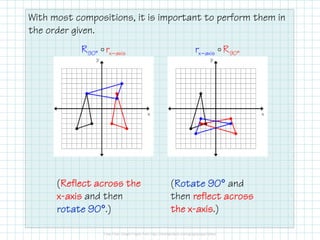
With most compositions, it is important to perform them in
the order given.

R 90° rx −axis

(Reflect across the
Reflect
x-axis and then
90°
rotate 90°.)

rx −axis R 90°

(Rotate 90° and
Rotate 90°
then reflect across
x-axis.)
the x-axis
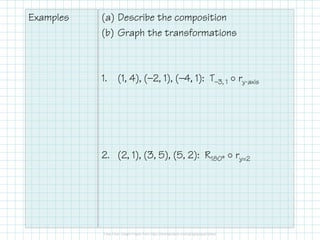
Examples

(a) Describe the composition
(b) Graph the transformations

1. (1, 4), (—2, 1), (—4, 1): T—3, 1

ry-axis

2. (2, 1), (3, 5), (5, 2): R180°

ry=2
Examples

(a) Describe the composition
(b) Graph the transformations

1. (1, 4), (—2, 1), (—4, 1): T—3, 1

ry-axis

a) Reflect across the y-axis and
translate along the vector 〈—3, 1〉
b)
Examples

(a) Describe the composition
(b) Graph the transformations

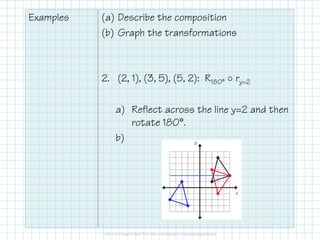
2. (2, 1), (3, 5), (5, 2): R180°

ry=2

a) Reflect across the line y=2 and then
rotate 180°.
b)

Obj. 32 Compositions of Transformations

  • 1.
    Obj. 32 Compositions Thestudent is able to (I can): • Draw and identify compositions of transformations
  • 2.
    composition of Performing twoor more transformations transformations sequentially (one after another) to a figure. An example that we have already seen of a composition is a glide reflection: we reflect the figure and then translate it along a vector.
  • 3.
    To describe acomposite transformation using notation, state each of the transformations that make up the composite transformation and link them with the symbol . The transformations are performed in order from right to left left. Example: To perform the transformation T2,4 R 90° rx −axis rx-axis — Reflect across the x-axis R90° — Rotate 90° counterclockwise T2, 4 — Translate along the vector 〈2, 4〉
  • 4.
    With most compositions,it is important to perform them in the order given. R 90° rx −axis (Reflect across the Reflect x-axis and then 90° rotate 90°.) rx −axis R 90° (Rotate 90° and Rotate 90° then reflect across x-axis.) the x-axis
  • 5.
    Examples (a) Describe thecomposition (b) Graph the transformations 1. (1, 4), (—2, 1), (—4, 1): T—3, 1 ry-axis 2. (2, 1), (3, 5), (5, 2): R180° ry=2
  • 6.
    Examples (a) Describe thecomposition (b) Graph the transformations 1. (1, 4), (—2, 1), (—4, 1): T—3, 1 ry-axis a) Reflect across the y-axis and translate along the vector 〈—3, 1〉 b)
  • 7.
    Examples (a) Describe thecomposition (b) Graph the transformations 2. (2, 1), (3, 5), (5, 2): R180° ry=2 a) Reflect across the line y=2 and then rotate 180°. b)