
UUNNIITT 99..44 CCOOMMPPOOSSIITTIIOONN OOFF 
IISSOOMMEETTRRIIEESS
Warm Up 
Determine the coordinates of the image 
of P(4, –7) under each transformation. 
1. a translation 3 units left and 1 unit up 
(1, –6) 
2. a rotation of 90° about the origin 
(7, 4) 
3. a reflection across the y-axis 
(–4, –7)
Objectives 
Apply theorems about isometries. 
Identify and draw compositions of 
transformations, such as glide 
reflections.
Vocabulary 
composition of transformations 
glide reflection
A composition of transformations is one 
transformation followed by another. For 
example, a glide reflection is the composition 
of a translation and a reflection across a line 
parallel to the translation vector.
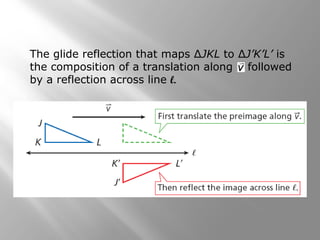
The glide reflection that maps ΔJKL to ΔJ’K’L’ is 
the composition of a translation along followed 
by a reflection across line l.
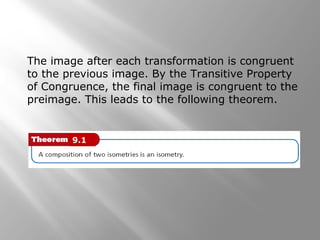
The image after each transformation is congruent 
to the previous image. By the Transitive Property 
of Congruence, the final image is congruent to the 
preimage. This leads to the following theorem. 
9.1
Example 1A: Drawing Compositions of Isometries 
Draw the result of the composition of isometries. 
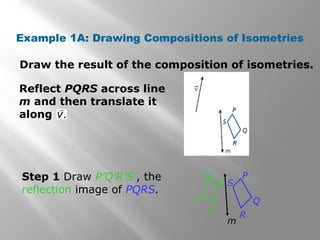
Reflect PQRS across line 
m and then translate it 
along 
Step 1 Draw P’Q’R’S’, the 
reflection image of PQRS. 
P’ 
R’ 
Q’ 
S’ S 
P 
R 
Q 
m
Example 1A Continued 
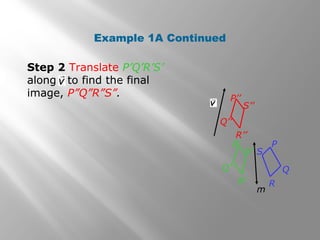
Step 2 Translate P’Q’R’S’ 
along to find the final 
image, P”Q”R”S”. 
P’ 
R’ 
Q’ 
S’ S 
P 
R 
Q 
m 
P’’ 
R’’ 
Q’’ 
S’’
Example 1B: Drawing Compositions of Isometries 
Draw the result of the composition of isometries. 
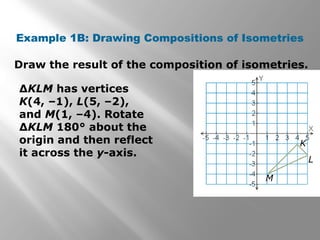
ΔKLM has vertices 
K(4, –1), L(5, –2), 
and M(1, –4). Rotate 
ΔKLM 180° about the 
origin and then reflect 
it across the y-axis. 
K 
L 
M
Example 1B Continued 
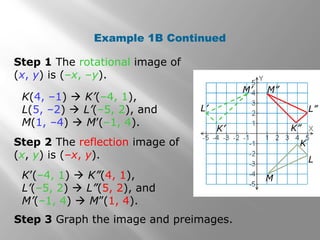
Step 1 The rotational image of 
(x, y) is (–x, –y). 
K(4, –1)  K’(–4, 1), 
L(5, –2)  L’(–5, 2), and 
M(1, –4)  M’(–1, 4). 
Step 2 The reflection image of 
(x, y) is (–x, y). 
K’(–4, 1)  K”(4, 1), 
L’(–5, 2)  L”(5, 2), and 
M’(–1, 4)  M”(1, 4). 
Step 3 Graph the image and preimages. 
L’ L” 
K 
L 
M 
M’ 
K’ 
M” 
K”
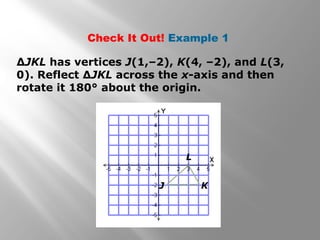
Check It Out! Example 1 
ΔJKL has vertices J(1,–2), K(4, –2), and L(3, 
0). Reflect ΔJKL across the x-axis and then 
rotate it 180° about the origin. 
L 
J K
L 
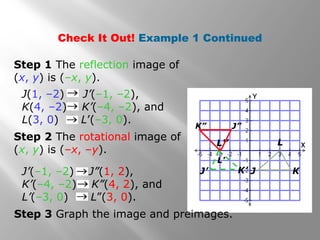
Check It Out! Example 1 Continued 
J K 
K” J” 
L'’ 
L' 
J’ K’ 
Step 1 The reflection image of 
(x, y) is (–x, y). 
J(1, –2) J’(–1, –2), 
K(4, –2) K’(–4, –2), and 
L(3, 0) L’(–3, 0). 
Step 2 The rotational image of 
(x, y) is (–x, –y). 
J’(–1, –2) J”(1, 2), 
K’(–4, –2) K”(4, 2), and 
L’(–3, 0) L”(3, 0). 
Step 3 Graph the image and preimages.
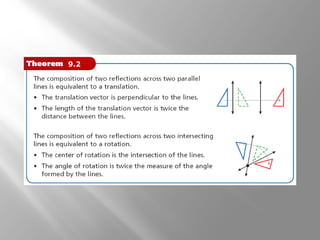
9.2
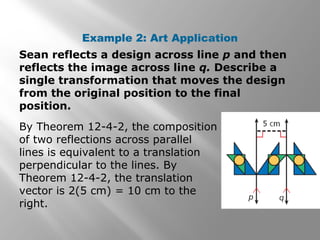
Example 2: Art Application 
Sean reflects a design across line p and then 
reflects the image across line q. Describe a 
single transformation that moves the design 
from the original position to the final 
position. 
By Theorem 12-4-2, the composition 
of two reflections across parallel 
lines is equivalent to a translation 
perpendicular to the lines. By 
Theorem 12-4-2, the translation 
vector is 2(5 cm) = 10 cm to the 
right.
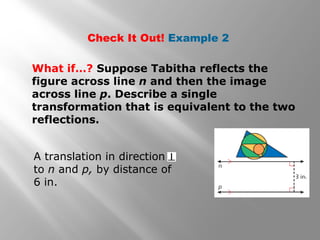
Check It Out! Example 2 
What if…? Suppose Tabitha reflects the 
figure across line n and then the image 
across line p. Describe a single 
transformation that is equivalent to the two 
reflections. 
A translation in direction 
to n and p, by distance of 
6 in.
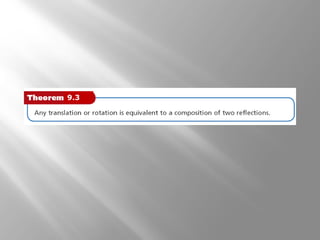
9.3
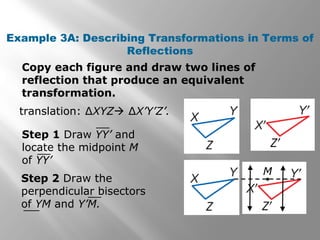
Example 3A: Describing Transformations in Terms of 
Reflections 
Copy each figure and draw two lines of 
reflection that produce an equivalent 
transformation. 
translation: ΔXYZ ΔX’Y’Z’. 
Step 1 Draw YY’ and 
locate the midpoint M 
of YY’ 
Step 2 Draw the 
perpendicular bisectors 
of YM and Y’M. 
M
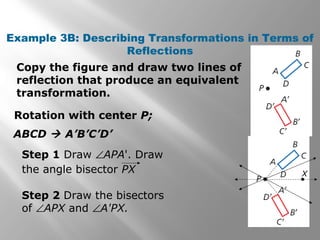
Example 3B: Describing Transformations in Terms of 
Reflections 
Copy the figure and draw two lines of 
reflection that produce an equivalent 
transformation. 
Rotation with center P; 
ABCD  A’B’C’D’ 
Step 1 Draw ÐAPA'. Draw 
the angle bisector PX X 
Step 2 Draw the bisectors 
of ÐAPX and ÐA'PX.
Remember! 
To draw the perpendicular bisector of a segment, 
use a ruler to locate the midpoint, and then use a 
right angle to draw a perpendicular line.
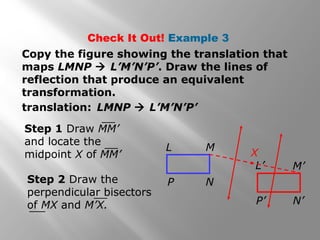
Check It Out! Example 3 
Copy the figure showing the translation that 
maps LMNP  L’M’N’P’. Draw the lines of 
reflection that produce an equivalent 
transformation. 
translation: LMNP  L’M’N’P’ 
Step 1 Draw MM’ 
and locate the 
L M 
midpoint X of MM’ X 
P N 
L’ M’ 
P’ N’ 
 
Step 2 Draw the 
perpendicular bisectors 
of MX and M’X.
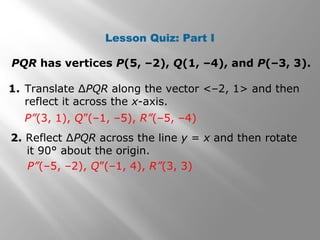
Lesson Quiz: Part I 
PQR has vertices P(5, –2), Q(1, –4), and P(–3, 3). 
1. Translate ΔPQR along the vector <–2, 1> and then 
reflect it across the x-axis. 
P”(3, 1), Q”(–1, –5), R”(–5, –4) 
2. Reflect ΔPQR across the line y = x and then rotate 
it 90° about the origin. 
P”(–5, –2), Q”(–1, 4), R”(3, 3)
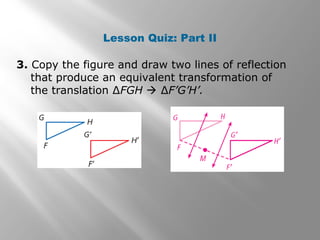
Lesson Quiz: Part II 
3. Copy the figure and draw two lines of reflection 
that produce an equivalent transformation of 
the translation ΔFGH  ΔF’G’H’.
All rights belong to their 
respective owners. 
Copyright Disclaimer Under 
Section 107 of the 
Copyright Act 1976, 
allowance is made for "fair 
use" for purposes such as 
criticism, comment, news 
reporting, TEACHING, 
scholarship, and research. 
Fair use is a use permitted 
by copyright statute that 
might otherwise be 
infringing. 
Non-profit, EDUCATIONAL 
or personal use tips the 
balance in favor of fair use.

Geometry unit 9.4

  • 1.
    UUNNIITT 99..44 CCOOMMPPOOSSIITTIIOONNOOFF IISSOOMMEETTRRIIEESS
  • 2.
    Warm Up Determinethe coordinates of the image of P(4, –7) under each transformation. 1. a translation 3 units left and 1 unit up (1, –6) 2. a rotation of 90° about the origin (7, 4) 3. a reflection across the y-axis (–4, –7)
  • 3.
    Objectives Apply theoremsabout isometries. Identify and draw compositions of transformations, such as glide reflections.
  • 4.
    Vocabulary composition oftransformations glide reflection
  • 5.
    A composition oftransformations is one transformation followed by another. For example, a glide reflection is the composition of a translation and a reflection across a line parallel to the translation vector.
  • 6.
    The glide reflectionthat maps ΔJKL to ΔJ’K’L’ is the composition of a translation along followed by a reflection across line l.
  • 7.
    The image aftereach transformation is congruent to the previous image. By the Transitive Property of Congruence, the final image is congruent to the preimage. This leads to the following theorem. 9.1
  • 8.
    Example 1A: DrawingCompositions of Isometries Draw the result of the composition of isometries. Reflect PQRS across line m and then translate it along Step 1 Draw P’Q’R’S’, the reflection image of PQRS. P’ R’ Q’ S’ S P R Q m
  • 9.
    Example 1A Continued Step 2 Translate P’Q’R’S’ along to find the final image, P”Q”R”S”. P’ R’ Q’ S’ S P R Q m P’’ R’’ Q’’ S’’
  • 10.
    Example 1B: DrawingCompositions of Isometries Draw the result of the composition of isometries. ΔKLM has vertices K(4, –1), L(5, –2), and M(1, –4). Rotate ΔKLM 180° about the origin and then reflect it across the y-axis. K L M
  • 11.
    Example 1B Continued Step 1 The rotational image of (x, y) is (–x, –y). K(4, –1)  K’(–4, 1), L(5, –2)  L’(–5, 2), and M(1, –4)  M’(–1, 4). Step 2 The reflection image of (x, y) is (–x, y). K’(–4, 1)  K”(4, 1), L’(–5, 2)  L”(5, 2), and M’(–1, 4)  M”(1, 4). Step 3 Graph the image and preimages. L’ L” K L M M’ K’ M” K”
  • 12.
    Check It Out!Example 1 ΔJKL has vertices J(1,–2), K(4, –2), and L(3, 0). Reflect ΔJKL across the x-axis and then rotate it 180° about the origin. L J K
  • 13.
    L Check ItOut! Example 1 Continued J K K” J” L'’ L' J’ K’ Step 1 The reflection image of (x, y) is (–x, y). J(1, –2) J’(–1, –2), K(4, –2) K’(–4, –2), and L(3, 0) L’(–3, 0). Step 2 The rotational image of (x, y) is (–x, –y). J’(–1, –2) J”(1, 2), K’(–4, –2) K”(4, 2), and L’(–3, 0) L”(3, 0). Step 3 Graph the image and preimages.
  • 14.
  • 15.
    Example 2: ArtApplication Sean reflects a design across line p and then reflects the image across line q. Describe a single transformation that moves the design from the original position to the final position. By Theorem 12-4-2, the composition of two reflections across parallel lines is equivalent to a translation perpendicular to the lines. By Theorem 12-4-2, the translation vector is 2(5 cm) = 10 cm to the right.
  • 16.
    Check It Out!Example 2 What if…? Suppose Tabitha reflects the figure across line n and then the image across line p. Describe a single transformation that is equivalent to the two reflections. A translation in direction to n and p, by distance of 6 in.
  • 17.
  • 18.
    Example 3A: DescribingTransformations in Terms of Reflections Copy each figure and draw two lines of reflection that produce an equivalent transformation. translation: ΔXYZ ΔX’Y’Z’. Step 1 Draw YY’ and locate the midpoint M of YY’ Step 2 Draw the perpendicular bisectors of YM and Y’M. M
  • 19.
    Example 3B: DescribingTransformations in Terms of Reflections Copy the figure and draw two lines of reflection that produce an equivalent transformation. Rotation with center P; ABCD  A’B’C’D’ Step 1 Draw ÐAPA'. Draw the angle bisector PX X Step 2 Draw the bisectors of ÐAPX and ÐA'PX.
  • 20.
    Remember! To drawthe perpendicular bisector of a segment, use a ruler to locate the midpoint, and then use a right angle to draw a perpendicular line.
  • 21.
    Check It Out!Example 3 Copy the figure showing the translation that maps LMNP  L’M’N’P’. Draw the lines of reflection that produce an equivalent transformation. translation: LMNP  L’M’N’P’ Step 1 Draw MM’ and locate the L M midpoint X of MM’ X P N L’ M’ P’ N’  Step 2 Draw the perpendicular bisectors of MX and M’X.
  • 22.
    Lesson Quiz: PartI PQR has vertices P(5, –2), Q(1, –4), and P(–3, 3). 1. Translate ΔPQR along the vector <–2, 1> and then reflect it across the x-axis. P”(3, 1), Q”(–1, –5), R”(–5, –4) 2. Reflect ΔPQR across the line y = x and then rotate it 90° about the origin. P”(–5, –2), Q”(–1, 4), R”(3, 3)
  • 23.
    Lesson Quiz: PartII 3. Copy the figure and draw two lines of reflection that produce an equivalent transformation of the translation ΔFGH  ΔF’G’H’.
  • 24.
    All rights belongto their respective owners. Copyright Disclaimer Under Section 107 of the Copyright Act 1976, allowance is made for "fair use" for purposes such as criticism, comment, news reporting, TEACHING, scholarship, and research. Fair use is a use permitted by copyright statute that might otherwise be infringing. Non-profit, EDUCATIONAL or personal use tips the balance in favor of fair use.