Obj. 31 Glide Reflections & Rotations
The student is able to (I can):
• Identify and draw glide reflections
• Identify and draw rotations
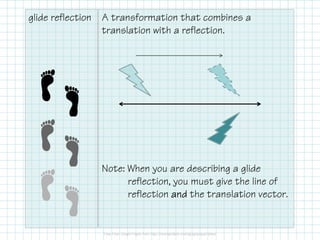
glide reflection A transformation that combines a
translation with a reflection.

Note: When you are describing a glide
reflection, you must give the line of
reflection and the translation vector.
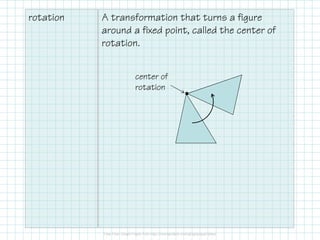
rotation

A transformation that turns a figure
around a fixed point, called the center of
rotation.
center of
rotation

•
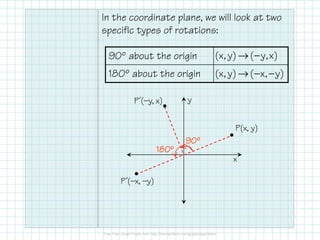
In the coordinate plane, we will look at two
specific types of rotations:
90º about the origin

(x, y) → (− y, x)

180º about the origin

(x, y) → (− x, − y)

P´(—y, x)

•

180º

y

90º

•

P(x, y)

x
•
P´(—x, —y)
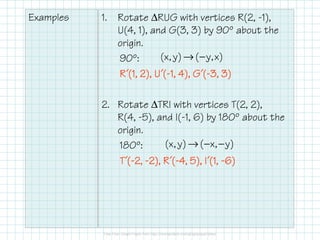
Examples

1. Rotate ∆RUG with vertices R(2, -1),
U(4, 1), and G(3, 3) by 90º about the
origin.
(x, y) → (− y, x)
90º:
U´
G´
R´(1, 2), U´(-1, 4), G´(-3, 3)
2. Rotate ∆TRI with vertices T(2, 2),
R(4, -5), and I(-1, 6) by 180º about the
origin.
(x, y) → (− x, − y)
180º:
R´
I´
T´(-2, -2), R´(-4, 5), I´(1, -6)

Obj. 31 Glide Reflections and Rotations

  • 1.
    Obj. 31 GlideReflections & Rotations The student is able to (I can): • Identify and draw glide reflections • Identify and draw rotations
  • 2.
    glide reflection Atransformation that combines a translation with a reflection. Note: When you are describing a glide reflection, you must give the line of reflection and the translation vector.
  • 3.
    rotation A transformation thatturns a figure around a fixed point, called the center of rotation. center of rotation •
  • 4.
    In the coordinateplane, we will look at two specific types of rotations: 90º about the origin (x, y) → (− y, x) 180º about the origin (x, y) → (− x, − y) P´(—y, x) • 180º y 90º • P(x, y) x • P´(—x, —y)
  • 5.
    Examples 1. Rotate ∆RUGwith vertices R(2, -1), U(4, 1), and G(3, 3) by 90º about the origin. (x, y) → (− y, x) 90º: U´ G´ R´(1, 2), U´(-1, 4), G´(-3, 3) 2. Rotate ∆TRI with vertices T(2, 2), R(4, -5), and I(-1, 6) by 180º about the origin. (x, y) → (− x, − y) 180º: R´ I´ T´(-2, -2), R´(-4, 5), I´(1, -6)