VECTOR COMPONENTSVECTOR COMPONENTS
 Part of a vectorPart of a vector
 x-componentx-component: Determines how far: Determines how far
horizontallyhorizontally the vector is tiltedthe vector is tilted
 y-componenty-component: Determines how far: Determines how far
verticallyvertically the vector is tiltedthe vector is tilted
VECTOR COMPONENTSVECTOR COMPONENTS
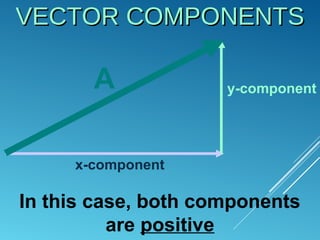
x-component
y-componentA
In this case, both components
are positive
PROJECTILE MOTIONPROJECTILE MOTION
 ActsActs onlyonly under the influence ofunder the influence of
gravity (neglecting air resistance)gravity (neglecting air resistance)
 Follows a curved, 2-D pathFollows a curved, 2-D path
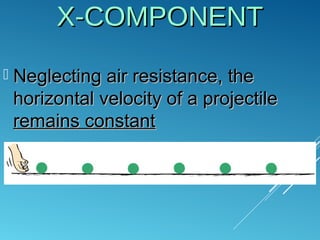
X-COMPONENTX-COMPONENT
 Neglecting air resistance, theNeglecting air resistance, the
horizontal velocity of a projectilehorizontal velocity of a projectile
remains constantremains constant
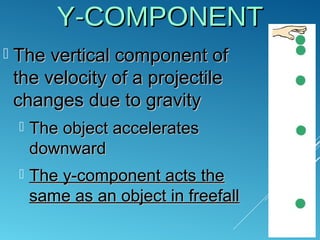
Y-COMPONENTY-COMPONENT
 The vertical component ofThe vertical component of
the velocity of a projectilethe velocity of a projectile
changes due to gravitychanges due to gravity
 The object acceleratesThe object accelerates
downwarddownward
 The y-component acts theThe y-component acts the
same as an object in freefallsame as an object in freefall
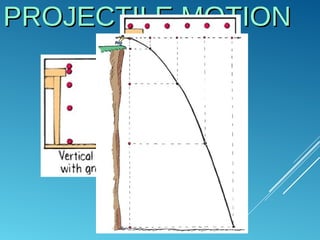
PROJECTILE MOTIONPROJECTILE MOTION
 These motions will combineThese motions will combine
to form a trajectory in theto form a trajectory in the
shape of a parabolashape of a parabola
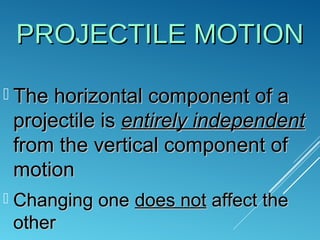
PROJECTILE MOTIONPROJECTILE MOTION
 The horizontal component of aThe horizontal component of a
projectile isprojectile is entirely independententirely independent
from the vertical component offrom the vertical component of
motionmotion
 Changing oneChanging one does notdoes not affect theaffect the
otherother
PROJECTILE MOTIONPROJECTILE MOTION
 The equations of 1-D motion still applyThe equations of 1-D motion still apply
(refer to your formula sheet), but keep(refer to your formula sheet), but keep
uniform motionuniform motion distinct fromdistinct from uniformlyuniformly
accelerated motionaccelerated motion..
 DONDON’T MIX’T MIX x- and y-components in thex- and y-components in the
same equation. Keep them separate!same equation. Keep them separate!
 Time, however, is a scalar quantity.Time, however, is a scalar quantity.
 Time (and only time) can be used withTime (and only time) can be used with
both x- and y-componentsboth x- and y-components
PROJECTILE MOTIONPROJECTILE MOTION
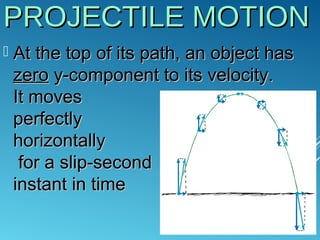
 At the top of its path, an object hasAt the top of its path, an object has
zerozero y-component to its velocity.y-component to its velocity.
It movesIt moves
perfectlyperfectly
horizontallyhorizontally
for a slip-secondfor a slip-second
instant in timeinstant in time
PROJECTILE MOTIONPROJECTILE MOTION
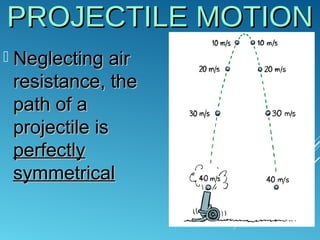
 Neglecting airNeglecting air
resistance, theresistance, the
path of apath of a
projectile isprojectile is
perfectlyperfectly
symmetricalsymmetrical

Projectile motion notes

  • 1.
    VECTOR COMPONENTSVECTOR COMPONENTS Part of a vectorPart of a vector  x-componentx-component: Determines how far: Determines how far horizontallyhorizontally the vector is tiltedthe vector is tilted  y-componenty-component: Determines how far: Determines how far verticallyvertically the vector is tiltedthe vector is tilted
  • 2.
  • 3.
    PROJECTILE MOTIONPROJECTILE MOTION ActsActs onlyonly under the influence ofunder the influence of gravity (neglecting air resistance)gravity (neglecting air resistance)  Follows a curved, 2-D pathFollows a curved, 2-D path
  • 4.
    X-COMPONENTX-COMPONENT  Neglecting airresistance, theNeglecting air resistance, the horizontal velocity of a projectilehorizontal velocity of a projectile remains constantremains constant
  • 5.
    Y-COMPONENTY-COMPONENT  The verticalcomponent ofThe vertical component of the velocity of a projectilethe velocity of a projectile changes due to gravitychanges due to gravity  The object acceleratesThe object accelerates downwarddownward  The y-component acts theThe y-component acts the same as an object in freefallsame as an object in freefall
  • 6.
    PROJECTILE MOTIONPROJECTILE MOTION These motions will combineThese motions will combine to form a trajectory in theto form a trajectory in the shape of a parabolashape of a parabola
  • 7.
  • 8.
  • 9.
    PROJECTILE MOTIONPROJECTILE MOTION The horizontal component of aThe horizontal component of a projectile isprojectile is entirely independententirely independent from the vertical component offrom the vertical component of motionmotion  Changing oneChanging one does notdoes not affect theaffect the otherother
  • 10.
    PROJECTILE MOTIONPROJECTILE MOTION The equations of 1-D motion still applyThe equations of 1-D motion still apply (refer to your formula sheet), but keep(refer to your formula sheet), but keep uniform motionuniform motion distinct fromdistinct from uniformlyuniformly accelerated motionaccelerated motion..  DONDON’T MIX’T MIX x- and y-components in thex- and y-components in the same equation. Keep them separate!same equation. Keep them separate!  Time, however, is a scalar quantity.Time, however, is a scalar quantity.  Time (and only time) can be used withTime (and only time) can be used with both x- and y-componentsboth x- and y-components
  • 11.
    PROJECTILE MOTIONPROJECTILE MOTION At the top of its path, an object hasAt the top of its path, an object has zerozero y-component to its velocity.y-component to its velocity. It movesIt moves perfectlyperfectly horizontallyhorizontally for a slip-secondfor a slip-second instant in timeinstant in time
  • 12.
    PROJECTILE MOTIONPROJECTILE MOTION Neglecting airNeglecting air resistance, theresistance, the path of apath of a projectile isprojectile is perfectlyperfectly symmetricalsymmetrical