* Use right triangles to evaluate trigonometric functions
* Use equal cofunctions of complementary angles
* Use the definitions of trigonometric functions for any angle
* Use right triangle trigonometry to solve applied problems
T7.2 Right TriangleTrigonometry
Chapter 7 The Unit Circle: Sine and Cosine
Functions
2.
Concepts and Objectives
⚫The objectives for this section are
⚫ Use right triangles to evaluate trigonometric
functions
⚫ Use equal cofunctions of complementary angles
⚫ Use the definitions of trigonometric functions for any
angle
⚫ Use right-triangle trigonometry to solve applied
problems
3.
Trigonometric Ratio Review
⚫In Geometry, we learned that for any given right triangle,
there are special ratios between the sides.
A
opposite
adjacent
=
opposite
sin
hypotenuse
A
=
adjacent
cos
hypotenuse
A
=
opposite
tan
adjacent
A
4.
Trigonometric Functions
⚫ Considera circle centered at the origin with radius r:
⚫ The equation for this circle is x2 + y2 = r2
⚫ A point (x, y) on the circle creates a right triangle whose
sides are x, y, and r.
⚫ The trig ratios are now (x, y)
r
x
y
=
sin
y
r
=
cos
x
r
=
tan
y
x
5.
Trigonometric Functions
⚫ Thereare three other ratios in addition to the three we
already know : cosecant, secant, and cotangent.
⚫ These ratios are the inverses of the original three:
(x, y)
r
x
y
= =
1
csc
sin
r
y
= =
1
sec
cos
r
x
= =
1
cot
tan
x
y
6.
Finding Function Values
⚫Example: The terminal side of an angle in standard
position passes through the point (15, 8). Find the
values of the six trigonometric functions of angle .
(15, 8)
7.
Finding Function Values
⚫Example: The terminal side of an angle in standard
position passes through the point (15, 8). Find the
values of the six trigonometric functions of angle .
8
15
(15, 8)
We know that x = 15 and y = 8, but
we still have to calculate r:
Now, we can calculate the values.
= +
2 2
r x y
= + =
2 2
15 8 17 17
8.
Finding Function Values
⚫Example: The terminal side of an angle in standard
position passes through the point (15, 8). Find the
values of the six trigonometric functions of angle .
8
15
(15, 8)
17
= =
8
sin
17
y
r
= =
15
cos
17
x
r
= =
8
tan
15
y
x
= =
17
csc
8
r
y
= =
17
sec
15
r
x
= =
15
cot
8
x
y
9.
The Unit Circle
⚫Angles in standard position whose terminal sides lie on
the x-axis or y-axis (90°, 180°, 270°, etc.) are called
quadrantal angles.
⚫ To find function values of quandrantal angles easily, we
⚫ Notice that at the quadrantal
angle points x and y are either
0, 1, or –1 (r is always 1).
use a circle with a radius of 1, which
is called a unit circle.
90
(0, 1)
(0, –1)
270
180
(–1, 0)
0/360
(1, 0)
10.
Values of QuadrantalAngles
⚫ Example: Find the values of the six trigonometric
functions for an angle of 270°.
11.
Values of QuadrantalAngles
⚫ Example: Find the values of the six trigonometric
functions for an angle of 270°.
At 270°, x = 0, y = –1, r = 1.
−
= = −
1
sin270 1
1
= =
0
cos270 0
1
−
= =
1
tan270 undefined
0
(0, –1)
12.
Values of QuadrantalAngles
⚫ Example: Find the values of the six trigonometric
functions for an angle of 270°.
At 270°, x = 0, y = –1, r = 1.
= = −
−
1
csc270 1
1
= =
1
sec270 undefined
0
= =
−
0
cot270 0
1
(0, –1)
13.
Identifying an Angle’sQuadrant
⚫ To identify the quadrant of an angle given certain
conditions, note the following:
⚫ In the first quadrant, x and y are both positive.
⚫ In QII, x is negative and y is positive.
⚫ In QIII, both are negative.
⚫ In QIV, x is positive and y is
IV
III
II I
(+,+)
(–,+)
(–,–)
negative.
(+,–)
14.
Identifying an Angle’sQuadrant
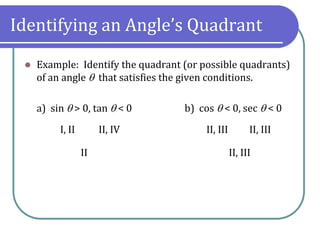
⚫ Example: Identify the quadrant (or possible quadrants)
of an angle that satisfies the given conditions.
a) sin > 0, tan < 0 b) cos < 0, sec < 0
15.
Identifying an Angle’sQuadrant
⚫ Example: Identify the quadrant (or possible quadrants)
of an angle that satisfies the given conditions.
a) sin > 0, tan < 0 b) cos < 0, sec < 0
I, II II, IV
II
II, III II, III
II, III
16.
Classwork
⚫ Algebra &Trigonometry 2e
⚫ 7.2: 10-22 (even); 7.1: 40-48 (even)
⚫ College Algebra 2e
⚫ 9.6: 30-38 (even)
⚫ T7.2 Classwork Check
⚫ Quiz T7.1