Conditional Statements
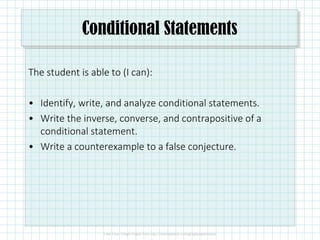
The student is able to (I can):
• Identify, write, and analyze conditional statements.
• Write the inverse, converse, and contrapositive of a
conditional statement.
• Write a counterexample to a false conjecture.
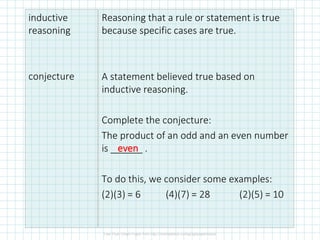
inductive
reasoning
conjecture
Reasoning that a rule or statement is true
because specific cases are true.
A statement believed true based on
inductive reasoning.
Complete the conjecture:
The product of an odd and an even number
is ______ .
inductive
reasoning
conjecture
Reasoning that a rule or statement is true
because specific cases are true.
A statement believed true based on
inductive reasoning.
Complete the conjecture:
The product of an odd and an even number
is ______ .
To do this, we consider some examples:
(2)(3) = 6 (4)(7) = 28 (2)(5) = 10
even
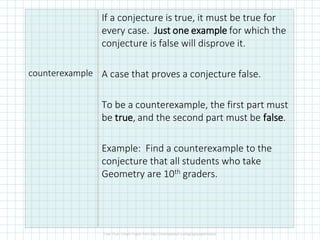
counterexample
If a conjecture is true, it must be true for
every case. Just one example for which the
conjecture is false will disprove it.
A case that proves a conjecture false.
To be a counterexample, the first part must
be true, and the second part must be false.
Example: Find a counterexample to the
conjecture that all students who take
Geometry are 10th graders.
counterexample
If a conjecture is true, it must be true for
every case. Just one example for which the
conjecture is false will disprove it.
A case that proves a conjecture false.
To be a counterexample, the first part must
be true, and the second part must be false.
Example: Find a counterexample to the
conjecture that all students who take
Geometry are 10th graders.
There are students in our class who are
taking Geometry, but are not 10th graders.
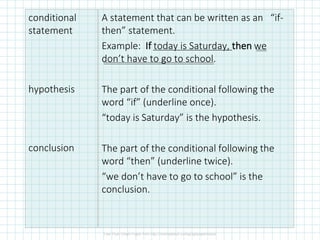
conditional
statement
hypothesis
conclusion
A statement that can be written as an “if-
then” statement.
Example: If today is Saturday, then we
don’t have to go to school.
The part of the conditional following the
word “if” (underline once).
“today is Saturday” is the hypothesis.
The part of the conditional following the
word “then” (underline twice).
“we don’t have to go to school” is the
conclusion.
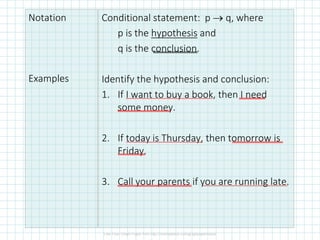
Notation
Examples
Conditional statement: p → q, where
p is the hypothesis and
q is the conclusion.
Identify the hypothesis and conclusion:
1. If I want to buy a book, then I need
some money.
2. If today is Thursday, then tomorrow is
Friday.
3. Call your parents if you are running late.
Notation
Examples
Conditional statement: p → q, where
p is the hypothesis and
q is the conclusion.
Identify the hypothesis and conclusion:
1. If I want to buy a book, then I need
some money.
2. If today is Thursday, then tomorrow is
Friday.
3. Call your parents if you are running late.
Examples
To write a statement as a conditional,
identify the sentence’s hypothesis and
conclusion by figuring out which part of the
statement depends on the other.
Write a conditional statement:
• Two angles that are complementary are
acute.
• Even numbers are divisible by 2.
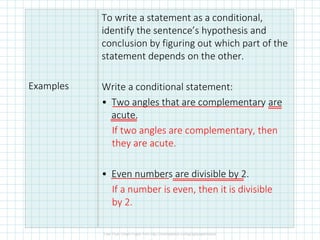
Examples
To write a statement as a conditional,
identify the sentence’s hypothesis and
conclusion by figuring out which part of the
statement depends on the other.
Write a conditional statement:
• Two angles that are complementary are
acute.
If two angles are complementary, then
they are acute.
• Even numbers are divisible by 2.
If a number is even, then it is divisible
by 2.
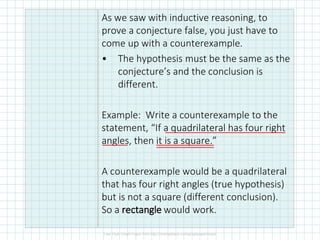
To prove a conjecture false, you just have
to come up with a counterexample.
• The hypothesis must be the same as the
conjecture’s and the conclusion is
different.
Example: Write a counterexample to the
statement, “If a quadrilateral has four right
angles, then it is a square.”
As we saw with inductive reasoning, to
prove a conjecture false, you just have to
come up with a counterexample.
• The hypothesis must be the same as the
conjecture’s and the conclusion is
different.
Example: Write a counterexample to the
statement, “If a quadrilateral has four right
angles, then it is a square.”
A counterexample would be a quadrilateral
that has four right angles (true hypothesis)
but is not a square (different conclusion).
So a rectangle would work.
Each of the conjectures is false. What
would be a counterexample?
If I get presents, then today is my birthday.
If Lamar is playing football tonight, then
today is Friday.
Each of the conjectures is false. What
would be a counterexample?
If I get presents, then today is my birthday.
• A counterexample would be a day that I
get presents (true hyp.) that isn’t my
birthday (different conc.), such as
Christmas.
If Lamar is playing football tonight, then
today is Friday.
• Lamar plays football (true hyp.) on days
other than Friday (diff. conc.), such as
games on Thursday.
Examples Determine if each conditional is true. If
false, give a counterexample.
1. If your zip code is 76012, then you live
in Texas.
True
2. If a month has 28 days, then it is
February.
September also has 28 days, which
proves the conditional false.
Texas
76012
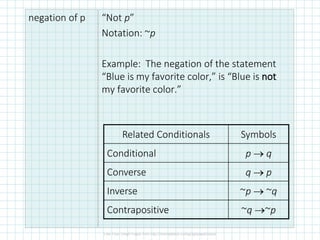
negation of p “Not p”
Notation: ~p
Example: The negation of the statement
“Blue is my favorite color,” is “Blue is not
my favorite color.”
Related Conditionals Symbols
Conditional p → q
Converse q → p
Inverse ~p → ~q
Contrapositive ~q →~p
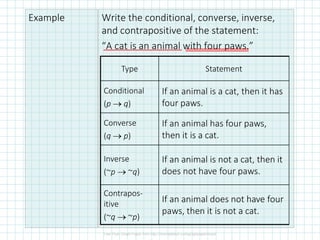
Example Write the conditional, converse, inverse,
and contrapositive of the statement:
“A cat is an animal with four paws.”
Type Statement
Conditional
(p → q)
If an animal is a cat, then it has
four paws.
Converse
(q → p)
If an animal has four paws,
then it is a cat.
Inverse
(~p → ~q)
If an animal is not a cat, then it
does not have four paws.
Contrapos-
itive
(~q → ~p)
If an animal does not have four
paws, then it is not a cat.
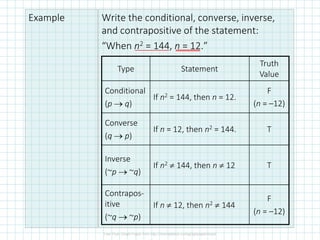
Example Write the conditional, converse, inverse,
and contrapositive of the statement:
“When n2 = 144, n = 12.”
Type Statement
Truth
Value
Conditional
(p → q)
If n2 = 144, then n = 12.
F
(n = –12)
Converse
(q → p)
If n = 12, then n2 = 144. T
Inverse
(~p → ~q)
If n2  144, then n  12 T
Contrapos-
itive
(~q → ~p)
If n  12, then n2  144
F
(n = –12)
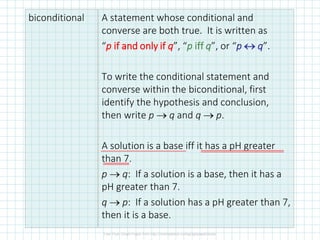
biconditional A statement whose conditional and
converse are both true. It is written as
“p if and only if q”, “p iff q”, or “p  q”.
To write the conditional statement and
converse within the biconditional, first
identify the hypothesis and conclusion,
then write p → q and q → p.
A solution is a base iff it has a pH greater
than 7.
p → q: If a solution is a base, then it has a
pH greater than 7.
q → p: If a solution has a pH greater than 7,
then it is a base.
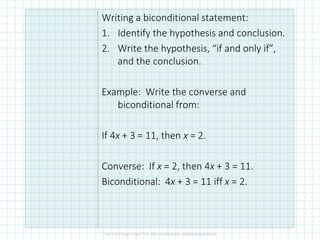
Writing a biconditional statement:
1. Identify the hypothesis and conclusion.
2. Write the hypothesis, “if and only if”,
and the conclusion.
Example: Write the converse and
biconditional from:
If 4x + 3 = 11, then x = 2.
Converse: If x = 2, then 4x + 3 = 11.
Biconditional: 4x + 3 = 11 iff x = 2.

1.4 Conditional Statements

  • 1.
    Conditional Statements The studentis able to (I can): • Identify, write, and analyze conditional statements. • Write the inverse, converse, and contrapositive of a conditional statement. • Write a counterexample to a false conjecture.
  • 2.
    inductive reasoning conjecture Reasoning that arule or statement is true because specific cases are true. A statement believed true based on inductive reasoning. Complete the conjecture: The product of an odd and an even number is ______ .
  • 3.
    inductive reasoning conjecture Reasoning that arule or statement is true because specific cases are true. A statement believed true based on inductive reasoning. Complete the conjecture: The product of an odd and an even number is ______ . To do this, we consider some examples: (2)(3) = 6 (4)(7) = 28 (2)(5) = 10 even
  • 4.
    counterexample If a conjectureis true, it must be true for every case. Just one example for which the conjecture is false will disprove it. A case that proves a conjecture false. To be a counterexample, the first part must be true, and the second part must be false. Example: Find a counterexample to the conjecture that all students who take Geometry are 10th graders.
  • 5.
    counterexample If a conjectureis true, it must be true for every case. Just one example for which the conjecture is false will disprove it. A case that proves a conjecture false. To be a counterexample, the first part must be true, and the second part must be false. Example: Find a counterexample to the conjecture that all students who take Geometry are 10th graders. There are students in our class who are taking Geometry, but are not 10th graders.
  • 6.
    conditional statement hypothesis conclusion A statement thatcan be written as an “if- then” statement. Example: If today is Saturday, then we don’t have to go to school. The part of the conditional following the word “if” (underline once). “today is Saturday” is the hypothesis. The part of the conditional following the word “then” (underline twice). “we don’t have to go to school” is the conclusion.
  • 7.
    Notation Examples Conditional statement: p→ q, where p is the hypothesis and q is the conclusion. Identify the hypothesis and conclusion: 1. If I want to buy a book, then I need some money. 2. If today is Thursday, then tomorrow is Friday. 3. Call your parents if you are running late.
  • 8.
    Notation Examples Conditional statement: p→ q, where p is the hypothesis and q is the conclusion. Identify the hypothesis and conclusion: 1. If I want to buy a book, then I need some money. 2. If today is Thursday, then tomorrow is Friday. 3. Call your parents if you are running late.
  • 9.
    Examples To write astatement as a conditional, identify the sentence’s hypothesis and conclusion by figuring out which part of the statement depends on the other. Write a conditional statement: • Two angles that are complementary are acute. • Even numbers are divisible by 2.
  • 10.
    Examples To write astatement as a conditional, identify the sentence’s hypothesis and conclusion by figuring out which part of the statement depends on the other. Write a conditional statement: • Two angles that are complementary are acute. If two angles are complementary, then they are acute. • Even numbers are divisible by 2. If a number is even, then it is divisible by 2.
  • 11.
    To prove aconjecture false, you just have to come up with a counterexample. • The hypothesis must be the same as the conjecture’s and the conclusion is different. Example: Write a counterexample to the statement, “If a quadrilateral has four right angles, then it is a square.”
  • 12.
    As we sawwith inductive reasoning, to prove a conjecture false, you just have to come up with a counterexample. • The hypothesis must be the same as the conjecture’s and the conclusion is different. Example: Write a counterexample to the statement, “If a quadrilateral has four right angles, then it is a square.” A counterexample would be a quadrilateral that has four right angles (true hypothesis) but is not a square (different conclusion). So a rectangle would work.
  • 13.
    Each of theconjectures is false. What would be a counterexample? If I get presents, then today is my birthday. If Lamar is playing football tonight, then today is Friday.
  • 14.
    Each of theconjectures is false. What would be a counterexample? If I get presents, then today is my birthday. • A counterexample would be a day that I get presents (true hyp.) that isn’t my birthday (different conc.), such as Christmas. If Lamar is playing football tonight, then today is Friday. • Lamar plays football (true hyp.) on days other than Friday (diff. conc.), such as games on Thursday.
  • 15.
    Examples Determine ifeach conditional is true. If false, give a counterexample. 1. If your zip code is 76012, then you live in Texas. True 2. If a month has 28 days, then it is February. September also has 28 days, which proves the conditional false. Texas 76012
  • 16.
    negation of p“Not p” Notation: ~p Example: The negation of the statement “Blue is my favorite color,” is “Blue is not my favorite color.” Related Conditionals Symbols Conditional p → q Converse q → p Inverse ~p → ~q Contrapositive ~q →~p
  • 17.
    Example Write theconditional, converse, inverse, and contrapositive of the statement: “A cat is an animal with four paws.” Type Statement Conditional (p → q) If an animal is a cat, then it has four paws. Converse (q → p) If an animal has four paws, then it is a cat. Inverse (~p → ~q) If an animal is not a cat, then it does not have four paws. Contrapos- itive (~q → ~p) If an animal does not have four paws, then it is not a cat.
  • 18.
    Example Write theconditional, converse, inverse, and contrapositive of the statement: “When n2 = 144, n = 12.” Type Statement Truth Value Conditional (p → q) If n2 = 144, then n = 12. F (n = –12) Converse (q → p) If n = 12, then n2 = 144. T Inverse (~p → ~q) If n2  144, then n  12 T Contrapos- itive (~q → ~p) If n  12, then n2  144 F (n = –12)
  • 19.
    biconditional A statementwhose conditional and converse are both true. It is written as “p if and only if q”, “p iff q”, or “p  q”. To write the conditional statement and converse within the biconditional, first identify the hypothesis and conclusion, then write p → q and q → p. A solution is a base iff it has a pH greater than 7. p → q: If a solution is a base, then it has a pH greater than 7. q → p: If a solution has a pH greater than 7, then it is a base.
  • 20.
    Writing a biconditionalstatement: 1. Identify the hypothesis and conclusion. 2. Write the hypothesis, “if and only if”, and the conclusion. Example: Write the converse and biconditional from: If 4x + 3 = 11, then x = 2. Converse: If x = 2, then 4x + 3 = 11. Biconditional: 4x + 3 = 11 iff x = 2.