MATH 1324 – Business College Algebra
Lesson 1:
1.3 Factoring
Unit 1 Mathematics Review and Functions
Concepts and Objectives
• Objectives for this section:
• Review factoring polynomial and quadratic expressions by
• Factoring out the greatest common factor
• Factoring when a = 1
• Factoring when a > 1
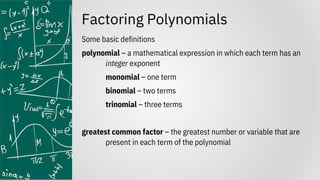
Factoring Polynomials
Some basic definitions
polynomial – a mathematical expression in which each term has an
integer exponent
monomial – one term
binomial – two terms
trinomial – three terms
greatest common factor – the greatest number or variable that are
present in each term of the polynomial
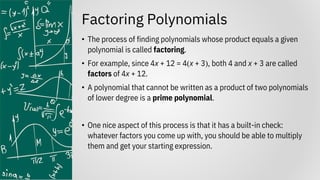
Factoring Polynomials
• The process of finding polynomials whose product equals a given
polynomial is called factoring.
• For example, since 4x + 12 = 4(x + 3), both 4 and x + 3 are called
factors of 4x + 12.
• A polynomial that cannot be written as a product of two polynomials
of lower degree is a prime polynomial.
• One nice aspect of this process is that it has a built-in check:
whatever factors you come up with, you should be able to multiply
them and get your starting expression.
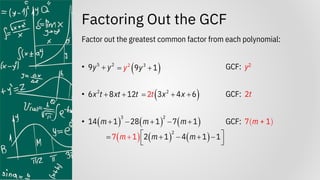
Factoring Out the GCF
Factor out the greatest common factor from each polynomial:
• GCF: y2
• GCF: 2t
• GCF: 7m + 1
+
5 2
9y y
2
6 8 12
x t xt t
+ +
( ) ( ) ( )
3 2
14 1 28 1 7 1
m m m
+ − + − +
( )
2 3
9 1
y y
= +
( )
2
3 4 6
2 x
t x
= + +
( ) ( ) ( )
2
2 1 4 1 1
7 1
m m m
 
= + − + −

+

Factoring Out the GCF (cont.)
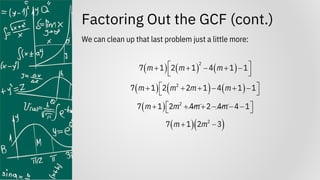
We can clean up that last problem just a little more:
( ) ( ) ( )
2
7 1 2 1 4 1 1
m m m
 
+ + − + −
 
( ) ( ) ( )
2
7 1 2 2 1 4 1 1
m m m m
 
+ + + − + −
 
( ) 2
7 1 2 4 2 4 4 1
m m m m
 
+ + + − − −
 
( )( )
2
7 1 2 3
m m
+ −
Factoring Trinomials
If you have an expression of the form ax2 +bx + c, you can use one of
the following methods to factor it:
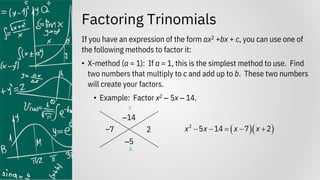
• X-method (a = 1): If a = 1, this is the simplest method to use. Find
two numbers that multiply to c and add up to b. These two numbers
will create your factors.
• Example: Factor x2 ‒ 5x ‒ 14.
‒14
‒5
( )( )
2
5 14 7 2
x x x x
− − = − +
c
b
–7 2
Factoring Trinomials (cont.)
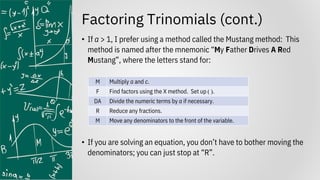
• If a > 1, I prefer using a method called the Mustang method: This
method is named after the mnemonic “My Father Drives A Red
Mustang”, where the letters stand for:
• If you are solving an equation, you don’t have to bother moving the
denominators; you can just stop at “R”.
M Multiply a and c.
F Find factors using the X method. Set up ( ).
DA Divide the numeric terms by a if necessary.
R Reduce any fractions.
M Move any denominators to the front of the variable.
Factoring Trinomials (cont.)
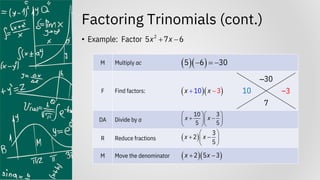
• Example: Factor 2
5 7 6
x x
+ −
M Multiply ac
F Find factors:
DA Divide by a
R Reduce fractions
M Move the denominator
‒30
7
( )( )
0 3
1
x x
+ −
10 3
5 5
x x
  
+ −
  
  
( )
3
2
5
x x
 
+ −
 
 
( )( )
2 5 3
x x
+ −
( )( )
5 6 30
− = −
–3
10
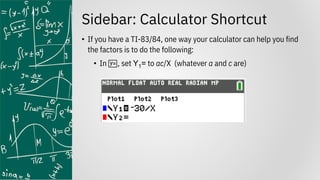
Sidebar: Calculator Shortcut
• If you have a TI-83/84, one way your calculator can help you find
the factors is to do the following:
• In o, set Y1= to ac/X (whatever a and c are)
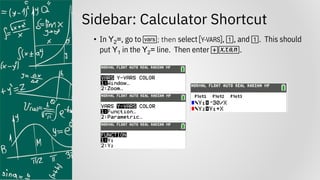
Sidebar: Calculator Shortcut
• In Y2=, go to ½; then select , À, and À. This should
put Y1 in the Y2= line. Then enter Ä.
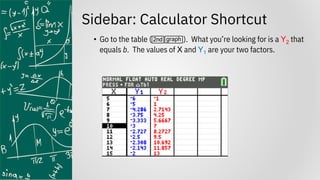
Sidebar: Calculator Shortcut
• Go to the table (ys). What you’re looking for is a Y2 that
equals b. The values of X and Y1 are your two factors.
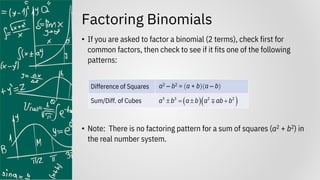
Factoring Binomials
• If you are asked to factor a binomial (2 terms), check first for
common factors, then check to see if it fits one of the following
patterns:
• Note: There is no factoring pattern for a sum of squares (a2 + b2) in
the real number system.
Difference of Squares a2 ‒ b2 = a + ba ‒ b
Sum/Diff. of Cubes ( )( )
3 3 2 2
a b a b a ab b
 =  +
Factoring Binomials (cont.)
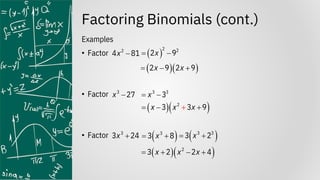
Examples
• Factor
• Factor
• Factor
2
4 81
x −
3
27
x −
3
3 24
x +
( )
2 2
2 9
x
= −
3 3
3
x
= −
( )
3
3 8
x
= +
( )( )
2 9 2 9
x x
= − +
( )( )
2
3 3 9
x x x
− +
= +
( )
3 3
3 2
x
= +
( )( )
2
3 2 2 4
x x x
= + − +
Summary
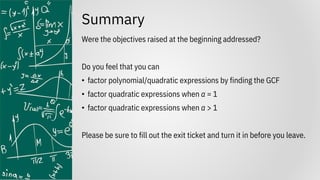
Were the objectives raised at the beginning addressed?
Do you feel that you can
• factor polynomial/quadratic expressions by finding the GCF
• factor quadratic expressions when a = 1
• factor quadratic expressions when a > 1
Please be sure to fill out the exit ticket and turn it in before you leave.
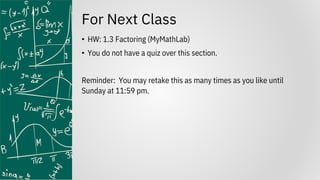
For Next Class
• HW: 1.3 Factoring (MyMathLab)
• You do not have a quiz over this section.
Reminder: You may retake this as many times as you like until
Sunday at 11:59 pm.
1.3 Factoring Quadratics (Presentation).pdf

  • 1.
    MATH 1324 –Business College Algebra Lesson 1: 1.3 Factoring Unit 1 Mathematics Review and Functions
  • 2.
    Concepts and Objectives •Objectives for this section: • Review factoring polynomial and quadratic expressions by • Factoring out the greatest common factor • Factoring when a = 1 • Factoring when a > 1
  • 3.
    Factoring Polynomials Some basicdefinitions polynomial – a mathematical expression in which each term has an integer exponent monomial – one term binomial – two terms trinomial – three terms greatest common factor – the greatest number or variable that are present in each term of the polynomial
  • 4.
    Factoring Polynomials • Theprocess of finding polynomials whose product equals a given polynomial is called factoring. • For example, since 4x + 12 = 4(x + 3), both 4 and x + 3 are called factors of 4x + 12. • A polynomial that cannot be written as a product of two polynomials of lower degree is a prime polynomial. • One nice aspect of this process is that it has a built-in check: whatever factors you come up with, you should be able to multiply them and get your starting expression.
  • 5.
    Factoring Out theGCF Factor out the greatest common factor from each polynomial: • GCF: y2 • GCF: 2t • GCF: 7m + 1 + 5 2 9y y 2 6 8 12 x t xt t + + ( ) ( ) ( ) 3 2 14 1 28 1 7 1 m m m + − + − + ( ) 2 3 9 1 y y = + ( ) 2 3 4 6 2 x t x = + + ( ) ( ) ( ) 2 2 1 4 1 1 7 1 m m m   = + − + −  + 
  • 6.
    Factoring Out theGCF (cont.) We can clean up that last problem just a little more: ( ) ( ) ( ) 2 7 1 2 1 4 1 1 m m m   + + − + −   ( ) ( ) ( ) 2 7 1 2 2 1 4 1 1 m m m m   + + + − + −   ( ) 2 7 1 2 4 2 4 4 1 m m m m   + + + − − −   ( )( ) 2 7 1 2 3 m m + −
  • 7.
    Factoring Trinomials If youhave an expression of the form ax2 +bx + c, you can use one of the following methods to factor it: • X-method (a = 1): If a = 1, this is the simplest method to use. Find two numbers that multiply to c and add up to b. These two numbers will create your factors. • Example: Factor x2 ‒ 5x ‒ 14. ‒14 ‒5 ( )( ) 2 5 14 7 2 x x x x − − = − + c b –7 2
  • 8.
    Factoring Trinomials (cont.) •If a > 1, I prefer using a method called the Mustang method: This method is named after the mnemonic “My Father Drives A Red Mustang”, where the letters stand for: • If you are solving an equation, you don’t have to bother moving the denominators; you can just stop at “R”. M Multiply a and c. F Find factors using the X method. Set up ( ). DA Divide the numeric terms by a if necessary. R Reduce any fractions. M Move any denominators to the front of the variable.
  • 9.
    Factoring Trinomials (cont.) •Example: Factor 2 5 7 6 x x + − M Multiply ac F Find factors: DA Divide by a R Reduce fractions M Move the denominator ‒30 7 ( )( ) 0 3 1 x x + − 10 3 5 5 x x    + −       ( ) 3 2 5 x x   + −     ( )( ) 2 5 3 x x + − ( )( ) 5 6 30 − = − –3 10
  • 10.
    Sidebar: Calculator Shortcut •If you have a TI-83/84, one way your calculator can help you find the factors is to do the following: • In o, set Y1= to ac/X (whatever a and c are)
  • 11.
    Sidebar: Calculator Shortcut •In Y2=, go to ½; then select , À, and À. This should put Y1 in the Y2= line. Then enter Ä.
  • 12.
    Sidebar: Calculator Shortcut •Go to the table (ys). What you’re looking for is a Y2 that equals b. The values of X and Y1 are your two factors.
  • 13.
    Factoring Binomials • Ifyou are asked to factor a binomial (2 terms), check first for common factors, then check to see if it fits one of the following patterns: • Note: There is no factoring pattern for a sum of squares (a2 + b2) in the real number system. Difference of Squares a2 ‒ b2 = a + ba ‒ b Sum/Diff. of Cubes ( )( ) 3 3 2 2 a b a b a ab b  =  +
  • 14.
    Factoring Binomials (cont.) Examples •Factor • Factor • Factor 2 4 81 x − 3 27 x − 3 3 24 x + ( ) 2 2 2 9 x = − 3 3 3 x = − ( ) 3 3 8 x = + ( )( ) 2 9 2 9 x x = − + ( )( ) 2 3 3 9 x x x − + = + ( ) 3 3 3 2 x = + ( )( ) 2 3 2 2 4 x x x = + − +
  • 15.
    Summary Were the objectivesraised at the beginning addressed? Do you feel that you can • factor polynomial/quadratic expressions by finding the GCF • factor quadratic expressions when a = 1 • factor quadratic expressions when a > 1 Please be sure to fill out the exit ticket and turn it in before you leave.
  • 16.
    For Next Class •HW: 1.3 Factoring (MyMathLab) • You do not have a quiz over this section. Reminder: You may retake this as many times as you like until Sunday at 11:59 pm.