VECTORS
PROJECTILE MOTION
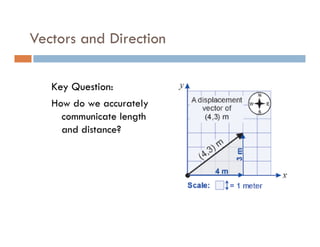
Vectors and Direction

   Key Question:
   How do we accurately
     communicate length
     and distance?
Vectors and Direction

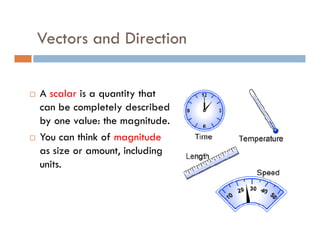
A scalar is a quantity that
can be completely described
by one value: the magnitude.
You can think of magnitude
as size or amount, including
units.
Vectors and Direction

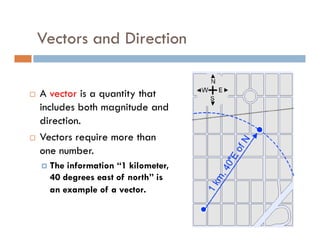
A vector is a quantity that
includes both magnitude and
direction.
Vectors require more than
one number.
  The information “1 kilometer,
  40 degrees east of north” is
  an example of a vector.
Vectors and Direction

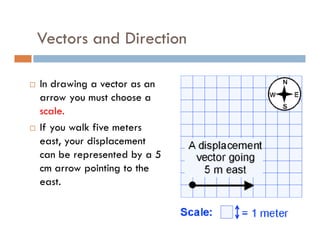
In drawing a vector as an
arrow you must choose a
scale.
If you walk five meters
east, your displacement
can be represented by a 5
cm arrow pointing to the
east.
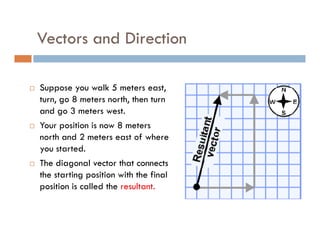
Vectors and Direction

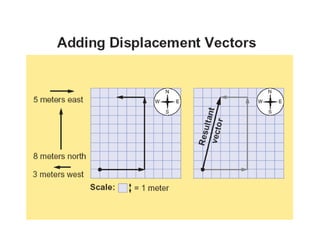
Suppose you walk 5 meters east,
turn, go 8 meters north, then turn
and go 3 meters west.
Your position is now 8 meters
north and 2 meters east of where
you started.
The diagonal vector that connects
the starting position with the final
position is called the resultant.
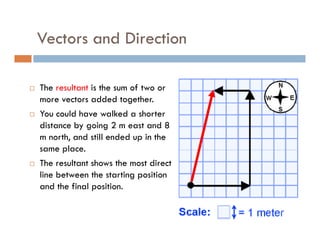
Vectors and Direction

The resultant is the sum of two or
more vectors added together.
You could have walked a shorter
distance by going 2 m east and 8
m north, and still ended up in the
same place.
The resultant shows the most direct
line between the starting position
and the final position.
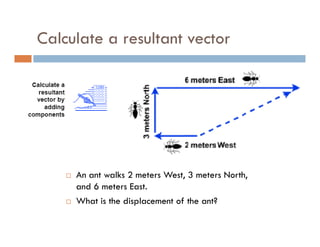
Calculate a resultant vector


     An ant walks 2 meters West, 3 meters North,
     and 6 meters East.
     What is the displacement of the ant?
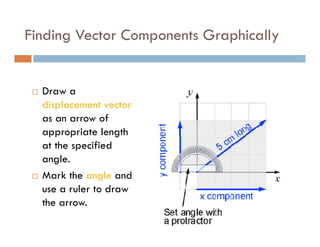
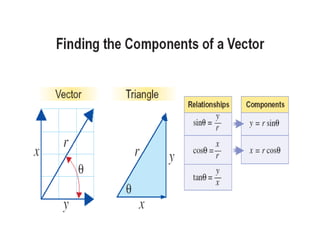
Finding Vector Components Graphically


  Draw a
  displacement vector
  as an arrow of
  appropriate length
  at the specified
  angle.
  Mark the angle and
  use a ruler to draw
  the arrow.
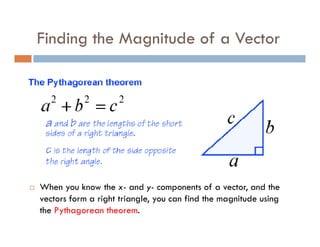
Finding the Magnitude of a Vector


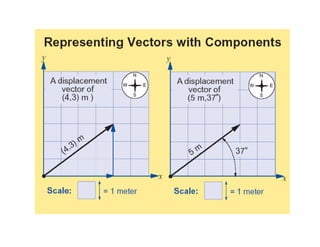
When you know the x- and y- components of a vector, and the
vectors form a right triangle, you can find the magnitude using
the Pythagorean theorem.
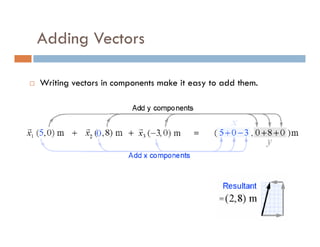
Adding Vectors

Writing vectors in components make it easy to add them.
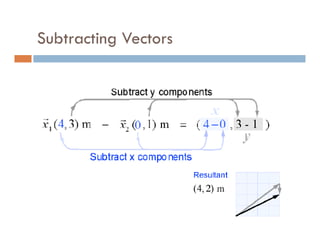
Subtracting Vectors
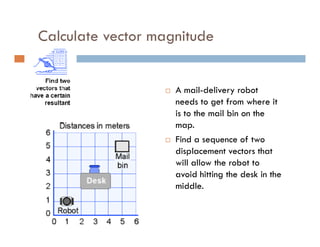
Calculate vector magnitude


                    A mail-delivery robot
                    needs to get from where it
                    is to the mail bin on the
                    map.
                    Find a sequence of two
                    displacement vectors that
                    will allow the robot to
                    avoid hitting the desk in the
                    middle.
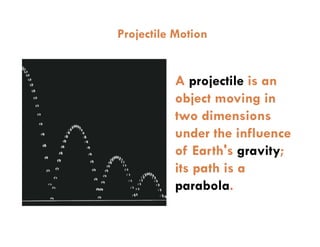
Projectile Motion


          A projectile is an
          object moving in
          two dimensions
          under the influence
          of Earth's gravity;
          its path is a
          parabola.
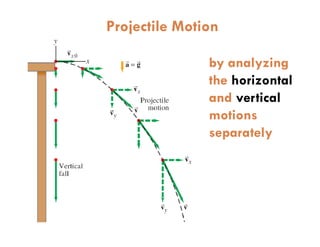
Projectile Motion

               by analyzing
               the horizontal
               and vertical
               motions
               separately
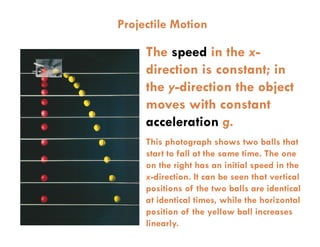
Projectile Motion

     The speed in the x-
     direction is constant; in
     the y-direction the object
     moves with constant
     acceleration g.
     This photograph shows two balls that
     start to fall at the same time. The one
     on the right has an initial speed in the
     x-direction. It can be seen that vertical
     positions of the two balls are identical
     at identical times, while the horizontal
     position of the yellow ball increases
     linearly.
Projectile Motion
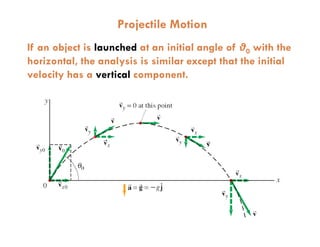
If an object is launched at an initial angle of θ0 with the
horizontal, the analysis is similar except that the initial
velocity has a vertical component.
Trajectory


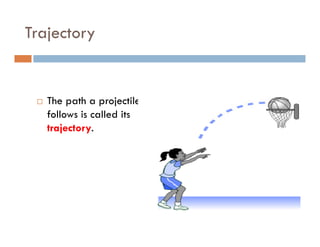
   The path a projectile
   follows is called its
   trajectory.
Trajectory, Range


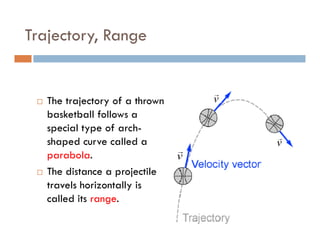
   The trajectory of a thrown
   basketball follows a
   special type of arch-
   shaped curve called a
   parabola.
   The distance a projectile
   travels horizontally is
   called its range.
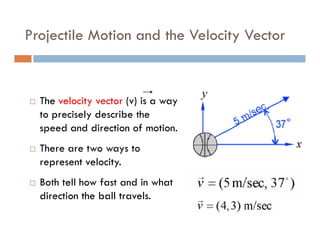
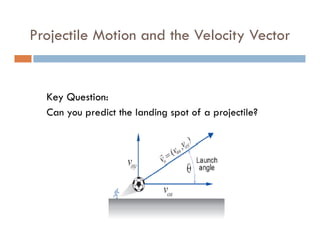
Projectile Motion and the Velocity Vector


  The velocity vector (v) is a way
  to precisely describe the
  speed and direction of motion.
  There are two ways to
  represent velocity.
  Both tell how fast and in what
  direction the ball travels.
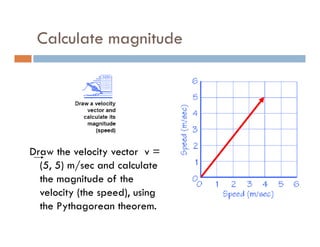
Calculate magnitude


Draw the velocity vector v =
  (5, 5) m/sec and calculate
  the magnitude of the
  velocity (the speed), using
  the Pythagorean theorem.
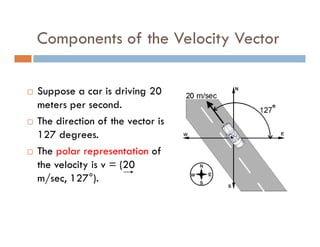
Components of the Velocity Vector

Suppose a car is driving 20
meters per second.
The direction of the vector is
127 degrees.
The polar representation of
the velocity is v = (20
m/sec, 127°).
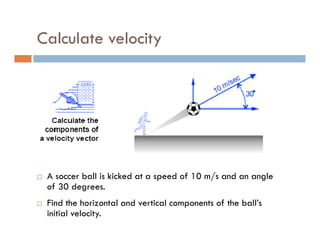
Calculate velocity


 A soccer ball is kicked at a speed of 10 m/s and an angle
 of 30 degrees.
 Find the horizontal and vertical components of the ball’s
 initial velocity.
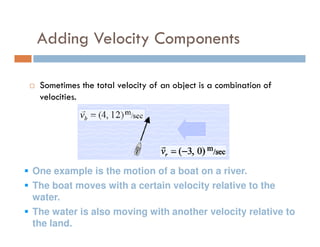
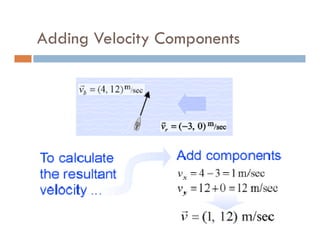
Adding Velocity Components

 Sometimes the total velocity of an object is a combination of
 velocities.


One example is the motion of a boat on a river.
The boat moves with a certain velocity relative to the
water.
The water is also moving with another velocity relative to
the land.
Adding Velocity Components
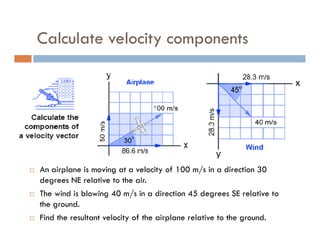
Calculate velocity components


An airplane is moving at a velocity of 100 m/s in a direction 30
degrees NE relative to the air.
The wind is blowing 40 m/s in a direction 45 degrees SE relative to
the ground.
Find the resultant velocity of the airplane relative to the ground.
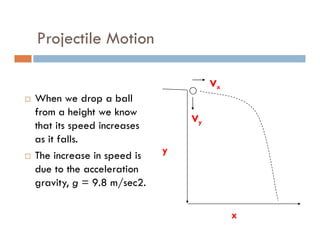
Projectile Motion

                                    Vx
When we drop a ball
from a height we know
                               Vy
that its speed increases
as it falls.
                           y
The increase in speed is
due to the acceleration
gravity, g = 9.8 m/sec2.

                                         x
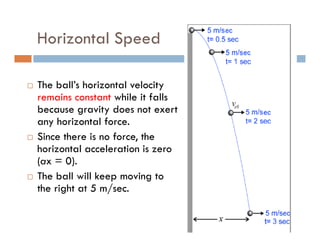
Horizontal Speed

The ball’s horizontal velocity
remains constant while it falls
because gravity does not exert
any horizontal force.
Since there is no force, the
horizontal acceleration is zero
(ax = 0).
The ball will keep moving to
the right at 5 m/sec.
Horizontal Speed

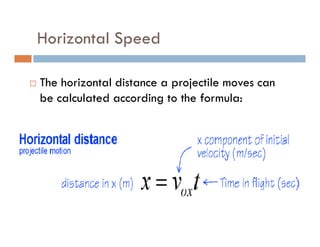
The horizontal distance a projectile moves can
be calculated according to the formula:
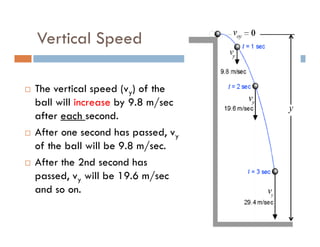
Vertical Speed

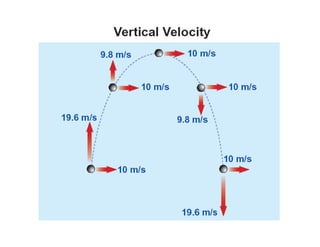
The vertical speed (vy) of the
ball will increase by 9.8 m/sec
after each second.
After one second has passed, vy
of the ball will be 9.8 m/sec.
After the 2nd second has
passed, vy will be 19.6 m/sec
and so on.
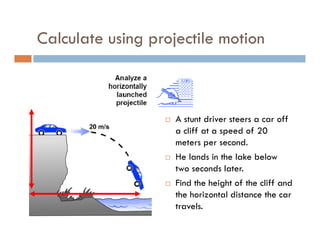
Calculate using projectile motion


                    A stunt driver steers a car off
                    a cliff at a speed of 20
                    meters per second.
                    He lands in the lake below
                    two seconds later.
                    Find the height of the cliff and
                    the horizontal distance the car
                    travels.
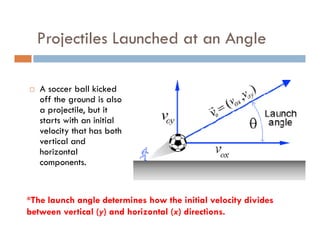
Projectiles Launched at an Angle

   A soccer ball kicked
   off the ground is also
   a projectile, but it
   starts with an initial
   velocity that has both
   vertical and
   horizontal
   components.


*The launch angle determines how the initial velocity divides
between vertical (y) and horizontal (x) directions.
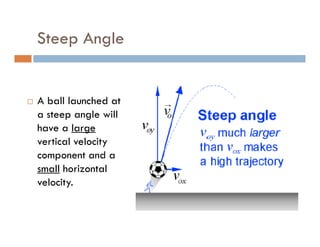
Steep Angle


A ball launched at
a steep angle will
have a large
vertical velocity
component and a
small horizontal
velocity.
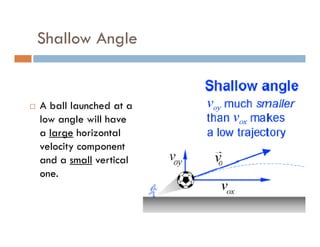
Shallow Angle


A ball launched at a
low angle will have
a large horizontal
velocity component
and a small vertical
one.
Projectiles Launched at an Angle

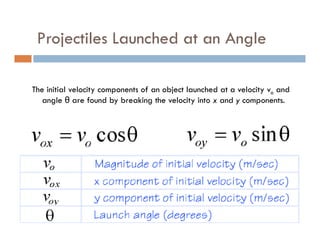
The initial velocity components of an object launched at a velocity vo and
   angle θ are found by breaking the velocity into x and y components.
Range of a Projectile

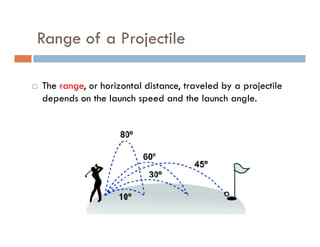
The range, or horizontal distance, traveled by a projectile
depends on the launch speed and the launch angle.
Range of a Projectile

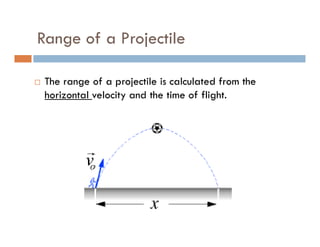
 The range of a projectile is calculated from the
 horizontal velocity and the time of flight.
Range of a Projectile

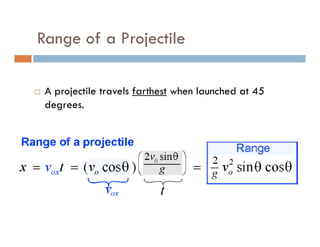
 A projectile travels farthest when launched at 45
 degrees.
Range of a Projectile

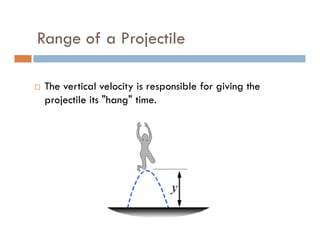
 The vertical velocity is responsible for giving the
 projectile its "hang" time.
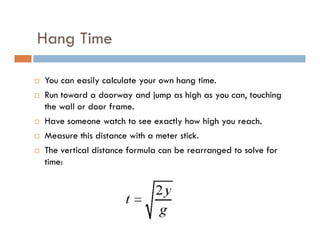
Hang Time

You can easily calculate your own hang time.
Run toward a doorway and jump as high as you can, touching
the wall or door frame.
Have someone watch to see exactly how high you reach.
Measure this distance with a meter stick.
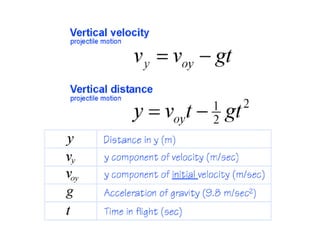
The vertical distance formula can be rearranged to solve for
time:
Projectile Motion and the Velocity Vector


  Key Question:
  Can you predict the landing spot of a projectile?
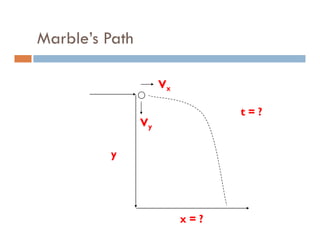
Marble’s Path

                     Vx

                                t=?
                Vy

         y


                          x=?
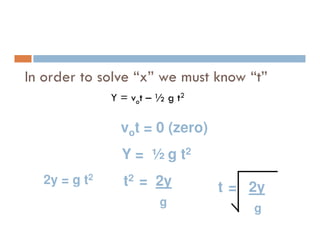
In order to solve “x” we must know “t”
              Y = vot – ½ g t2

                vot = 0 (zero)
                Y = ½ g t2
  2y = g t2     t2 = 2y          t = 2y
                        g
                                     g

Vectors projectile motion

  • 1.
  • 2.
    Vectors and Direction Key Question: How do we accurately communicate length and distance?
  • 3.
    Vectors and Direction Ascalar is a quantity that can be completely described by one value: the magnitude. You can think of magnitude as size or amount, including units.
  • 4.
    Vectors and Direction Avector is a quantity that includes both magnitude and direction. Vectors require more than one number. The information “1 kilometer, 40 degrees east of north” is an example of a vector.
  • 5.
    Vectors and Direction Indrawing a vector as an arrow you must choose a scale. If you walk five meters east, your displacement can be represented by a 5 cm arrow pointing to the east.
  • 6.
    Vectors and Direction Supposeyou walk 5 meters east, turn, go 8 meters north, then turn and go 3 meters west. Your position is now 8 meters north and 2 meters east of where you started. The diagonal vector that connects the starting position with the final position is called the resultant.
  • 7.
    Vectors and Direction Theresultant is the sum of two or more vectors added together. You could have walked a shorter distance by going 2 m east and 8 m north, and still ended up in the same place. The resultant shows the most direct line between the starting position and the final position.
  • 10.
    Calculate a resultantvector An ant walks 2 meters West, 3 meters North, and 6 meters East. What is the displacement of the ant?
  • 11.
    Finding Vector ComponentsGraphically Draw a displacement vector as an arrow of appropriate length at the specified angle. Mark the angle and use a ruler to draw the arrow.
  • 13.
    Finding the Magnitudeof a Vector When you know the x- and y- components of a vector, and the vectors form a right triangle, you can find the magnitude using the Pythagorean theorem.
  • 14.
    Adding Vectors Writing vectorsin components make it easy to add them.
  • 15.
  • 16.
    Calculate vector magnitude A mail-delivery robot needs to get from where it is to the mail bin on the map. Find a sequence of two displacement vectors that will allow the robot to avoid hitting the desk in the middle.
  • 17.
    Projectile Motion A projectile is an object moving in two dimensions under the influence of Earth's gravity; its path is a parabola.
  • 18.
    Projectile Motion by analyzing the horizontal and vertical motions separately
  • 19.
    Projectile Motion The speed in the x- direction is constant; in the y-direction the object moves with constant acceleration g. This photograph shows two balls that start to fall at the same time. The one on the right has an initial speed in the x-direction. It can be seen that vertical positions of the two balls are identical at identical times, while the horizontal position of the yellow ball increases linearly.
  • 20.
    Projectile Motion If anobject is launched at an initial angle of θ0 with the horizontal, the analysis is similar except that the initial velocity has a vertical component.
  • 21.
    Trajectory The path a projectile follows is called its trajectory.
  • 22.
    Trajectory, Range The trajectory of a thrown basketball follows a special type of arch- shaped curve called a parabola. The distance a projectile travels horizontally is called its range.
  • 24.
    Projectile Motion andthe Velocity Vector The velocity vector (v) is a way to precisely describe the speed and direction of motion. There are two ways to represent velocity. Both tell how fast and in what direction the ball travels.
  • 25.
    Calculate magnitude Draw thevelocity vector v = (5, 5) m/sec and calculate the magnitude of the velocity (the speed), using the Pythagorean theorem.
  • 26.
    Components of theVelocity Vector Suppose a car is driving 20 meters per second. The direction of the vector is 127 degrees. The polar representation of the velocity is v = (20 m/sec, 127°).
  • 27.
    Calculate velocity Asoccer ball is kicked at a speed of 10 m/s and an angle of 30 degrees. Find the horizontal and vertical components of the ball’s initial velocity.
  • 28.
    Adding Velocity Components Sometimes the total velocity of an object is a combination of velocities. One example is the motion of a boat on a river. The boat moves with a certain velocity relative to the water. The water is also moving with another velocity relative to the land.
  • 29.
  • 30.
    Calculate velocity components Anairplane is moving at a velocity of 100 m/s in a direction 30 degrees NE relative to the air. The wind is blowing 40 m/s in a direction 45 degrees SE relative to the ground. Find the resultant velocity of the airplane relative to the ground.
  • 31.
    Projectile Motion Vx When we drop a ball from a height we know Vy that its speed increases as it falls. y The increase in speed is due to the acceleration gravity, g = 9.8 m/sec2. x
  • 32.
    Horizontal Speed The ball’shorizontal velocity remains constant while it falls because gravity does not exert any horizontal force. Since there is no force, the horizontal acceleration is zero (ax = 0). The ball will keep moving to the right at 5 m/sec.
  • 33.
    Horizontal Speed The horizontaldistance a projectile moves can be calculated according to the formula:
  • 34.
    Vertical Speed The verticalspeed (vy) of the ball will increase by 9.8 m/sec after each second. After one second has passed, vy of the ball will be 9.8 m/sec. After the 2nd second has passed, vy will be 19.6 m/sec and so on.
  • 36.
    Calculate using projectilemotion A stunt driver steers a car off a cliff at a speed of 20 meters per second. He lands in the lake below two seconds later. Find the height of the cliff and the horizontal distance the car travels.
  • 37.
    Projectiles Launched atan Angle A soccer ball kicked off the ground is also a projectile, but it starts with an initial velocity that has both vertical and horizontal components. *The launch angle determines how the initial velocity divides between vertical (y) and horizontal (x) directions.
  • 38.
    Steep Angle A balllaunched at a steep angle will have a large vertical velocity component and a small horizontal velocity.
  • 39.
    Shallow Angle A balllaunched at a low angle will have a large horizontal velocity component and a small vertical one.
  • 40.
    Projectiles Launched atan Angle The initial velocity components of an object launched at a velocity vo and angle θ are found by breaking the velocity into x and y components.
  • 41.
    Range of aProjectile The range, or horizontal distance, traveled by a projectile depends on the launch speed and the launch angle.
  • 42.
    Range of aProjectile The range of a projectile is calculated from the horizontal velocity and the time of flight.
  • 43.
    Range of aProjectile A projectile travels farthest when launched at 45 degrees.
  • 44.
    Range of aProjectile The vertical velocity is responsible for giving the projectile its "hang" time.
  • 45.
    Hang Time You caneasily calculate your own hang time. Run toward a doorway and jump as high as you can, touching the wall or door frame. Have someone watch to see exactly how high you reach. Measure this distance with a meter stick. The vertical distance formula can be rearranged to solve for time:
  • 46.
    Projectile Motion andthe Velocity Vector Key Question: Can you predict the landing spot of a projectile?
  • 47.
    Marble’s Path Vx t=? Vy y x=?
  • 48.
    In order tosolve “x” we must know “t” Y = vot – ½ g t2 vot = 0 (zero) Y = ½ g t2 2y = g t2 t2 = 2y t = 2y g g