NEHRU NAGAR
           Prepared by:-


Siddhant-[XI-A]   Saurabh-[X-C]
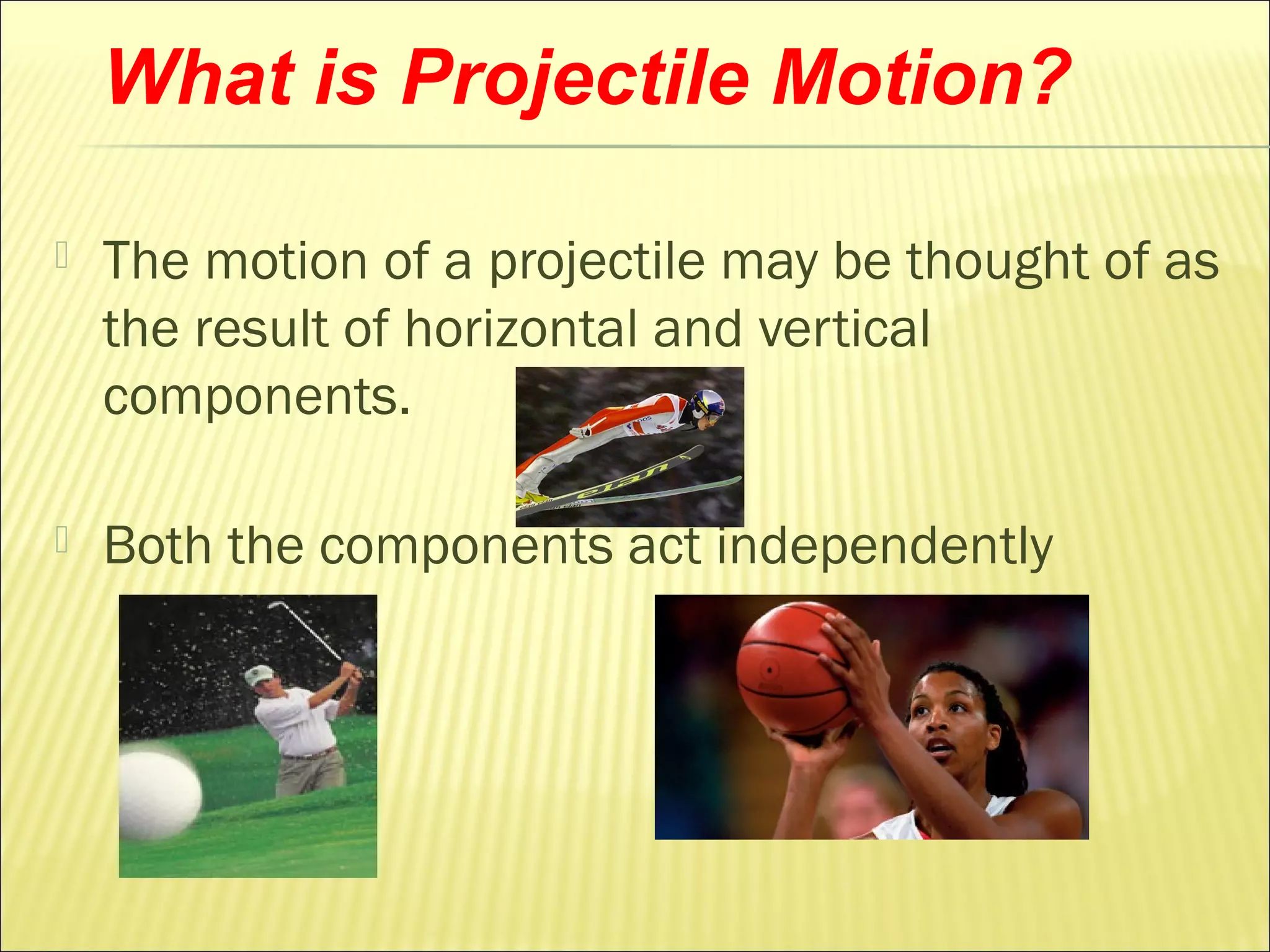
What is Projectile Motion?

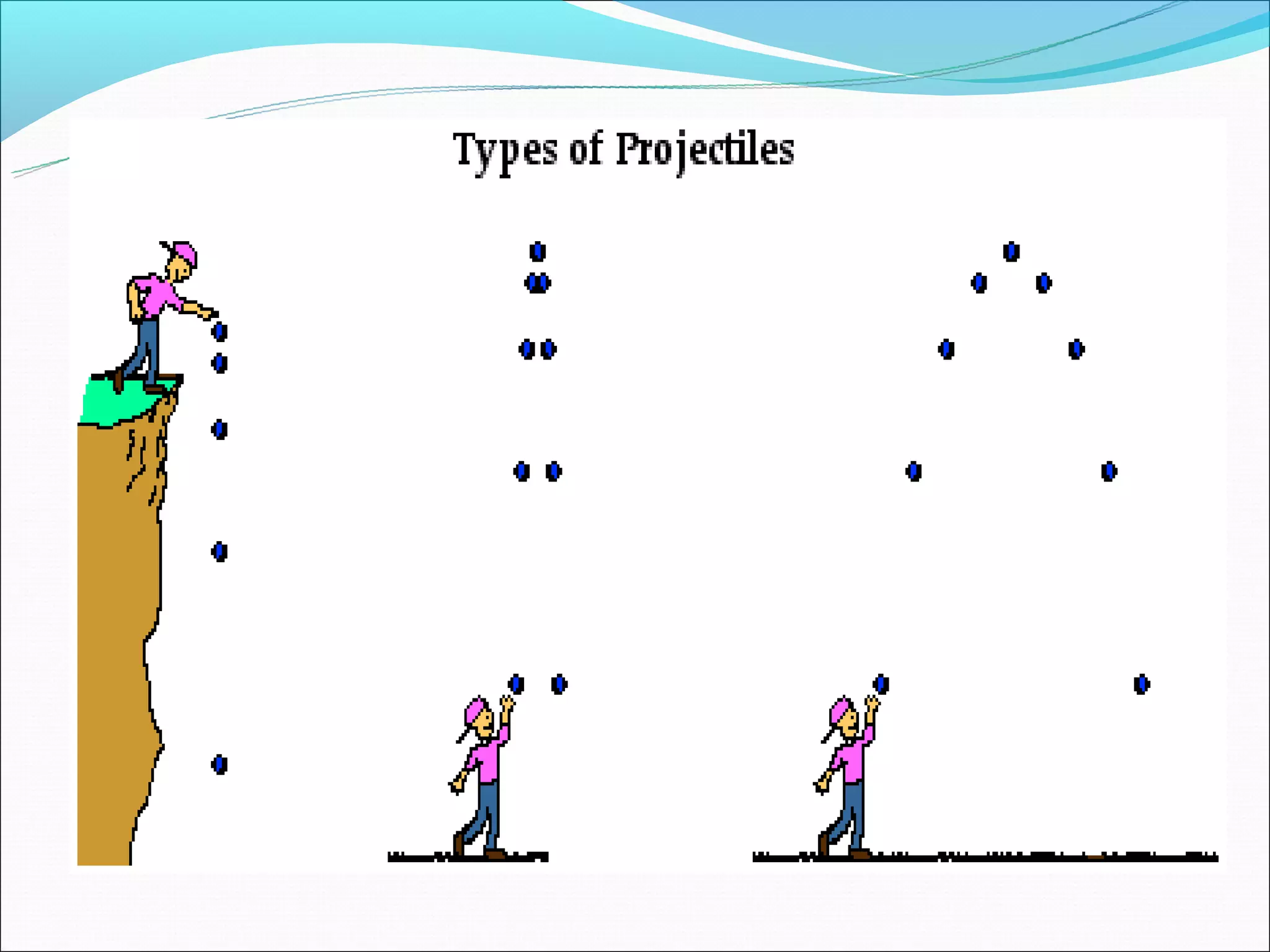
   The motion of a projectile may be thought of as
    the result of horizontal and vertical
    components.

   Both the components act independently
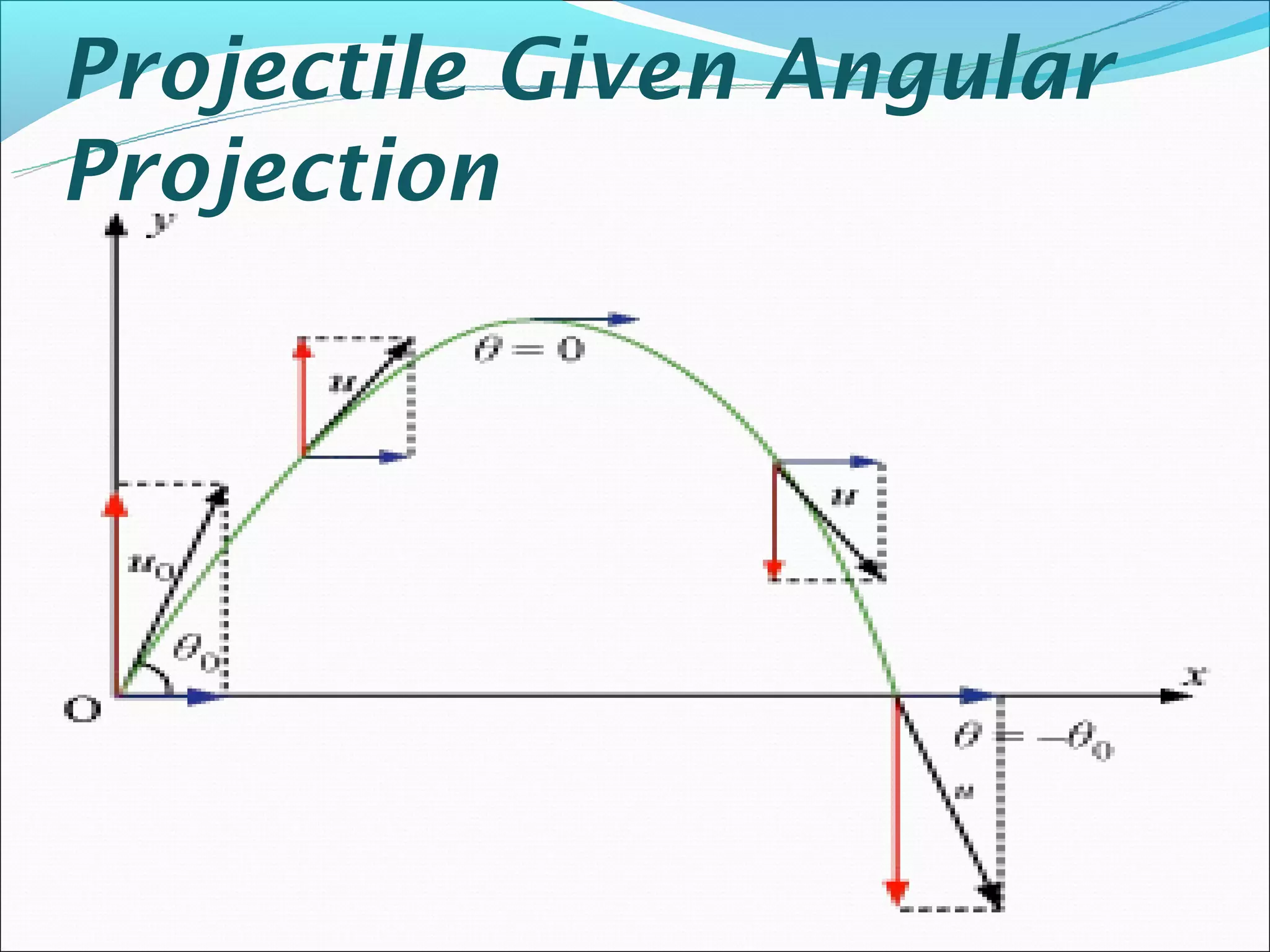
Projectile Given Angular
Projection
Equation of path of projectile
Suppose at any time t, the object is at point P (x, y).
 For motion along horizontal direction, the acceleration ax is zero.
  The position of the object at any time t is given by,


Here, x0 = 0, ux = u cos θ, ax = 0
[ Velocity of an object in the horizontal direction is constant]
Putting these values in equation (i),
⇒ x = ut cos θ


For motion along vertical direction, the acceleration ay is −g.
The position of the object at any time t along the vertical direction is
  given by,

Here,
∴


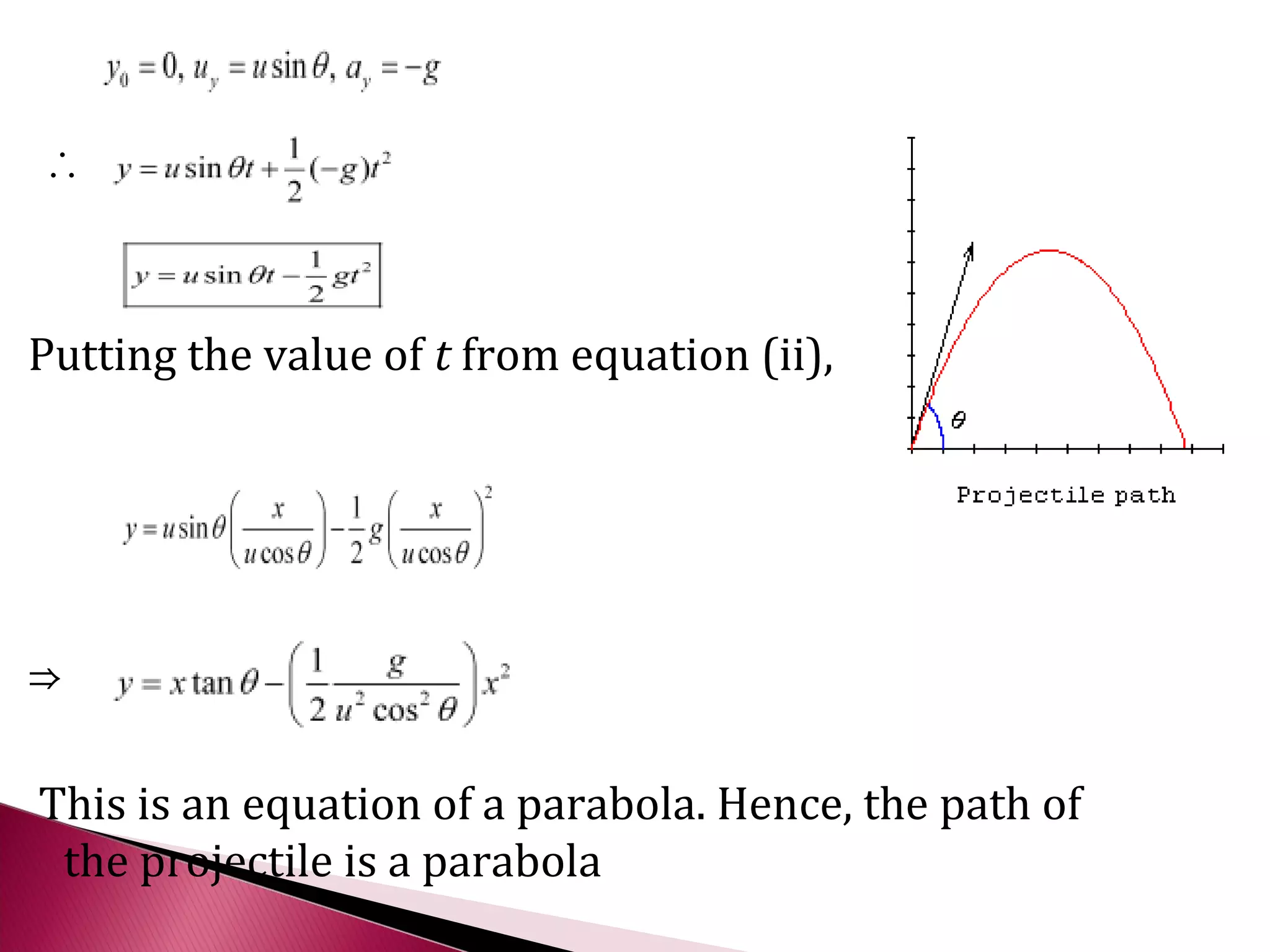
Putting the value of t from equation (ii),


⇒

This is an equation of a parabola. Hence, the path of
 the projectile is a parabola
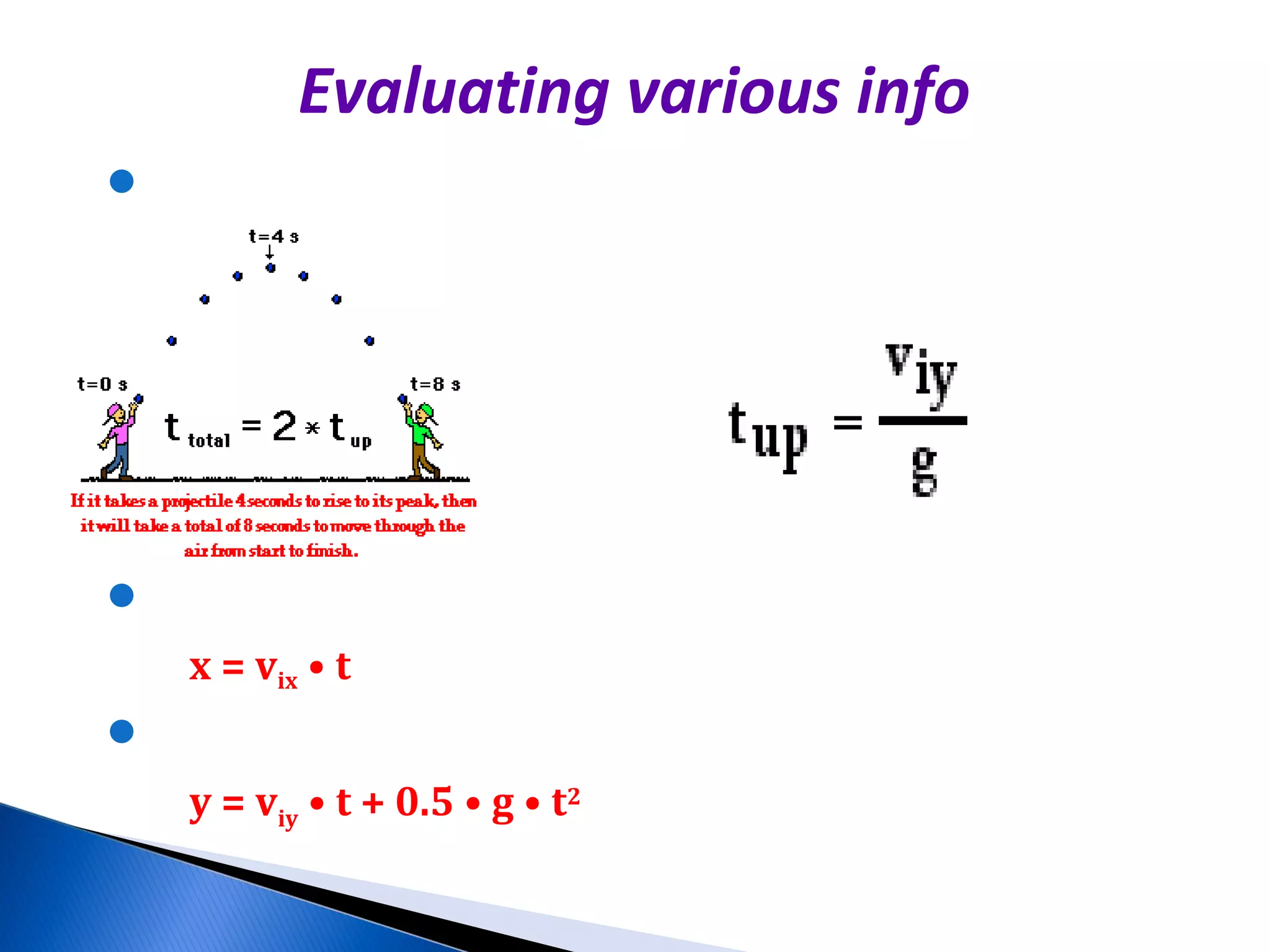
Time of flight
 Total time for which the object is in flight

 It is denoted by T.
 Total time of flight = Time of ascent + Time of descent
 ∴ T = t + t = 2t [Time of ascent = Time of descent = t]
      ⇒

  At the highest point H, the vertical component of velocity
  becomes zero. For vertical motion of the object (from 0 to H),


  ∴
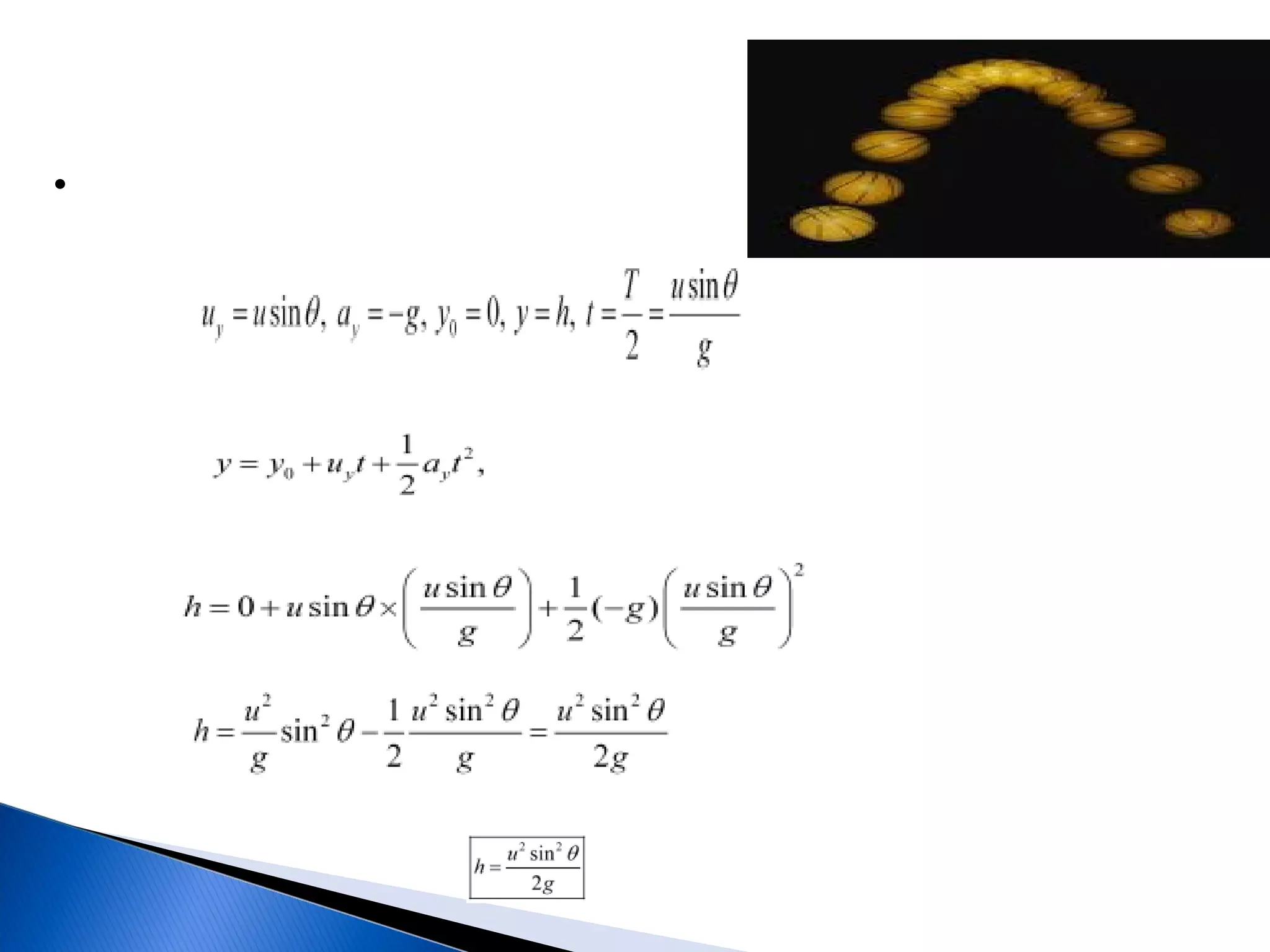
Maximum height
•Maximum height ‘h’ reached by the projectile
For vertical upward motion from 0 to H,


 Using the relation


 we obtain


    ⇒


             That is,
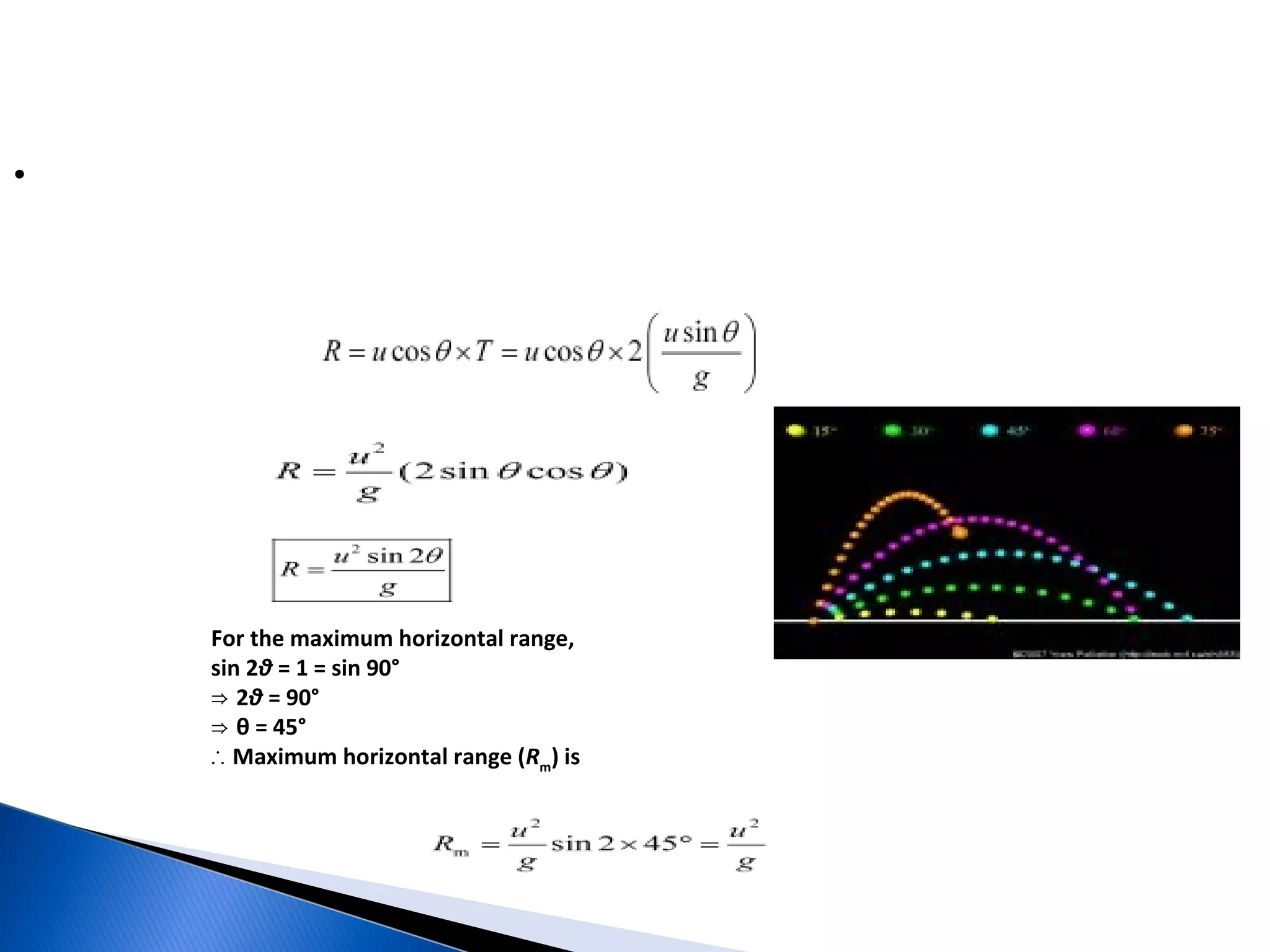
Horizontal Range
•Horizontal distance covered by the object between its point of projection and the point of hitting the
ground. It is denoted by R.
‘R’ is the distance travelled during time of flight T.


                  ⇒


                 ⇒
                  For the maximum horizontal range,
                  sin 2θ = 1 = sin 90°
                  ⇒ 2θ = 90°
                  ⇒ θ = 45°
                  ∴ Maximum horizontal range (Rm) is
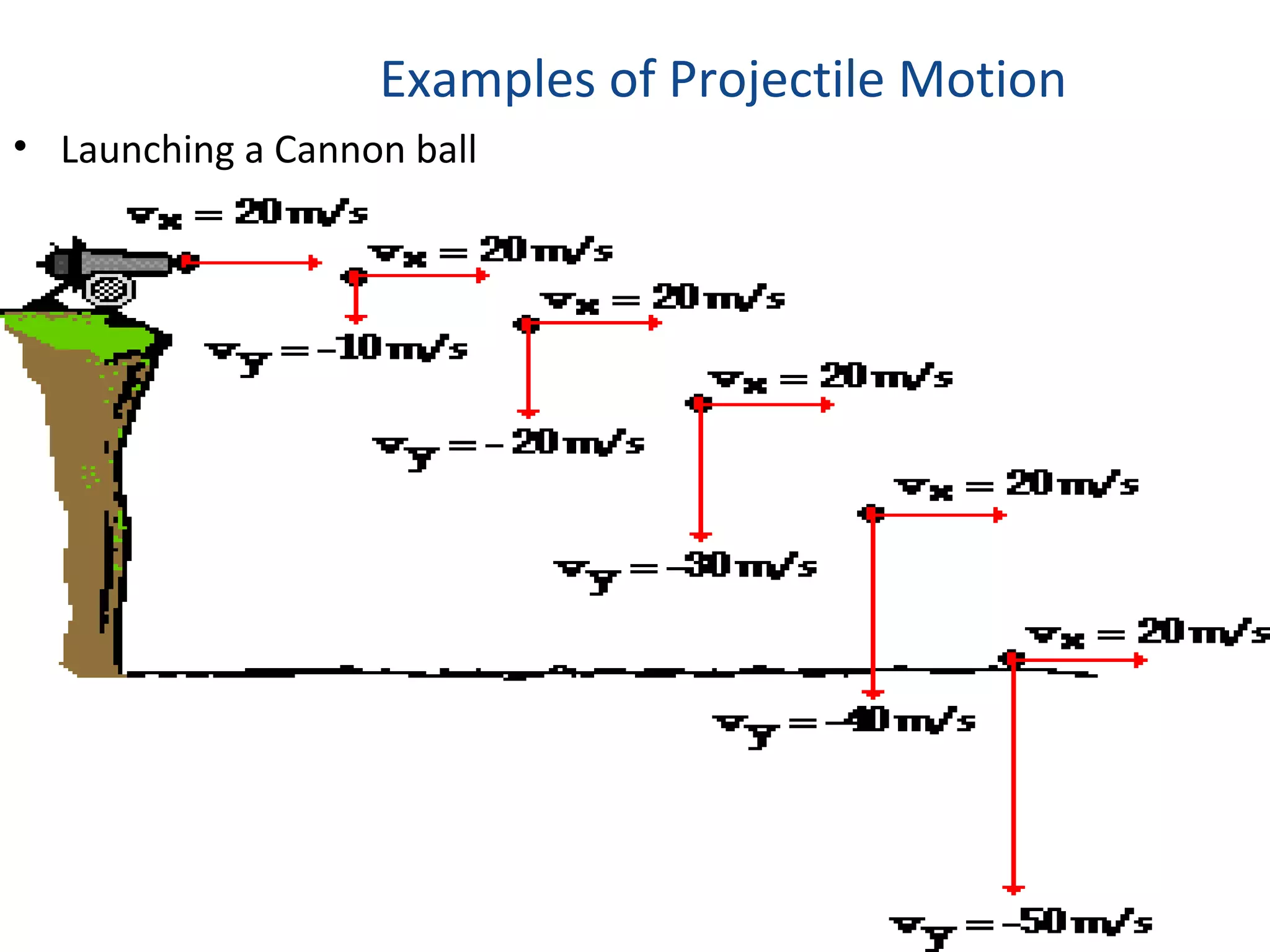
Examples of Projectile Motion
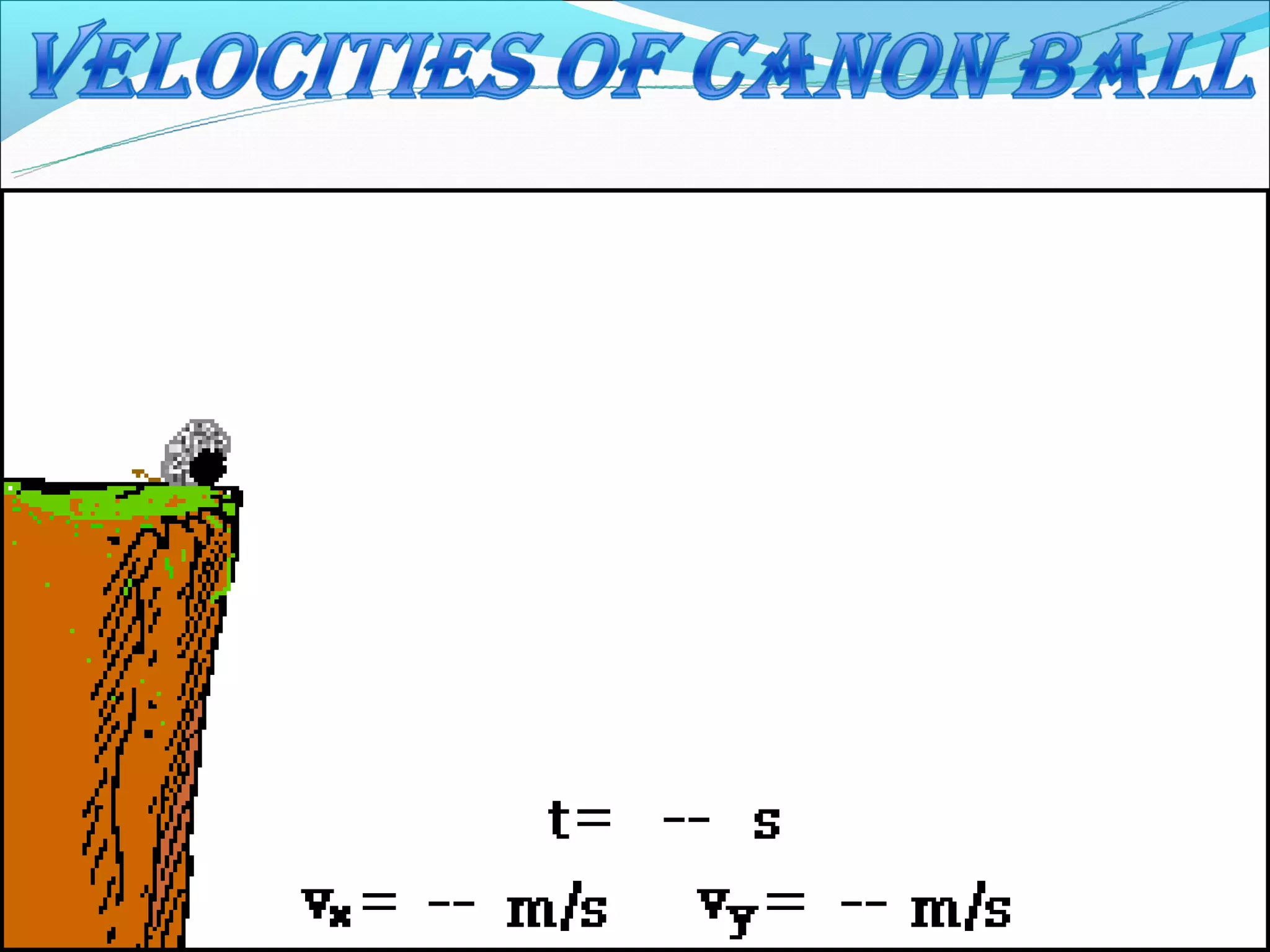
• Launching a Cannon ball
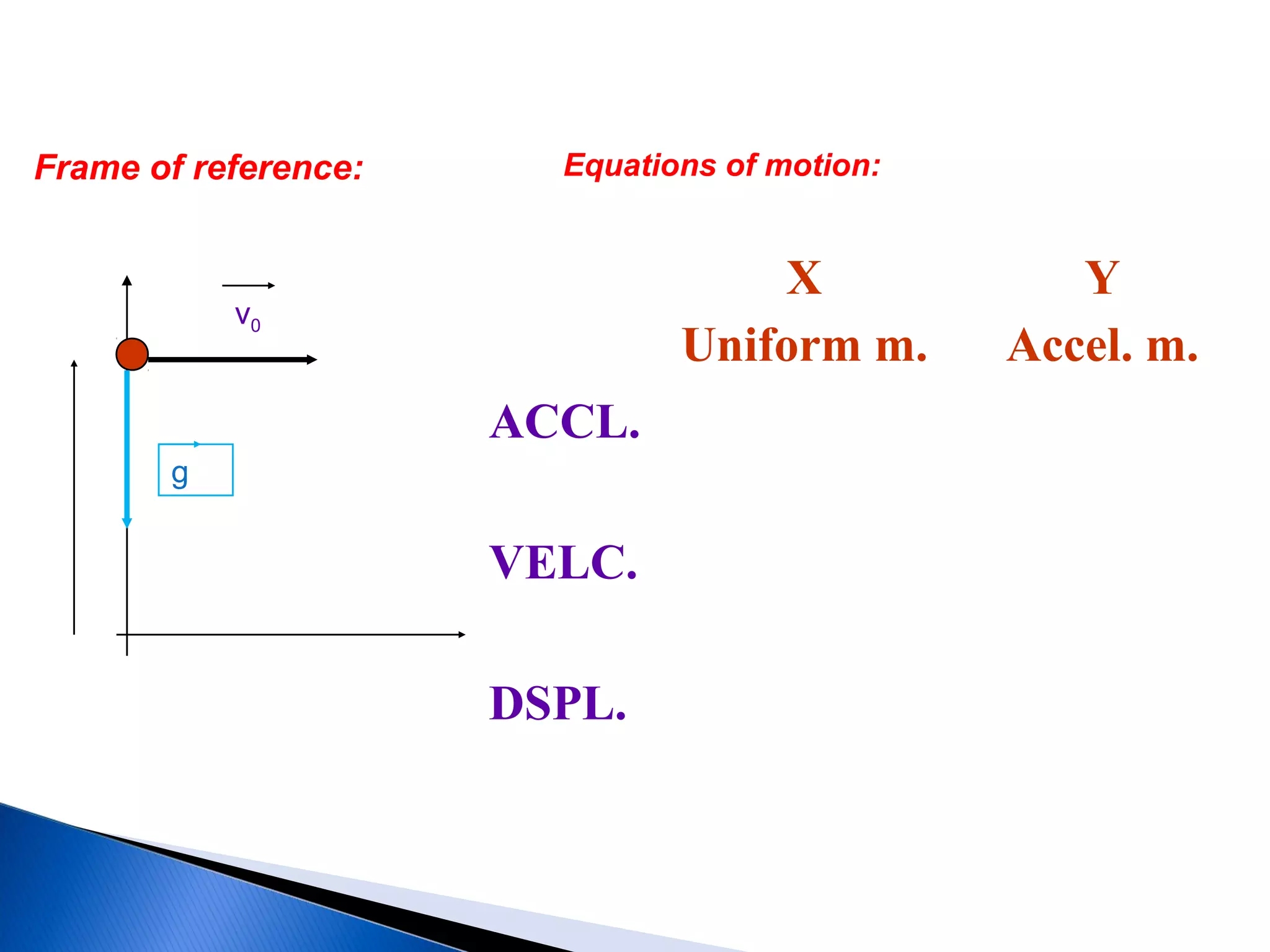
Frame of reference:         Equations of motion:

           y
                                           X                Y
                   v0
                                       Uniform m.        Accel. m.
                              ACCL.        ax = 0      ay = g = -9.81
               g
h                                                           m/s2
                              VELC.        vx = v0        vy = g t

                          x
       0                      DSPL.       x = v0 t     y = h + ½ g t2
Important points :
In case of projectile motion , the horizontal
 component of a velocity (u cos θ) , acceleration
 (g) and mechanical energy remains constant
 while, speed ,velocity , vertical component of
 velocity (v sin θ) ,momentum ,kinetic energy
 and potential energy all change.
Velocity and K.E are maximum at the point of
 projection while minimum (but not zero) at the
 highest point.
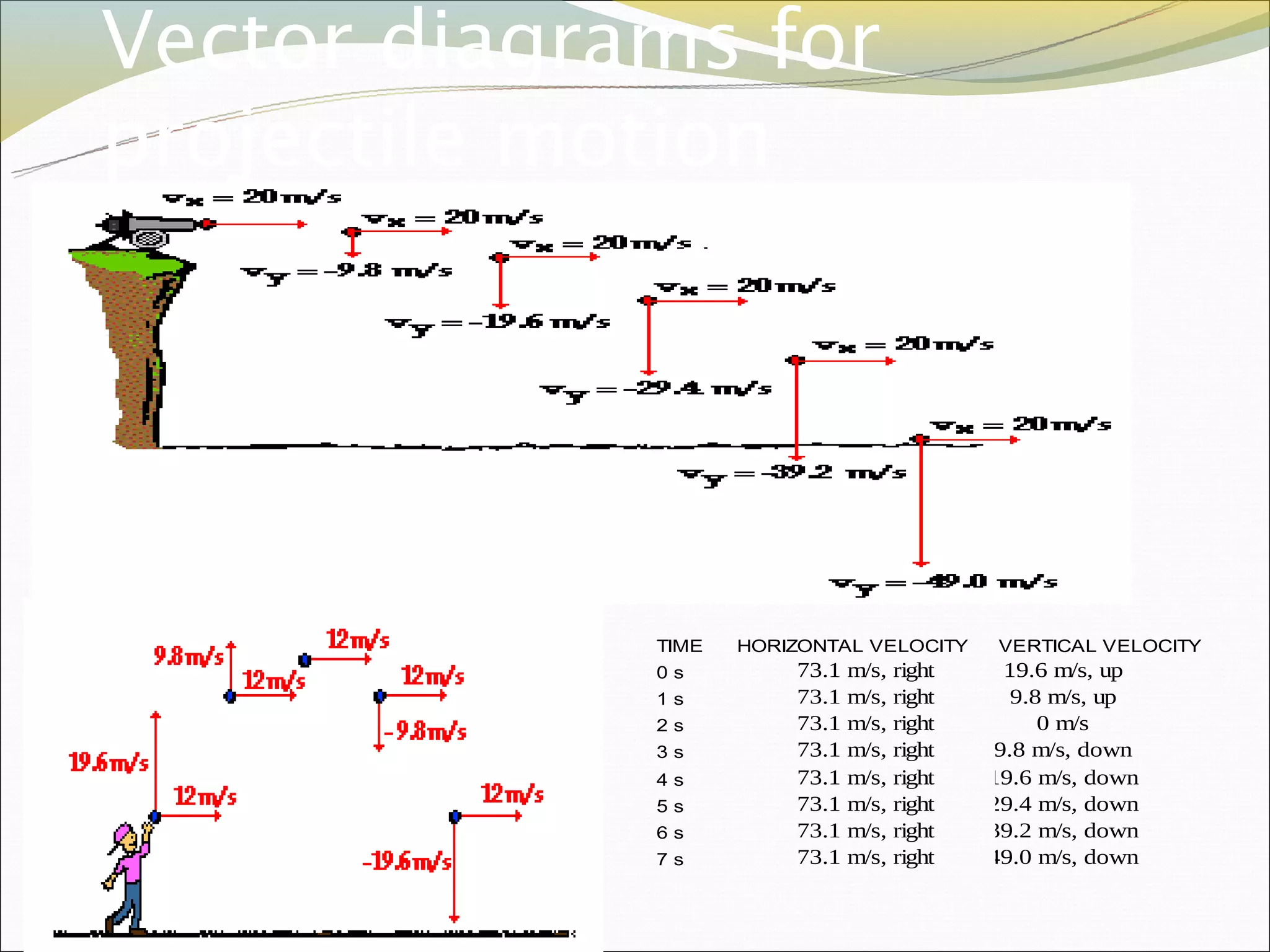
Vector diagrams for
projectile motion


             TIME   HORIZONTAL VELOCITY    VERTICAL VELOCITY
             0s         73.1 m/s, right    19.6 m/s, up
             1s         73.1 m/s, right     9.8 m/s, up
             2s         73.1 m/s, right        0 m/s
             3s         73.1 m/s, right   9.8 m/s, down
             4s         73.1 m/s, right   19.6 m/s, down
             5s         73.1 m/s, right   29.4 m/s, down
             6s         73.1 m/s, right   39.2 m/s, down
             7s         73.1 m/s, right   49.0 m/s, down
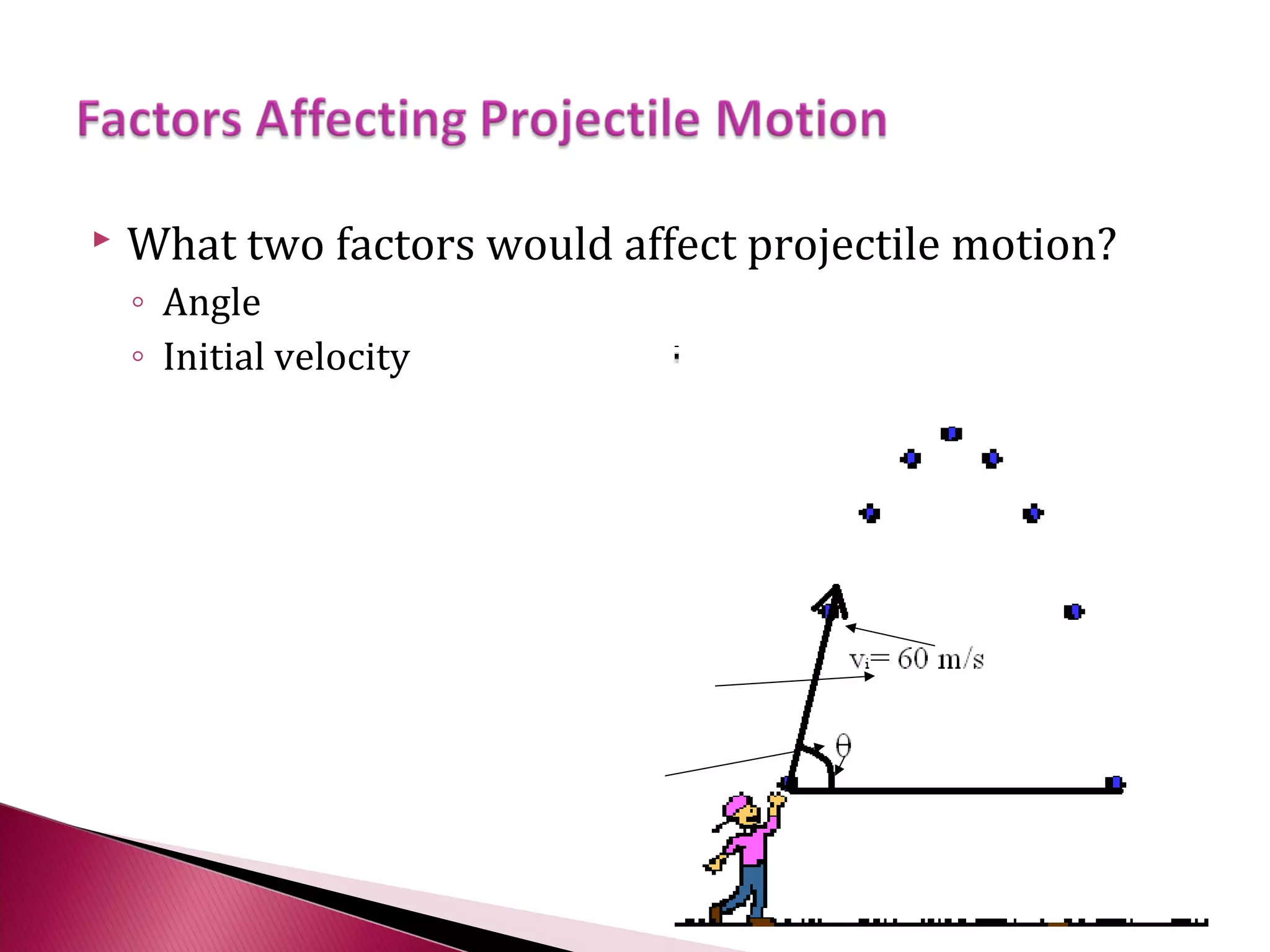
   What two factors would affect projectile motion?
    ◦ Angle
    ◦ Initial velocity


                         Initial Velocity

                             Angle
Evaluating various info
Determination of the Time of Flight


Determination of Horizontal Displacement
   x = vix • t
Determination of the Peak Height
   y = viy • t + 0.5 • g • t2
Applications
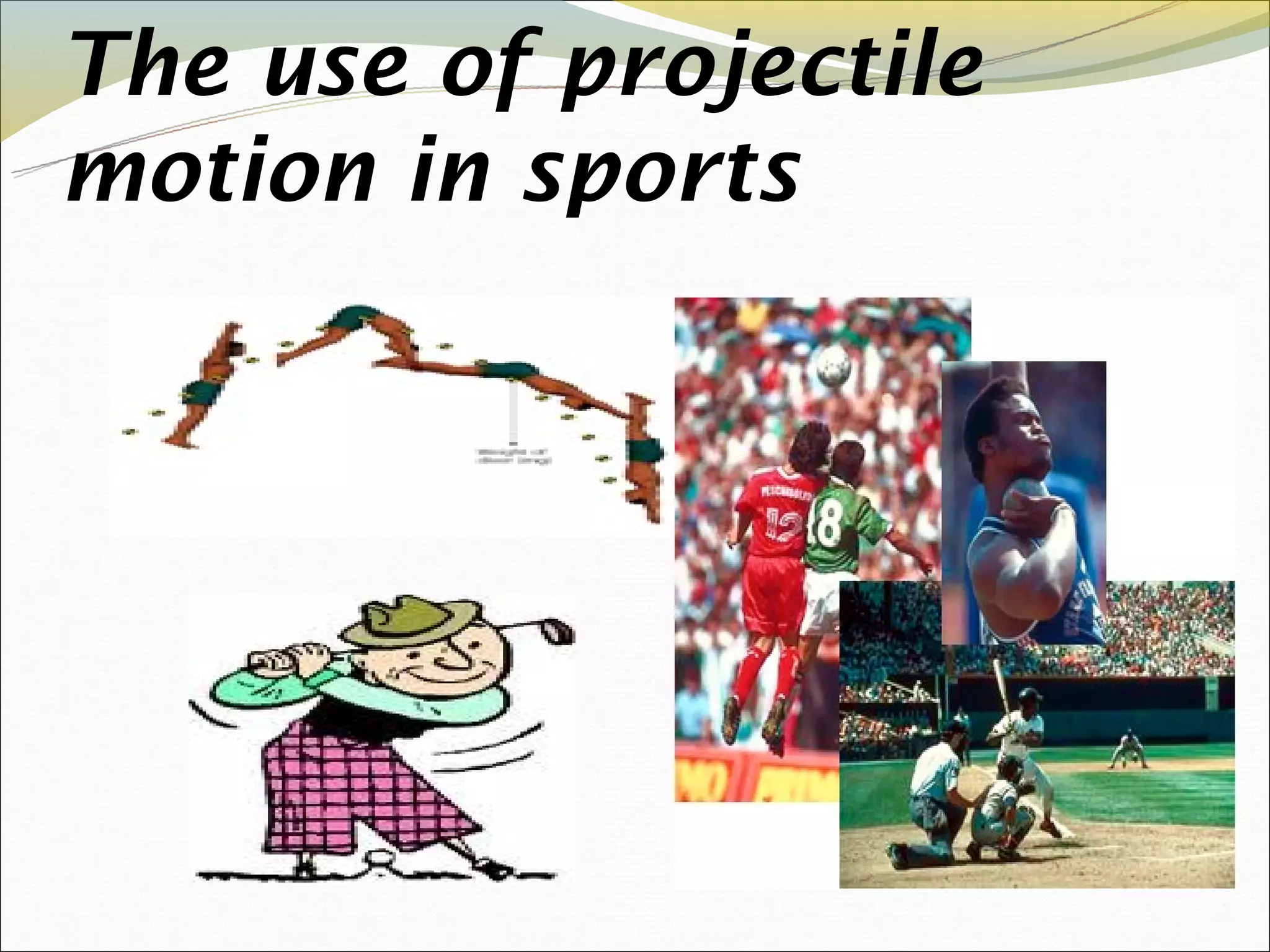
The use of projectile
motion in sports
   Like:-
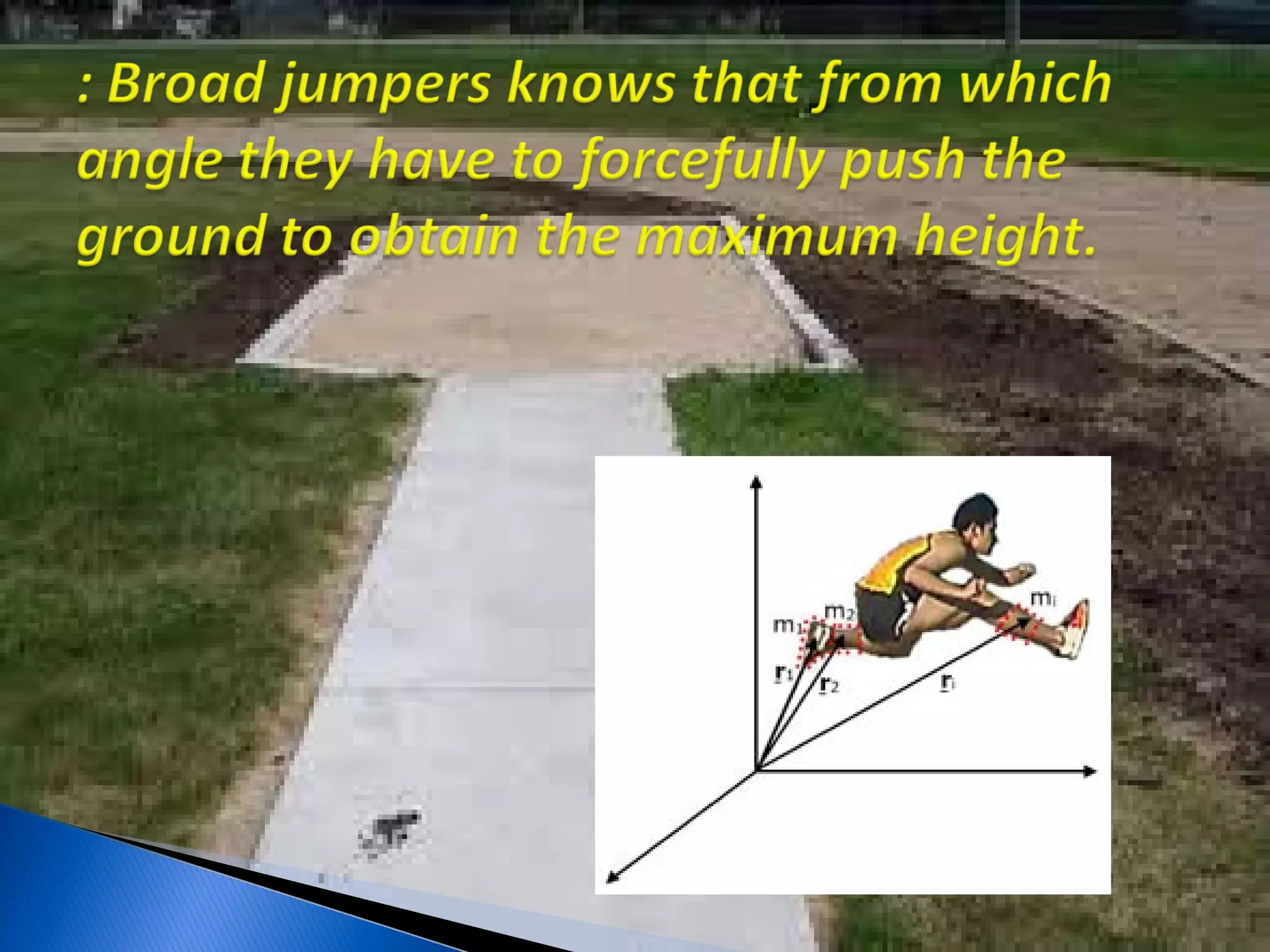
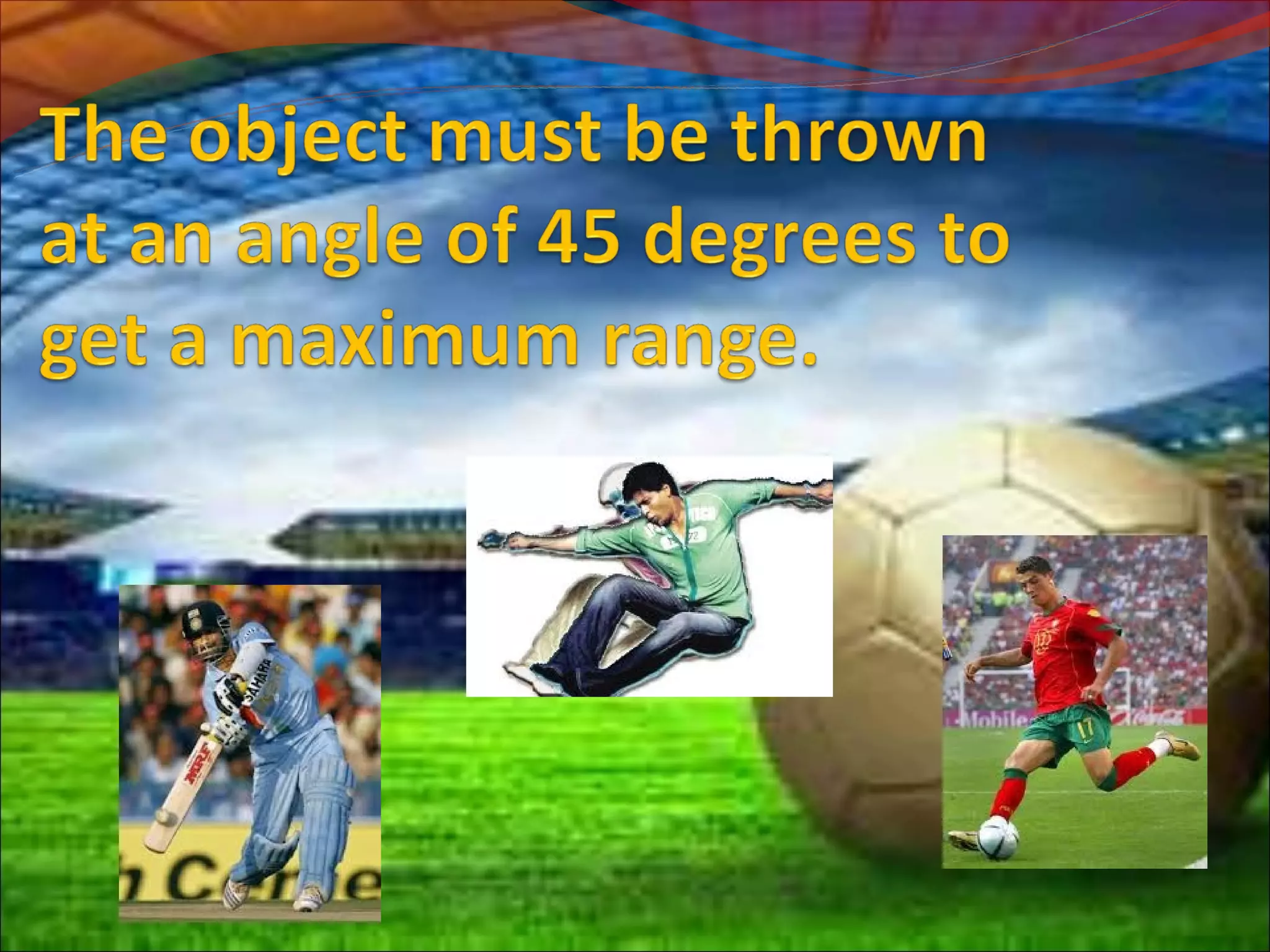
        Cricketers know that from which angle
    they have to hit to get the maximum range.
For your co-
operation

Projectile motionchemistory (4)

  • 1.
    NEHRU NAGAR Prepared by:- Siddhant-[XI-A] Saurabh-[X-C]
  • 3.
    What is ProjectileMotion?  The motion of a projectile may be thought of as the result of horizontal and vertical components.  Both the components act independently
  • 4.
  • 5.
    Equation of pathof projectile Suppose at any time t, the object is at point P (x, y).  For motion along horizontal direction, the acceleration ax is zero. The position of the object at any time t is given by, Here, x0 = 0, ux = u cos θ, ax = 0 [ Velocity of an object in the horizontal direction is constant] Putting these values in equation (i), ⇒ x = ut cos θ For motion along vertical direction, the acceleration ay is −g. The position of the object at any time t along the vertical direction is given by, Here,
  • 6.
    ∴ Putting the valueof t from equation (ii), ⇒ This is an equation of a parabola. Hence, the path of the projectile is a parabola
  • 7.
    Time of flight Total time for which the object is in flight It is denoted by T. Total time of flight = Time of ascent + Time of descent ∴ T = t + t = 2t [Time of ascent = Time of descent = t] ⇒ At the highest point H, the vertical component of velocity becomes zero. For vertical motion of the object (from 0 to H), ∴
  • 8.
    Maximum height •Maximum height‘h’ reached by the projectile For vertical upward motion from 0 to H, Using the relation we obtain ⇒ That is,
  • 9.
    Horizontal Range •Horizontal distancecovered by the object between its point of projection and the point of hitting the ground. It is denoted by R. ‘R’ is the distance travelled during time of flight T. ⇒ ⇒ For the maximum horizontal range, sin 2θ = 1 = sin 90° ⇒ 2θ = 90° ⇒ θ = 45° ∴ Maximum horizontal range (Rm) is
  • 11.
    Examples of ProjectileMotion • Launching a Cannon ball
  • 12.
    Frame of reference: Equations of motion: y X Y v0 Uniform m. Accel. m. ACCL. ax = 0 ay = g = -9.81 g h m/s2 VELC. vx = v0 vy = g t x 0 DSPL. x = v0 t y = h + ½ g t2
  • 13.
    Important points : Incase of projectile motion , the horizontal component of a velocity (u cos θ) , acceleration (g) and mechanical energy remains constant while, speed ,velocity , vertical component of velocity (v sin θ) ,momentum ,kinetic energy and potential energy all change. Velocity and K.E are maximum at the point of projection while minimum (but not zero) at the highest point.
  • 14.
    Vector diagrams for projectilemotion TIME HORIZONTAL VELOCITY VERTICAL VELOCITY 0s 73.1 m/s, right 19.6 m/s, up 1s 73.1 m/s, right 9.8 m/s, up 2s 73.1 m/s, right 0 m/s 3s 73.1 m/s, right 9.8 m/s, down 4s 73.1 m/s, right 19.6 m/s, down 5s 73.1 m/s, right 29.4 m/s, down 6s 73.1 m/s, right 39.2 m/s, down 7s 73.1 m/s, right 49.0 m/s, down
  • 15.
    What two factors would affect projectile motion? ◦ Angle ◦ Initial velocity Initial Velocity Angle
  • 16.
    Evaluating various info Determinationof the Time of Flight Determination of Horizontal Displacement x = vix • t Determination of the Peak Height y = viy • t + 0.5 • g • t2
  • 18.
  • 19.
    The use ofprojectile motion in sports
  • 20.
    Like:- Cricketers know that from which angle they have to hit to get the maximum range.
  • 27.