1
2-D
Transformations
Transformations
• The geometrical changes of an object from a current state to modified
state.
• To manipulate the initially created object and to display the modified
object without having to redraw it.
• Object Transformation
• Alter the coordinates descriptions of an object
• Translation, rotation, scaling etc.
2
2D Transformations
• Translation
• Rotation
• Scaling
• Mirror / Reflect
• Shearing /shear
3
• A translation moves all points in an
object along the same straight-line
path to new positions.
• The path is represented by a vector,
called the translation or shift vector.
p'x = tx + px
p'y = ty + py
tx
t
= 6
= 4
x’
y’
x
y
tx
ty
= +
Translation
4
[P'] = [ T] + [P]
P’
P
Rotation
5

P
P’
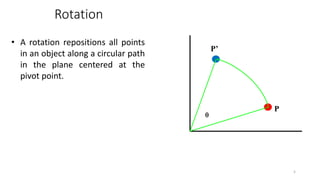
• A rotation repositions all points
in an object along a circular path
in the plane centered at the
pivot point.

P(x,y)

r

P’(x’, y’)
r
• x = r cos 
• y = r sin 
• x’ = r cos( + )
• x’ = r cos cos - r sin sin
• y’ = r sin( + )
• y’ = r cos sin + r sin cos
• From (A) & (B)
• x’ = xcos - ysin
• From (A) & (C)
• y’ = xsin + ycos
(A)
(B)
Rotation
6
(C)
[P'] = [T] [P]
x’
y’
x
y
=
cos -sin
sin cos
Scaling
• Scaling changes the size of an
object and involves two scale
factors, Sx and Sy for the X and Y
coordinates respectively.
• Scales are about the origin.
• x’ = sx * x
• y’ = sy * y
[P'] = [T] [P]
x’
y’
x
y
=
Sx 0
0 Sy
Image Reference:- CAD/CAM AND AUTOMATION By
Farazdak Haideri, Nirali Prakashan, Ninth Edition
7
Reflection
[P'] = [T] [P]
x’
y’
x
y
=
1 0
0 -1
@ Y-axis
x’
y’
x
y
=
-1 0
0 1
@ X-axis
[P'] = [T] [P]
x’ = x
y’ = -y
x’ = -x
y’ = y
8
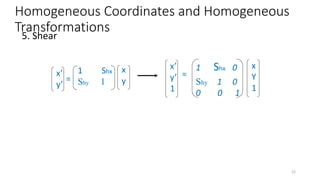
Shear
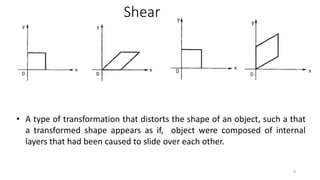
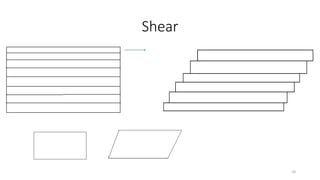
• A type of transformation that distorts the shape of an object, such a that
a transformed shape appears as if, object were composed of internal
layers that had been caused to slide over each other.
9
Shear
10
Shear
•x’ = x + yshx
•y’ = y
[P'] = [T] [P]
x’
y’
x
y
=
1 Shx
Shy 1
•x’ = x
•y’ = y + xshy
x’
y’
x
y
=
1 Shx
0 1
x’
y’
x
y
=
1 0
Shy 1
11
2D Transformations
12
x’
y’
x
y
tx
ty
= +
x’
y’
x
y
=
cos -sin
sin cos
x’
y’
x
y
=
Sx 0
0 Sy
x’
y’
x
y
= 1 0
0 -1
x’
y’
x
y
=
-1 0
0 1
x’
y’
x
y
=
1 Shx
Shy 1
[P'] = [ T] + [P]
[P'] = [T] [P]
Homogeneous Coordinates and Homogeneous
Transformations
• All the transformations, except translation, are in the form of matrix
multiplication.
• “Translation” takes the form of vector addition.
• This makes it inconvenient to concatenate transformations involving
translation.
• It is therefore desirable to express all geometric transformations in the
form of matrix multiplication only.
13
Homogeneous Coordinates and Homogeneous
Transformations
• Many graphics applications involve sequence of geometric
transformations.
• Animations also require an object to be translated, rotated, scaled, etc.
at an each increment of a motion sequence.
• In design and picture construction applications different transformations
are used to fit the picture components into their proper positions.
14
Homogeneous Coordinates and Homogeneous
Transformations
• Representing points by their homogeneous coordinates, provides an
effective way to unify the description of geometric transformations
as matrix multiplication.
• Homogeneous coordinates have been used in computer graphics and
geometric modelling techniques.
• With the help of homogeneous coordinates, geometric
transformations are customarily embedded into graphics hardware to
speed their execution.
15
Homogeneous Coordinates and
Homogeneous Transformations
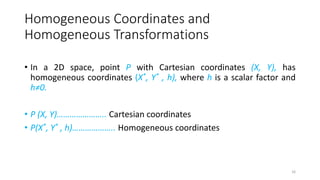
• In a 2D space, point P with Cartesian coordinates (X, Y), has
homogeneous coordinates (X*, Y* , h), where h is a scalar factor and
h≠0.
• P (X, Y)………………….. Cartesian coordinates
• P(X*, Y* , h)……………….. Homogeneous coordinates
16
Homogeneous Coordinates and Homogeneous
Transformations
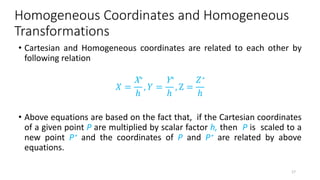
• Cartesian and Homogeneous coordinates are related to each other by
following relation
𝑋 =
X∗
ℎ
, 𝑌 =
Y∗
ℎ
, Z =
𝑍∗
ℎ
• Above equations are based on the fact that, if the Cartesian coordinates
of a given point P are multiplied by scalar factor h, then P is scaled to a
new point P∗ and the coordinates of P and P∗ are related by above
equations.
17
Homogeneous Coordinates and Homogeneous
Transformations
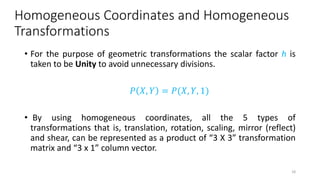
• For the purpose of geometric transformations the scalar factor h is
taken to be Unity to avoid unnecessary divisions.
𝑃 𝑋, 𝑌 = 𝑃(𝑋, 𝑌, 1)
• By using homogeneous coordinates, all the 5 types of
transformations that is, translation, rotation, scaling, mirror (reflect)
and shear, can be represented as a product of “3 X 3” transformation
matrix and “3 x 1” column vector.
18
Homogeneous Coordinates and Homogeneous
Transformations
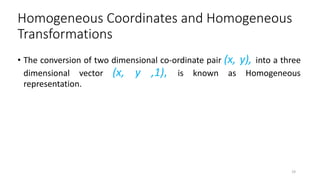
• The conversion of two dimensional co-ordinate pair (x, y), into a three
dimensional vector (x, y ,1), is known as Homogeneous
representation.
19
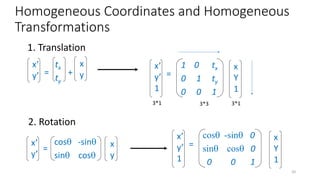
x’
y’
x
y
tx
ty
= +
x’
y’
x
y
=
cos -sin
sin cos
x’
y’
1
1 0 tx
0 1 ty
0 0 1
=
x
Y
1
x’
y’
1
cos -sin 0
sin cos 0
0 0 1
=
x
Y
1
Homogeneous Coordinates and Homogeneous
Transformations
20
1. Translation
2. Rotation
3*3 3*1
3*1
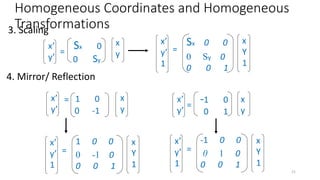
x’
y’
x
y
=
Sx 0
0 Sy
x’
y’
x
y
= 1 0
0 -1
x’
y’
x
y
=
-1 0
0 1
x’
y’
1
Sx 0 0
0 Sy 0
0 0 1
=
x
Y
1
x’
y’
1
1 0 0
0 -1 0
0 0 1
=
x
Y
1
x’
y’
1
-1 0 0
0 1 0
0 0 1
=
x
Y
1
3. Scaling
4. Mirror/ Reflection
Homogeneous Coordinates and Homogeneous
Transformations
21
x’
y’
x
y
=
1 Shx
Shy 1
x’
y’
1
1 Shx 0
Shy 1 0
0 0 1
=
x
Y
1
5. Shear
Homogeneous Coordinates and Homogeneous
Transformations
22
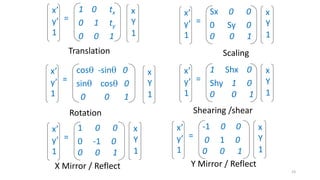
x’
y’
1
1 0 tx
0 1 ty
0 0 1
=
x
Y
1
x’
y’
1
cos -sin 0
sin cos 0
0 0 1
=
x
Y
1
x’
y’
1
Sx 0 0
0 Sy 0
0 0 1
=
x
Y
1
x’
y’
1
1 0 0
0 -1 0
0 0 1
=
x
Y
1
x’
y’
1
-1 0 0
0 1 0
0 0 1
=
x
Y
1
x’
y’
1
1 Shx 0
Shy 1 0
0 0 1
=
x
Y
1
Shearing /shear
Translation
Rotation
Scaling
X Mirror / Reflect Y Mirror / Reflect
23
Homogeneous Coordinates and Homogeneous
Transformations
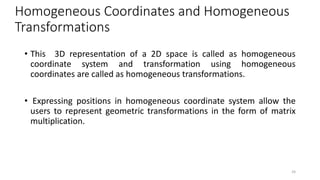
• This 3D representation of a 2D space is called as homogeneous
coordinate system and transformation using homogeneous
coordinates are called as homogeneous transformations.
• Expressing positions in homogeneous coordinate system allow the
users to represent geometric transformations in the form of matrix
multiplication.
24
Composite Transformations /
Concatenations
25
[P'] = [Tn] [Tn-1] [Tn-2]…… [T3] [T2] [T1] [P]
[P'] = [T] [P]
[T1], [T2], [T3],…….., [Tn-2], [Tn-1],[Tn]
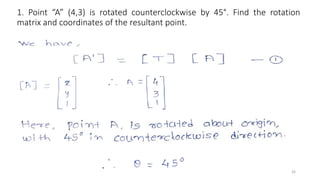
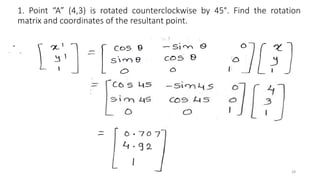
1. Point “A” (4,3) is rotated counterclockwise by 45°. Find the rotation
matrix and coordinates of the resultant point.
26
1. Point “A” (4,3) is rotated counterclockwise by 45°. Find the rotation matrix and
coordinates of the resultant point.
27
[A']
[T]Rotation
[A]
[T]
1. Point “A” (4,3) is rotated counterclockwise by 45°. Find the rotation
matrix and coordinates of the resultant point.
28
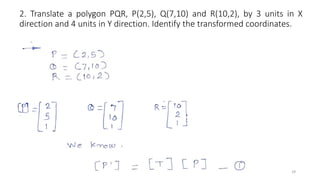
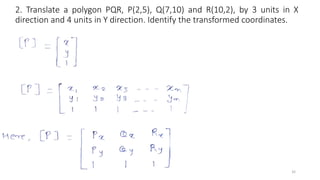
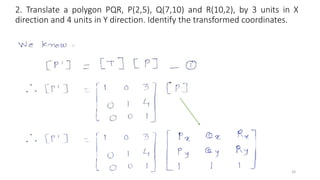
2. Translate a polygon PQR, P(2,5), Q(7,10) and R(10,2), by 3 units in X
direction and 4 units in Y direction. Identify the transformed coordinates.
29
2. Translate a polygon PQR, P(2,5), Q(7,10) and R(10,2), by 3 units in X
direction and 4 units in Y direction. Identify the transformed coordinates.
30
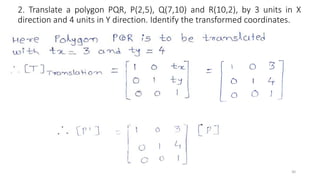
2. Translate a polygon PQR, P(2,5), Q(7,10) and R(10,2), by 3 units in X
direction and 4 units in Y direction. Identify the transformed coordinates.
31
2. Translate a polygon PQR, P(2,5), Q(7,10) and R(10,2), by 3 units in X
direction and 4 units in Y direction. Identify the transformed coordinates.
32
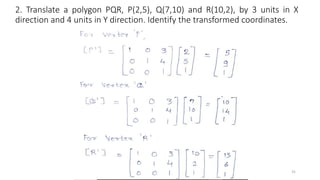
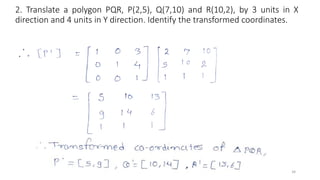
2. Translate a polygon PQR, P(2,5), Q(7,10) and R(10,2), by 3 units in X
direction and 4 units in Y direction. Identify the transformed coordinates.
33
2. Translate a polygon PQR, P(2,5), Q(7,10) and R(10,2), by 3 units in X
direction and 4 units in Y direction. Identify the transformed coordinates.
34
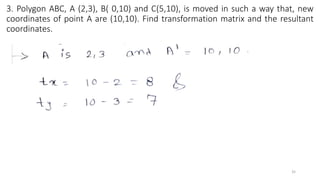
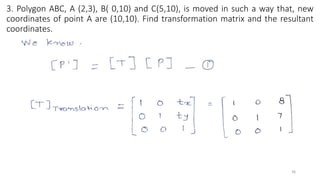
3. Polygon ABC, A (2,3), B( 0,10) and C(5,10), is moved in such a way that, new
coordinates of point A are (10,10). Find transformation matrix and the resultant
coordinates.
35
3. Polygon ABC, A (2,3), B( 0,10) and C(5,10), is moved in such a way that, new
coordinates of point A are (10,10). Find transformation matrix and the resultant
coordinates.
36
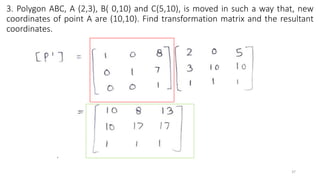
3. Polygon ABC, A (2,3), B( 0,10) and C(5,10), is moved in such a way that, new
coordinates of point A are (10,10). Find transformation matrix and the resultant
coordinates.
37
Thank You

2D Transformation.pdf

  • 1.
  • 2.
    Transformations • The geometricalchanges of an object from a current state to modified state. • To manipulate the initially created object and to display the modified object without having to redraw it. • Object Transformation • Alter the coordinates descriptions of an object • Translation, rotation, scaling etc. 2
  • 3.
    2D Transformations • Translation •Rotation • Scaling • Mirror / Reflect • Shearing /shear 3
  • 4.
    • A translationmoves all points in an object along the same straight-line path to new positions. • The path is represented by a vector, called the translation or shift vector. p'x = tx + px p'y = ty + py tx t = 6 = 4 x’ y’ x y tx ty = + Translation 4 [P'] = [ T] + [P] P’ P
  • 5.
    Rotation 5  P P’ • A rotationrepositions all points in an object along a circular path in the plane centered at the pivot point.
  • 6.
     P(x,y)  r  P’(x’, y’) r • x= r cos  • y = r sin  • x’ = r cos( + ) • x’ = r cos cos - r sin sin • y’ = r sin( + ) • y’ = r cos sin + r sin cos • From (A) & (B) • x’ = xcos - ysin • From (A) & (C) • y’ = xsin + ycos (A) (B) Rotation 6 (C) [P'] = [T] [P] x’ y’ x y = cos -sin sin cos
  • 7.
    Scaling • Scaling changesthe size of an object and involves two scale factors, Sx and Sy for the X and Y coordinates respectively. • Scales are about the origin. • x’ = sx * x • y’ = sy * y [P'] = [T] [P] x’ y’ x y = Sx 0 0 Sy Image Reference:- CAD/CAM AND AUTOMATION By Farazdak Haideri, Nirali Prakashan, Ninth Edition 7
  • 8.
    Reflection [P'] = [T][P] x’ y’ x y = 1 0 0 -1 @ Y-axis x’ y’ x y = -1 0 0 1 @ X-axis [P'] = [T] [P] x’ = x y’ = -y x’ = -x y’ = y 8
  • 9.
    Shear • A typeof transformation that distorts the shape of an object, such a that a transformed shape appears as if, object were composed of internal layers that had been caused to slide over each other. 9
  • 10.
  • 11.
    Shear •x’ = x+ yshx •y’ = y [P'] = [T] [P] x’ y’ x y = 1 Shx Shy 1 •x’ = x •y’ = y + xshy x’ y’ x y = 1 Shx 0 1 x’ y’ x y = 1 0 Shy 1 11
  • 12.
    2D Transformations 12 x’ y’ x y tx ty = + x’ y’ x y = cos-sin sin cos x’ y’ x y = Sx 0 0 Sy x’ y’ x y = 1 0 0 -1 x’ y’ x y = -1 0 0 1 x’ y’ x y = 1 Shx Shy 1 [P'] = [ T] + [P] [P'] = [T] [P]
  • 13.
    Homogeneous Coordinates andHomogeneous Transformations • All the transformations, except translation, are in the form of matrix multiplication. • “Translation” takes the form of vector addition. • This makes it inconvenient to concatenate transformations involving translation. • It is therefore desirable to express all geometric transformations in the form of matrix multiplication only. 13
  • 14.
    Homogeneous Coordinates andHomogeneous Transformations • Many graphics applications involve sequence of geometric transformations. • Animations also require an object to be translated, rotated, scaled, etc. at an each increment of a motion sequence. • In design and picture construction applications different transformations are used to fit the picture components into their proper positions. 14
  • 15.
    Homogeneous Coordinates andHomogeneous Transformations • Representing points by their homogeneous coordinates, provides an effective way to unify the description of geometric transformations as matrix multiplication. • Homogeneous coordinates have been used in computer graphics and geometric modelling techniques. • With the help of homogeneous coordinates, geometric transformations are customarily embedded into graphics hardware to speed their execution. 15
  • 16.
    Homogeneous Coordinates and HomogeneousTransformations • In a 2D space, point P with Cartesian coordinates (X, Y), has homogeneous coordinates (X*, Y* , h), where h is a scalar factor and h≠0. • P (X, Y)………………….. Cartesian coordinates • P(X*, Y* , h)……………….. Homogeneous coordinates 16
  • 17.
    Homogeneous Coordinates andHomogeneous Transformations • Cartesian and Homogeneous coordinates are related to each other by following relation 𝑋 = X∗ ℎ , 𝑌 = Y∗ ℎ , Z = 𝑍∗ ℎ • Above equations are based on the fact that, if the Cartesian coordinates of a given point P are multiplied by scalar factor h, then P is scaled to a new point P∗ and the coordinates of P and P∗ are related by above equations. 17
  • 18.
    Homogeneous Coordinates andHomogeneous Transformations • For the purpose of geometric transformations the scalar factor h is taken to be Unity to avoid unnecessary divisions. 𝑃 𝑋, 𝑌 = 𝑃(𝑋, 𝑌, 1) • By using homogeneous coordinates, all the 5 types of transformations that is, translation, rotation, scaling, mirror (reflect) and shear, can be represented as a product of “3 X 3” transformation matrix and “3 x 1” column vector. 18
  • 19.
    Homogeneous Coordinates andHomogeneous Transformations • The conversion of two dimensional co-ordinate pair (x, y), into a three dimensional vector (x, y ,1), is known as Homogeneous representation. 19
  • 20.
    x’ y’ x y tx ty = + x’ y’ x y = cos -sin sincos x’ y’ 1 1 0 tx 0 1 ty 0 0 1 = x Y 1 x’ y’ 1 cos -sin 0 sin cos 0 0 0 1 = x Y 1 Homogeneous Coordinates and Homogeneous Transformations 20 1. Translation 2. Rotation 3*3 3*1 3*1
  • 21.
    x’ y’ x y = Sx 0 0 Sy x’ y’ x y =1 0 0 -1 x’ y’ x y = -1 0 0 1 x’ y’ 1 Sx 0 0 0 Sy 0 0 0 1 = x Y 1 x’ y’ 1 1 0 0 0 -1 0 0 0 1 = x Y 1 x’ y’ 1 -1 0 0 0 1 0 0 0 1 = x Y 1 3. Scaling 4. Mirror/ Reflection Homogeneous Coordinates and Homogeneous Transformations 21
  • 22.
    x’ y’ x y = 1 Shx Shy 1 x’ y’ 1 1Shx 0 Shy 1 0 0 0 1 = x Y 1 5. Shear Homogeneous Coordinates and Homogeneous Transformations 22
  • 23.
    x’ y’ 1 1 0 tx 01 ty 0 0 1 = x Y 1 x’ y’ 1 cos -sin 0 sin cos 0 0 0 1 = x Y 1 x’ y’ 1 Sx 0 0 0 Sy 0 0 0 1 = x Y 1 x’ y’ 1 1 0 0 0 -1 0 0 0 1 = x Y 1 x’ y’ 1 -1 0 0 0 1 0 0 0 1 = x Y 1 x’ y’ 1 1 Shx 0 Shy 1 0 0 0 1 = x Y 1 Shearing /shear Translation Rotation Scaling X Mirror / Reflect Y Mirror / Reflect 23
  • 24.
    Homogeneous Coordinates andHomogeneous Transformations • This 3D representation of a 2D space is called as homogeneous coordinate system and transformation using homogeneous coordinates are called as homogeneous transformations. • Expressing positions in homogeneous coordinate system allow the users to represent geometric transformations in the form of matrix multiplication. 24
  • 25.
    Composite Transformations / Concatenations 25 [P']= [Tn] [Tn-1] [Tn-2]…… [T3] [T2] [T1] [P] [P'] = [T] [P] [T1], [T2], [T3],…….., [Tn-2], [Tn-1],[Tn]
  • 26.
    1. Point “A”(4,3) is rotated counterclockwise by 45°. Find the rotation matrix and coordinates of the resultant point. 26
  • 27.
    1. Point “A”(4,3) is rotated counterclockwise by 45°. Find the rotation matrix and coordinates of the resultant point. 27 [A'] [T]Rotation [A] [T]
  • 28.
    1. Point “A”(4,3) is rotated counterclockwise by 45°. Find the rotation matrix and coordinates of the resultant point. 28
  • 29.
    2. Translate apolygon PQR, P(2,5), Q(7,10) and R(10,2), by 3 units in X direction and 4 units in Y direction. Identify the transformed coordinates. 29
  • 30.
    2. Translate apolygon PQR, P(2,5), Q(7,10) and R(10,2), by 3 units in X direction and 4 units in Y direction. Identify the transformed coordinates. 30
  • 31.
    2. Translate apolygon PQR, P(2,5), Q(7,10) and R(10,2), by 3 units in X direction and 4 units in Y direction. Identify the transformed coordinates. 31
  • 32.
    2. Translate apolygon PQR, P(2,5), Q(7,10) and R(10,2), by 3 units in X direction and 4 units in Y direction. Identify the transformed coordinates. 32
  • 33.
    2. Translate apolygon PQR, P(2,5), Q(7,10) and R(10,2), by 3 units in X direction and 4 units in Y direction. Identify the transformed coordinates. 33
  • 34.
    2. Translate apolygon PQR, P(2,5), Q(7,10) and R(10,2), by 3 units in X direction and 4 units in Y direction. Identify the transformed coordinates. 34
  • 35.
    3. Polygon ABC,A (2,3), B( 0,10) and C(5,10), is moved in such a way that, new coordinates of point A are (10,10). Find transformation matrix and the resultant coordinates. 35
  • 36.
    3. Polygon ABC,A (2,3), B( 0,10) and C(5,10), is moved in such a way that, new coordinates of point A are (10,10). Find transformation matrix and the resultant coordinates. 36
  • 37.
    3. Polygon ABC,A (2,3), B( 0,10) and C(5,10), is moved in such a way that, new coordinates of point A are (10,10). Find transformation matrix and the resultant coordinates. 37
  • 38.