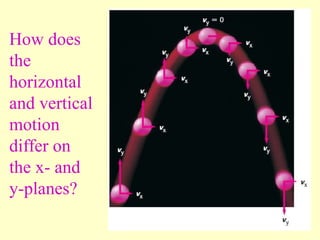
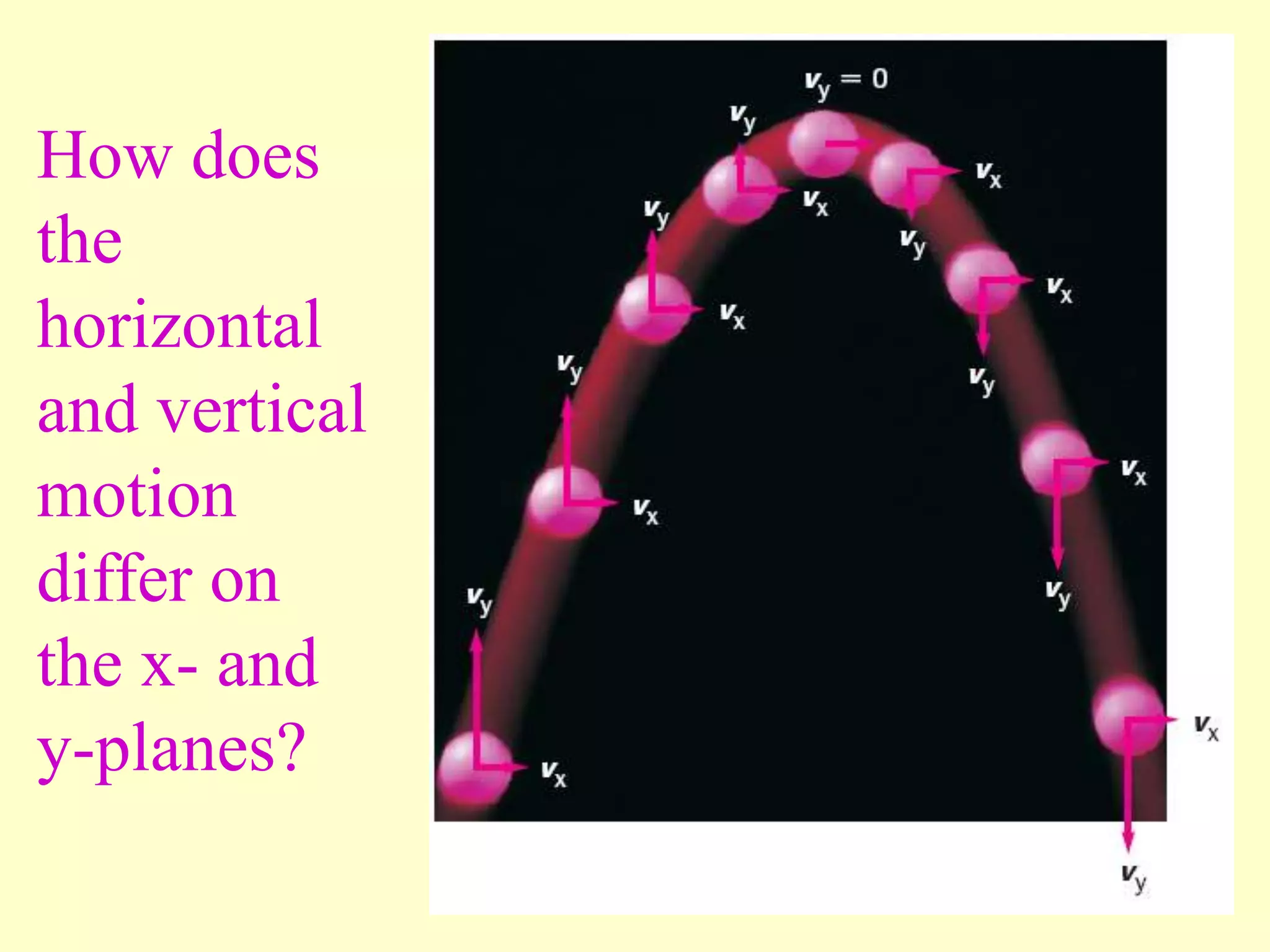
How does
the
horizontal
and vertical
motion
differ on
the x- and
y-planes?
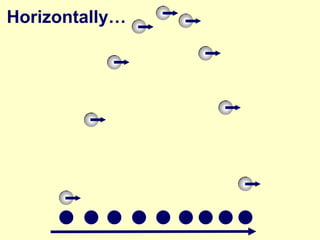
Horizontally…
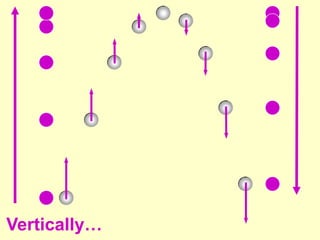
Vertically…
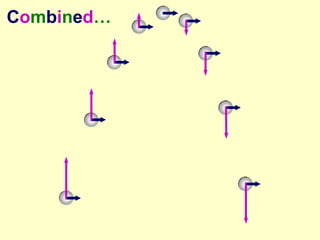
Combined…
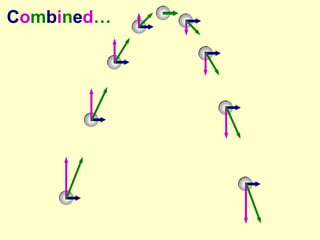
Combined…
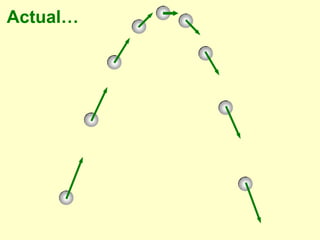
Actual…
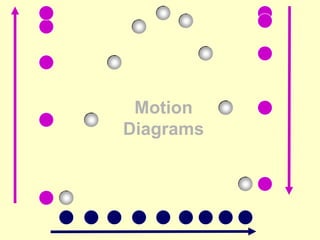
Motion
Diagrams
Projectile Motion
For a projectile:

a)
b)
c)

Describe the horizontal and vertical
motion. Horizontal constant velocity
Vertical

accelerating

Describe the horizontal and vertical
Horizontal
zero
acceleration.
Vertical

9.8 m/s2

What equations would you use to
calculate horizontal and vertical
motion. Horizontal v = d/t
Vertical

v = at and d = ½ at2
Horizontally…

If you throw a projectile horizontally
Describe the horizontal will it
What is the horizontal
at a speed of 25 m/s, how fast
acceleration for projectile. 3 s?
motion of a a projectile?
be moving, horizontally, after
A projectile moveswill still be
Horizontally, it horizontally
Horizontal acceleration is zero.
with constant25 m/s.
moving at velocity.
If a projectile is thrown
What
What a speed
horizontally at
happens, vertically, as a
happens, vertically, as
of 25 m/s, howvertical
Describe the fast is
aprojectile moves
projectile moves
the projectile moving
motion of a projectile.
upward? 3
downward? s?
vertically after

Vertically, a projectile slows
Vertically, a projectile speeds
Vertically, projectile will
a way up.
Vertically,on the projectile
theway down.
down the
up on
accelerates…
be moving 29.4 m/s.
…at a rate of 9.8 m/s2
Vertically…
Initially…

25 m/s

0 vertical
velocity

So, if you throw a projectile
horizontally at a speed of After 3 s…
25 m/s
25 m/s, how fast is it
moving after 3 seconds?
actual
30 m/s

Horizontally, it is moving at 25
39 m/s
m/s, vertically it is moving 30
30 m/s
m/s, so (by Pythagorean’s
Theorem) the projectile is moving
25 m/s
at 39 m/s.

motion
Group
1
2
3
4
5
6
7
8

9
10

Round 1

Round 2

Round 3
B4 stopped

Projectile motion problems…
The key to solving problems involving
projectile motion is…
• understanding that x and y are
independent.
• identifying and separating x and y
variables.
• understanding that time is the same
for both x and y.
• Using appropriate equations for x
and y.
Projectile motion problems…
Useful tips…
• Draw a picture.
• Make a table with an x column
and a y column to identify
variables.
• Immediately write down
acceleration due to gravity (g) in
the y column.
• Time connects x and y.
Projectile motion problems…
Equations…
• Along the x-axis:
– no acceleration;
moves w/ constant velocity.
– v = d/t

• Along the y-axis:
– Accelerates b/c of gravity; g = 9.8 m/s2.
– v = at
– d = ½at2
Lamp on a table…
If I knock a lamp off an end-table with
a horizontal velocity of 5 m/s and
the table is 0.5 meters high, how far
away does the lamp land?

1.6 meters in front of table.
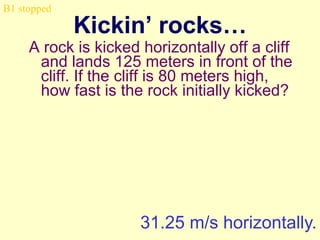
B1 stopped

Kickin’ rocks…

A rock is kicked horizontally off a cliff
and lands 125 meters in front of the
cliff. If the cliff is 80 meters high,
how fast is the rock initially kicked?

31.25 m/s horizontally.
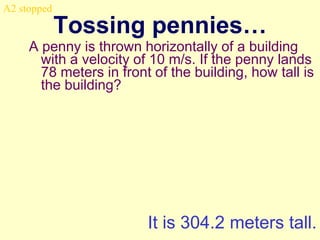
A2 stopped

Tossing pennies…

A penny is thrown horizontally of a building
with a velocity of 10 m/s. If the penny lands
78 meters in front of the building, how tall is
the building?

It is 304.2 meters tall.
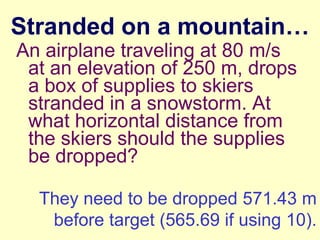
Stranded on a mountain…
An airplane traveling at 80 m/s
at an elevation of 250 m, drops
a box of supplies to skiers
stranded in a snowstorm. At
what horizontal distance from
the skiers should the supplies
be dropped?
They need to be dropped 571.43 m
before target (565.69 if using 10).
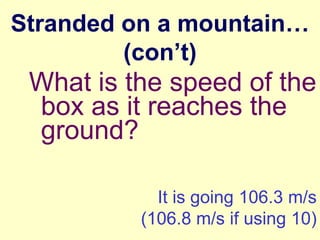
Stranded on a mountain…
(con’t)

What is the speed of the
box as it reaches the
ground?
It is going 106.3 m/s
(106.8 m/s if using 10)
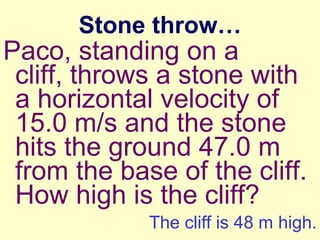
Stone throw…

Paco, standing on a
cliff, throws a stone with
a horizontal velocity of
15.0 m/s and the stone
hits the ground 47.0 m
from the base of the cliff.
How high is the cliff?
The cliff is 48 m high.

2.3 010 projectile_motion

  • 1.
  • 3.
  • 4.
  • 5.
  • 6.
  • 7.
  • 8.
  • 9.
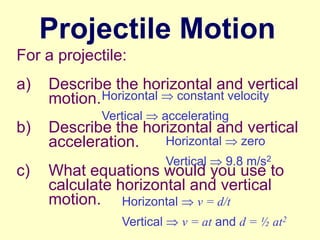
    Projectile Motion For aprojectile: a) b) c) Describe the horizontal and vertical motion. Horizontal constant velocity Vertical accelerating Describe the horizontal and vertical Horizontal zero acceleration. Vertical 9.8 m/s2 What equations would you use to calculate horizontal and vertical motion. Horizontal v = d/t Vertical v = at and d = ½ at2
  • 10.
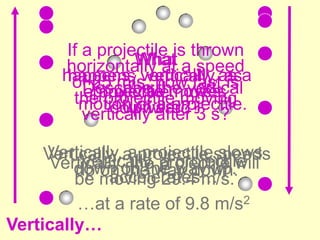
    Horizontally… If you throwa projectile horizontally Describe the horizontal will it What is the horizontal at a speed of 25 m/s, how fast acceleration for projectile. 3 s? motion of a a projectile? be moving, horizontally, after A projectile moveswill still be Horizontally, it horizontally Horizontal acceleration is zero. with constant25 m/s. moving at velocity.
  • 11.
    If a projectileis thrown What What a speed horizontally at happens, vertically, as a happens, vertically, as of 25 m/s, howvertical Describe the fast is aprojectile moves projectile moves the projectile moving motion of a projectile. upward? 3 downward? s? vertically after Vertically, a projectile slows Vertically, a projectile speeds Vertically, projectile will a way up. Vertically,on the projectile theway down. down the up on accelerates… be moving 29.4 m/s. …at a rate of 9.8 m/s2 Vertically…
  • 12.
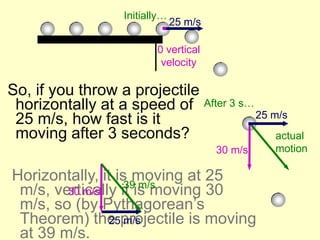
    Initially… 25 m/s 0 vertical velocity So,if you throw a projectile horizontally at a speed of After 3 s… 25 m/s 25 m/s, how fast is it moving after 3 seconds? actual 30 m/s Horizontally, it is moving at 25 39 m/s m/s, vertically it is moving 30 30 m/s m/s, so (by Pythagorean’s Theorem) the projectile is moving 25 m/s at 39 m/s. motion
  • 13.
  • 14.
    B4 stopped Projectile motionproblems… The key to solving problems involving projectile motion is… • understanding that x and y are independent. • identifying and separating x and y variables. • understanding that time is the same for both x and y. • Using appropriate equations for x and y.
  • 15.
    Projectile motion problems… Usefultips… • Draw a picture. • Make a table with an x column and a y column to identify variables. • Immediately write down acceleration due to gravity (g) in the y column. • Time connects x and y.
  • 16.
    Projectile motion problems… Equations… •Along the x-axis: – no acceleration; moves w/ constant velocity. – v = d/t • Along the y-axis: – Accelerates b/c of gravity; g = 9.8 m/s2. – v = at – d = ½at2
  • 17.
    Lamp on atable… If I knock a lamp off an end-table with a horizontal velocity of 5 m/s and the table is 0.5 meters high, how far away does the lamp land? 1.6 meters in front of table.
  • 18.
    B1 stopped Kickin’ rocks… Arock is kicked horizontally off a cliff and lands 125 meters in front of the cliff. If the cliff is 80 meters high, how fast is the rock initially kicked? 31.25 m/s horizontally.
  • 19.
    A2 stopped Tossing pennies… Apenny is thrown horizontally of a building with a velocity of 10 m/s. If the penny lands 78 meters in front of the building, how tall is the building? It is 304.2 meters tall.
  • 20.
    Stranded on amountain… An airplane traveling at 80 m/s at an elevation of 250 m, drops a box of supplies to skiers stranded in a snowstorm. At what horizontal distance from the skiers should the supplies be dropped? They need to be dropped 571.43 m before target (565.69 if using 10).
  • 21.
    Stranded on amountain… (con’t) What is the speed of the box as it reaches the ground? It is going 106.3 m/s (106.8 m/s if using 10)
  • 22.
    Stone throw… Paco, standingon a cliff, throws a stone with a horizontal velocity of 15.0 m/s and the stone hits the ground 47.0 m from the base of the cliff. How high is the cliff? The cliff is 48 m high.