By
KAUSHAL KUMAR SAHU
Assistant Professor (Ad Hoc)
Department of Biotechnology
Govt. Digvijay Autonomous P. G. College
Raj-Nandgaon ( C. G. )
SYNOPSIS:-
INTRODUCTION
HYBRIDIZATION STAGES
PROBE SYNTHESIS
PROBE MARKING
TARGET DNA PROCESSING
TARGET DNA DENATURATION
TARGET DNA TRANSFER TO SOLID CARRIER
VISUALIZATION
CONCLUSIONS
REFERENCES
INTRODUCTION
Nucleic acid hybridization is a fundamental tool in molecular
genetics which takes advantage of the ability of individual
single-stranded nucleic acid molecules to form double
stranded molecules (that is, to hybridize to each other)
The nucleic acid hybridization is the process wherein two DNA
or RNA single chains from different biological sources, make
the double catenary configuration, based on nucleotide
complementary and of sequence homology of the two sources,
resulting DNA-DNA, RNA-RNA or DNA-RNA hybrids.
Hybridization can detect identical or similar sequences.
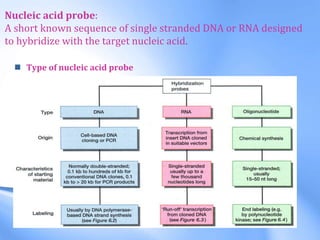
Nucleic acid probe:
A short known sequence of single stranded DNA or RNA designed
to hybridize with the target nucleic acid.
 Type of nucleic acid probe
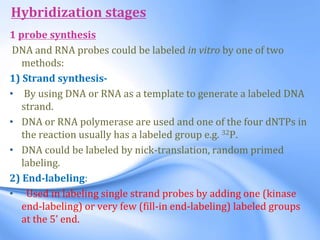
1 probe synthesis
DNA and RNA probes could be labeled in vitro by one of two
methods:
1) Strand synthesis-
• By using DNA or RNA as a template to generate a labeled DNA
strand.
• DNA or RNA polymerase are used and one of the four dNTPs in
the reaction usually has a labeled group e.g. 32P.
• DNA could be labeled by nick-translation, random primed
labeling.
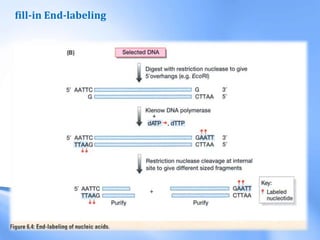
2) End-labeling:
• Used in labeling single strand probes by adding one (kinase
end-labeling) or very few (fill-in end-labeling) labeled groups
at the 5’ end.
Hybridization stages
Strand synthesis-
Randomized primers
fill-in End-labeling
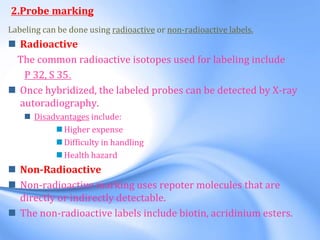
2.Probe marking
Labeling can be done using radioactive or non-radioactive labels.
 Radioactive
The common radioactive isotopes used for labeling include
P 32, S 35.
 Once hybridized, the labeled probes can be detected by X-ray
autoradiography.
 Disadvantages include:
 Higher expense
 Difficulty in handling
 Health hazard
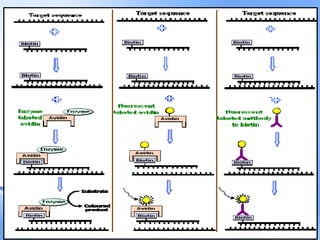
 Non-Radioactive
 Non-radioactive marking uses repoter molecules that are
directly or indirectly detectable.
 The non-radioactive labels include biotin, acridinium esters.
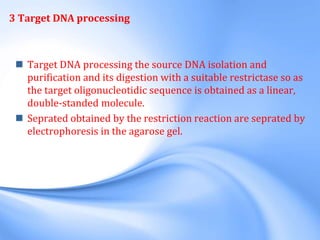
3 Target DNA processing
 Target DNA processing the source DNA isolation and
purification and its digestion with a suitable restrictase so as
the target oligonucleotidic sequence is obtained as a linear,
double-standed molecule.
 Seprated obtained by the restriction reaction are seprated by
electrophoresis in the agarose gel.
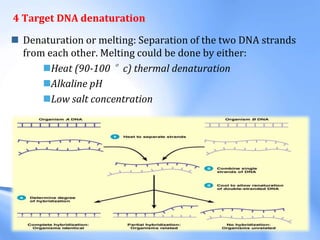
4 Target DNA denaturation
 Denaturation or melting: Separation of the two DNA strands
from each other. Melting could be done by either:
Heat (90-100 °c) thermal denaturation
Alkaline pH
Low salt concentration
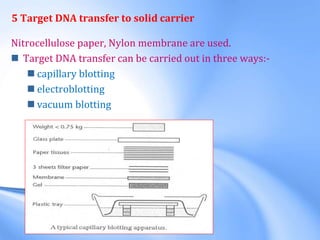
5 Target DNA transfer to solid carrier
Nitrocellulose paper, Nylon membrane are used.
 Target DNA transfer can be carried out in three ways:-
 capillary blotting
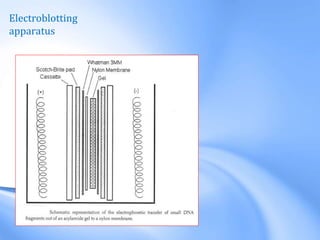
 electroblotting
 vacuum blotting
Electroblotting
apparatus
blotting
When hybridization takes place on solid carrier is named blotting
and is divided in 3 categories:-
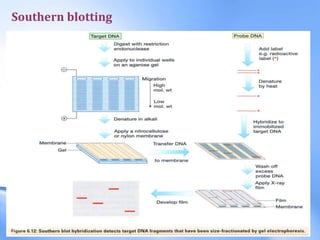
1 )Southern blotting where by DNA molecules are identified using
DNA or RNA probes.
 Southern blotting are 4 steps:
 DNA extraction
 Electrophoresis to separate
 Transfer to membrane
 Use labeled probes, which will hybridize to specific sequence,
to identify sequence of interest.
2) Northern blotting where by RNA molecules are identified using
RNA or DNA probes.
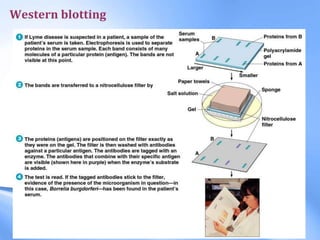
3) Western blotting where by protein sequences are identified
using specific antibodies.
Southern blotting
Northern blotting
Western blotting
6. Visualization
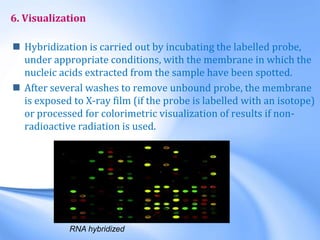
 Hybridization is carried out by incubating the labelled probe,
under appropriate conditions, with the membrane in which the
nucleic acids extracted from the sample have been spotted.
 After several washes to remove unbound probe, the membrane
is exposed to X-ray film (if the probe is labelled with an isotope)
or processed for colorimetric visualization of results if non-
radioactive radiation is used.
RNA hybridized
CONCLUSIONS
 Nucleic acid hybridization is widely used for scientific
applications but essentially restricted to specialized
laboratories.
 The commonly used recombinant plasmids as the
preparation of the DNA probe is very simple and it can
easily be labeled directly, Nucleic Acids and used for
hybridization.
 Microarrays can be used in many ways to analyze gene
expression in various cell types, in response to various
stimuli.
REFERENCES
1. TEXT BOOK OF BIOCHEMISTRY
LEHNINGER NELSON & COX (iv EDITION)
2 PDF FILE:-
I. wolf49.pdf fail
II. MBPS.Ch14(1).pdf

Nucleic acid hybridization by kk

  • 1.
    By KAUSHAL KUMAR SAHU AssistantProfessor (Ad Hoc) Department of Biotechnology Govt. Digvijay Autonomous P. G. College Raj-Nandgaon ( C. G. )
  • 2.
    SYNOPSIS:- INTRODUCTION HYBRIDIZATION STAGES PROBE SYNTHESIS PROBEMARKING TARGET DNA PROCESSING TARGET DNA DENATURATION TARGET DNA TRANSFER TO SOLID CARRIER VISUALIZATION CONCLUSIONS REFERENCES
  • 3.
    INTRODUCTION Nucleic acid hybridizationis a fundamental tool in molecular genetics which takes advantage of the ability of individual single-stranded nucleic acid molecules to form double stranded molecules (that is, to hybridize to each other) The nucleic acid hybridization is the process wherein two DNA or RNA single chains from different biological sources, make the double catenary configuration, based on nucleotide complementary and of sequence homology of the two sources, resulting DNA-DNA, RNA-RNA or DNA-RNA hybrids. Hybridization can detect identical or similar sequences.
  • 4.
    Nucleic acid probe: Ashort known sequence of single stranded DNA or RNA designed to hybridize with the target nucleic acid.  Type of nucleic acid probe
  • 5.
    1 probe synthesis DNAand RNA probes could be labeled in vitro by one of two methods: 1) Strand synthesis- • By using DNA or RNA as a template to generate a labeled DNA strand. • DNA or RNA polymerase are used and one of the four dNTPs in the reaction usually has a labeled group e.g. 32P. • DNA could be labeled by nick-translation, random primed labeling. 2) End-labeling: • Used in labeling single strand probes by adding one (kinase end-labeling) or very few (fill-in end-labeling) labeled groups at the 5’ end. Hybridization stages
  • 6.
  • 7.
  • 8.
    2.Probe marking Labeling canbe done using radioactive or non-radioactive labels.  Radioactive The common radioactive isotopes used for labeling include P 32, S 35.  Once hybridized, the labeled probes can be detected by X-ray autoradiography.  Disadvantages include:  Higher expense  Difficulty in handling  Health hazard  Non-Radioactive  Non-radioactive marking uses repoter molecules that are directly or indirectly detectable.  The non-radioactive labels include biotin, acridinium esters.
  • 10.
    3 Target DNAprocessing  Target DNA processing the source DNA isolation and purification and its digestion with a suitable restrictase so as the target oligonucleotidic sequence is obtained as a linear, double-standed molecule.  Seprated obtained by the restriction reaction are seprated by electrophoresis in the agarose gel.
  • 11.
    4 Target DNAdenaturation  Denaturation or melting: Separation of the two DNA strands from each other. Melting could be done by either: Heat (90-100 °c) thermal denaturation Alkaline pH Low salt concentration
  • 12.
    5 Target DNAtransfer to solid carrier Nitrocellulose paper, Nylon membrane are used.  Target DNA transfer can be carried out in three ways:-  capillary blotting  electroblotting  vacuum blotting
  • 13.
  • 14.
    blotting When hybridization takesplace on solid carrier is named blotting and is divided in 3 categories:- 1 )Southern blotting where by DNA molecules are identified using DNA or RNA probes.  Southern blotting are 4 steps:  DNA extraction  Electrophoresis to separate  Transfer to membrane  Use labeled probes, which will hybridize to specific sequence, to identify sequence of interest. 2) Northern blotting where by RNA molecules are identified using RNA or DNA probes. 3) Western blotting where by protein sequences are identified using specific antibodies.
  • 15.
  • 16.
  • 17.
  • 18.
    6. Visualization  Hybridizationis carried out by incubating the labelled probe, under appropriate conditions, with the membrane in which the nucleic acids extracted from the sample have been spotted.  After several washes to remove unbound probe, the membrane is exposed to X-ray film (if the probe is labelled with an isotope) or processed for colorimetric visualization of results if non- radioactive radiation is used. RNA hybridized
  • 19.
    CONCLUSIONS  Nucleic acidhybridization is widely used for scientific applications but essentially restricted to specialized laboratories.  The commonly used recombinant plasmids as the preparation of the DNA probe is very simple and it can easily be labeled directly, Nucleic Acids and used for hybridization.  Microarrays can be used in many ways to analyze gene expression in various cell types, in response to various stimuli.
  • 20.
    REFERENCES 1. TEXT BOOKOF BIOCHEMISTRY LEHNINGER NELSON & COX (iv EDITION) 2 PDF FILE:- I. wolf49.pdf fail II. MBPS.Ch14(1).pdf