PCR
Polymerase Chain Reaction
Ahmad A. Al-Qudah
PCR
Polymerase Chain Reaction
- Definitions .
- Polymerase Chain Reaction History .
- Advantages & disadvantages .
- Types of PCR :
- Quantitative PCR ( Real Time-PCR ).
- Reverse Transcriptase-PCR .
- Less Common .
- Polymerase Chain Reaction Principle .
- Applications of PCR .
- PCR Technologies Bright Future .
- Bibliography .
PCR
Polymerase Chain Reaction
Definitions
is a Molecular Biochemical technology, Used to Amplify a single piece
of DNA, By a series of Heating and Cooling cycles , generating millions
of copies of a particular DNA sequence In Vitro .
- DNA template : contains the DNA region (target) to be amplified .
- DNA primers : complementary to the 3' (three prime) ends of each of
the sense and anti-sense strand of the DNA target .
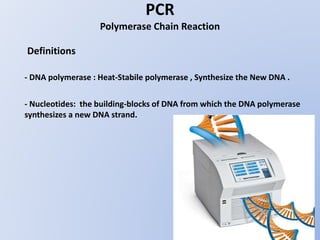
- DNA polymerase : Heat-Stabile polymerase , Synthesize the New DNA .
- Nucleotides: the building-blocks of DNA from which the DNA polymerase
synthesizes a new DNA strand.
PCR
Polymerase Chain Reaction
Definitions
- PCR was invented in the 1984 as a way to make numerous
copies of DNA fragments in the laboratory.
Polymerase Chain Reaction
History
- The in vitro version of DNA Replication .
“ Beginning with a single molecule of the genetic material DNA,
the PCR can generate 100 billion similar molecules in an
afternoon ! “
Polymerase Chain Reaction
History
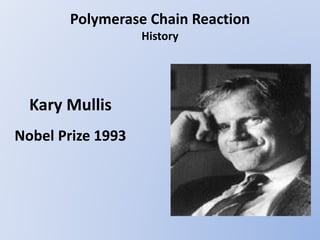
Kary Mullis
Nobel Prize 1993
Polymerase Chain Reaction
Advantages Vs. Disadvantages
* PCR advantages:
- Specific amplification .
- Rapid .
- Post-PCR processing of products
- Most specific, sensitive .
*PCR disadvantages
- Setting up and Running requires high technical skills .
- High equipment cost .
- High Test cost .
- High Sterile environment should be provided . (DNA contamination )
Polymerase Chain Reaction
Advantages Vs. Disadvantages
Polymerase Chain Reaction
Priciple
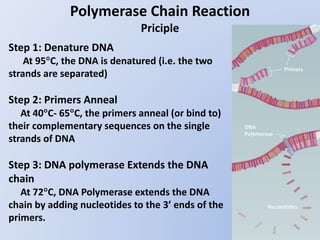
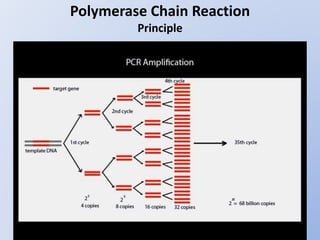
Step 1: Denature DNA
At 95C, the DNA is denatured (i.e. the two
strands are separated)
Step 2: Primers Anneal
At 40C- 65C, the primers anneal (or bind to)
their complementary sequences on the single
strands of DNA
Step 3: DNA polymerase Extends the DNA
chain
At 72C, DNA Polymerase extends the DNA
chain by adding nucleotides to the 3’ ends of the
primers.
Polymerase Chain Reaction
Principle
Polymerase Chain Reaction
Types of PCR
* Quantitative PCR
- Used to measure the quantity of a target sequence .
- It quantitatively measures starting amounts of DNA,
cDNA, or RNA .
- qPCR is commonly used to determine whether a DNA
sequence is present in a sample and the number of its
copies in the sample .
Polymerase Chain Reaction
Types of PCR
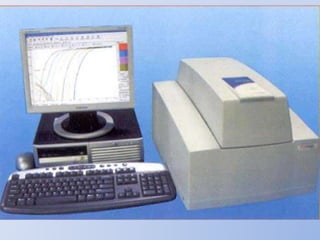
* Quantitative PCR ( Real Time-PCR )
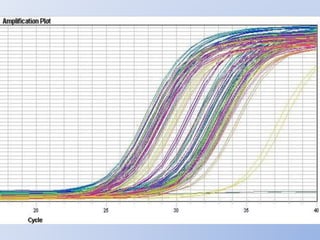
- Quantitative real-time PCR has a very high degree of
precision .
- Use fluorescent dyes , or fluorophore-containing DNA
probes .
- To measure the amount of amplified product in real
time.
Polymerase Chain Reaction
Types of PCR
* Reverse Transcriptase-PCR
- is one of many variants of polymerase chain reaction
(PCR) .
- For amplifying DNA from RNA .
- Used to qualitatively detect gene expression through
creation of complementary DNA (cDNA) transcripts from
RNA , to detect RNA expression levels .
Polymerase Chain Reaction
Types of PCR
- qPCR is the abbreviation used for Real-Time PCR .
- RT-PCR commonly used as abbreviation for reverse
transcription polymerase chain reaction and not
real-time PCR .
- Real-time PCR is combined with reverse
transcription to quantify messenger RNA (mRNA)
and non-coding RNA in cells or tissues
RT-PCR Vs. RT-PCR
Polymerase Chain Reaction
Types of PCR
Less Common :
- Inverse Polymerase Chain Reaction
- Nested polymerase chain reaction
- Hot start PCR
- Ligation-mediated PCR
- Multiplex-PCR
- Overlap-extension PCR
Polymerase Chain Reaction
Application of PCR Products
Application of PCR products into one of these
Techniques :
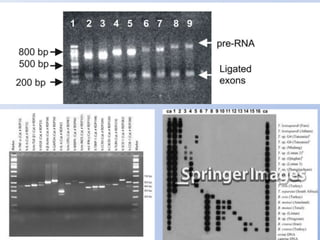
- Electrophoresis .
- Southern Blotting .
- Enzyme-Linked Hybridization .
- Cross-Linked Hybridization .
- FISH .
- ASO .
- Direct Sequencing .
Polymerase Chain Reaction
Application of PCR
Application of PCR According to the Field of
Science :
- Medical applications
- Infectious disease applications
- Forensic applications
- Research applications
Polymerase Chain Reaction
Medical applications
- Genetic testing :
where a sample of DNA is analyzed for the
presence of genetic disease mutations
- Tissue typing :
in organ transplantation.
- Oncogenes :
Many forms of cancer involve alterations to
Polymerase Chain Reaction
Infectious disease applications
- The Human Immunodeficiency Virus (HIV) :
Antibodies to the virus circulating in the bloodstream.
don't appear until many weeks after infection, maternal
antibodies mask the infection of a newborn .
Detection of the Antigen . RT-PCR .
- Tuberculosis :
Are difficult to sample from patients and slow to
be grown in the laboratory. PCR-based tests allowed
detection of small numbers of disease organisms
(both live or dead) .
Polymerase Chain Reaction
Forensic applications
- Genetic fingerprinting :
can uniquely discriminate any person from the
entire population of the world. samples of DNA can be
isolated from a crime scene , and compared to that from
suspects, or from a DNA database of earlier evidence .
- Parental testing :
an individual is matched with their close relatives. Less
discriminating forms of DNA fingerprinting . DNA
compared with that from possible parents, siblings, or
children. Similar testing can be used to confirm the
biological parents of an adopted (or kidnapped) child .
Polymerase Chain Reaction
Technologies Bright Future
Immunoliposome-PCR
- Several advantages over other immune-PCR
methods .
- Ultrasensitive quantitative antigen detection
system .
- Reduces false-positive by allows nonspecific DNA in
the assay medium to be degraded .
Polymerase Chain Reaction
Bibliography
- Bartlett, J. M. S.; Stirling, D. (2003). "A Short History of the Polymerase Chain
Reaction". PCR Protocols 226. pp. 3–6.
- Saiki, R.; Scharf, S.; Faloona, F.; Mullis, K.; Horn, G.; Erlich, H.; Arnheim, N.
(1985). "Enzymatic amplification of beta-globin genomic sequences and
restriction site analysis for diagnosis of sickle cell anemia". Science 230(4732):
1350–1354
- Salis AD (2009). "Applications in Clinical Microbiology".Real-Time PCR: Current
Technology and Applications. Caister Academic Press
- Pavlov, A. R.; Pavlova, N. V.; Kozyavkin, S. A.; Slesarev, A. I. (2004). "Recent
developments in the optimization of thermostable DNA polymerases for
efficient applications".Trends in Biotechnology 22 (5): 253–260.
- Q. Chou, M. Russell, D.E. Birch, J. Raymond and W. Bloch (1992). "Prevention of pre-
PCR mis-priming and primer dimerization improves low-copy-number amplifications".
Nucleic Acids Research 20 (7): 1717–1723.
- http://en.wikipedia.org/wiki/
Polymerase Chain Reaction - PCR