Southern Blotting
Department of Botany
University of Sargodha, Sargodha
Punjab, Pakistan
mujahid.hussain7877@gmail.com
1
Southern blotting
• The technique was developed by E.M. Southern
in 1975.
• The Southern blot is used to detect the presence
of a particular piece of DNA in a sample.
• The DNA detected can be a single gene, or it
can be part of a larger piece of DNA such as a
viral genome.
mujahid.hussain7877@g
mail.com
2
Steps
• Extract and purify DNA from the cell
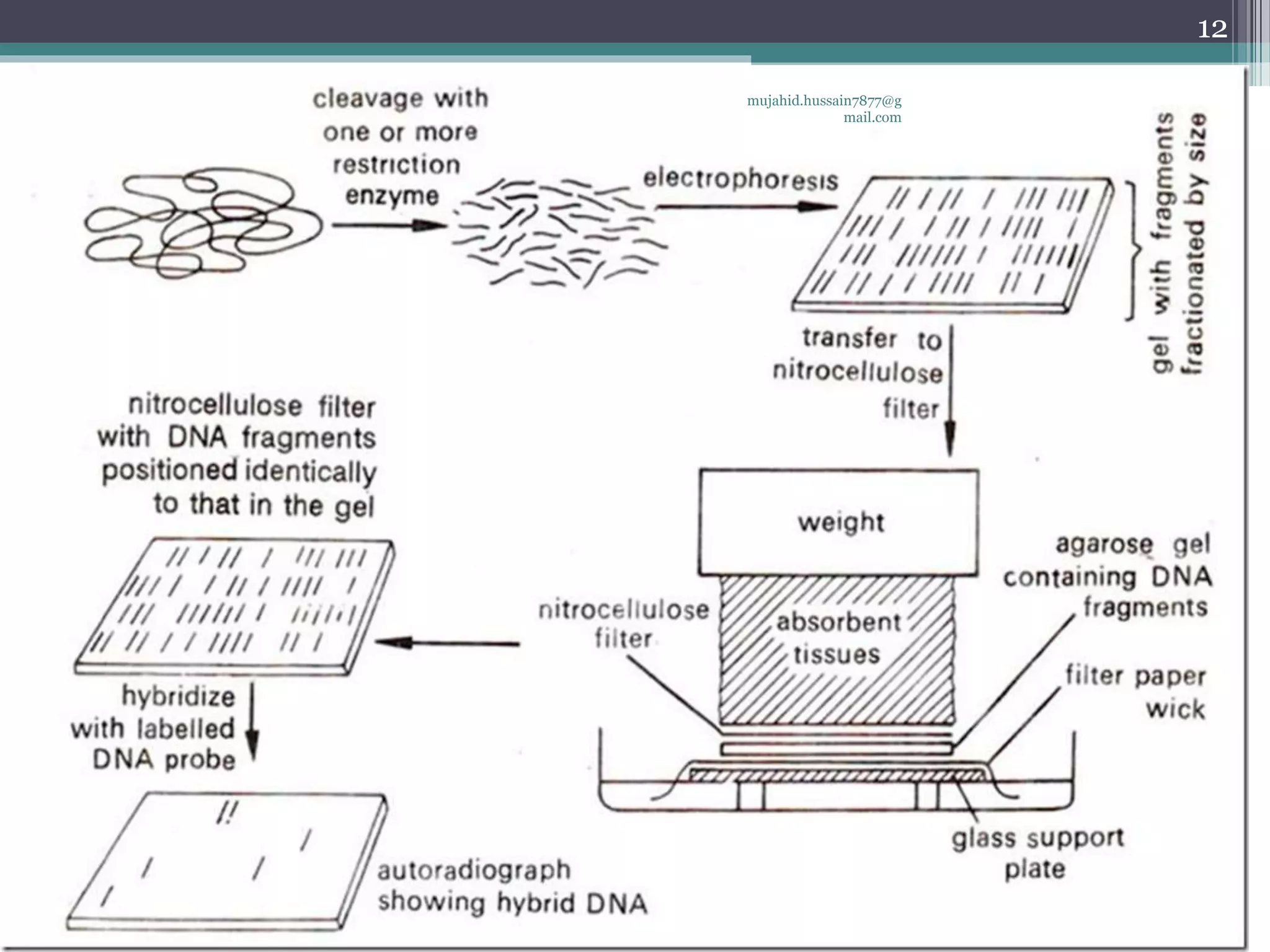
• DNA is restricted with enzyme
• Separated by gel electrophoresis
• Denatured the DNA
• transfer to the Nitrocellulose membrane paper
(Blotting)
• Add radio labelled probe for hybridization to take
place
• Wash off unbound probe
• Autoradiograph
mujahid.hussain7877@g
mail.com
3
Isolation of DNA
• Isolate the DNA from the rest of the cellular
material in the nucleus.
• Incubate specimen with detergent to promote cell
lysis.
• A buffer containing a detergent such as sodium
dodecyl sulfate (SDS) is usually sufficient to
disrupt the cell membranes and release high-
molecular weight DNA.
mujahid.hussain7877@g
mail.com
4
Isolation of DNA
• Lysis frees cellular proteins and DNA.
• Proteins are enzymatically degraded by incubation
with proteinase.
• Digestion of RNA with ribonuclease.
• A final treatment with ethanol, which precipitates the
remaining nucleic acid polymers, enabling
ribonucleotides and other low-molecular weight
contaminants to be removed.
mujahid.hussain7877@g
mail.com
5
Restriction Digestion
• Cut the DNA into different sized pieces.
• Use restriction endonucleases (RE)
• Example, Eco R1
• For genomic DNA, overnight digestion is usually
required.
mujahid.hussain7877@g
mail.com
6
Gel electrophoresis
• Nucleic acid have a net negatively charge and will
move from left to right.
• The larger molecule are hold up while the smaller
ones moves faster.
• This results in separation by size.
• Agarose gels have microscopic pores
• Gel is soaked in a buffer which controls the size of
pores.
• Gel can be stained with ethidium bromide.
mujahid.hussain7877@g
mail.com
7
Gel electrophoresis
• EtBr causes the DNA to fluoresce under UV light.
• This will help to know the exact migration of DNA.
Denaturation and blotting .
• DNA is then denature with an alkaline solution e.g. NaOH.
• This causes the double stranded of DNA to single stranded.
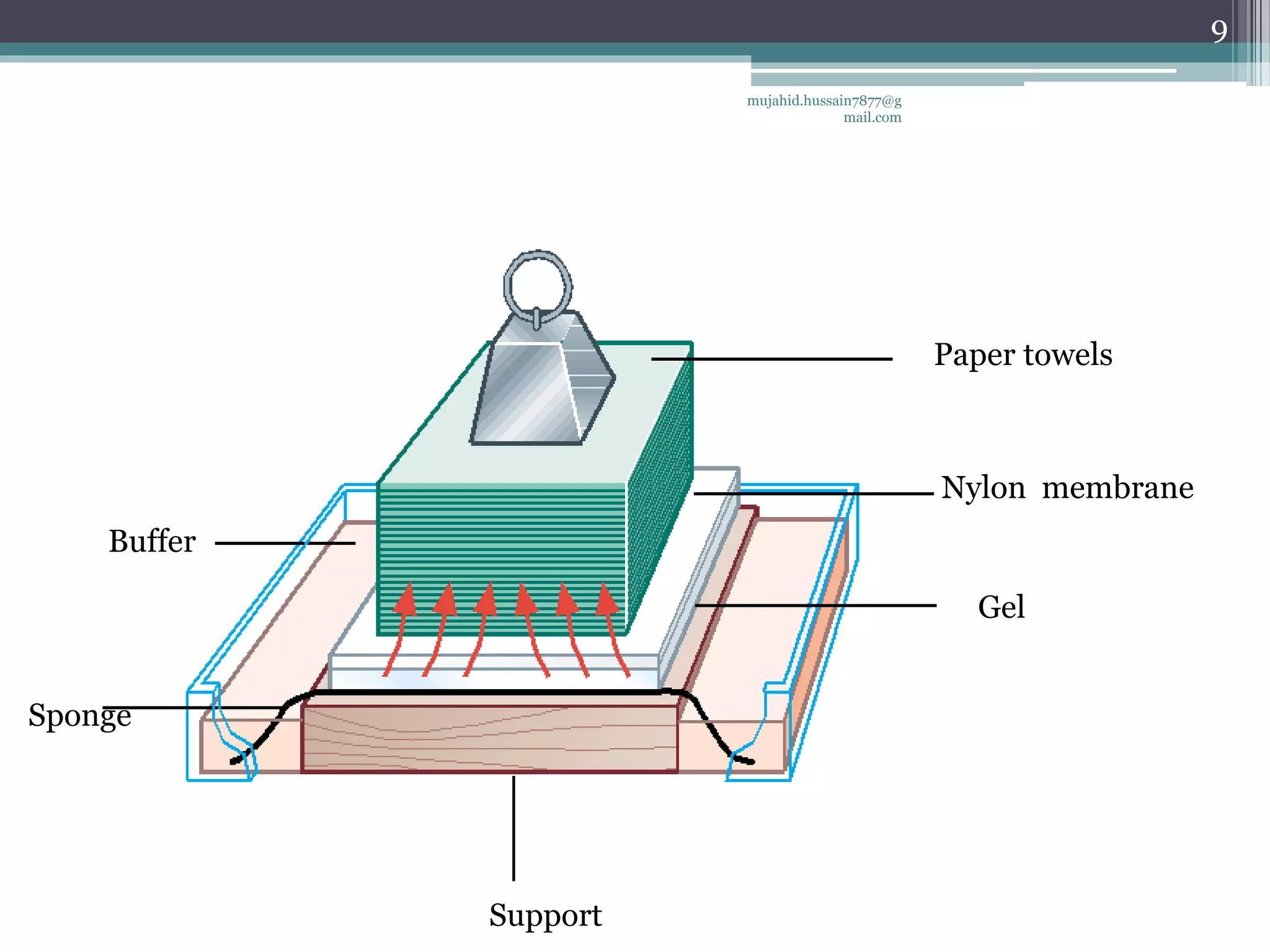
• The process of transferring the DNA from the gel to membrane is called as blotting.
• The blot is done on the sheet of nitrocellulose membrane or nylon.
• DNA is neutralize with NaCl to prevent re-hybridization before adding the probe.
• Transfer is by capillary blotting.
• The blot is made permanent either by
• 1) Drying at 80~ C
• 2)Exposing to UV irradiation.
mujahid.hussain7877@g
mail.com
8
Paper towels
Nylon membrane
Gel
Buffer
Support
Sponge
mujahid.hussain7877@g
mail.com
9
Hybridization
• It is a process of forming a double stranded DNA
molecule between a single stranded DNA probe and a
single stranded target DNA.
• The labelled probe is add to the membrane in a buffer
and incubated for several hours to allow the probe
molecule to find their targets.
• Probe
• Small piece of labelled DNA used to find another
piece of DNA.
mujahid.hussain7877@g
mail.com
10
Wash and autoradiography
• Wash excess probe that are bound non-specifically
with the membrane.
• Blot is incubate with wash buffer containing NaCl
and detergent to wash away excess probe.
• Radioactive probes enable autoradiography
detection.
• The probe is radioactive, the particle it emits will
expose X-ray film.
• After development, there will the dark spots on the
film where the probe bound.
mujahid.hussain7877@g
mail.com
11
mujahid.hussain7877@g
mail.com
12
Advantages
• Examine entire genome
• Easier
• Detect multiple product
• Disadvantages
• Costly
• Greater quantity of DNA required
• Labor intensive
• Time consuming
• This technique requires fresh or frozen specimens
mujahid.hussain7877@g
mail.com
13
Application
• To identify specific DNA in the sample
• To isolate desired DNA for making of rDNA
• Used to prognosis cancer and in prenatal diagnosis of
genetic disease
• Used in phylogenetic analysis
• Diagnosis of HIV-I and infectious disease
• And application DNA finger printing
mujahid.hussain7877@g
mail.com
14

southern blotting (used to detect the presence of a particular piece of DNA in a sample)

  • 1.
    Southern Blotting Department ofBotany University of Sargodha, Sargodha Punjab, Pakistan mujahid.hussain7877@gmail.com 1
  • 2.
    Southern blotting • Thetechnique was developed by E.M. Southern in 1975. • The Southern blot is used to detect the presence of a particular piece of DNA in a sample. • The DNA detected can be a single gene, or it can be part of a larger piece of DNA such as a viral genome. mujahid.hussain7877@g mail.com 2
  • 3.
    Steps • Extract andpurify DNA from the cell • DNA is restricted with enzyme • Separated by gel electrophoresis • Denatured the DNA • transfer to the Nitrocellulose membrane paper (Blotting) • Add radio labelled probe for hybridization to take place • Wash off unbound probe • Autoradiograph mujahid.hussain7877@g mail.com 3
  • 4.
    Isolation of DNA •Isolate the DNA from the rest of the cellular material in the nucleus. • Incubate specimen with detergent to promote cell lysis. • A buffer containing a detergent such as sodium dodecyl sulfate (SDS) is usually sufficient to disrupt the cell membranes and release high- molecular weight DNA. mujahid.hussain7877@g mail.com 4
  • 5.
    Isolation of DNA •Lysis frees cellular proteins and DNA. • Proteins are enzymatically degraded by incubation with proteinase. • Digestion of RNA with ribonuclease. • A final treatment with ethanol, which precipitates the remaining nucleic acid polymers, enabling ribonucleotides and other low-molecular weight contaminants to be removed. mujahid.hussain7877@g mail.com 5
  • 6.
    Restriction Digestion • Cutthe DNA into different sized pieces. • Use restriction endonucleases (RE) • Example, Eco R1 • For genomic DNA, overnight digestion is usually required. mujahid.hussain7877@g mail.com 6
  • 7.
    Gel electrophoresis • Nucleicacid have a net negatively charge and will move from left to right. • The larger molecule are hold up while the smaller ones moves faster. • This results in separation by size. • Agarose gels have microscopic pores • Gel is soaked in a buffer which controls the size of pores. • Gel can be stained with ethidium bromide. mujahid.hussain7877@g mail.com 7
  • 8.
    Gel electrophoresis • EtBrcauses the DNA to fluoresce under UV light. • This will help to know the exact migration of DNA. Denaturation and blotting . • DNA is then denature with an alkaline solution e.g. NaOH. • This causes the double stranded of DNA to single stranded. • The process of transferring the DNA from the gel to membrane is called as blotting. • The blot is done on the sheet of nitrocellulose membrane or nylon. • DNA is neutralize with NaCl to prevent re-hybridization before adding the probe. • Transfer is by capillary blotting. • The blot is made permanent either by • 1) Drying at 80~ C • 2)Exposing to UV irradiation. mujahid.hussain7877@g mail.com 8
  • 9.
  • 10.
    Hybridization • It isa process of forming a double stranded DNA molecule between a single stranded DNA probe and a single stranded target DNA. • The labelled probe is add to the membrane in a buffer and incubated for several hours to allow the probe molecule to find their targets. • Probe • Small piece of labelled DNA used to find another piece of DNA. mujahid.hussain7877@g mail.com 10
  • 11.
    Wash and autoradiography •Wash excess probe that are bound non-specifically with the membrane. • Blot is incubate with wash buffer containing NaCl and detergent to wash away excess probe. • Radioactive probes enable autoradiography detection. • The probe is radioactive, the particle it emits will expose X-ray film. • After development, there will the dark spots on the film where the probe bound. mujahid.hussain7877@g mail.com 11
  • 12.
  • 13.
    Advantages • Examine entiregenome • Easier • Detect multiple product • Disadvantages • Costly • Greater quantity of DNA required • Labor intensive • Time consuming • This technique requires fresh or frozen specimens mujahid.hussain7877@g mail.com 13
  • 14.
    Application • To identifyspecific DNA in the sample • To isolate desired DNA for making of rDNA • Used to prognosis cancer and in prenatal diagnosis of genetic disease • Used in phylogenetic analysis • Diagnosis of HIV-I and infectious disease • And application DNA finger printing mujahid.hussain7877@g mail.com 14