By
G.MANIMARAN
I st Msc Biotechnology
SYNOPSIS
▫ INTRODUCTION
▫ PRINCIPLE
▫ PROCEDURE
▫ APPLICATIONS
2
introduction
▫ Colony hybridization is a method of selecting
bacterial colonies with desired genes. This
method was discovered by Michael
Grunstein and David S. Hogness in 1975
3
definition
▫ Colony hybridization can define as the
method for the isolation of the specific
DNA sequences or genes from the
bacterial cells containing hybrid DNA, by
the means of a nitrocellulose membrane
filter. The transferring medium then goes
through several chemical and physical
treatments.
4
principle
▫ Selection of Recombinant bacteria by
hybridization of probe DNA with DNAs of
bacterial colonies on a nitrocellulose Filter
is called colony hybridization
▫ This used to pick out recombinant bacteria
has rDNA that has specific gene
5
procedure
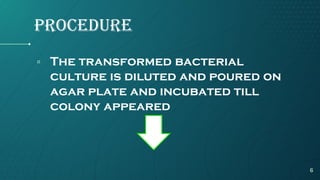
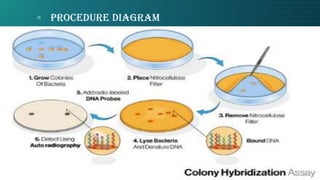
▫ The transformed bacterial
culture is diluted and poured on
agar plate and incubated till
colony appeared
6
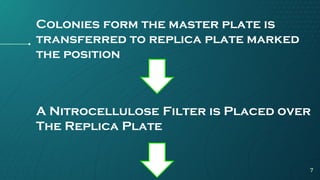
Colonies form the master plate is
transferred to replica plate marked
the position
A Nitrocellulose Filter is Placed over
The Replica Plate
7
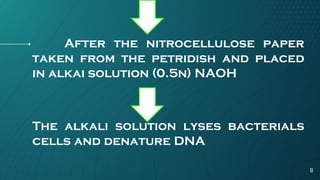
After the nitrocellulose paper
taken from the petridish and placed
in alkai solution (0.5n) NAOH
The alkali solution lyses bacterials
cells and denature DNA
8
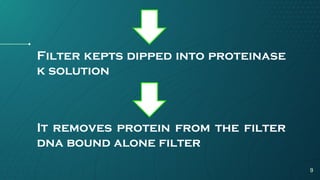
Filter kepts dipped into proteinase
k solution
It removes protein from the filter
dna bound alone filter
9
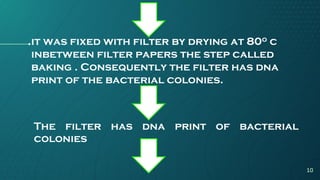
it was fixed with filter by drying at 80o c
inbetween filter papers the step called
baking . Consequently the filter has dna
print of the bacterial colonies.
The filter has dna print of bacterial
colonies
10
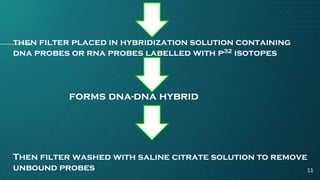
then filter placed in hybridization solution containing
dna probes or rna probes labelled with p32 isotopes
forms dna-dna hybrid
Then filter washed with saline citrate solution to remove
unbound probes 11
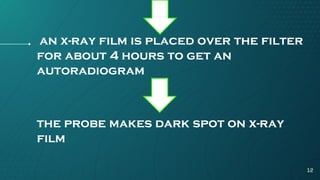
an x-ray film is placed over the filter
for about 4 hours to get an
autoradiogram
the probe makes dark spot on x-ray
film
12
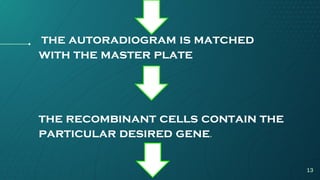
the autoradiogram is matched
with the master plate
the recombinant cells contain the
particular desired gene.
13
the recombinant colonies are
picked up and cultured for future
use
14
application
 identification recombinant
bacterial colonies by hybridization
of probe dna or rna
 it used in cytogenetics studies
 it is used for the diagonosis of
infectious diseases.
 it is used In finger printing
 it is used as screening method of
bacterial colonies 15
▫ Procedure diagram
16
Thank you
17